



Whether to build your own agent at all, and which framework to pick if you do.
Last verified: 21 September 2026 · 20 minute read · For people deciding whether to build
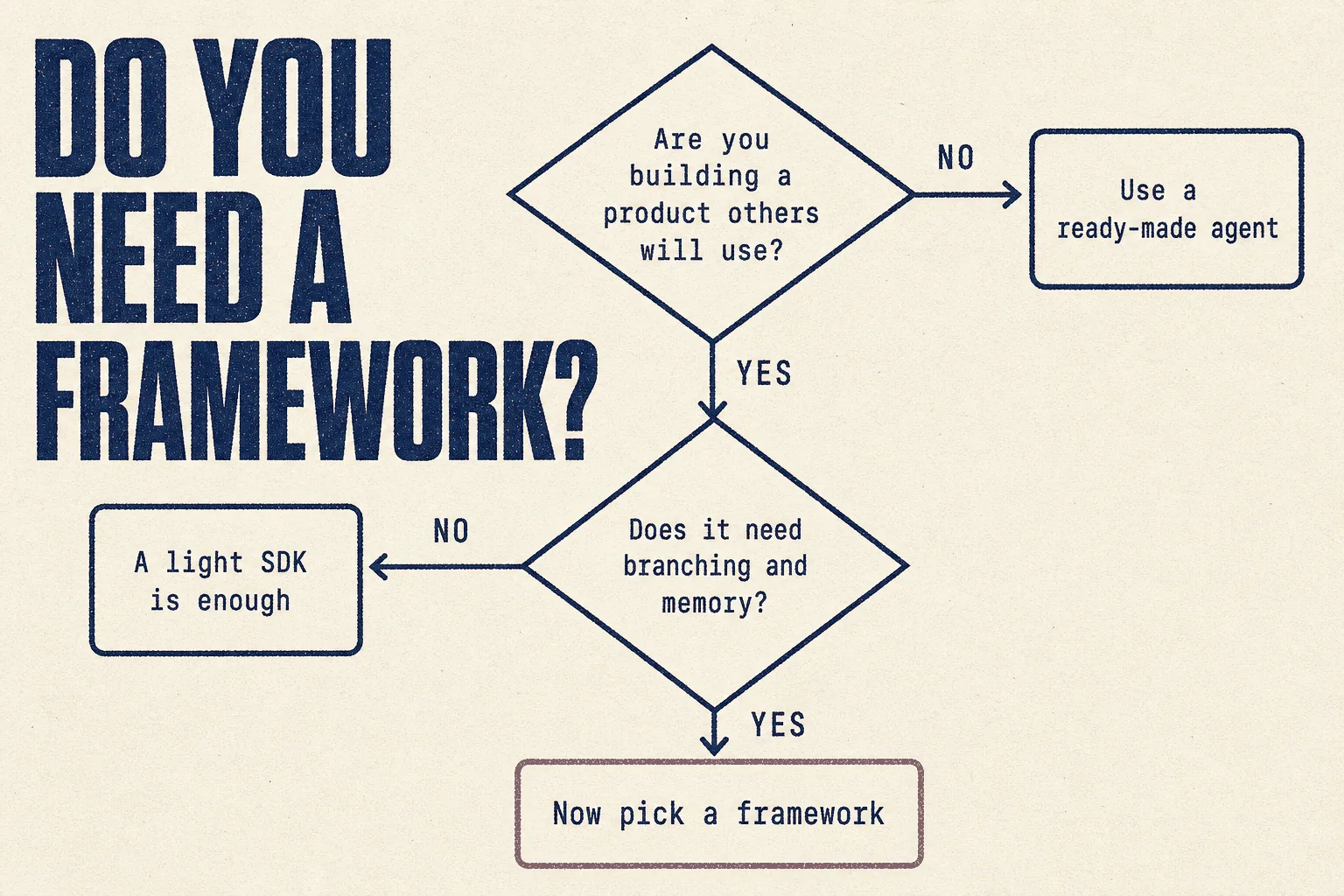
Who this guide is for
People wondering whether to build their own AI agent rather than use one of the ready-made ones in this library.
Most readers don't need this guide, and that's the most useful thing in it. If you want an assistant for your own business, use Hermes, NanoClaw or Claude Code. Frameworks are for people building a product that other people will use.
By the end you'll know: whether you need a framework at all, the nine that matter, how to install each one, and the problems that actually kill agents in production, which no framework solves for you.
In one sentence
An agent framework is a code library that handles the plumbing of building an AI agent (memory, tools, retries, handing work between agents) so a developer can focus on what the agent should do.
The analogy that makes it click
The rest of this library is about hiring an assistant. This guide is about building a staffing agency.
A ready-made agent is a car you drive. A framework is a garage full of parts and tools for building cars. If you just need to get to work, you don't want the garage. If you're going to sell cars, you do.
Do you need one?
| Your situation | What to use |
|---|---|
| An assistant for your own work | a ready-made agent. Skip frameworks |
| A simple agent inside your product, one or two tools | a light SDK from a model company |
| Complex multi-step workflows with branching and memory | a full framework |
| A team of agents coordinating | a multi-agent framework |
And the most useful sentence in the community research, from someone running about 30 agents for paying customers for six months (57 votes):
"LangChain, CrewAI, AutoGen, OpenAI Agents SDK. Pick whichever one your team already knows. It doesn't matter as much as you think."
Another (12 votes) titled their post "Picking an AI agent framework is the least important decision in your agent stack."
The nine that matter
Star counts and install commands verified against each project's own repository and documentation on 21 September 2026.
| Framework | Stars | Language | Licence | In one line |
|---|---|---|---|---|
| CrewAI | 58,856★ | Python | MIT | teams of role-playing agents working together |
| LangGraph | 42,074★ | Python | MIT | workflows as graphs, with branching, memory and checkpoints |
| Agno | 42,277★ | Python | Apache 2.0 | build, run and manage agent platforms |
| OpenAI Agents SDK | 29,609★ | Python | MIT | a light multi-agent SDK from OpenAI |
| Mastra | 28,238★ | TypeScript | see repo | the main option for JavaScript developers |
| Google ADK | 21,585★ | Python | Apache 2.0 | Google's toolkit for building, evaluating and deploying agents |
| Pydantic AI | 20,090★ | Python | MIT | agents in the style of the popular Pydantic library |
| Microsoft Agent Framework | 13,685★ | Python | MIT | Microsoft's enterprise framework, AutoGen's successor |
| Claude Agent SDK | 8,144★ | Python | MIT | the engine behind Claude Code, as a library |
⚠️ One to avoid for new work: AutoGen
AutoGen still shows 61,094 stars, so it tops a lot of lists. But its own README says:
"AutoGen is now in maintenance mode. It will not receive new features or enhancements and is community managed going forward. New users should start with Microsoft Agent Framework."
Its last update was in April 2026. Star counts measure past popularity, not current health. Always check when a project was last updated.
Installing each one
The commands each project's own documentation gives.
# CrewAI
uv tool install crewai

# LangGraph
pip install -U langgraph

# Agno
uv add "agno[os,sqlite]" openai

# OpenAI Agents SDK
pip install openai-agents

# Mastra (JavaScript / TypeScript)
npm create mastra@latest

# Google ADK
pip install google-adk

# Pydantic AI
uv add pydantic-ai pydantic-ai-harness

# Microsoft Agent Framework
pip install agent-framework

# Claude Agent SDK
pip install claude-agent-sdk
uv is a fast modern Python package manager. If you don't have it, the project
documentation explains how to install it in one line, or you can usually use pip
instead.
Which one for which job
| You want to build | Start with | Why |
|---|---|---|
| A team of agents with roles | CrewAI | role-based crews are its whole design |
| Complex workflows with branching and human approval steps | LangGraph | the standard for stateful, multi-step work |
| Something simple, quickly | OpenAI Agents SDK, Pydantic AI, or Claude Agent SDK | the lightest path to a working agent |
| In JavaScript or TypeScript | Mastra | the leading option in that language |
| On Google Cloud | Google ADK | built for it |
| In a Microsoft enterprise | Microsoft Agent Framework | long-term support, and AutoGen's successor |
| On Claude, with Claude Code's tools | Claude Agent SDK | the same engine Claude Code runs on |
A comparison post (37 votes) that built the same agent in nine frameworks reached a similar conclusion: LangGraph for state and resilience, the light SDKs for speed of getting started, CrewAI and Google ADK for coordinating multiple agents. A reply fairly asked for the test code, which wasn't shared, so treat its detailed numbers as one team's impression rather than a benchmark.
⚠️ What actually kills agents
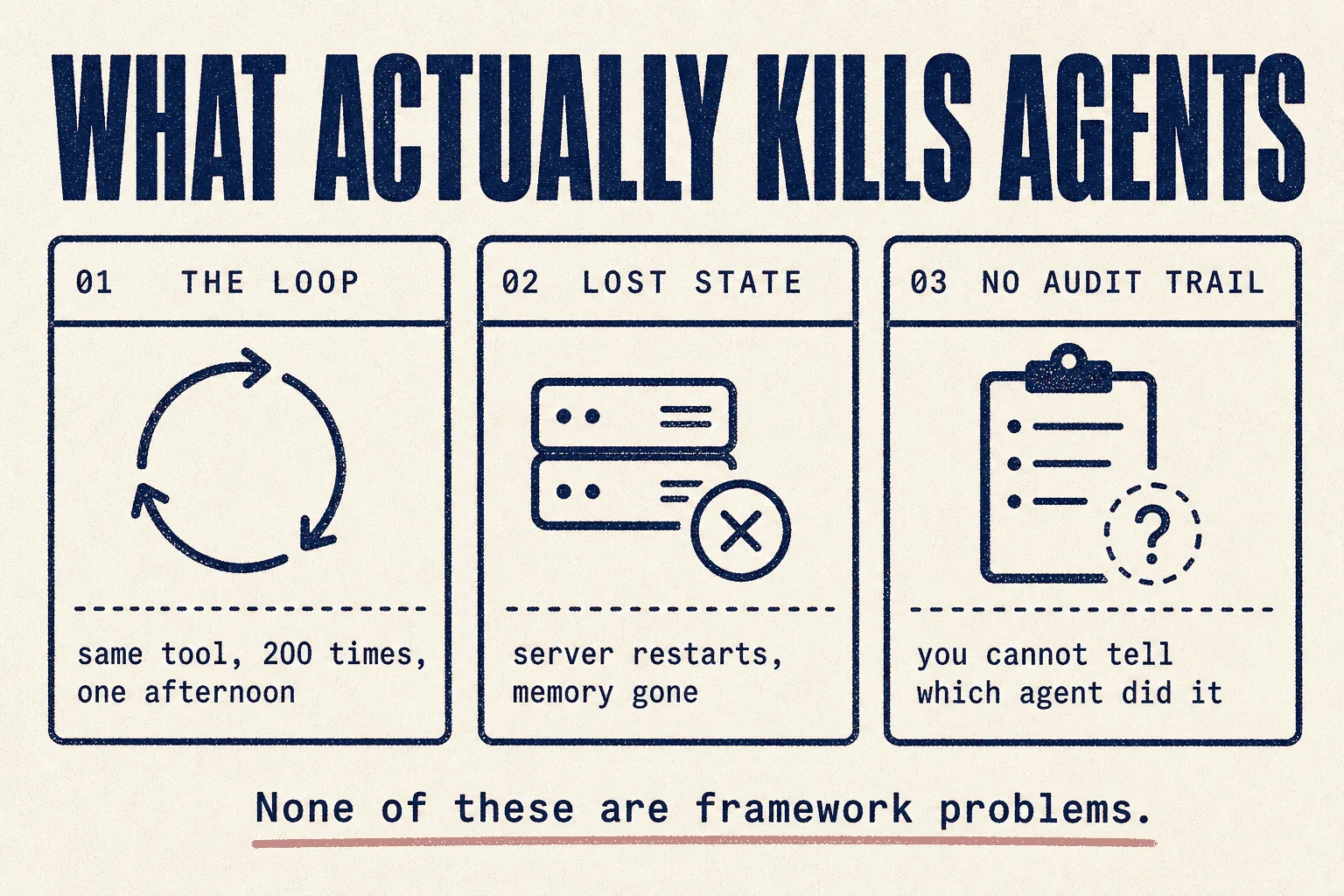
This is the section to read even if you skip the rest. From the operator running 30 production agents (57 votes), none of these are solved by picking a framework:
1 · The loop
"The agent gets stuck in a loop. It calls the same tool 200 times in 4 minutes because something downstream returned ambiguous data and the model decided to retry forever. Your bill goes from $3 a day to $400 in one afternoon."
Fix: a hard cap on retries and on spend, per agent, enforced outside the model.
2 · Lost state
"Your server reboots overnight for kernel patches. Every agent that was mid-task loses everything. Tomorrow morning the support agent has no memory of yesterday's tickets."
Fix: save state to a database as the agent works, so it can resume.
3 · No audit trail
"By the time you notice you've burned a grand. You can't even tell which agent did it because there's no audit trail."
Fix: log every tool call, with which agent made it and what it cost.
A fair counterpoint
Not everyone agreed. One reply (11 votes) called it "table stakes for an AI agent framework," meaning a good framework should handle these. Another (25 votes) put it simply: "Basic software engineering, right? Auditability, control, consistency. Testing the technology before letting it in the wild."
Both are right. Some frameworks help with these problems, but none of them solve them for you. You still have to switch the protections on and test them.
These are exactly the problems Paperclip was built around: per-agent budgets with hard stops, persistent state, and a full audit log.
Best practices
✅ Don't build if a ready-made agent does the job
✅ Pick the framework your team already knows
✅ Check when a project was last updated, not only its stars
✅ Hard caps on retries and spending, outside the model
✅ Save state as the agent works, so it survives a restart
✅ Log every tool call with the agent and the cost
✅ Test on real, messy data before real customers
Mistakes to avoid
❌ Mistake 1: building when you should be buying
If it's an assistant for your own work, you don't need a framework.
❌ Mistake 2: choosing on star count
AutoGen has more stars than most of this list and isn't getting new features.
❌ Mistake 3: spending weeks choosing
"I've burned weeks evaluating orchestrators, and at the end they all converge on the same patterns once you're past the tutorial stage." (5 votes)
❌ Mistake 4: shipping without spending limits
The $3-to-$400 afternoon is the most common production story in this research.
❌ Mistake 5: assuming the framework handles safety
It gives you the tools. You still have to use them.
If you run a marketing or SEO agency
| Situation | Recommendation |
|---|---|
| Automating your own agency work | Don't build. Use Claude Code, Hermes or Paperclip |
| Building a tool you'll sell to clients | CrewAI or LangGraph for Python; Mastra for JavaScript |
| A light assistant inside your own software | a model company's SDK |
| A client asks you to "build them an AI agent" | ask first whether a ready-made one would do. Usually it would |
Verdict
Frameworks: 🔵 Trial them only if you're building a product
For most readers of this library, the right number of frameworks is zero. The ready-made agents in the other guides do the job with none of the engineering.
If you are building, pick the one your team already knows, check it's still actively maintained, and spend your effort on the three things that actually kill agents: loops, lost state and missing audit trails.
This week: if you think you need a framework, write down the one job the agent must do. Then check whether any of the ready-made agents in this library already does it. Usually one does.
Sources
Primary, checked 21 September 2026
- Each project's GitHub repository, for stars, licence, language and last update: CrewAI · LangGraph · Agno · OpenAI Agents SDK · Mastra · Google ADK · Pydantic AI · Microsoft Agent Framework · Claude Agent SDK · AutoGen
- Install commands from each README, plus the CrewAI installation docs and Agno quickstart
- AutoGen's maintenance-mode notice, from its README
Community reports, quoted with upvotes. Anecdotes, not measurements.
- After 6 months of running AI agents in production, the framework barely matters (57 votes)
- We tested LangGraph against 8 other frameworks (37 votes), detailed figures unverified
- Picking an AI agent framework is the least important decision (12 votes)
Part of The Agent Guides by Massive Impact. Illustrations generated in-house. No third-party screenshots or marks reproduced.
The rest of the guide is yours, free.
Enter your email to keep reading and get the PDF to keep.
No spam. One email unlocks every Massive Impact resource.
“What you did with the website, they did not have that level of architecture to it, and I think that just is helping it climb.”
The service behind this
More from the library
