How big is the escape room industry?
It is a mature global category of thousands of independently owned venues, and it is measured directly by owner surveys rather than by guesswork.
The escape room industry is a mature global category made up of thousands of independently owned venues, most of them small operators running a handful of themed rooms. It grew fast through the 2010s, consolidated and professionalised after the shutdown years, and now competes on experience quality, booking convenience, and local search visibility. Because it is fragmented across small owners, the most reliable read on the category comes from surveying owners directly. Massive Impact has published a State of the Escape Room Industry owner survey since 2018, the most recent gathering responses from 364 owners.
What does a good escape room website look like?
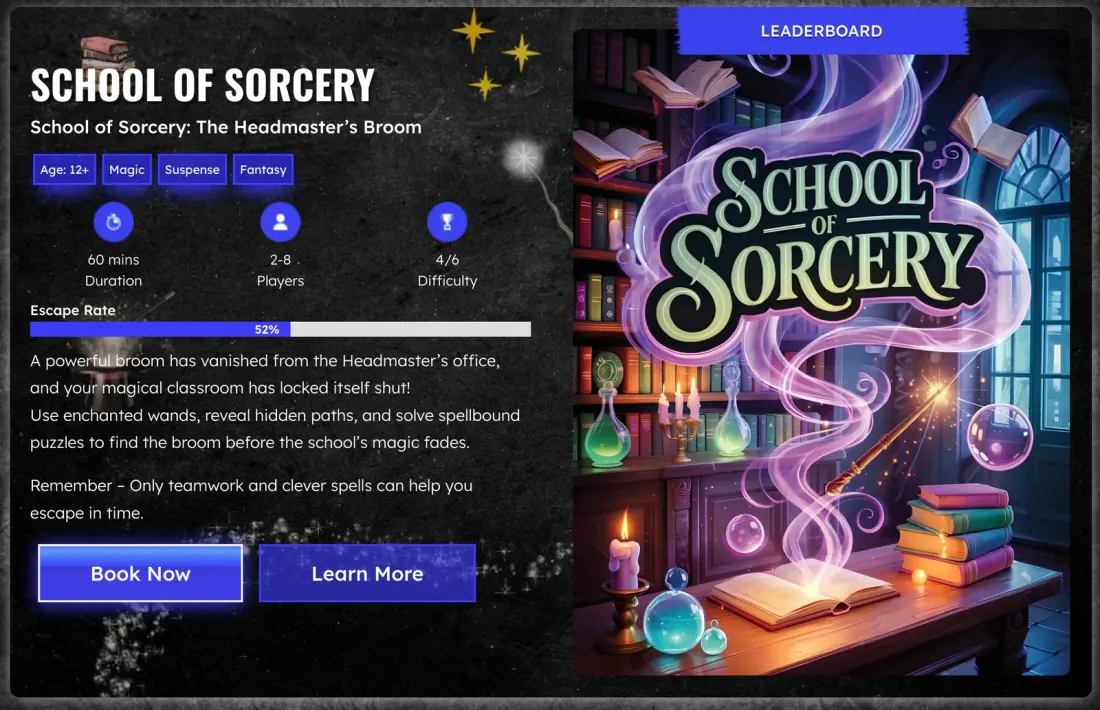
One page per room, each ending in a booking widget, with a themed card that carries the room's world, its stats, and the two buttons a player needs.
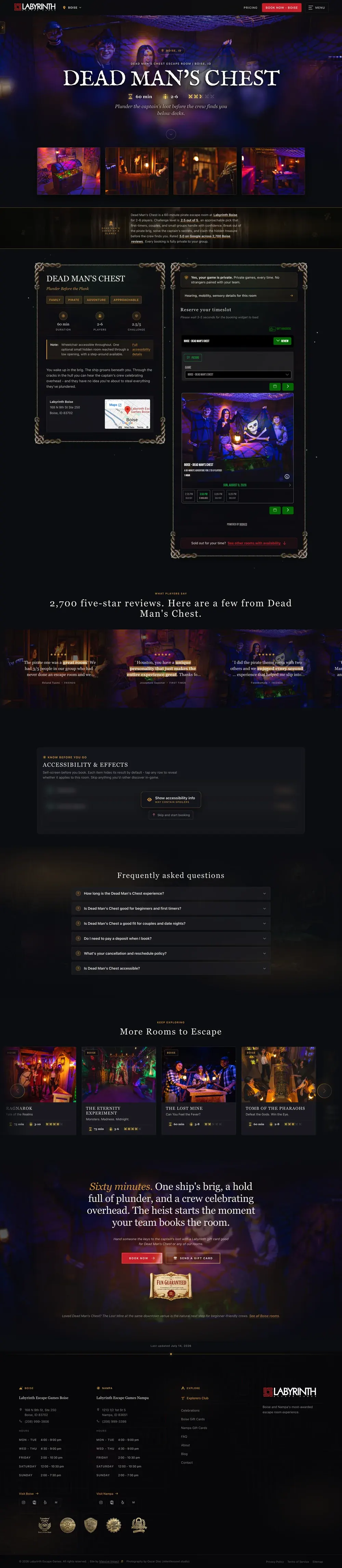
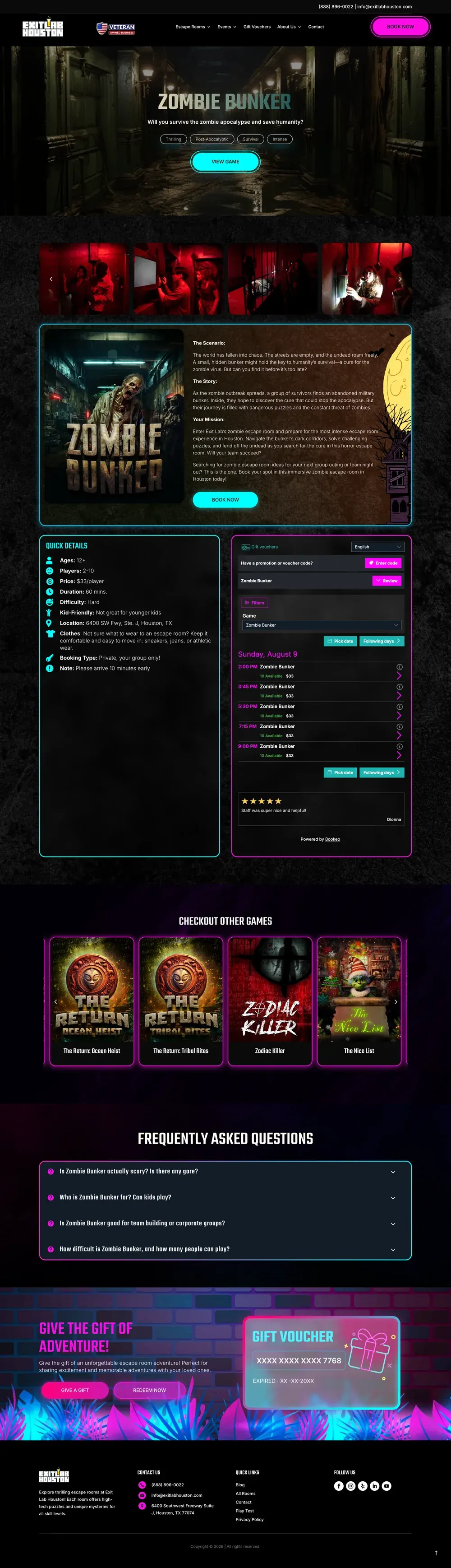
A good escape room website gives every room its own themed page rather than listing rooms in a shared grid, and each page runs in the order a player decides: a themed hero, a gallery, a card summarising the room, the key details, real reviews, accessibility notes, an FAQ, and a booking widget. The room card itself carries the whole decision on one tile, themed art, a one-line hook, the duration, group size, difficulty and escape rate, and a clear book button. This one-room-per-page structure, ending in a booking action, is the pattern Massive Impact designed in 2020 that spread across the category.
What is a good ROAS for an escape room?
There is no single number, because it depends on your margins, but a strong account holds its return across a full year rather than spiking for one month.
A good return on ad spend for an escape room depends on your margins, so there is no universal figure. The better test is durability: any account can catch a lucky month, but a strong one holds its return across seasons. As a real reference, one escape-room account Massive Impact runs held a Google Ads return between 65X and 95X across 2026 after a 114X peak in January, which is the kind of sustained performance worth judging an account on rather than a single screenshot month. Fixed costs are the same whether a room runs or sits empty, so returns are usually strongest when spend is pointed at the midweek slots that would otherwise go unsold.
Why are escape rooms usually empty midweek?
Because almost none of a venue's marketing is aimed at the people who are actually free Monday to Thursday.
Escape rooms are usually empty Monday to Thursday because the midweek audience is different from the weekend one and rarely marketed to. Weekend players are consumers browsing for something to do; midweek players are companies booking team events, schools and student groups, and locals who would return if asked. Those are different audiences reached through different channels, so a single always-on campaign pointed at a venue's busiest days never finds them. Since a venue's rent, wages, and game design are paid for whether a room runs or sits dark, a filled midweek slot is close to pure margin, which is why it is the clearest growth opportunity most venues have.