Does Email Marketing Still Work in 2026? A Halloween Campaign Guide
Your ad gets you noticed. Your follow-up gets the booking. What the 2026 numbers actually say about email, how to plan a short Halloween sequence, how to track it, and a free sample email you can rework with AI.

If you're paying to get attention but never following up, you're making your ads do all the work. Halloween gives people a reason to make plans, book experiences, go out with friends and buy seasonal things. Someone can see your ad, like what you're offering, and still not book that day. A few days later they've forgotten you, or made other plans.
Your ad gets you noticed. Your follow-up gives people another reason to choose you.
Does email marketing still work in 2026?
Yes, when it gives the right audience a relevant reason to act. Email isn't magic and it won't rescue a weak offer or a broken booking page. What it does is give you a direct line to people who already asked to hear from you, including past customers and anyone who signed up after seeing your campaign.
What email is good at
- Reminding interested people that you exist
- Bringing previous customers back
- Explaining an offer in more detail than an ad can
- Giving people a direct path to book or buy
What email cannot fix on its own
- An offer nobody wants
- A confusing or slow booking page
- A list full of people who never wanted your emails
- Bad deliverability or untracked conversions
Litmus puts the average return at $36 for every $1 spent. Treat that as a broad industry estimate, not a promise. Your own return depends on your list, your costs, your margin, your offer and how you attribute the sale.
The channel isn't the strategy. The follow-up is. Platforms change, ad costs change, algorithms change. The need to remind interested people, answer their questions and make the next step easy does not.
Do people really shop more around Halloween?
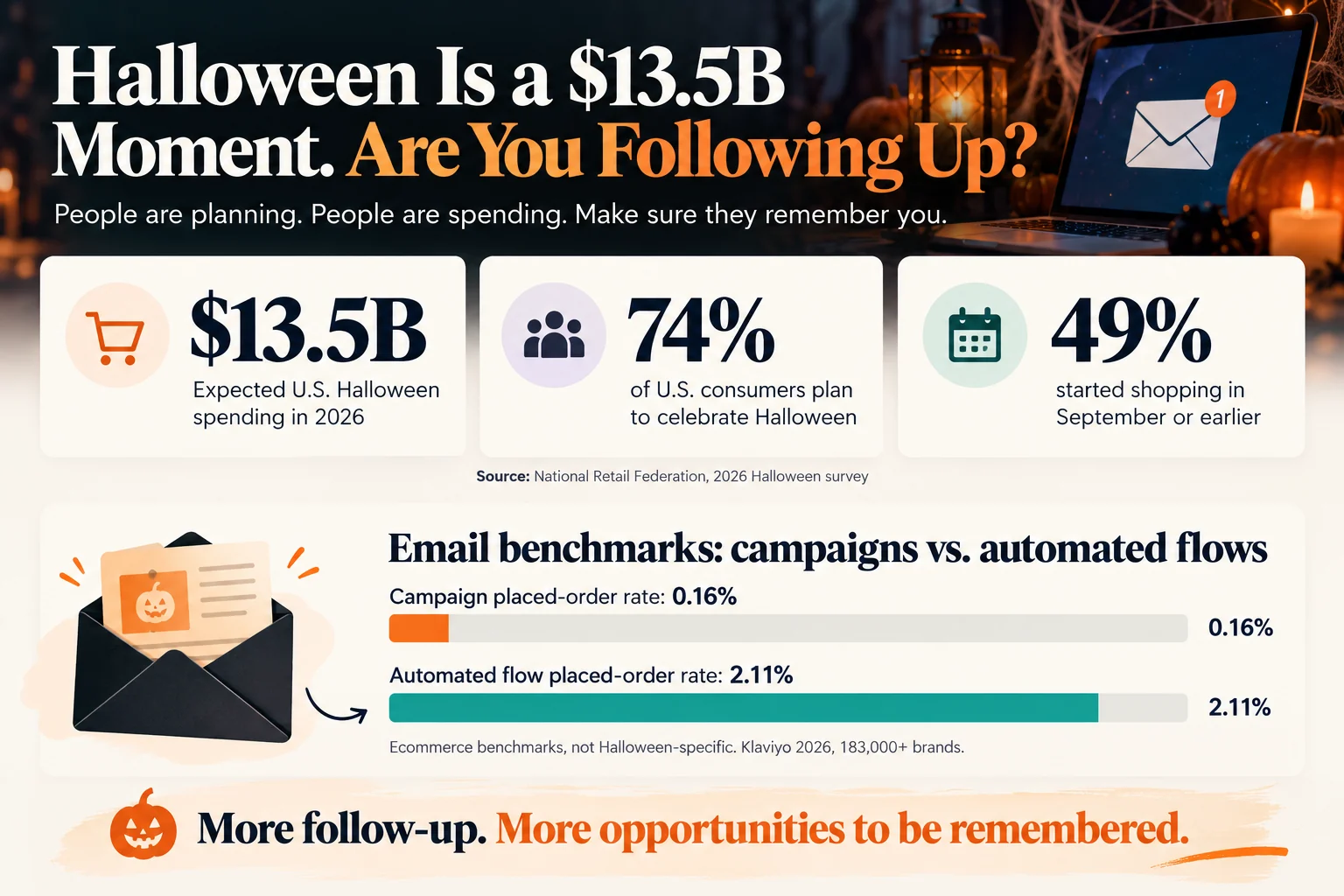
In the US, yes, and many of them plan well before 31 October. That gives retailers, venues, restaurants and attractions a seasonal reason to get in front of people early.
Source: National Retail Federation, 2026 Halloween survey. US consumers, not global figures.
How many businesses actually run Halloween email campaigns?
We couldn't find a reliable figure for that specific question, so we're not going to invent one. What matters for your business is simpler: do interested people hear from you again after they see an ad, visit your site or sign up?
Does the social side of Halloween push people to spend?
It can. Halloween is a group occasion. Friends coordinate plans, families look for something to do, and people want in on whatever their group is talking about. When a seasonal event feels relevant, people are more likely to decide now rather than later. The job is to make a genuinely good experience easy to find and easy to book, not to pressure anyone.
Does following up actually produce bookings?
It gives people another chance to act, which matters most when they need time to compare options, get a group together, check dates or talk it over with someone else.
Someone sees your Halloween ad, post or local promotion
They sign up for an offer or for updates
You send the details, the proof, the answers and a booking link
You track clicks, bookings, revenue and what each one cost
Seeing something once doesn't mean remembering it when you're ready to decide. Each follow-up should add something: what the experience is actually like, who it suits, what's included, which dates are left, why the offer is worth it.
One note on permission. Email people who subscribed or who you otherwise have a lawful basis to contact. For visitors who never gave you an address, use proper remarketing instead of assuming an ad click is consent.
What counts as a good email conversion rate?
There isn't a single number that fits every business. Klaviyo's 2026 benchmarks, drawn from more than 183,000 brands, show how far apart one-off campaigns and automated flows sit.
Source: Klaviyo 2026 email marketing benchmarks, where the same dataset is summarised as roughly 13 times the placed-order rate and over three times the click rate (5.58% against 1.69%). Ecommerce benchmarks, not Halloween-specific, and not a forecast for local bookings. A flow is triggered by something the customer does, so it isn't a like-for-like comparison with a one-off send.
What a local business should actually watch
- Click rate. Are people reaching the offer or booking page?
- Conversion rate. Do those visits turn into bookings, sales or real leads?
- Revenue and margin. Does it still make sense after the discount and the costs?
- Completed bookings. How many can you actually attribute?
- Unsubscribes. Is the frequency or the content wrong?
- Complaints. Are people marking you as spam?
Don't judge a campaign on open rates alone. Track the bookings, the revenue and the margin, and use UTM parameters so you can tell email traffic apart from everything else.
Why email your existing customers first
Past customers already know you. If they had a good time, they need less convincing than a stranger. Split out past Halloween customers, recent customers, group bookers, gift-card buyers and the subscribers who showed interest but never booked, then write to each group differently.
Discounting isn't the only lever. A group perk, a useful add-on, a bundle, a gift-card benefit or an early booking window can all work. Discounts are fine when the margin supports them. The point is not to reach for price by default.
How to make a Halloween offer worth talking about
For a venue, the strongest offer usually isn't the cheapest one. Make the night more social, more rewarding, or easier to organise.
Bring the crew, and the best player plays free
- For qualifying group bookings, the top player on a clearly defined challenge wins a free return game. Publish the eligibility and prize rules.
Book one room, get the second at half price
- Encourage a longer visit or a second booking. Check the discounted booking still makes commercial sense.
Give a gift, get 20% off the gift card
- Works if the margins and redemption terms support it. State expiry dates and restrictions plainly.
Solve the room, then head to the neighbourhood
- Partner with a nearby restaurant or cafe on a joint package. Both of you promote it to your own opted-in audiences.
Beat our record, win a half-price return
- Use a verified leaderboard. Publish the rules and the redemption window.
Subscribers get first pick of Halloween slots
- Offer priority booking before the remaining slots go public, if the schedule genuinely allows it.
The partnership one is worth dwelling on. The restaurant gets exposure and footfall, you get a stronger package and another reason to book, and the customer gets a complete night out. That's a partnership, not a discount.
How many Halloween emails should you send?
There's no magic number. For a short booking window, start with a small sequence and adjust it to your sales cycle, your list and your availability. Each email needs its own job.
Those are suggestions, not rules. If the list is small, if people have already booked, or if you're full, send fewer. Customers who have booked should get useful pre-visit information, not more "book now" emails.
How to build the list before Halloween
Use your social content and paid campaigns to offer something worth an email address: early access, a seasonal guide, a gift-card promotion, a giveaway with clear terms, or updates on a limited run.
Don't buy lists, and don't treat an ad click as permission to email someone. Follow the rules that apply where you and your recipients are, and honour unsubscribes immediately.
How to track it with UTM parameters
Put UTM parameters on your campaign links so your analytics can tell email traffic apart from paid, social and direct. Without that, you're guessing.
https://yourwebsite.com/halloween-offer?utm_source=email&utm_medium=email&utm_campaign=halloween_2026&utm_content=booking_cta| Parameter | Example | What it tells you |
|---|---|---|
| utm_source | Where the traffic came from | |
| utm_medium | The marketing medium | |
| utm_campaign | halloween_2026 | Which seasonal campaign |
| utm_content | booking_cta | Which link or placement |
Swap utm_content for each link, such as hero_cta, gift_card or last_call, so you can see which one people clicked. Tag your booking, purchase and offer links. Don't tag internal navigation on your own site, because that overwrites the original attribution.
Before you send: click the final link yourself, check the page loads, and confirm your analytics records the campaign the way you expect.
What should the email actually look like?
It doesn't need bats, blood-red fonts and a dozen pumpkins. A little atmosphere goes a long way: a dark hero image, warm orange accents, lantern light, one clear headline and a single call to action.
- Set the scene. A strong seasonal image and a headline that sells the experience.
- Show the details. What's included, who it's for, timing, price and any real restrictions.
- Make booking easy. One obvious button, a direct destination, consistent tracking.
On the creative side, aim for a subject line that earns curiosity, a clear hero headline, the offer in plain language and one primary action. On the conversion side, include price, date, location and booking details, reviews or proof where you have them, real deadlines and terms, and working links.
Five Halloween emails worth opening
These are other people's designs, shared as inspiration rather than assets to copy. Each link opens the original creator's or publisher's page.
- Bold Halloween visuals, on Behance. A full seasonal concept, useful for the overall look.
- High-contrast, low clutter, on Behance. Short copy and one focused call to action instead of filling every inch.
- A reusable newsletter structure, on Behance. Shows how a campaign flows from headline to supporting content to action.
- A playful product campaign, on Dribbble. A bakery concept, handy if you're promoting seasonal products rather than an experience.
- Halloween emails from real brands, on Klaviyo. How brands use seasonal colour without losing the offer.
What to borrow: one strong seasonal visual, readable copy, a relevant offer and one obvious button. The styling should support the message, not compete with it.
A free template you can customise with AI
We built a sample Halloween campaign for a fictional escape room, Hollowkey Escape Co. It has atmospheric creative, a riddle, themed room descriptions and booking calls to action. Take it as a starting point and swap in your own brand, images, offer and copy.
Don't start with a blank email
Grab the sample HTML, then use Claude or ChatGPT to rework it for your business. Replace the fictional details and links, test it in your email platform, and check the unsubscribe and compliance parts work before you send anything.
Download the HTML templateThe brand and the rooms in it are invented. It's a starting point, not a ready-to-send campaign.
A prompt to write your own
Paste this into Claude or ChatGPT, attach the template if you want to keep its design, and fill in the brackets.
Write a Halloween marketing email for my business. Make it engaging, skimmable, on-brand and focused on one clear action. Avoid generic spooky cliches and don't invent discounts, deadlines, reviews or scarcity.

Business name: [NAME]
Industry: [INDUSTRY]
Target audience: [AUDIENCE]
Website: [WEBSITE]
Halloween offer or experience: [OFFER]
Key benefits: [BENEFITS]
Booking or purchase URL: [URL]
Brand voice: [VOICE]
Brand colours and available images: [ASSETS]

Include 3 subject line options, preheader text, a strong headline, concise body copy, one primary CTA, any necessary terms, and a short follow-up email idea. Add this UTM structure to the main CTA URL:
?utm_source=email&utm_medium=email&utm_campaign=halloween_2026&utm_content=booking_cta

Use only the information supplied. Flag missing details instead of making them up. If an HTML template is attached, customise its copy and branding while preserving the responsive email structure and compliance elements.Want help turning attention into bookings?
If you'd like a hand planning the campaign, writing the sequence, setting up tracking or connecting your ads to the follow-up, talk to us.
The rest of this is yours, free.
Enter your email to keep reading — and unlock every Massive Impact resource.
No spam. One email unlocks every Massive Impact resource.