


Who owns it now, what it costs, and whether it still does what the hype promised.
Last verified: 21 September 2026 · 20 minute read · No technical background needed
Who this guide is for
Anyone who's heard Manus called "the AI that actually does things" and wants to know whether that's still true, who owns it now, and what it costs.
That second question matters more than it usually would. Most articles about Manus are already wrong about it.
By the end you'll know: its real ownership situation, what it's genuinely good at, what it costs, and the one mistake that can cost you a client's database.
In one sentence
Manus is an AI that takes a task, works on it by itself inside its own cloud computer, and hands back a finished deliverable: a report, a slide deck, a website or a dataset.
The analogy that makes it click
A chatbot is a consultant who tells you what to do.
Manus is a contractor who goes away and does it. You describe the job, it works inside its own sealed-off computer, and it comes back with the thing: a finished deck, a working website, a spreadsheet full of research.
Like any contractor, the useful question isn't only "can they do the work". It's also "whose name is on the accounts when they leave?" That turns out to matter a great deal, and there's a whole section on it below.
At a glance
| What it is | A general-purpose agent that produces finished deliverables |
| Made by | Manus AI, a Chinese-founded startup, now operating independently |
| First launched | March 2025, when it went viral for automating around 50 tasks |
| Desktop app | March 2026, with a "My Computer" mode for local files |
| Cost | $20 / $40 / $200 a month, all credit-based |
| Where the work happens | A secure cloud computer, plus optional local access via the desktop app |
| Talk to it in | Web, desktop app, Telegram and email |
| Verdict | 🟡 Watch it (judged from documentation and community reports; we have not run it in production) |
⚠️ Who owns Manus? Most articles have this wrong
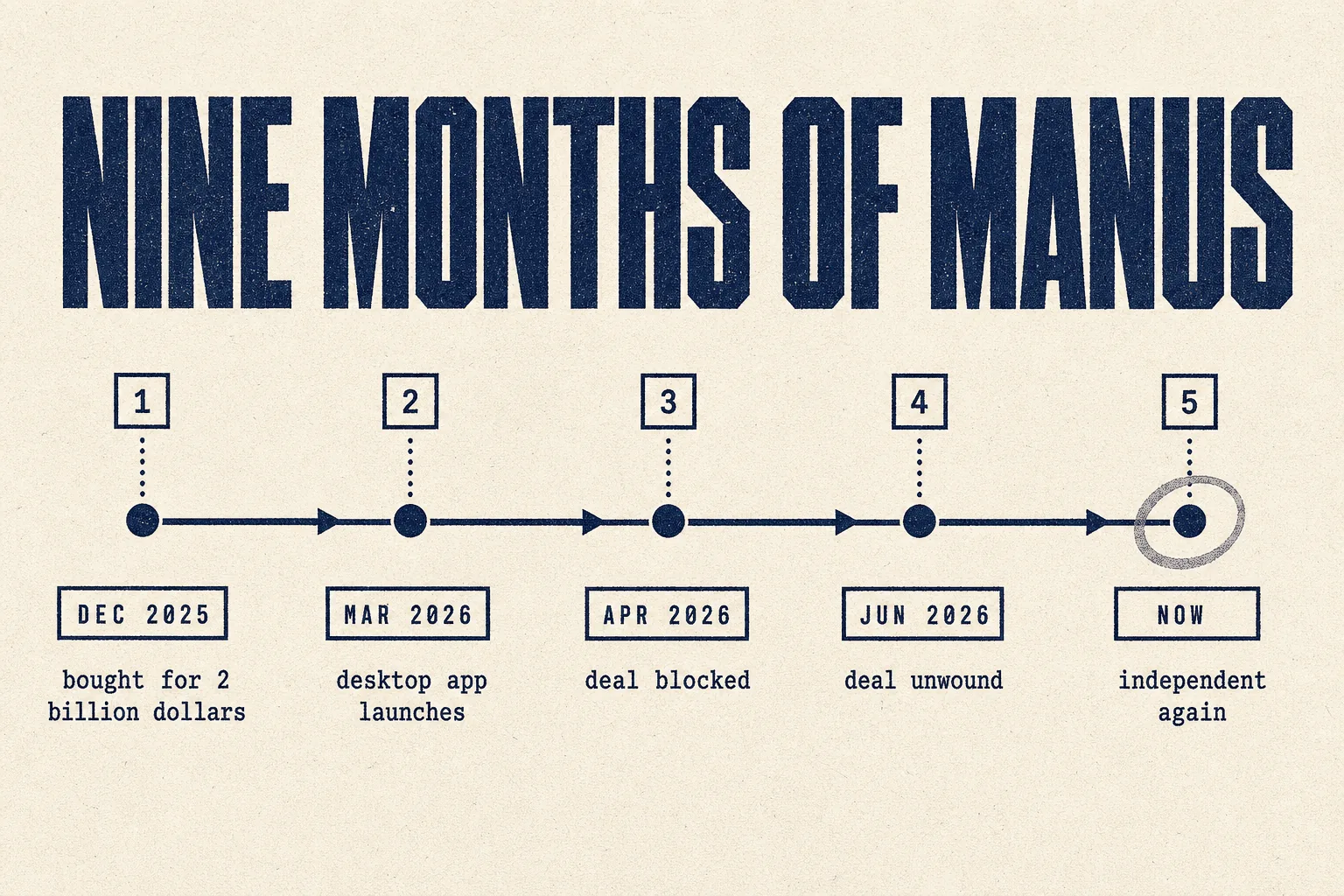
If you read anything about Manus from the first half of 2026, it probably told you Meta owns it. That's no longer true.
| When | What happened |
|---|---|
| Dec 2025 | Meta announces it's buying Manus for more than $2 billion |
| Mar 2026 | Manus ships its desktop app, while the deal is still going through |
| 27 Apr 2026 | China blocks the acquisition on national security grounds and orders it unwound |
| Jun 2026 | Meta completes an operational separation and halts data sharing between the two companies |
| Now | The Manus website states it "has resumed independent operations" |
Why this matters to you: a product that has changed hands, been ordered apart by a government, and relaunched independently, all within nine months, carries more continuity risk than most. It may be completely fine. But don't build a client process on it that you couldn't move elsewhere within a week.
We verified the "independent operations" statement directly on manus.im on 21 Sep 2026. The acquisition and unwinding are covered by CNN, CNBC and TechCrunch, linked in the sources.
What it's genuinely good at
Manus has two research modes, and knowing which to use is the core skill.
| Mode | How it works | Use it for |
|---|---|---|
| Wide Research | hundreds of agents working in parallel | covering a lot of ground fast: "find every X in Y" |
| Deep Research | one analyst following leads iteratively | a hard question that needs digging |
A long community guide called that split "the killer feature", and singled out the reusable Skills and Projects system as the part that matters most: you turn a workflow that worked into a playbook you can trigger again, with its context kept.
It also produces finished formats directly:
- Research reports
- Slide decks
- Websites
- Structured files and datasets
- Images and video
And through Manus Agent you can hand it work from Telegram or email, and schedule tasks to run on their own.
What it costs
Read directly from manus.im/pricing on 21 September 2026.
| Plan | Monthly | Credits | Also included |
|---|---|---|---|
| Entry | $20 | 4,000 a month + 300 refresh credits daily | 20 concurrent tasks, 20 scheduled tasks |
| Mid | $40 | 8,000 a month + 300 daily, adjustable | the same, with more usage |
| Top | $200 | 40,000 a month + 300 daily, adjustable | the same, for sustained heavy use |
Paying annually saves 17%.
The 300 daily refresh credits are worth understanding: they top up every day whether you use them or not, so light daily use costs less than the monthly number suggests.
⚠️ Like every credit-based tool in this library, the subscription is the entry fee, not the price. Work consumes credits. See the mistakes section.
Getting started
Step 1 · Start on the lowest plan
$20 a month. Don't buy the annual plan until you've watched a month of real use.
Step 2 · Run one research task in each mode
Try the same question in Wide Research and Deep Research. The difference in output is the fastest way to understand what it's for.
Step 3 · Turn the task that worked into a Skill
Once a workflow produces something good, save it as a reusable Skill inside a Project. That's where the time savings actually come from.
Step 4 · Connect Telegram or email if you want to delegate from your phone
Step 5 · Before it touches anything real, read the next section
⚠️ The most important section: own your accounts
This is the single most valuable warning in this guide, and it applies to every agent that can create things online, not only Manus.
A developer described what happened after their team used Manus to start a project:
*"Manus was too expensive and too slow, and always jumped straight into production servers, pumping out code without thinking about software architecture or even using git. We switched to ChatGPT/Codex. I thought we were fine, but yesterday we realised our website's database is unresponsive. Turns out the database provider account is still managed by Manus. We lost the database."*
Their conclusion: "Manus might seem fast and efficient at first, but it will poison your project with hidden technical debt you'll have to pay off one day."
A reply with more upvotes disagreed, and it's worth hearing:
"I have all the keys to my code. If anything happens, I can easily rebuild. I was smart enough to get all that information ahead of time when Manus hosted it."
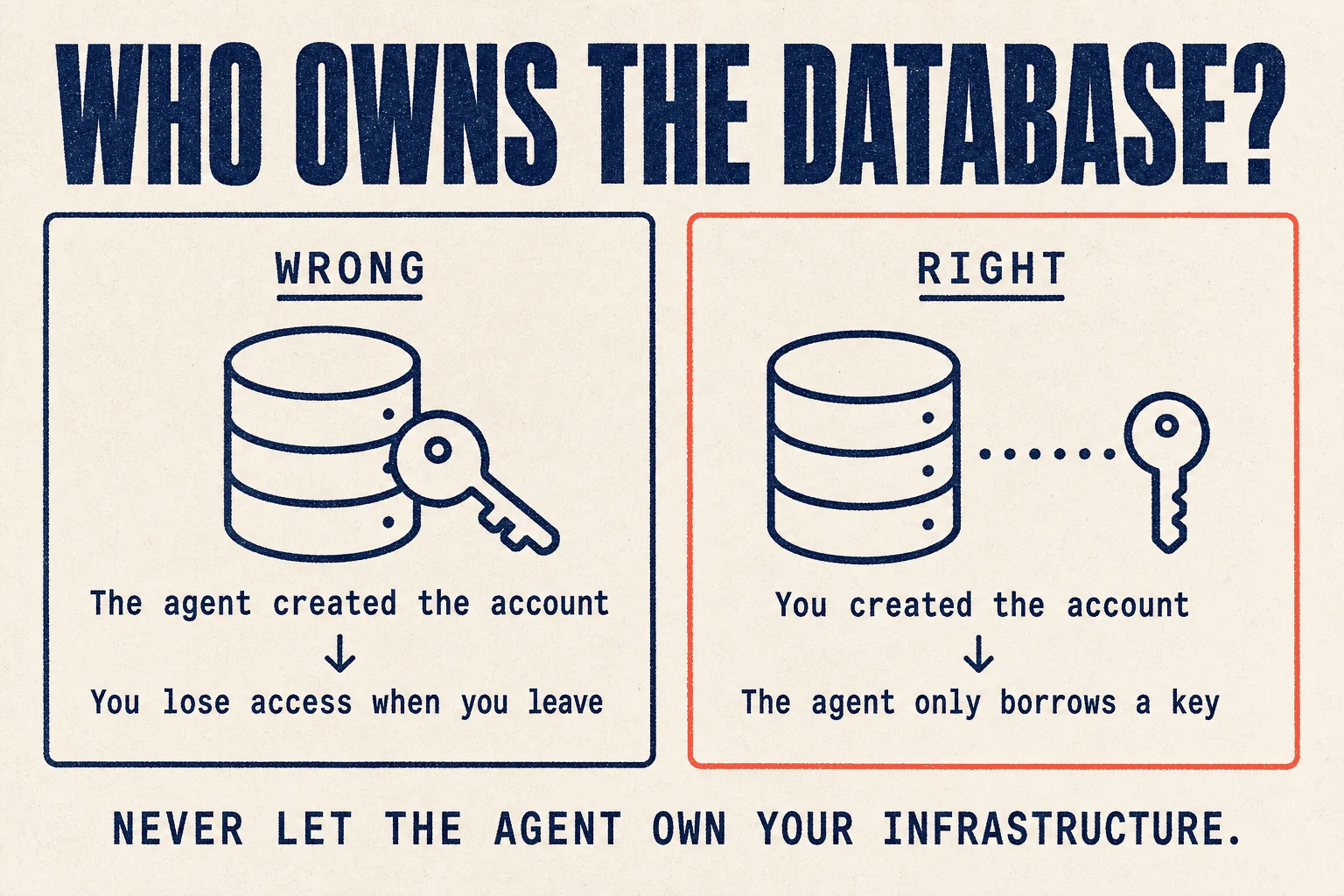
Both are right, and that's the lesson. The problem wasn't Manus. It was letting the agent create and own the accounts.
The rule
You create every account. The agent borrows a key.
| Wrong | Right |
|---|---|
| Agent signs up for the database host | You sign up, then give the agent access |
| Agent registers the domain | You register it, in your or your client's name |
| Agent holds the only copy of the code | Code lives in your Git repository from day one |
| Agent's credentials are the admin login | You're the admin, the agent has a limited role |
If you run an agency, this is non-negotiable. A client's database living in an account only an AI tool can reach is a liability you're carrying on their behalf.
Mistakes to avoid
❌ Mistake 1: letting it own infrastructure
Covered above. The most expensive mistake in this guide.
❌ Mistake 2: skipping version control
The same report: it "pumped out code without thinking about software architecture or even using git." Put everything it builds into a Git repository you control. One reply summed it up: "This whole process taught me the value of GitHub."
❌ Mistake 3: not watching the credits when a task drifts
At 14 votes:
"It can't even comprehend the most basic of tasks anymore and will deviate to something else entirely that you didn't even ask for, and end up wasting your credits."
And the follow-ups:
"It happened to me like 5 times already. Even they admitted it was a bug and refunded the credits. They refunded 4 times only, the last time they didn't reply, and I now cancelled my sub."
"I didn't even get refunded for thousands of credits."
Watch the first few minutes of any long task. If it's heading somewhere you didn't ask for, stop it before the credits go.
❌ Mistake 4: looking for one tool to do everything
A 16-vote thread made a point worth taking seriously: the best Manus replacement might be two tools rather than one. The author's split:
| Job | Best tool, in their view |
|---|---|
| Reasoning and writing | Claude |
| Open-ended research and browser work | Manus |
| Websites, decks, reports | a dedicated builder |
| Coding | a coding agent |
| Repetitive scheduled jobs | n8n |
And a reply that stung: "My coding subscription was doing about 90% of the real work, while the 'god agent' subscription was mostly research rabbit holes a 30-second Claude answer would have handled."
Audit what you actually use it for after a month.
❌ Mistake 5: building something you can't move
Given the ownership history above, keep your Skills documented and your outputs exported. Don't create a dependency you couldn't unpick quickly.
Best practices
✅ You own every account, the agent borrows keys
✅ Everything it builds goes into Git you control
✅ Watch the first minutes of long tasks, stop drift early
✅ Wide Research for breadth, Deep Research for depth
✅ Turn what works into Skills, that's where time is saved
✅ Monthly plan first, annual only after a month of real use
✅ Keep an exit route, given its recent history
How it compares
| Manus | Perplexity Computer | Grok Bot | |
|---|---|---|---|
| Entry cost | $20/mo + credits | $17/mo + credits | from $20/mo |
| Finished deliverables | ✅ decks, sites, reports | ✅ | partial |
| Parallel research | ✅ hundreds of agents | ✅ sub-agents | ✅ several bots |
| Local file access | ✅ desktop app | ✅ Personal Computer | ❌ |
| Delegate from phone | ✅ Telegram, email | partial | ✅ iOS |
| Ownership stability | ⚠️ recently turbulent | stable | stable |
If you run a marketing or SEO agency
| Job | Fit | Note |
|---|---|---|
| Competitor and market research | 🟢 Strong | Wide Research across dozens of competitors at once is exactly its shape |
| Client pitch decks and reports | 🟢 Good | It produces finished decks directly |
| Prospect lists | 🟢 Good | "Find every X in Y" is what Wide Research is for |
| Client websites | 🟡 Careful | Only if you own every account and the code is in your Git |
| Directory listings | 🟡 Possible | Computer-use agents do this more reliably |
| Ongoing scheduled monitoring | 🟡 Possible | Hermes does recurring work more cheaply |
Security and continuity
| ☐ | You create every account. The agent never holds admin |
| ☐ | Code goes into your own Git repository from the first day |
| ☐ | Export your Skills and outputs regularly |
| ☐ | Decide whether the desktop app should see your local files at all |
| ☐ | Treat anything it reads online as untrusted, as with any agent |
| ☐ | Given its recent history, keep a plan for moving elsewhere |
Verdict
🟡 Watch it
Based on Manus's own pricing and product pages, news coverage of its ownership, and community reports. We have not run it in production on client work. This guide gets updated when we do.
The product is capable. Wide Research running hundreds of agents in parallel is a genuinely useful idea, and producing finished decks and reports saves real time.
Two things hold it back. Credits that drain when a task drifts, with refunds reported as inconsistent. And an ownership history that makes it hard to call a safe long-term foundation for client work, however good the software is today.
Use it for research and deliverables you'll export and keep: competitor analysis, pitch decks, prospect lists.
Don't use it for anything where it would end up owning something you can't get back. Especially not a client's infrastructure.
This week: run one competitor research job in Wide Research on the $20 plan. Export the result. If it saved you a morning, you've found its job.
Sources
Primary, checked 21 September 2026
- manus.im/pricing, plans and credits read directly
- manus.im, including the independent operations statement
- Manus joins Meta for next era of innovation, the original announcement
News coverage of the acquisition and its unwinding
- TechCrunch: Meta just bought Manus, Dec 2025
- CNN: China blocks Meta's acquisition of Manus, Apr 2026
- CNBC: China blocks Meta's $2 billion takeover, Apr 2026
- CNBC: Meta begins dismantling the deal, Jun 2026
- TechCrunch: Meta moves to unwind the deal, Jun 2026
Community reports, quoted with upvotes. Anecdotes, not measurements.
- The guide I wish I had for Manus (20 votes)
- Has Manus become a terrible agent? (14 votes)
- Is the best Manus replacement actually 2 tools? (16 votes)
- Manus is a trap (4 votes)
Prices, credits and ownership can change. Verify before buying.
Part of The Agent Guides by Massive Impact. Illustrations generated in-house. No third-party screenshots or marks reproduced.
The rest of the guide is yours, free.
Enter your email to keep reading and get the PDF to keep.
No spam. One email unlocks every Massive Impact resource.
“Very open to critique and criticism.”
The service behind this
More from the library
