


12 formats and 50 hooks for the founder who refuses to skip a day.
Part 1, The deal
You opened the app. The blank box is staring at you. Again.
You've been there 11 minutes. Nothing. So you close it and tell yourself you'll post tomorrow. Tomorrow becomes Friday. Friday becomes next month.
Look. Most founders post one thing a week and call themselves content creators. They're not. The ones building real audiences post every single day, and they don't sit there wondering what to write. They have a system.
Daily posting isn't a discipline problem. It's a system problem. The founders who skip days don't lack willpower. They lack a vault. So we built one.
The rule is simple. Post every day or stop calling yourself a content operator. The "I'll batch on Sunday" lane closes after six weeks because batching without a system is just procrastination with a calendar invite. The "I post when inspired" lane closes the day you realize the algorithm doesn't care about your moods.
Brought to you by Massive Impact. Massive Impact is a free lead magnet library for founders, marketers, and operators. Playbooks, prompts, frameworks, and checklists at the Massive Impact resource library. Browse the full set at the Massive Impact resource library.
How to use this vault
Three steps.
- Pick a format that matches your energy. Tired? Shareable Tip. Got a customer story? Personal Story. Hot opinion in the shower? Hot Take. Match the format to the energy you actually have today.
- Pick a hook from Part 3 and swap the brackets. 50 hooks, six trigger categories. Each tagged with the format it pairs with. Pick. Swap. Post.
This playbook is built for founders, operators, coaches, and creators who actually have something to sell. If you don't have a product or service yet, build one first.
For everyone else: turn the page.
Eat. Sleep. Post. Repeat.
Part 2, The 12 Post Formats
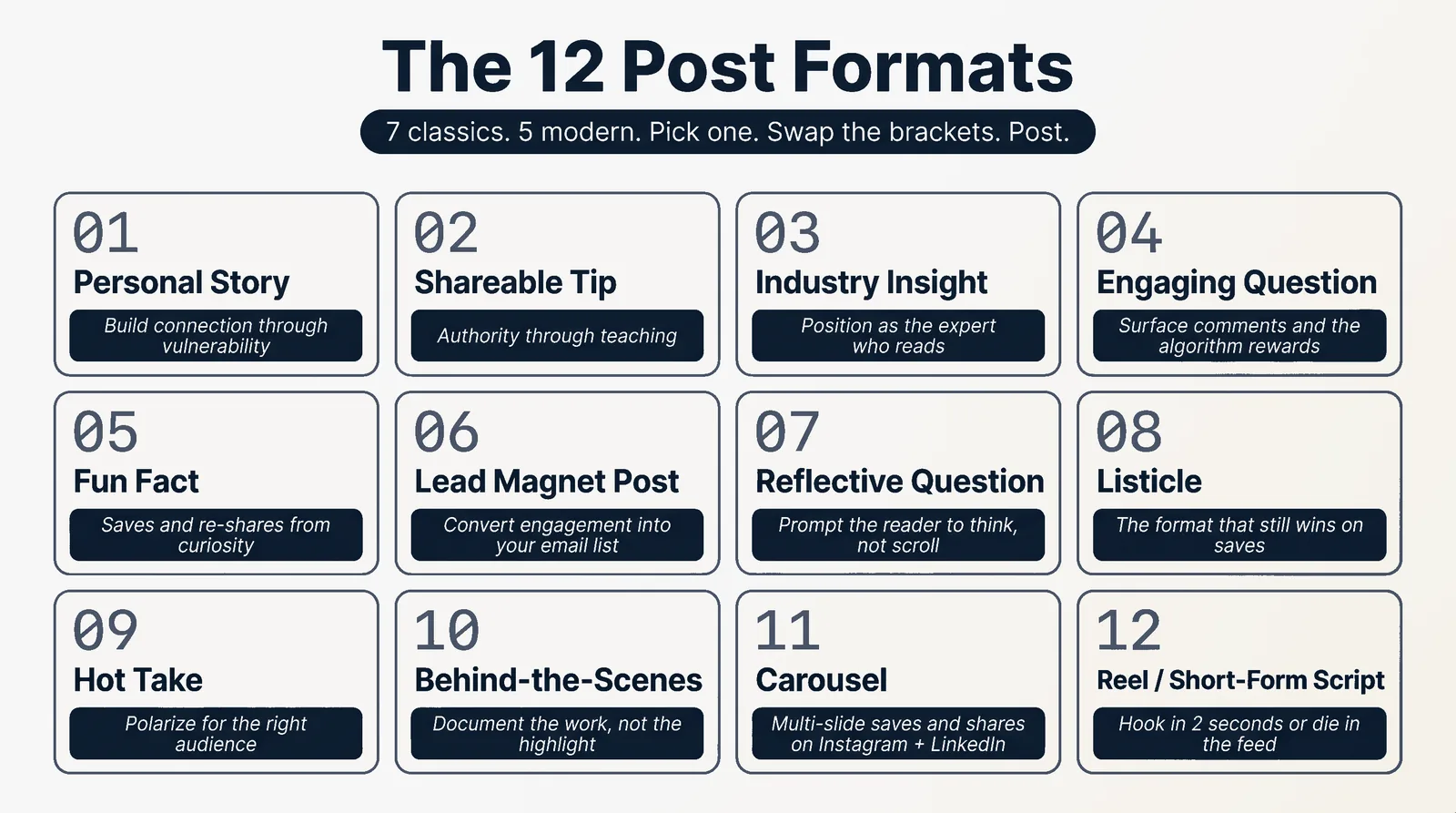
7 classics. 5 modern. Same structure for every one so you can scan, lift, and ship. For each: when to use it, the structure, three worked examples in different niches, a fill-in template, and a Pro tip.
1. Personal Story
When to use: When you want connection over information. Mondays after a hard weekend. The day after a big win or a quiet loss. Story posts build the relationship that everything else converts on.
The structure:
- Opener: a timestamped admission ("3 years ago I was..." or "Last Tuesday at 6am...")
- Body: 3-5 short lines that escalate the stakes
- Pivot: the line where the situation flipped. One sentence.
- Now: the present-tense state. Two or three things true today.
- Close: a one-line takeaway, or a PS that asks the reader something specific.
Worked examples:
Example 1 (Founder voice): "3 years ago I was answering DMs at 2am from my dad's basement. 2 years ago I had two clients and was scared to raise prices. 1 year ago I quit my job and called myself a founder without flinching. Last month I closed a $42K retainer in a 22-minute call. Calendar I control. Team of three. Payroll I cover before my salary. PS: What did you used to flinch at saying about yourself that you say with a straight face now?"
Example 2 (Agency voice): "Last Friday I fired my biggest client. $11K a month. 38% of revenue, 92% of the operational stress. Three of my best people were thinking about leaving because of this account. Called the CMO at 9am. By 9:14 the contract was over. By 5pm I had three Slack messages from my team. All said: thank you. Revenue you hate is debt with a different name. PS: Have you ever fired a client?"
Example 3 (Fitness coach): "Six years ago I weighed 247 pounds and couldn't run a mile. Five years ago I joined a 5am bootcamp and quit after eight days. Three years ago I changed one thing. I walked 30 minutes every morning. Now I'm 178 pounds, coach 41 clients, and haven't missed a morning walk in 1,089 days. The cheat code wasn't the workout. It was the walk so easy I couldn't skip it. PS: What's the smallest version of the habit you've been trying to build?"
Fill-in template:
[TIME] ago I was [STATE]. [SHORTER TIME] ago I [INCREMENTAL CHALLENGE]. [SHORTER STILL] ago I [MOMENT WHERE THINGS SHIFTED]. [RECENT WIN WITH A NUMBER]. Now I have [OUTCOME 1], [OUTCOME 2], and [OUTCOME 3]. [ONE-LINE TAKEAWAY]. PS: [SPECIFIC QUESTION TIED TO THE STORY].
Pro tip: The numbers do the work. "I lost weight" is forgettable. "I weighed 247 pounds" is a hook. Specific beats poetic.
2. Shareable Tip
When to use: When you have a framework, a checklist, or a step-by-step that someone could screenshot and use this week. Saves outperform likes for distribution in 2026.
The structure:
- Opener: a named framework with a result number ("The 6-step retention framework that took our churn from 8.4% to 2.1%")
- Name the method
- The list: 5-7 numbered steps. Each one a verb plus a sharp object.
- A personal-credibility line ("I've used this on X clients")
- Close: a remember-this line and a tag-someone CTA.
Worked examples:
Example 1 (SaaS founder): "6-step retention framework that took our churn from 8.4% to 2.1% in 9 months. The 'First 90' system.
- Map the activation event (the action that predicts retention)
- Build a 7-day onboarding sequence around it
- Measure activation weekly, not monthly
- Surface the at-risk cohort by day 28
- Email anyone not activated by day 35
- Run a 90-day check-in call with every activated account Used on three SaaS teams. Churn is decided in the first 90, not in pricing. PS: Tag a SaaS founder."
Example 2 (Real estate agent): "5-step listing presentation that closes 8 of 10. The 'No Surprises' close.
- Send comps the night before
- Open with the seller's number, not yours
- Walk through the 90-day strategy before pricing
- Show three pricing scenarios with timelines
- Ask: 'What would make this an easy yes tonight?' 51 presentations, 41 signed. Surprises kill deals. PS: What's your close rate?"
Example 3 (E-commerce operator): "7-part checkout audit that lifted conversion from 1.9% to 4.6% in 60 days. The 'Friction Hunt.'
- Time the page load on 3G (target: under 3s)
- Count form fields (target: under 6)
- Show shipping cost above the fold
- Add Apple Pay and Google Pay above the card form
- Strip every link that pulls them off checkout
- Replace 'Continue Shopping' with a back arrow
- One-line trust badge near the pay button Ran on a $2.4M Shopify store. 2.5x conversion. PS: When did you last audit yours?"
Fill-in template:
The [NUMBER]-step [FRAMEWORK / SYSTEM] that [OUTCOME WITH A NUMBER]: The [NAMED FRAMEWORK] method.
- [STEP 1, VERB + SHARP OBJECT]
- [STEP 2] ... (5-7 total) [PROOF LINE: I've used this on X clients]. [ONE-LINE OPINION ABOUT WHY MOST PEOPLE GET THIS WRONG]. PS: [TAG-SOMEONE OR SOFT QUESTION].
Pro tip: Name the framework. "5 tips" gets ignored. "The First 90 system" gets saved.
3. Industry Insight
When to use: When you've spotted a pattern in your niche others are missing. Insight posts build authority and spark long comment threads.
The structure:
- Opener: a sharp claim most people in your niche would push back on
- Soft pivot ("But it is often treated as one" or "Here is what most people miss")
- The why: 3-4 lines on the underlying pattern
- A one-line reorienting statement
- 3-5 bullets on what to do about it
- Close: credibility line and a soft question.
Worked examples:
Example 1 (Marketing agency owner): "Most marketing agencies aren't agencies. They're project shops in agency language. A real agency owns the outcome. A project shop owns the deliverable. Clients want a number to move. To charge agency rates:
- Price by quarter
- You pick channels
- Report on the number that pays the bill
- Say 'next quarter' to scope creep
- Schedule, not 24/7 31 engagements, 4 years. Retention: 84%. PS: Project shop or agency?"
Example 2 (B2B SaaS marketer): "B2B content is in a quiet crisis. Everyone publishing more, ranking less. SEO isn't a distribution channel. It's a citation channel. Search answers the question on the results page. The click is gone unless you're the answer. What to do:
- Build content an LLM can lift in one paragraph
- Add original data LLMs can't get anywhere else
- Optimize for citation, not keyword density
- Track citations, not impressions
- Build presence where LLMs train (Reddit, GitHub, Substack) Three SaaS clients rebuilt around this in 8 months. Two are seeing 40% to 60% pipeline lift. PS: Anyone else seeing the shift?"
Example 3 (Coaching industry): "The coaching industry has an attribution problem. Most coaches can't tell you which clients got results from the methodology versus their own drive. The 5 things every coaching business should track:
- Pre-engagement baseline (prove movement)
- Halfway-point check-in (adjust mid-flight)
- End-of-engagement outcome (claim the result)
- Six-month follow-up (prove durability)
- Cohort comparison (prove methodology beat doing nothing) Without this you sell vibes. With it you sell a system. 14 coaches in 2 years. The ones who run it close 3x more. PS: What's your version?"
Fill-in template:
[SHARP CLAIM ABOUT YOUR INDUSTRY]. [SOFT PIVOT THAT REFRAMES THE CLAIM]. [3-4 LINES OF UNDERLYING PATTERN]. Here's what to do about it:
- [ACTION 1] / [ACTION 2] / [ACTION 3] / [ACTION 4] / [ACTION 5] [CREDIBILITY LINE WITH A NUMBER]. PS: [QUESTION TARGETED AT YOUR PEER GROUP].
Pro tip: Insight posts live or die on the opening claim. Sharpen until it makes you slightly nervous to post. That's the right amount of risk.
4. Engaging Question
When to use: When the algorithm is sleeping on you and you need to wake it up. Every comment is a vote.
The structure:
- Opener: a specific stat or claim that frames the question
- 2-3 sub-questions that twist the knife ("How will they..." / "Why does...")
- Reality check: a stat that grounds the post
- 3-4 lines that hint at the answer without giving it away
- Close: a one-line conclusion that begs for a comment.
Worked examples:
Example 1 (Content strategist): "92% of LinkedIn posts get fewer than 100 impressions. Why does the post I shipped half-asleep outperform the one I edited for an hour? Reality check: the algorithm rewards depth in the first 60 minutes. Comments, not likes. What moves a post:
- Reply to every comment in the first hour
- Ask the commenter a follow-up
- Tag one specific person who'd have an opinion
- Post when your network is awake The hard part isn't knowing. It's doing it on the day you don't feel like it. What's your biggest blocker?"
Example 2 (E-commerce founder): "78% of abandoned carts never come back. Reality check: first email needs to land in 60 minutes, not 24 hours. After day 1, recovery collapses. The 4 things that lift cart recovery from 5% to 15%+:
- First email at 60 minutes
- Subject names the product, not the brand
- Include the cart link, not the homepage
- One-line objection handler (shipping, fit, returns) Most stores run default templates and wonder why nothing converts. What's your cart recovery rate?"
Example 3 (B2B sales): "84% of B2B prospects say they will think about it. Most never reply again. Reality check: the close happens in the discovery call, not the proposal. If you're sending a proposal hoping to close it, you've already lost. What to do instead:
- Ask 'what does this look like if we don't do it' early
- Get the budget out loud before you talk price
- Name the next two steps before the call ends
- Send a 90-second Loom recap inside 4 hours Sales isn't magic. It's removing every reason for the prospect to stall. What's your discovery-to-signed conversion rate?"
Fill-in template:
[SPECIFIC STAT OR CLAIM]. [SUB-QUESTION 1]? [SUB-QUESTION 2]? [SUB-QUESTION 3]? Reality check: [STAT THAT GROUNDS THE POST]. Here's what actually works:
- [ACTION 1] / [ACTION 2] / [ACTION 3] / [ACTION 4] [ONE-LINE TRUTH]. [DIRECT QUESTION TO READER].
Pro tip: End with a question that has an easy answer. "What's your biggest blocker?" beats "What do you think?" The easier the answer, the more comments.
5. Fun Fact
When to use: The day you have no inspiration and need to ship anyway. Fun Fact builds personality without needing a teaching moment.
The structure:
- Opener: a weird comparison or stat ("My LinkedIn is bigger than my hometown")
- The "it's funny because" pivot
- 3-line escalation that anchors the fact in your timeline
- "Today..." present-tense state
- A small philosophical takeaway
- PS that invites the reader to share their version.
Worked examples:
Example 1 (Founder): "My email list has more people on it than my high school had students. Carlton High: 412. My list: 9,800. 3 years ago I sent my first newsletter to 31 people. 2 replied to ask who I was. Last week one newsletter drove $14K in 18 hours. Growth is just showing up before it makes sense to. PS: Where are you reading this from?"
Example 2 (Solo coach): "More time on Loom than on the phone this year. Loom: 312 hours. Phone: 41 hours. 4 years ago I was a salesperson who lived on the phone. Last month I closed 9 new clients without a single discovery call. The cheat code wasn't avoiding sales. It was building one that didn't need a phone. PS: When was your last unscheduled phone call?"
Example 3 (Indie hacker): "Took me 14 months to make my first dollar online. $4,200 on courses I never finished. $1,800 on tools I cancelled. Then I shipped one $9 product. Made $271 the first month. Next product: $4K. The one after: $19K. Today my products do $11K a month on autopilot. Money is fuel. It isn't supposed to sit there. PS: What was the first thing you built that made a dollar?"
Fill-in template:
[WEIRD COMPARISON OR STAT]. [THING A]: [NUMBER A]. [THING B]: [NUMBER B]. It's funny because... [TIME] ago I was [PAST STATE]. [SHORTER TIME] ago I [FORWARD STEP]. [RECENT MILESTONE]. Today I'm [ACTIVITY 1], [ACTIVITY 2], [ACTIVITY 3]. [PHILOSOPHICAL TAKEAWAY]. PS: [QUESTION INVITING READER TO SHARE].
Pro tip: Don't try to make these deep. The comparison does the work. Trust the numbers.
6. Lead Magnet Post
When to use: When you have something to give away. Lead Magnet posts only convert if the magnet is actually good. If it's not, build a better magnet first.
The structure:
- Opener: a personal-authority line ("I spent X hours breaking down how Y did Z")
- Name what they're getting in plain language
- 4-5 bullets on what's inside
- 2-step process to get it: comment + connect
- Optional repost-for-a-bonus offer.
Worked examples:
Example 1 (Cold email expert): "Spent 60 hours reverse-engineering how the top 9 cold email senders write subject lines. 22-page PDF. Free. Inside:
- The 9-word formula that lifts opens above 60%
- 50 swipe-ready subject lines by industry
- The 3 mistakes that send everything to spam
- The follow-up sequence that doubles reply rate Comment 'SUBJECTS' and connect. Bonus: Repost and I'll add the 12-template enterprise sequence. PS: Same playbook we use to book $200K+ deals."
Example 2 (Coach for course creators): "Helped 41 course creators take their first launch from idea to $20K in 90 days. Free checklist. Inside the 'First Launch' kit:
- 90-day launch timeline mapped to tasks
- Pre-launch survey that locks in your first 10 buyers
- 7 webinar slide templates that close at 12% to 18%
- 'Last call' email sequence that drives 40% of sales Comment 'LAUNCH' and connect. Bonus: Repost and I'll add the 30-day post-launch nurture sequence. PS: Tag a course creator sitting on a draft."
Example 3 (B2B agency owner): "Over 3 years I've taken 28 SaaS founders from 'we publish stuff' to 'pipeline source #1.' Free playbook. Included:
- The 14-question content strategy intake
- Cadence that lifts pipeline-attributed traffic 3x in 6 months
- 5 distribution moves we run on every post
- Dashboard that proves content ROI to skeptical CFOs Comment 'CONTENT' and connect. Bonus: Repost and I'll send the 6-month roadmap. PS: What's your content-attributed pipeline %?"
Fill-in template:
I [SPENT TIME / WORKED WITH AUDIENCE] to [OUTCOME WITH A NUMBER]. [NAMED THING YOU'RE GIVING AWAY]. Inside:
- [BULLET 1, SPECIFIC] / [BULLET 2] / [BULLET 3] / [BULLET 4] To get it:
- Comment '[KEYWORD]' on this post
- Connect with me Bonus: Repost and I'll throw in [BONUS]. PS: [SOFT QUESTION OR TAG-SOMEONE CTA].
Pro tip: "Comment YES" gets ignored. "Comment SUBJECTS" gets action. Pick a one-word keyword that means something in context.
The full set of magnet templates, opt-in pages, and email sequences lives in the Massive Impact library. Browse the set at the Massive Impact resource library.
7. Reflective Question
When to use: When you want to make the reader stop scrolling and think. The compounder format. Builds the kind of reader who comes back.
The structure:
- Opener: a sharp claim or confession that flips a common belief
- A grounding line that reframes the claim
- 3-5 habits or behaviors that prove the point
- 1-2 lines on the mechanism
- The reflective question, posed directly. No easy answer.
- Close: an invitation to sit with it, not to comment.
Worked examples:
Example 1 (Solopreneur): "Your obsession with originality is killing your output. Founders sit on a draft for three weeks because it 'doesn't feel original enough.' Truth: nothing is original. Everything is a remix. The work isn't to be original. It's to be specific.
- Show your numbers / share your process / use real names / what happened on Tuesday at 2pm Specificity is the only original thing left. The question: am I waiting for an idea that doesn't exist, or scared to ship the one I have?"
Example 2 (Founder): "How you do one thing is how you do everything.
- How you reply to Slack messages
- How you show up to a 9am call
- How you write a follow-up email
- How you handle the moment someone disagrees
- How you spend the 12 minutes between meetings These feel small. They aren't. They're the operating system you bring to every decision that pays you. The question: am I the person I'd hire to run my business? If no, the work is on you."
Example 3 (Creator): "Confession: I post things I don't fully agree with sometimes. Not lies. Opinions I'm not 100% locked into. Used to think this was bad. Now I think it's the cheat code. The 100% opinions are boring. The 70% ones are alive. They generate comments. They sharpen. What matters isn't certainty. It's having a take. The question: what do you believe at 70% that you've been waiting to be 100% sure of before saying? Post the 70%. The 30% sorts itself out in the comments."
Fill-in template:
[SHARP CLAIM OR CONFESSION THAT FLIPS A BELIEF]. [GROUNDING LINE]. [TRUTH STATEMENT].
- [HABIT 1] / [HABIT 2] / [HABIT 3] / [HABIT 4] [ONE-LINE WHY THIS MATTERS]. The question to sit with: [REFLECTIVE QUESTION, NO EASY YES OR NO].
Pro tip: Ship these on weekends or late evenings when people read slower. Sunday 7pm beats Tuesday 9am.
8. Listicle (modern)
When to use: When you want maximum scannable density. Workhorse format of 2026. Repurpose-ready by default.
The structure:
- Opener: a sharp number-led promise ("11 things X")
- One-line setup: who this list is for
- Numbered list, each item a single line
- Close: a one-line takeaway and a soft CTA.
Worked examples:
Example 1 (Marketing): "9 marketing moves that cost nothing and outperform 90% of paid. For founders without $5K a month for ads.
- Reply to every comment in the first hour
- 60-second voice note to every new subscriber
- Write your bio in the customer's voice
- One-line testimonial above your CTA on every page
- Repost your best post from 30 days ago with a new hook
- Email last 50 buyers, ask what they almost didn't buy because of
- DM 5 ideal customers a week with a question, not a pitch
- P.S. on every email that asks one question
- Paper thank-you to customers over $500 Run one a day for 9 days."
Example 2 (Founder ops): "9 founder ops moves that recover 8 hours a week. For the founder who hasn't had a real lunch in 6 weeks.
- Block 9 to 11am for deep work
- Internal meetings only Tuesdays and Thursdays
- Meetings at 25 or 50 minutes, not 30 or 60
- Email twice a day in batches
- Desktop notifications off. Phone too.
- Outsource bookkeeping. Today.
- Loom for any explanation longer than 4 sentences
- 'No thanks' template for weekly inbound rejections
- End at 5pm even if you're not done Time is the only thing you can't make more of. Which one this week?"
Example 3 (Sales): "9 things every B2B salesperson should know by end of first quarter. For the rep panicking. Don't.
- Discovery is the close, not the proposal
- The budget comes out if you ask the third time
- 90-second Loom recap inside 4 hours of every call
- The objection is rarely the real objection
- Silence after a price quote is a feature
- CRM hygiene isn't optional
- Decision-maker is rarely on the first call. Find out who is.
- Pricing pages are theater. Most teams discount 12% to 18% on day one.
- The quiet deal is paused, not lost. Follow up at 6 weeks. Re-read on the day a deal stalls."
Fill-in template:
[NUMBER] [THINGS / MOVES] that [OUTCOME]: For [SPECIFIC AUDIENCE].
- [ITEM 1] / 2. [ITEM 2] / ... continue to full count [ONE-LINE TAKEAWAY]. .
Pro tip: Don't land on 5, 7, or 10. Those feel AI-rounded. Land on 9, 11, 13, or 14. Off-round numbers feel earned.
9. Hot Take (modern)
When to use: When you want to wake up your feed. Use sparingly. One a week max, otherwise you become the angry guy.
The structure:
- Opener: "Unpopular opinion" or a sharp counter-claim. No hedging.
- One line that doubles down. No softening.
- 2-3 lines of blunt explanation. State opinions as facts.
- Optional list of 2-3 things you'd do differently
- Close: a challenge ("Tell me I'm wrong" / "Change my mind").
Worked examples:
Example 1 (Agency): "Unpopular opinion: most agencies are coasting on retainers from clients who'd fire them tomorrow if they looked at the dashboard. The client tolerates it because switching is annoying. That isn't loyalty. That's friction. To keep clients past month 12:
- Send the dashboard before the meeting, not in it
- Kill any deliverable that doesn't move a number
- Have one quarterly 'should we still be doing this' conversation Most agencies won't because it ends 30% of accounts. The 70% who stay will pay double. Tell me I'm wrong."
Example 2 (Content): "Unpopular opinion: 'authenticity' is the laziest word in content marketing. It means nothing. It justifies everything. If your post is boring, it isn't authentic. It's just boring. What people want: a specific take, story, number. Stop calling your generic post authentic. Call it what it is: a draft you didn't finish. Change my mind."
Example 3 (SaaS): "Unpopular opinion: most SaaS founders should kill their free trial. 14 days during which 96% of signups never activate and CS spends 60% of their time onboarding people who'll never pay. Switch to a $1 trial. Signup drops 80%. Activation jumps 4x. Free isn't a strategy. Free is a habit you inherited from 2014. Tell me I'm wrong."
Fill-in template:
Unpopular opinion: [CONTRARIAN CLAIM, NO HEDGING]. [LINE THAT DOUBLES DOWN]. Here is what's true: [BLUNT EXPLANATION]. If you [DO X], do this:
- [ACTION 1] / [ACTION 2] / [ACTION 3] [ONE-LINE TAKEAWAY]. [CHALLENGE: 'Tell me I'm wrong'].
Pro tip: Don't manufacture controversy you don't feel. Pick the opinion you've been quietly holding for 6 months and finally say it.
10. Behind-the-Scenes (modern)
When to use: When you want to build trust without pitching. BTS works because it's rare. Most people only post wins.
The structure:
- Opener: a moment-in-time line ("11pm on Thursday and I'm still...")
- A small detail that grounds the reader in your day
- 3-5 lines that show what's happening
- One line that admits something most people would hide
- Close: a one-line takeaway about the work itself, not the outcome.
Worked examples:
Example 1 (Founder): "11pm Thursday. Editing a sales page for the third time today. Converts at 4.1%. I want 6%. The current version is fine. Most people would ship. I'm stuck on one line. Every replacement feels worse. The work isn't the launch. It's the third pass at 11pm on Thursday. If you're doing the third pass too, you're doing it right."
Example 2 (Coach): "Just finished a 90-minute call with a client who cried for 11 minutes. She's launching her first $5K offer in 9 days. The doubt has hit. My job isn't to be a strategist. It's to sit on the call and not fill the silence. We didn't solve the funnel today. We solved the doubt. Coaching looks like strategy. Most weeks it's being the person who sits in the silence."
Example 3 (Indie hacker): "Shipped v1 at 6:42am Saturday after a 14-hour build. Ugly. Onboarding's a mess. Pricing page has a typo. Six bugs I know about. Three people signed up. Two paid. Going to sleep. Tomorrow I fix the typo. Pretty version comes after the ugly version. No skip button."
Fill-in template:
[SPECIFIC TIME / SETTING]. I am [DOING THE WORK]. [SMALL DETAIL THAT GROUNDS THE MOMENT]. [3-5 LINES IN REAL TIME]. [ONE LINE ADMITTING SOMETHING MOST PEOPLE HIDE]. [TAKEAWAY ABOUT THE NATURE OF THE WORK].
Pro tip: No selling in BTS. None. The minute you pitch, the format collapses. The pitch lives in other formats.
11. Carousel (modern)
When to use: When you have a framework or comparison that wants to live across multiple slides. Highest save rate of any format on LinkedIn and Instagram in 2026.
The structure (per slide):
- Slide 1 (cover): big headline + 1-line promise
- Slide 2: paragraph that frames the problem
- Slides 3 to N-1: one idea per slide. Headline, supporting line, optional example.
- Final slide: "Save this" + "Follow for more" or a soft offer.
Worked examples:
Example 1 (9-slide Sales carousel): Slide 1: "9 questions that close B2B deals in one call" Slide 2: "Most discovery calls die because the rep asks the wrong questions. These 9 fix it." Slide 3: "1. 'What does this look like if we don't do it?' (frames urgency)" Slides 4 to 8: questions 2 through 8 in the same format Slide 9: "Save this. Run one in your next discovery call."
Example 2 (8-slide Founder Ops carousel): Slide 1: "8 founder ops moves that recover 6 hours a week" Slide 2: "Time is the only resource you can't manufacture. These 8 give you back a workday." Slides 3 to 7: moves 1 through 7 in the same format Slide 8: "Pick one. Run it 14 days. DM me what changed."
Example 3 (11-slide Cold Email carousel): Slide 1: "11 cold email subject lines that get 60%+ opens" Slide 2: "Tested across 4,200 cold emails to B2B SaaS founders. Top decile only." Slide 3: "1. 'quick question on [their company]'" Slides 4 to 10: subject lines 2 through 10 in the same format Slide 11: "Save this. Test 3 in your next sequence."
Fill-in template:
Slide 1: "[NUMBER] [THINGS] that [OUTCOME]" Slide 2: [ONE-PARAGRAPH FRAME OF THE PROBLEM] Slides 3 to N-1: "[ITEM]. [HEADLINE]" + [SUPPORTING LINE] Final slide: "Save this. [NEXT ACTION]. Follow for more."
Pro tip: Cover slide does 80% of the work. Spend half your build time on slide 1. If the cover doesn't earn the swipe, the rest doesn't matter.
12. Short-Form Video Script (Reel / TikTok / Shorts)
When to use: When you want reach that compounds. Short-form video gets distributed to non-followers more aggressively than any other format. The hook is everything.
The structure:
- Hook (1.5 sec): pattern interrupt or specific claim
- Frame (3 sec): name what they're about to learn
- Body (30-50 sec): 3 beats, 8-12 sec each. One idea per beat.
- Payoff (5 sec): the one thing they should remember
- CTA: follow, save, or comment (baked into payoff or caption).
Worked examples:
Example 1 (Founder, 45-sec Reel): Hook: "Posting once a week and nothing works? You're not posting too little. You're posting wrong." Frame: "Here is the cadence that built every audience I've seen grow past 50,000." Beat 1: "One personal story per week. Mondays." Beat 2: "Three tactical posts. Tuesday, Wednesday, Thursday. Frameworks. Lists." Beat 3: "One hot take per week. Friday. The opinion you've been holding back." Payoff: "Five posts a week. Run it for 90 days. The algorithm has no choice but to find you." Caption CTA: "Save this for the next time you plan a content week."
Example 2 (Coach, 30-sec TikTok): Hook: "Three signs you are about to lose a client and don't know it yet." Frame: "11 years of coaching. These three patterns show up before every client departure." Beat 1: "Sign one. They stop replying inside 24 hours. Used to be 4. Now it's 2 days." Beat 2: "Sign two. They ask 'how is this going to work for me specifically' more than once a session." Beat 3: "Sign three. They miss a session and don't apologize." Payoff: "Two of these and you have the conversation now. Don't wait for the cancellation email."
Example 3 (Operator, 50-sec YouTube Short): Hook: "I deleted 14 of my 19 SaaS subscriptions and saved $2,800 a month." Frame: "The audit I ran in 90 minutes. You can do it today." Beat 1: "Open your bank statement. Highlight every recurring SaaS charge." Beat 2: "For each tool: did anyone open this in 30 days? If no, kill it." Beat 3: "For survivors: could a cheaper tool do 80%? If yes, switch." Payoff: "Cut $33,600 a year in one Saturday morning. Run the audit."
Fill-in template:
Hook (1.5 sec): [PATTERN INTERRUPT OR SHARP CLAIM]. Frame (3 sec): [WHAT THEY'RE ABOUT TO LEARN]. Beat 1 / Beat 2 / Beat 3 (8-12 sec each): [ONE IDEA PER BEAT]. Payoff (5 sec): [THE ONE THING TO REMEMBER]. Caption CTA: [FOLLOW / SAVE / COMMENT].
Pro tip: Write the hook 12 times. Pick the best. Re-write that one 5 more times. The right hook is usually around draft 14. This is where 90% of creators give up. Don't.
The full set of scripts, templates, and content systems lives at the Massive Impact resource library. Free, always.
Part 3, The Hook Library
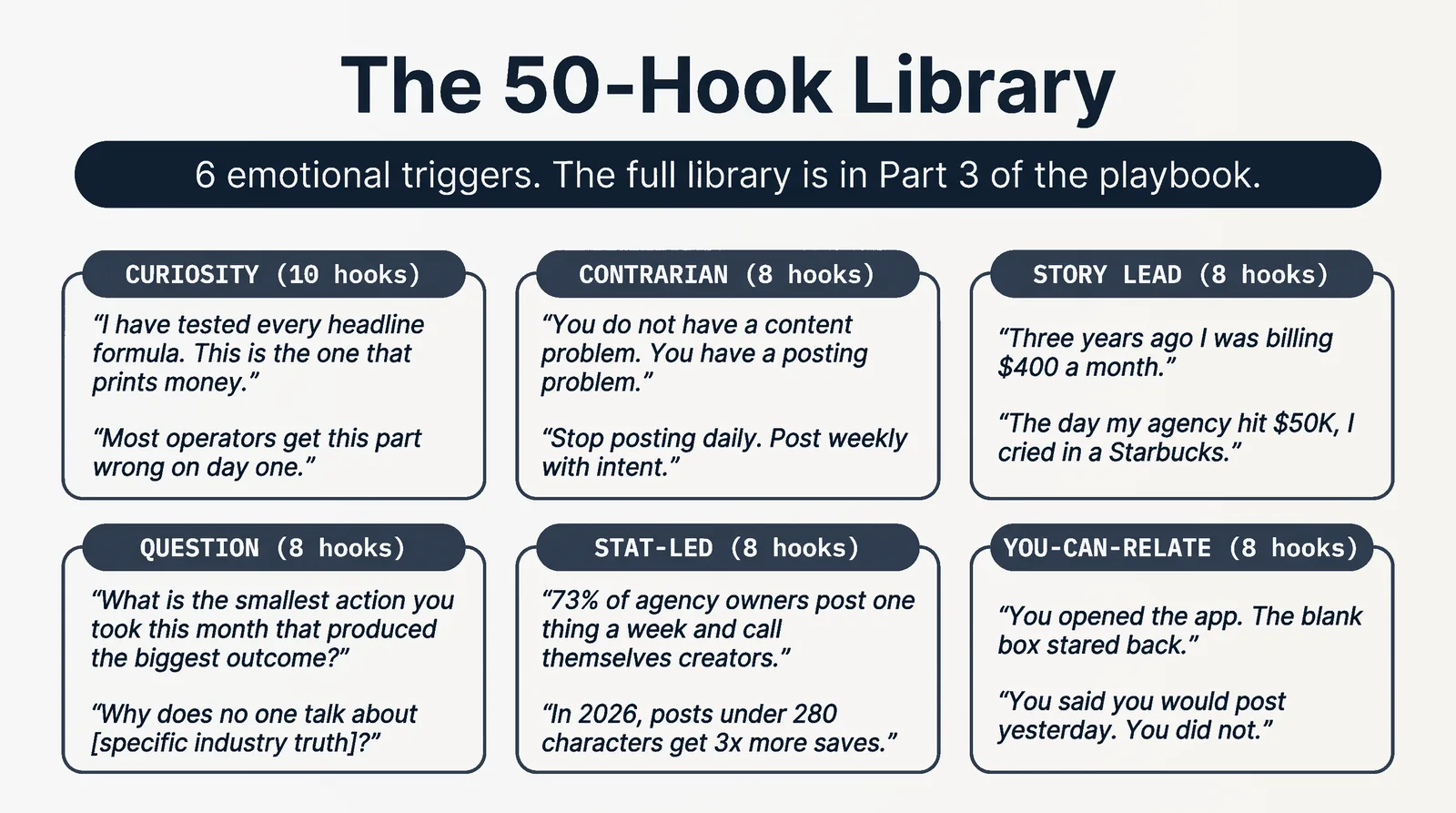
50 first lines sorted by trigger. Pick a category that matches the post you're shipping today. Lift the hook. Swap the bracket. Pair with a format from Part 2.
Curiosity (10)
"I just deleted the post I was about to ship. Here is why." Pairs with: Personal Story, Behind-the-Scenes.
"The line that doubled my reply rate is not the one you'd guess." Pairs with: Shareable Tip, Industry Insight.
"I spent 14 hours on this and the best part took 11 minutes." Pairs with: Behind-the-Scenes, Personal Story.
"Nobody is talking about what just changed in [your niche]. Here is what I'm seeing." Pairs with: Industry Insight, Hot Take.
"The thing I almost cut from this product is the part everyone uses." Pairs with: Personal Story, Behind-the-Scenes.
"What happened in the 6 weeks after my biggest launch is the part nobody warns you about." Pairs with: Personal Story, Reflective Question.
"I asked 12 founders what they would do differently. The answer was not what I expected." Pairs with: Industry Insight, Listicle.
"There is a quiet move in [your niche] that is paying right now and most people are missing it." Pairs with: Industry Insight, Hot Take.
"I rewrote one paragraph on my homepage. Sales doubled in 9 days." Pairs with: Shareable Tip, Personal Story.
"The customer who ghosted me three months ago just sent the email I was waiting for." Pairs with: Personal Story, Behind-the-Scenes.
Contrarian / Hot Take (8)
"Most [your niche] advice is bad. Here is why." Pairs with: Hot Take, Industry Insight.
"Unpopular opinion: [the thing everyone praises] is the reason most of you are stuck." Pairs with: Hot Take, Reflective Question.
"The 'best practice' for [your category] has been wrong since 2019." Pairs with: Hot Take, Industry Insight.
"If your [strategy / playbook / process] still works in 2026, you are doing it wrong." Pairs with: Hot Take, Reflective Question.
"Stop calling yourself a [common label]. You are a [sharper label]." Pairs with: Hot Take, Reflective Question.
"The reason your [funnel / pipeline / launch] is broken is not the reason you think." Pairs with: Hot Take, Industry Insight.
"You don't have a [traffic / sales / lead] problem. You have a [deeper] problem." Pairs with: Hot Take, Reflective Question.
"Half of [common practice] is theater. Here is what's real." Pairs with: Hot Take, Industry Insight.
Story Lead (8)
"Last Tuesday at 2pm I closed the biggest deal of my career. It started with a typo." Pairs with: Personal Story, Behind-the-Scenes.
"11 years ago I was [vulnerable past state]. Today I [current state]. Here is the through-line." Pairs with: Personal Story, Reflective Question.
"I almost did not send the email that closed our biggest client. I want to tell you why." Pairs with: Personal Story, Behind-the-Scenes.
"The night I decided to stop calling myself a freelancer is the night the business actually started." Pairs with: Personal Story, Reflective Question.
"There is a Slack message I will never delete. Here is what it says and why it changed everything." Pairs with: Personal Story, Behind-the-Scenes.
"On Wednesday I lost a $32K retainer. By Friday I had a $48K one. Here is the play." Pairs with: Personal Story, Industry Insight.
"I quit my job on a Monday with $4,200 in savings. Eight months later I had to make a call." Pairs with: Personal Story, Reflective Question.
"The first time a client paid me $10K I cried in my car. Here is what I learned that day." Pairs with: Personal Story, Reflective Question.
Question (8)
"When was the last time you actually [meaningful action] without [common avoidance]?" Pairs with: Engaging Question, Reflective Question.
"If you could only run one [marketing / sales / ops] move next quarter, which one would it be?" Pairs with: Engaging Question, Industry Insight.
"What is the one [tool / habit / belief] you used to swear by that you've completely abandoned?" Pairs with: Engaging Question, Reflective Question.
"How long does it take you to [common task]? Honest answers only." Pairs with: Engaging Question, Industry Insight.
"What would you do in your business this quarter if you knew it would work?" Pairs with: Engaging Question, Reflective Question.
"Founders, what did you spend money on in your first year that paid back 10x?" Pairs with: Engaging Question, Industry Insight.
"What's the one thing you wish you'd known about [your niche] before you started?" Pairs with: Engaging Question, Industry Insight.
"If your [funnel / launch / sequence] is not converting, where do you look first?" Pairs with: Engaging Question, Industry Insight.
Stat-Led (8)
"92% of [your audience] never [common action]. Here is what the 8% do differently." Pairs with: Industry Insight, Listicle.
"Last quarter we ran 1,400 cold emails. 11 closed. Here is what the 11 had in common." Pairs with: Industry Insight, Shareable Tip.
"I analyzed 800 [pieces of content / pages / campaigns] in the last 60 days. The pattern is brutal." Pairs with: Industry Insight, Hot Take.
"The average [thing] in [your niche] takes 9 months. Mine took 11 weeks. Here is what I cut." Pairs with: Personal Story, Industry Insight.
"Across 91 launches I have shipped, the ones that hit had one move in common." Pairs with: Industry Insight, Shareable Tip.
"B2B sales cycles are stretching past 90 days for the first time in a decade. Here is what changed." Pairs with: Industry Insight, Hot Take.
"44 of our last 60 customers came from one channel. It is not the one you'd guess." Pairs with: Industry Insight, Shareable Tip.
"Open rates on the average B2B newsletter just dropped 8 points in 6 months. The fix is structural." Pairs with: Industry Insight, Shareable Tip.
You-Can-Relate (8)
"If you have ever stared at the blank box at 9pm wondering what to post, this is for you." Pairs with: Personal Story, Engaging Question.
"You said you would post every day in January. It is now [current month]. Let's fix that." Pairs with: Engaging Question, Hot Take.
"The Slack message you've been avoiding is the one you should send first thing tomorrow." Pairs with: Reflective Question, Personal Story.
"If your [sales call / discovery call / pitch] keeps stalling at the same step, it's not the prospect." Pairs with: Industry Insight, Hot Take.
"You have a draft you have not shipped for 11 days. You know which one. Ship it." Pairs with: Personal Story, Hot Take.
"If you have ever been on a call with a prospect and felt yourself shrinking on price, read this." Pairs with: Personal Story, Industry Insight.
"You are not stuck. You are over-researching the move you already know you need to make." Pairs with: Reflective Question, Hot Take.
"If your inbox at 9pm tonight has 41 unanswered emails, the post you should write tomorrow is this one." Pairs with: Personal Story, Engaging Question.
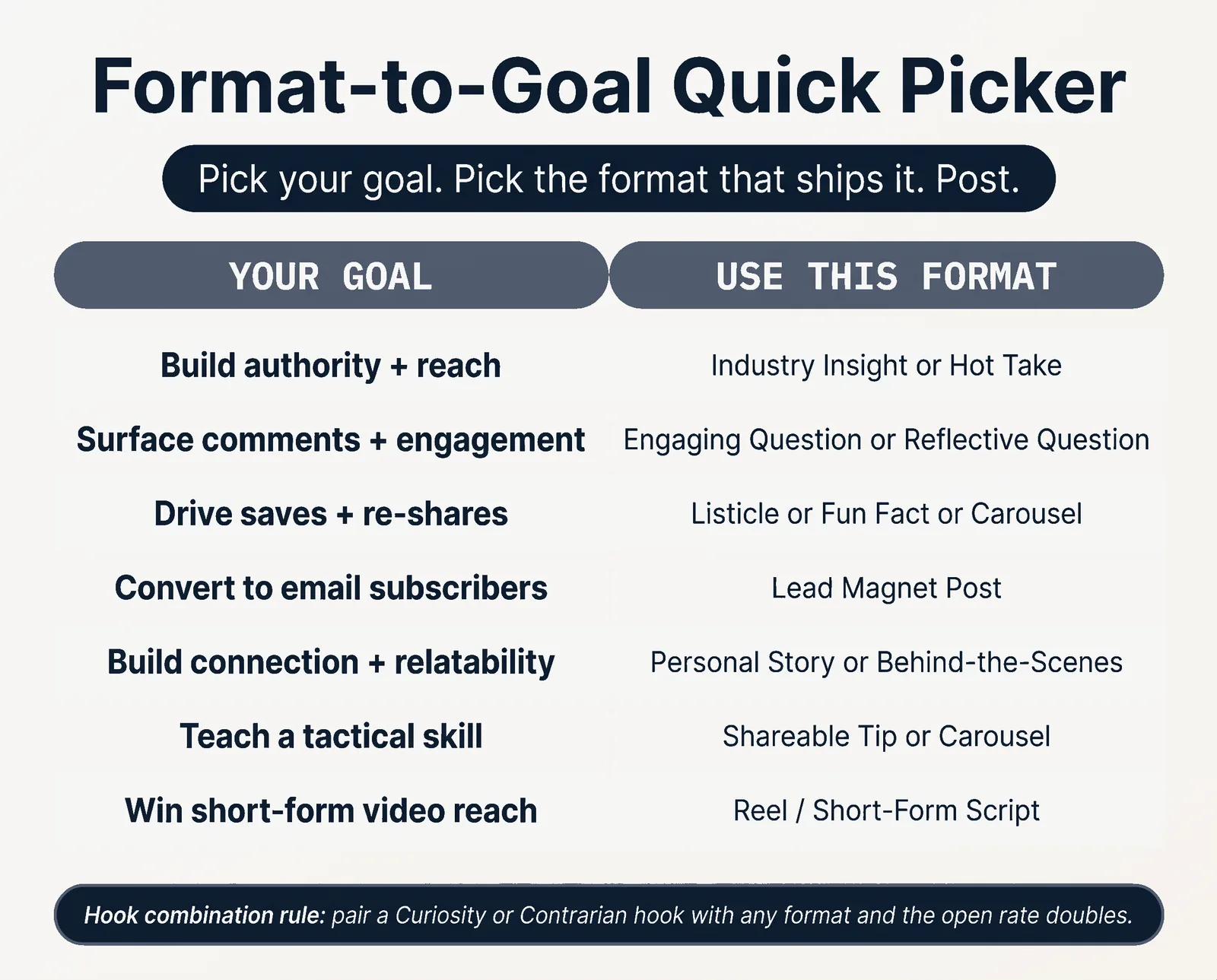
Hook combination rule
The shortcut: if the hook makes a claim, follow with a teaching format. If the hook tells a story, follow with a story format. If the hook asks a question, follow with a question format. Match the energy or the post breaks.
Part 4, What to read next
If this helped, the rest of the Massive Impact library is built the same way. Tactical first. Templates over theory.
- The Headline Mastery Playbook (P33) for the 14 formulas, 200 swipe-ready headlines, and the scoring rubric. Every post in Part 2 lives or dies on the first line.
- The Just Enough Trap Playbook (P32) for the 60 mistakes founders make. Daily posting is one of the moves that breaks Stage 1 and Stage 2 plateaus.
- The Meta Ads Playbook (P26) for paid social. Your organic posts feed your paid creative library. Same hooks, bigger budget.
- The TikTok Ads Playbook (P28) for short-form video at scale. Same hook that wins organic Reels wins paid TikTok.
- The Master Brand Intake Prompt (P02) for locking your voice before you ship. If the voice is unclear, format won't save you.
Pick one. Open it the day you need it. Run the play.
Eat. Sleep. Post. Repeat.
The rest of the guide is yours, free.
Enter your email to keep reading and get the PDF to keep.
No spam. One email unlocks every Massive Impact resource.
“You clearly have the heart of a teacher, giving and giving and giving.”
The service behind this
More from the library
