


PLAYBOOK / CONTENT
Edgy Content That Converts
Why polarizing content works in 2026. The 5 strategic filters. The 5-tier risk spectrum with scoring. A 100-point pre-post rubric. Five fill-in-the-blank templates. Five approaches to never use. The backlash recovery playbook. And a 50-line hook vault you can swipe today.

Why polarizing content works in 2026. The 5 strategic filters. The 5-tier risk spectrum with scoring. A 100-point pre-post rubric. Five fill-in-the-blank templates. Five approaches to never use. The backlash recovery playbook. And a 50-line hook vault you can swipe today.
Who this is for
Solo founders, agency owners, in-house marketers, and content creators publishing on LinkedIn, X, Facebook, and Instagram in 2026. Anyone whose growth depends on stopping the scroll without burning the brand.
I lost a thirty-thousand-dollar account to a single LinkedIn post in 2024.
The post was a contrarian take on outsourced SEO. I wrote it on a Tuesday morning between client calls, hit publish, watched the numbers climb, felt great. By Friday the founder of one of my biggest accounts had emailed me a screenshot of the post and a one-line message. "We're going to wind down at the end of the quarter." His agency was the kind of agency I had just spent four hundred and twenty words calling out.
Same week, that exact same post pulled in nine inbound calls, four of which became clients. Net revenue: positive. Net learnings: I had not built a system. I got lucky on the math, and unlucky on the relationship.
This playbook is the system I built afterwards. Eight parts. The exact filters, scores, templates, and recovery moves I run every post through now. None of it is theoretical. Every section has been used on something I have published since.
Brought to you by Massive Impact. Massive Impact is a free lead magnet library for founders, marketers, and operators. Playbooks, prompts, frameworks, and checklists at the Massive Impact resource library. Browse the full set at the Massive Impact resource library.
What is in this playbook
- Part 1, Why Polarizing Content Works in 2026
- Part 2, The 5 Strategic Filters
- Part 3, The 5-Tier Risk Spectrum
- Part 4, The Pre-Post Risk Scoring Rubric
- Part 5, The 5 Effective Approaches with Templates
- Part 6, The 5 Approaches to Never Use
- Part 7, The Backlash Recovery Playbook
- Part 8, The Hot Take Hook Vault
Part 1, Why Polarizing Content Works in 2026
The case for sharp content used to be a creator argument. "Stand for something or get drowned out." True, and now the algorithms have moved into the same camp. Posts that produce strong reactions get pushed harder than posts that produce nothing. The platforms reward engagement signal over engagement sentiment. A comment is a comment whether it is "this is brilliant" or "this is the worst take I've read all week".
So the question is not whether to publish polarizing content. The question is which post wins the bet. Most do not. The ones that do follow a pattern.
Here is the platform reality I am working with this quarter.
What each platform actually does with controversial posts
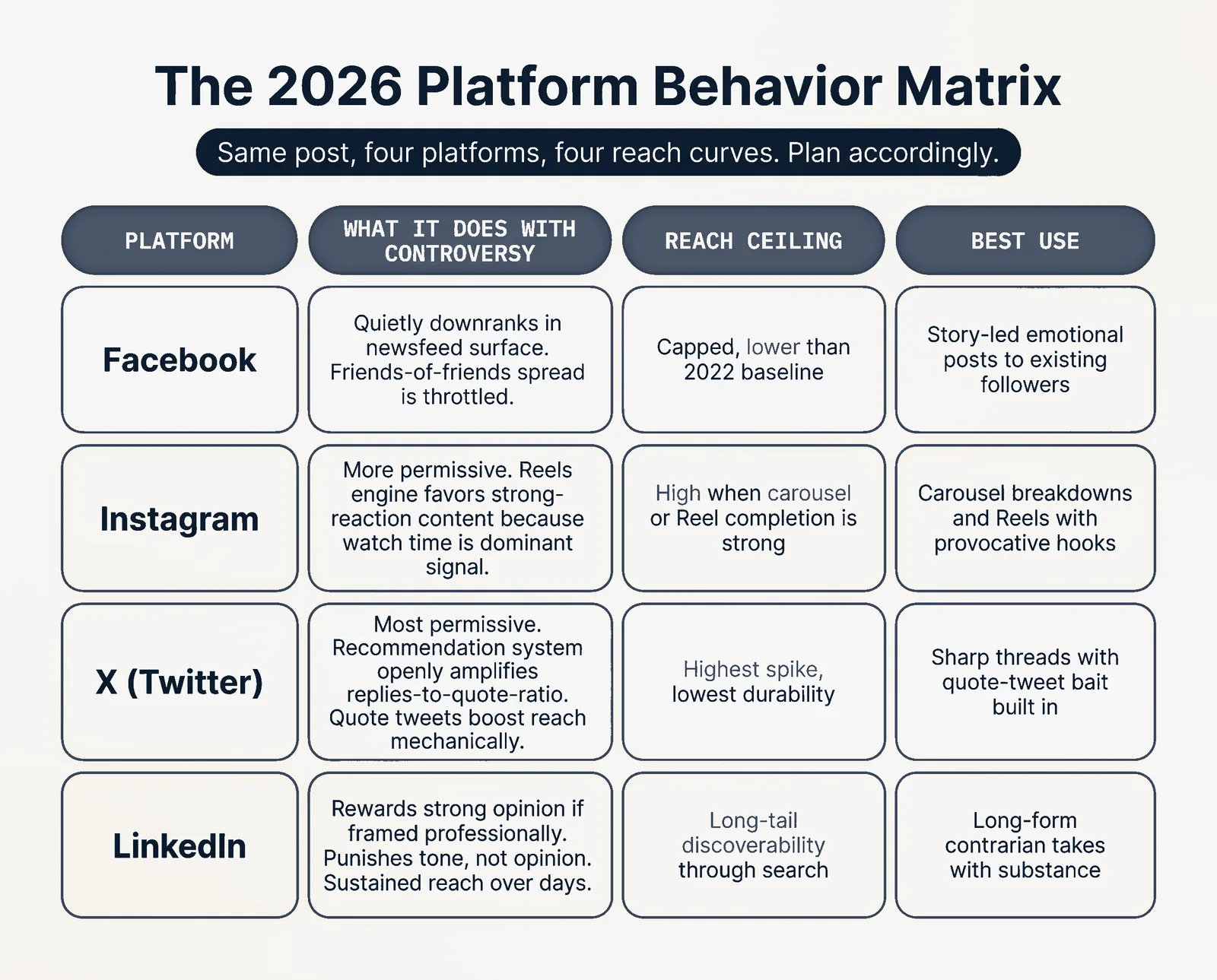
Meta on Facebook. Quietly downranks posts that the system flags as controversial in newsfeed surface. The post still gets your followers, but the friends-of-friends spread is throttled. You can feel it in the hour-by-hour reach numbers. A post that climbed to forty thousand impressions in 2022 now caps at twelve. The engagement rate looks the same. The total ceiling is lower.
Meta on Instagram. More permissive than Facebook. The Reels engine in particular favors strong-reaction content because watch time is the dominant signal and provocative hooks earn it. Carousel posts with controversial frames also do well, because every swipe is a watch-time signal. The trade is that aggressive comment moderation now triggers shadow-flags faster than it used to. Delete a comment too aggressively and the post's reach gets clipped within the hour.
X (formerly Twitter). The most permissive of the four. The recommendation system openly amplifies replies-to-quote-ratio, which means controversial posts that draw quote tweets are mechanically pushed harder. Reply guys are an algorithmic asset on X. The risk on X is not reach, it is durability. A post that lights up on a Tuesday is forgotten by Thursday. Plan your follow-up beats accordingly.
LinkedIn. Rewards strong opinion if framed professionally. The "professionally" word is doing the work. A take like "most agencies are scamming you" performs in raw numbers and torches your inbound. A take like "the agency model has structural problems and here's what I'd buy instead if I were a founder today" performs in raw numbers AND fills your DMs. Same energy, different register. LinkedIn punishes tone, not opinion.
When polarization wins vs loses
Polarization wins when:
- The take is true to your actual operating belief, not a pose
- The audience you want to attract feels seen, even if the audience you want to repel feels attacked
- You can defend it with specifics if pushed
- You have a follow-up plan if the post goes wider than expected
- The downside cost (a few unfollows, a churned client) is one you have priced in
Polarization loses when:
- The take is a hot take you do not actually hold
- It attacks people instead of practices
- It cannot be backed with a real example from your work
- You have no plan for the inbox if it lands hot
- The downside cost is a relationship you cannot afford to lose
That last one is the one I missed in 2024. The post was true. I could defend every word. But I had an agency client on a thirty-thousand-dollar retainer who fit the description. The cost was not in the polarization. The cost was in not asking, before I hit publish, "who in my current book of business will read this and feel called out".
The "polarize to filter" theory
Here is the theory in one sentence. The job of a polarizing post is not to convince the undecided. It is to filter the audience.
Most creators publish trying to be liked by everyone. The math on that is brutal. Trying to be liked by everyone produces content liked by no one in particular. Average performance, average inbound, average revenue.
Polarizing content does the opposite. It actively pushes some readers away so the readers who remain are the ones who actually buy. The unfollow is not a failure mode. It is the system working. If your post triggers ten unfollows and one inbound, and that inbound becomes a four-thousand-dollar-a-month client, you just paid yourself four hundred dollars per unfollow.
The filter only works if you know who you are filtering toward. Without an ICP definition sharp enough to recognize on sight, you are not polarizing strategically. You are just being rude on the internet.
The full library has more frameworks like this. Adjacent playbooks at the Massive Impact resource library.
Part 2, The 5 Strategic Filters
Before any provocative post leaves your drafts folder, run it through these five filters. If it fails any of them, the post is not ready. Rewrite or delete.
Filter 1, Business Relevance
The question: does this post connect to a problem your offer actually solves?
The trap here is the off-topic hot take. You see a creator going viral on a parenting take and think "controversy is controversy". It is not. Controversy that lives outside your business circle pulls in an audience that will never buy from you. The reach feels good, the inbound is empty.
Pass/fail check: can you draw a one-sentence line from the post's argument to a thing you sell? If you cannot, the post is recreational, not strategic. Park it in a personal account.
Filter 2, ICP Alignment
The question: will the people you most want as clients nod when they read this?
Your ICP has beliefs about their own industry, their competitors, the gurus they have stopped trusting, and the tools they wish someone would call out. If your post mirrors one of those beliefs back to them in language they would not have dared to use themselves, you become the creator who said the thing they were thinking. That is conversion gravity.
Pass/fail check: name two people from your last ten clients. Will both of them, on reading this, feel like you are speaking to them? If only one will, the post is too narrow. If neither will, the post is not for your ICP.
Filter 3, Strategic Purpose
The question: what does this post accomplish that a non-edgy version of the same point would not?
If a milder version of the same idea would do the same job, the edge is unnecessary. Edge has a cost. It pays for itself only when the cost buys differentiation, audience filtering, or memorability you would not have gotten otherwise. Edge for its own sake is the cost without the payoff.
Pass/fail check: write the same point in milder language for a moment. Is the milder version weaker, or just gentler? If just gentler, ship the milder version. If genuinely weaker, the edge earns its place.
Filter 4, Risk Assessment
The question: what is the realistic worst case, and can you absorb it?
This is the filter most creators skip. They imagine the upside (viral reach, inbound flood) and ignore the downside (client churn, relationship damage, comment pile-on, screenshot circulation). The risk is not theoretical. It is named: which specific clients might churn, which specific peers might withdraw, which specific revenue might be at risk.
Pass/fail check: name the specific worst-case scenario in one sentence. If the answer is "I cannot afford that", do not publish. If the answer is "that would sting and I would survive it", proceed.
Filter 5, Value First
The question: does the reader walk away with something useful, or just an opinion?
A strong opinion without value is a tantrum. A strong opinion with a useful insight, framework, or action item is a magnet. The two read similarly in your drafts folder and very differently in the comments. The former earns "ok and?", the latter earns "saved this, thank you".
Pass/fail check: if you removed the polarizing line and kept everything else, does the reader still get a takeaway? If yes, the value is real. If no, the post is just heat.
The full filter set runs in about ninety seconds per draft. Skipping it costs more than running it.
Part 3, The 5-Tier Risk Spectrum
Polarizing content is not one thing. It is a spectrum. Tier 1 is mild and broadly survivable. Tier 5 is the kind of post that ends careers if it lands wrong and changes them if it lands right. The error most creators make is treating all five tiers the same. The hot-take post that works at Tier 2 is not the same shape as the post that works at Tier 5.
For each tier: a risk score (1 to 10 scale, my read after running content through this for two years), who it attracts, who it repels, the typical outcome data I have seen, the most common pitfall, and two real opener examples in agency-owner voice.
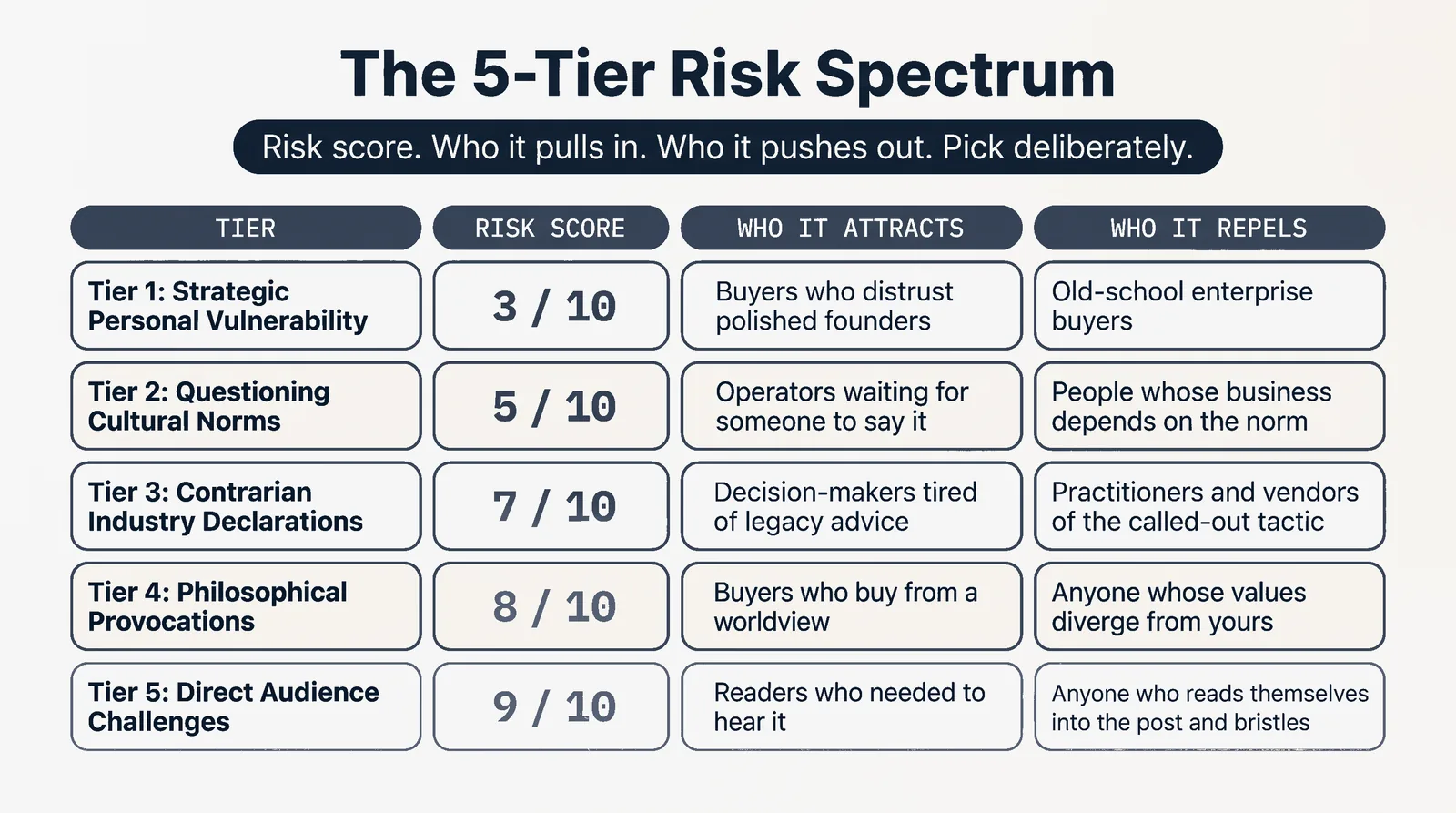
Tier 1, Strategic Personal Vulnerability
Risk score: 3 / 10
What it is: sharing a struggle, a failure, or a low moment from your own story to establish credibility while keeping authority intact. The "I have been where you are" move, executed without the saccharine wrap-up.
Who it attracts: prospects who do not trust polished founders. The audience that has been burned by gurus. People who buy from creators they feel they could grab a coffee with.
Who it repels: old-school enterprise buyers who confuse polish with competence. Some peers will read vulnerability as weakness; that subset is rarely your buyer anyway.
Typical outcome: moderate engagement, high warmth in DMs, slow conversion of inbound but high stickiness. Posts at this tier rarely go viral, often outperform on reply quality.
Common pitfall: trauma-dumping. There is a line between vulnerability that demonstrates a lesson and vulnerability that uses your audience as a therapist. Stay on the lesson side. The story serves the takeaway, not the other way around.
Opener examples in agency-owner voice:
- "I missed payroll in March 2022 and had to email my four contractors at 11pm asking for a 14-day delay. Here is what that taught me about cash buffers."
- "First time I lost a five-figure client, I spent the night convinced I was done as an operator. Three days later the post-mortem changed how I run every retainer now."
Tier 2, Questioning Cultural Norms
Risk score: 5 / 10
What it is: challenging an industry-wide assumption that gets repeated as if it were a law. The "everyone says X is the way; here is why X stopped being the way three years ago" move.
Who it attracts: operators who have quietly suspected the same thing and were waiting for someone to say it out loud. The buyer who is shopping for a contrarian.
Who it repels: people whose business model depends on the norm you are questioning. They will not just disagree; they will brigade.
Typical outcome: strong engagement curve, longer comment threads, mixed-sentiment ratio (about 65/35 in my experience), higher-than-average inbound from people who have been burned by the norm.
Common pitfall: norms often have nuance you do not see from the outside. Question the norm without honoring the reason it became one and you sound like you skipped your homework. Acknowledge the why before you tear it down.
Opener examples:
- "Every agency owner says you have to fire your worst client every quarter. I have not fired a client in two years and we just had our best one."
- "The 'productize your service' advice was right in 2019 and is wrong for new agencies in 2026. Here is what changed."
Tier 3, Contrarian Industry Declarations
Risk score: 7 / 10
What it is: taking a firm position against a popular industry practice or belief. Not a question, a declaration. "X is dead. Y is what to do instead."
Who it attracts: decision-makers tired of legacy advice. People in the buying window who need permission to do something different. Your clearest ICP signal.
Who it repels: practitioners of X. Vendors of X. Influencers who built their following teaching X. Some of these will respond publicly; most will quietly remove you from rec lists.
Typical outcome: highest raw reach of any tier in my experience. Long-tail discoverability through search and quote tweets. Highest inbound conversion to discovery calls. Also the highest unfollow rate per impression.
Common pitfall: declaring something dead without naming what replaces it. The declaration without the alternative reads as venting. The declaration paired with a sharper alternative reads as a strategist.
Opener examples:
- "Cold email is dead for agencies above twenty thousand monthly recurring. Here is the LinkedIn-only flow that has built my last three retainers."
- "Stop running ads to lead magnets. The CAC math broke in late 2024 and the funnels that worked are now hospice care for your budget."
Tier 4, Philosophical Provocations
Risk score: 8 / 10
What it is: posts that touch on purpose, meaning, ideology, faith, identity, or personal values as they intersect with how you work or build. The deepest end of the polarization spectrum that still belongs in business conversation.
Who it attracts: the audience that wants to buy from a worldview, not just a service. Stickiest customer base if you can find them. They become evangelists.
Who it repels: anyone whose values diverge from yours. Often a wide swath. Some will unfollow quietly; some will email a peer about you. Reputation effects can extend past the platform.
Typical outcome: lower raw reach than Tier 3 but disproportionately high impact on the people it lands with. Inbound is fewer messages, longer messages, often resulting in higher-ticket deals.
Common pitfall: broadcasting a worldview without earning it through specifics. A philosophical claim with no personal evidence reads as preaching. Same claim grounded in a real story reads as conviction.
Opener examples:
- "I will not work with founders who treat their team like a renewable resource. Three signals I screen for on the discovery call to spot it early."
- "The 'hustle until you collapse' identity is a tax most operators are quietly paying. Here is what shifted when I built around recovery instead of around grinding."
Tier 5, Direct Audience Challenges
Risk score: 9 / 10
What it is: posts that directly confront your audience's behavior, mindset, or excuses. Second-person, not third. "You" not "people".
Who it attracts: the readers who needed to hear it and recognize themselves. They convert at the highest rate per engagement of any tier.
Who it repels: anyone who reads themselves into the post and bristles. Confrontation is uncomfortable; some readers will unfollow simply to avoid the discomfort, even if the post was right.
Typical outcome: the highest variance of any tier. Either lights up massively or eats a comment-section beating. Depends on whether the call-out feels earned or scolding. The line is thin.
Common pitfall: scolding without a path forward. "You are doing this wrong" without "here is what to do instead" lands as judgment. Pair the challenge with the alternative in the same post or it does not work.
Opener examples:
- "You say you want consistent inbound, and you have published twice this month. Pick a side. The math is the math."
- "If you cannot name your top three lead sources from memory, you do not have a marketing strategy. You have a hobby that occasionally makes money."
The five tiers are not a ladder. You do not need to graduate to Tier 5. The best content calendars I have seen mix tiers deliberately. Mostly Tier 2 and Tier 3, occasional Tier 1 for warmth, occasional Tier 4 for filter, rare Tier 5 for the posts that have to land hard.
Part 4, The Pre-Post Risk Scoring Rubric
Before you publish anything in Tier 3 or higher, run it through this rubric. Score the draft against six categories. Add the scores. Apply the decision rule.
I built this after the 2024 incident. Took me about a year of using a messy version before it stabilized into the form below. The scoring takes about two minutes per post once you have run it a dozen times.
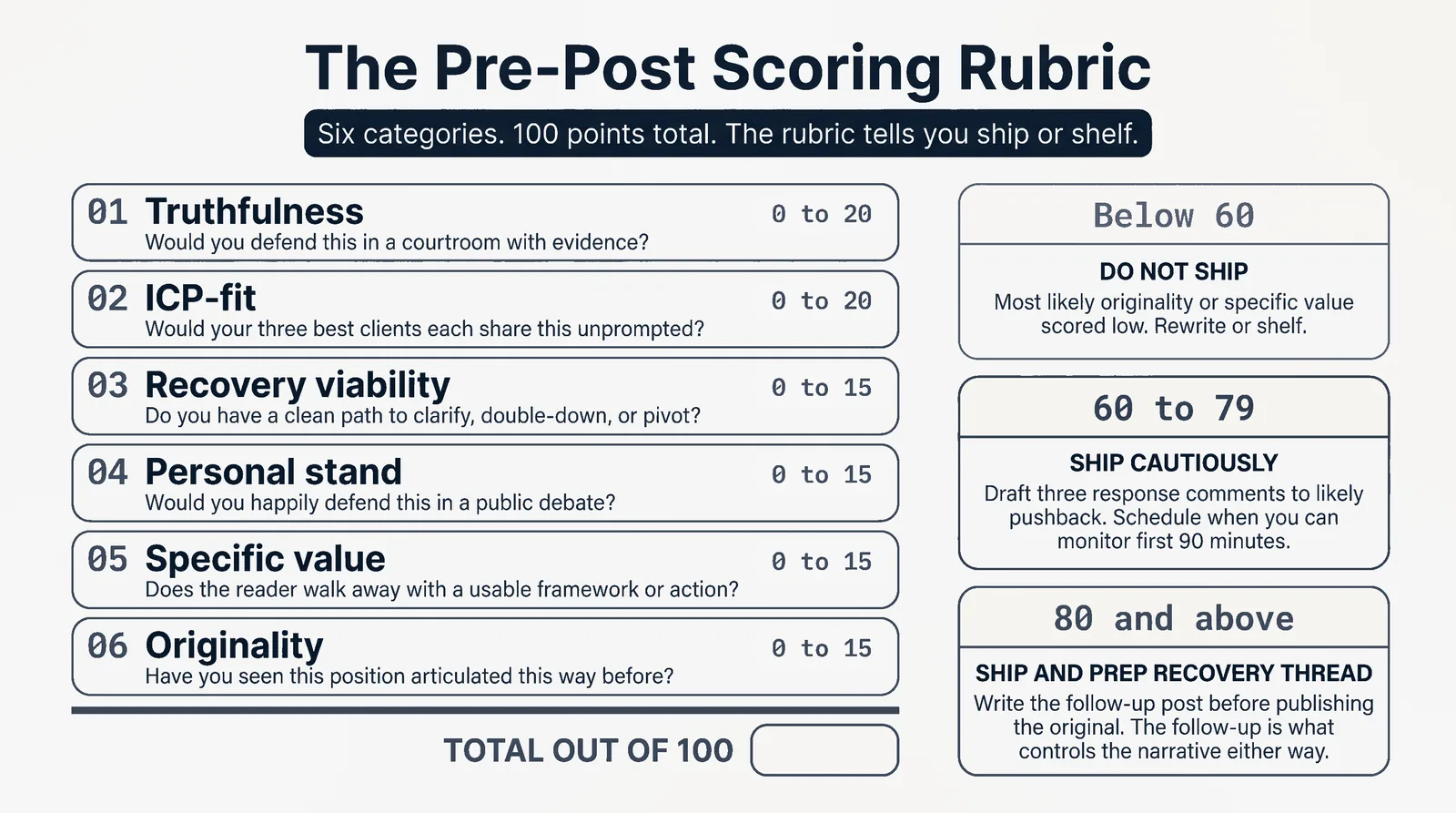
The 6 categories (100 points total)
Truthfulness (0 to 20 points) Score how genuinely you believe the claim, on a scale of 0 (would not say it on a podcast under your real name) to 20 (would defend it in a courtroom with evidence). Performative takes lose points here. Hot takes you secretly think are a stretch lose more. The post that scores 20 is the one you would still post if your largest client were watching.
ICP-fit (0 to 20 points) Score how directly the post speaks to the people you want as clients. 0 means the audience attracted will not buy from you. 10 means a portion of the readers fit. 20 means your three best clients would each share this post unprompted.
Recovery viability (0 to 15 points) Score how clean a recovery you could mount if the post lands wrong. 0 means there is no graceful recovery; the post is binary. 8 means recovery is possible but messy. 15 means you have a clear path to clarify, double-down, or pivot if needed.
Personal stand (0 to 15 points) Score how willing you are to defend the post in the comments, the DMs, and on a future call. 0 means you would delete at the first heat. 8 means you would argue but not enthusiastically. 15 means you would happily defend the take in a public debate.
Specific value delivered (0 to 15 points) Score how much the reader walks away with. 0 means just an opinion. 8 means an opinion with light reasoning. 15 means an opinion plus a usable framework, example, or action they can apply this week.
Originality (0 to 15 points) Score how fresh the take is. 0 means a recycled hot take that has been making the rounds. 8 means a familiar idea with a new angle. 15 means a position you have not seen articulated this way before.
The math
Add the six scores. Out of 100.
The decision rule
Below 60: do not ship. The post is not ready. Most likely the originality or specific value scored low. Rewrite or shelf.
60 to 79: ship cautiously, prep response. The post is publishable. Before hitting publish: draft three response comments to the most likely pushback. Have them ready in your notes app. Schedule the post for a window when you can monitor the first ninety minutes.
80 and above: ship and prep the recovery thread proactively. The post is strong enough to warrant a follow-up. Write the follow-up before you publish the original. The follow-up post is the one that controls the narrative whether the original lands well or hot.
A worked example
The post I lost the thirty-thousand-dollar account on, scored honestly:
- Truthfulness: 19 (I genuinely believed every word)
- ICP-fit: 11 (it spoke to founders shopping for an alternative; it also called out a current client of mine)
- Recovery viability: 4 (binary post; no clean recovery once a client recognized themselves)
- Personal stand: 14 (I was ready to defend it)
- Specific value delivered: 10 (good frame, light on actionable specifics)
- Originality: 13 (the angle was fresh)
Total: 71. Ship cautiously, prep response.
Where I went wrong: I ignored the rubric (had not built it yet) and most acutely the recovery-viability score of 4. A post with a 4 on recovery is one you should re-engineer to be less binary before publishing. I did not. The math caught up with me.
The rubric is not a guarantee. It is a forcing function. It makes you confront the trade you are making instead of pretending the trade does not exist.
Part 5, The 5 Effective Approaches with Templates
Five approaches that work. For each one: how it works, a fill-in-the-blank template, and an example with the template filled in. The brackets are the only placeholders.
Approach 1, Direct Industry Criticism
This is the move where you call out a specific practice in your industry that is hurting buyers, then provide the alternative. Works because it positions you as the operator who breaks ranks to tell the truth. The risk is sounding bitter. The fix is specificity. Generic industry-bashing reads as petty. Targeted criticism with receipts reads as authority.
The template:
Most [INDUSTRY] are [WHAT THEY DO WRONG] and pretending it works.

Here is what is actually happening:

- [SPECIFIC SYMPTOM 1]
- [SPECIFIC SYMPTOM 2]
- [SPECIFIC SYMPTOM 3]

The reason it persists is [STRUCTURAL REASON], and the operators inside the industry know it.

Here is what to do instead:

[YOUR ALTERNATIVE APPROACH IN ONE PARAGRAPH]

If you are buying [SERVICE], ask your provider [SPECIFIC QUESTION]. Their answer tells you everything.
Filled-in example:
Most retainer agencies are billing for hours their team is not actually working and pretending it works.

Here is what is actually happening:

- The senior who pitched you handles your account for two weeks then disappears
- The junior assigned to your work is on three other accounts simultaneously
- The "strategy call" is a status update with no strategic input

The reason it persists is the agency margin model only works at scale, and scale means juniors. The operators inside the industry know it.

Here is what to do instead:

Hire one senior on a smaller scope, fewer deliverables, more brain. You will pay similar money for one third the volume of work and three times the result. The math feels wrong on the spreadsheet and right in the revenue.

If you are buying a retainer, ask your provider what percentage of the work is done by the person who pitched you. Their answer tells you everything.
Approach 2, Challenging Audience Behaviors
The move where you confront a behavior your audience knows they do, in language they would use about themselves but have not. Works because it earns trust through accuracy. The risk is condescension. The fix is to call yourself out alongside them, or to offer the alternative in the same breath as the criticism.
The template:
You say you want [STATED GOAL].

Your behavior says [ACTUAL BEHAVIOR].

Here is the gap:

- You [BEHAVIOR THAT CONTRADICTS GOAL 1]
- You [BEHAVIOR THAT CONTRADICTS GOAL 2]
- You [BEHAVIOR THAT CONTRADICTS GOAL 3]

I get it. I did the same thing for [TIMEFRAME] before [TURNING POINT].

The shift that worked: [SPECIFIC ALTERNATIVE BEHAVIOR].

Pick the goal or pick the behavior. The math will not let you have both.
Filled-in example:
You say you want predictable inbound.

Your behavior says you want the dopamine of a viral post.

Here is the gap:

- You publish for engagement spikes, not for the slow reader who buys in month four
- You write hooks built for shares, then complain when the audience that shares does not buy
- You will not commit to a posting schedule because consistency is boring and consistency is what works

I get it. I did the same thing for fourteen months before I cleared one hundred thousand dollars in revenue from boring weekly posts.

The shift that worked: write each post for one specific person on your buyer list. Send them the post directly when it goes live. Forget the rest of the audience entirely.

Pick the goal or pick the behavior. The math will not let you have both.
Approach 3, Provocative Industry Positions
The move where you take a sharp stand against a tool, a tactic, or a trend that the industry treats as gospel. Works because the gospel is rarely audited. The risk is that the audit needs to be real, not lazy. The fix is to lead with the data or the case study, not the slogan.
The template:
[INDUSTRY TOOL OR TACTIC] is [DEAD / OVERRATED / WRONG FOR MOST] in 2026.

I have run [SPECIFIC EXPERIMENT OR EXPERIENCE] across [SCOPE / TIMEFRAME].

Here is what the numbers say:

- [DATA POINT 1]
- [DATA POINT 2]
- [DATA POINT 3]

The reason this is not common knowledge yet is [STRUCTURAL REASON THE INDUSTRY HIDES IT].

What to do instead:

[ALTERNATIVE TACTIC, NAMED, WITH ONE EXAMPLE OF IT WORKING]

I will be wrong about this for some operators in some niches. I am not wrong about it for [SPECIFIC AUDIENCE WHERE THE CLAIM HOLDS].
Filled-in example:
Lead magnet funnels are dead for B2B services in 2026.

I have run six funnel rebuilds across four client accounts and my own from January 2025 to last month.

Here is what the numbers say:

- Cost per qualified lead up 280 percent year over year
- Show-up rate on booked calls down from 64 percent to 31 percent
- Time-to-close on funnel-sourced leads now twice as long as referral-sourced

The reason this is not common knowledge yet is the agencies selling funnel buildouts have a quarter of revenue locked into selling them. They will not be the ones to call it.

What to do instead:

I will be wrong about this for some operators in some niches. I am not wrong about it for B2B services selling above two thousand dollars a month with a six-week-plus sales cycle.
Approach 4, Blunt Personal Experiences
The move where you share a real moment from your own work that illustrates a business principle, even if it makes you or someone in the story look bad. Works because everything in marketing is theory until someone tells you the actual story. The risk is making it about your own ego. The fix is to put the takeaway above the protagonist.
The template:
[YEAR / TIMEFRAME]. I [SPECIFIC ACTION YOU TOOK OR THING THAT HAPPENED].

The setup: [TWO TO THREE SENTENCES OF CONTEXT, IN PLAIN LANGUAGE].

What I did: [WHAT YOU DECIDED, IN A SENTENCE].

What happened: [THE OUTCOME, INCLUDING THE PARTS THAT REFLECT POORLY ON YOU].

What I learned, and what I do differently now:

[THE PRINCIPLE, NAMED, FOLLOWED BY THE SPECIFIC NEW BEHAVIOR THAT IMPLEMENTS IT]

If [READER IN A SIMILAR SITUATION], [SPECIFIC ADVICE].
Filled-in example:
March 2023. I gave a client a fifteen-percent discount they did not ask for.

The setup: we had blown a deadline by four days. The client was annoyed but not at-risk. I sent the recovery email and added a unilateral credit at the bottom because I felt guilty.

What I did: assumed a discount would buy back the trust faster than a process change would.

What happened: the client took the credit. They also continued to bring the missed deadline up in three of the next four monthly reviews. The discount confirmed the mistake was big. The process change would have proved the mistake was over.

What I learned, and what I do differently now:

Apologies pay in process changes, not in dollars. The principle: a discount without a process change reads as a bribe to stop complaining. A process change without a discount reads as confidence. Now I never offer a credit before the client has been heard, and I rarely offer one at all.

If you are about to add a guilt discount to a recovery email, delete it. Send the process change instead. Ask later if a credit would feel like the right close. The client says yes, no, or names something else. The conversation stays theirs.
Approach 5, Straight-Talk About Results
The move where you tell the truth about how long things take, how often things fail, or what the realistic outcomes actually look like. Works because the industry around you is lying about the same numbers. The risk is sounding bitter or, worse, sounding like you are managing expectations because you cannot deliver. The fix is to own the standard you do hit, in numbers, alongside the honest version of what you do not promise.
The template:
The truth about [SERVICE / TACTIC / OUTCOME]:

- [HONEST TIMEFRAME UNTIL RESULTS]
- [HONEST PERCENTAGE OF CLIENTS WHO HIT THE GOAL]
- [HONEST COMMON FAILURE MODE]

Anyone telling you [INFLATED PROMISE] is lying to close the deal.

Here is what actually happens for the [PERCENTAGE] who succeed:

[TWO TO THREE SENTENCES OF THE REAL JOURNEY]

If you cannot stomach [HONEST PRECONDITION], you are not the buyer for this and that is fine.

If you can, [SPECIFIC NEXT STEP].
Filled-in example:
The truth about LinkedIn organic growth for solo agencies:

- 90 days minimum before inbound feels reliable
- About a third of operators who start give up before day 60
- Most common failure mode is publishing four times in week one and zero times in week three

Anyone telling you "viral in thirty days" is lying to close the deal.

Here is what actually happens for the operators who succeed:

You publish twice a week for three months and the numbers look flat. Around day 80 the first inbound DM comes in unprompted. By day 120 there are three to five per week. The work feels invisible until it isn't.

If you cannot stomach publishing into silence for two months, you are not the buyer for this and that is fine.

If you can, draft your first ten posts before you publish a single one. Pre-loaded creators outlast inspired ones.
Five approaches. Five templates. Five worked examples. Pull what you need into your drafts folder and adapt the brackets to your real situation.
Part 6, The 5 Approaches to Never Use
Even inside a no-filter strategy, certain moves consistently undermine the work. Each one named, why it fails in a line, a wrong example, and a corrected rewrite.
Mistake 1, Gratuitously Offensive Without a Point
Why it fails: insults without insight pull the wrong audience. The people who reshare it are the ones who like cruelty as entertainment. None of them buy.
Wrong example: "If you are still using spreadsheets to run your business in 2026, you are an idiot who deserves to fail. Evolve or go extinct."
Corrected rewrite: "Spreadsheets are killing your service business in 2026. While you are manually updating cells, your competitors have automated customer follow-ups, scheduling, and reporting. The spreadsheet era is over for serious operators. Are you serious?"
The corrected version makes the same argument, treats the reader as an adult, and earns a response other than defensive comments.
Mistake 2, Politically Charged Without Business Relevance
Why it fails: political identity overrides business intent. Half the audience that would have bought from you closes the tab on the keyword alone. The half that stayed cannot be turned into customers because politics absorbed the conversation.
Wrong example: "Conservative founders build systems. Liberal founders expect handouts. That is why our client base leans heavily right."
Corrected rewrite: "No election outcome saves a business with broken systems. The operators who win in any economy respond faster, deliver more consistently, and run on lower overhead. Politics does not pick the winner. Operations does."
Same energy, none of the unforced cost.
Mistake 3, Personal Attacks on Named Individuals
Why it fails: the post stops being about the idea and becomes about the fight. Quote-tweet defenders pile in. Lawyers eventually email. Even when you are factually correct, you spend three days on a beef instead of building.
Wrong example: "John Smith at XYZ Agency is a fraud who has not delivered for a single client in five years. His Twitter is theater."
Corrected rewrite: "Beware operators who built a personal brand on case studies they cannot reproduce. Three signals to check before you sign with anyone making big public claims: ask for a current-client introduction call, check the dates on the case studies, look for publicly visible client work in the last six months."
Same target outcome, no name in the post, real protective value for the reader.
Mistake 4, Oversharing Personal Details Unrelated to Business Value
Why it fails: TMI breaks trust. The reader did not sign up to be your therapist. Personal vulnerability that lands well always pulls a business lesson. Vulnerability without the lesson reads as a vent.
Wrong example: "After my messy divorce and custody battle and my brother's diagnosis I realized I needed systems that could run without me during personal crises."
Corrected rewrite: "Your business needs to run without you, and not just for vacations. I built systems-first after a personal crisis took me out of the work for three weeks. Without them I would have lost the agency. Here is the minimum systems stack that survives a founder being unreachable for ten business days."
Personal stake intact, lesson explicit, audience served.
Mistake 5, Unverifiable Claims and Promises
Why it fails: the experienced reader spots an unverifiable claim from a mile away and downgrades you to a hype account. The inexperienced reader who buys it eventually feels lied to and tells everyone.
Wrong example: "Our automation will instantly double your revenue, guaranteed, or we work for free forever."
Corrected rewrite: "The honest math on automation: about a third of operators who implement it well see real impact. About 40 percent see moderate gains. About a quarter see nothing because they implement halfway. The differentiator is execution, not the tool. Half-measures get half-results. If you are not all in, do not start."
Specific, defensible, and ironically more compelling than the hype version.
Part 7, The Backlash Recovery Playbook
Sometimes a post lands wrong. Maybe the timing was bad, maybe a take that worked in your head read differently in the wild, maybe a misread of who would see it. When that happens, the next twenty-four hours decide whether the post becomes a blip or a story. Here is the playbook.
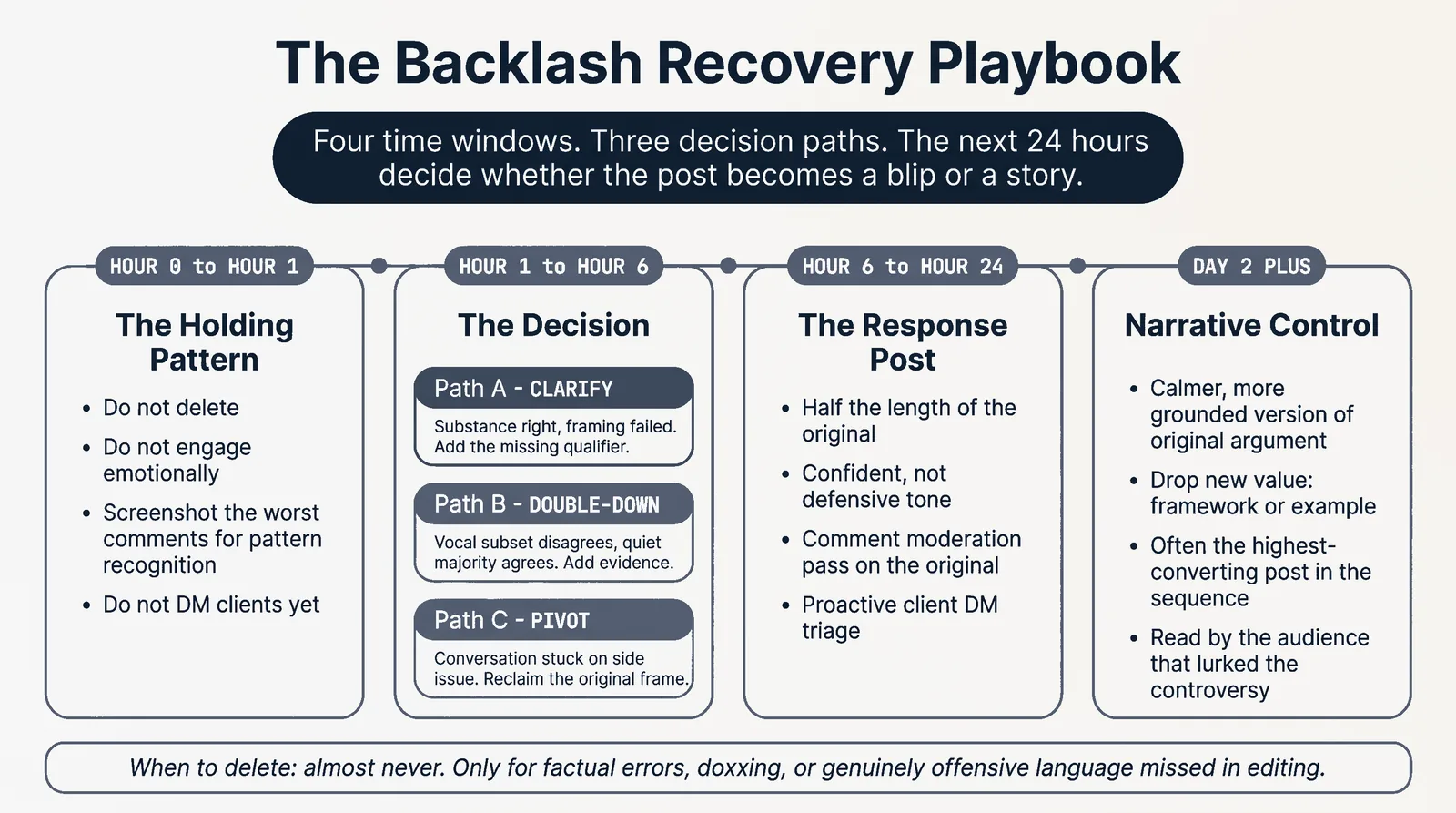
Hour 0 to Hour 1, the holding pattern
Your job in the first hour is to do almost nothing in public and a lot of work in private.
Do not delete. Deleting confirms the post was wrong, removes any shot at controlling the narrative, and creates a "they deleted it after backlash" headline that travels further than the original post would have. The only deletion case is a factual error you cannot defend; in that case, delete and replace with a clarification post inside the hour.
Do not engage emotionally. Every reply you write in the first hour you will want to delete by hour three. The reader cannot hear emotion through pixels; what reads as "I am hurt by the pile-on" lands as "I am defensive". Stay off your own comments for sixty minutes minimum.
Do screenshot the worst comments. Not for replying. For pattern recognition. The comments that hurt the most are usually the ones with the same critique repeated. Identifying the dominant critique takes three minutes once you have ten screenshots in front of you.
Do not dm anyone yet. Especially not clients. Sending a "did you see the post?" DM in the first hour signals panic. If a client raises it themselves, respond with grace. If they have not raised it, do not raise it for them.
Hour 1 to Hour 6, the decision
By hour two you have enough information to choose between three paths.
Path A, clarify. The pile-on is rooted in a misreading of what you actually meant. Either the framing was unclear or a key qualifier was missing. The fix is a follow-up post or pinned comment that adds the qualifier without retreating from the underlying point. Tone is "to be clear, here is what I meant", not "I'm sorry, I misspoke". Use clarify when the substance is right but the wrapper failed.
Path B, double-down. The pile-on is not actually a pile-on. It is a vocal subset that disagrees while a quiet majority agrees. The fix is to escalate by adding the strongest evidence for your original position. Not louder, deeper. Use double-down when you have receipts you did not include in the original and your scoring rubric numbers are still strong.
Path C, pivot the conversation. The post was directionally right but the conversation has gotten stuck on a side issue. The fix is a follow-up that names the side issue, addresses it briefly, and moves the conversation back to the original point with new framing. Use pivot when you are losing the thread and need to reclaim it.
The wrong move at hour 2 is no choice. Three paths, pick one, execute. Indecision shows up as silence and silence at this stage reads as fear.
Hour 6 to Hour 24, the response post
If the situation calls for a response post (Path A or Path C usually do; Path B is more often comments and quote-replies), here is the structure.
The response post is not an apology by default. It is a reframe. Open by acknowledging the conversation has been heated. Name the dominant critique in the words your critics used. Address it honestly, including the parts where they have a point. Restate your core position in tighter language. Close with a forward action. Do not reread the original post in the response; the response should stand alone.
Length: about half the length of the original. Tone: confident, not defensive. Posting time: within twenty-four hours of the original, ideally during your audience's peak window so the response gets pulled by the algorithm to the same audience that saw the original.
While the response post is going up, run a comment moderation pass on the original. Hide nothing that is critical of the take. Hide only personal attacks, slurs, or off-topic spam. Aggressive moderation triggers the visibility downranks I mentioned in Part 1; restraint here is operationally important, not just ethically.
DM triage runs in parallel. Your tier-one and tier-two clients get a short proactive note if the post is touching their industry: "saw the post is generating heat. Wanted to give you a heads up. If anything in it is going to land awkwardly with your team, tell me and I'll handle it." That message has saved me three retainers over two years.
Day 2 and beyond, the narrative-control post
The follow-up two to four days after the original is the post that changes the story. The pile-on has died down, the audience that engaged has moved on, but the algorithm still has memory of who saw the first post. The day-two follow-up reaches a chunk of that same audience with a calmer, more grounded version of the original argument.
Structure: open with a one-line reference to the prior post being heated. Briefly state what you took from the response. Drop a piece of new value, an actual framework or example, that builds on the original premise. Close with a forward action. The day-two post is rarely your highest-engagement post, but it is often the one that converts to inbound, because it is read by the audience that lurked the controversy without participating in it.
When to delete
Almost never. The cases where deletion is the right call:
- The post contains a factual error you cannot correct
- The post names a person without their consent in a way that creates legal exposure
- The post inadvertently outed personal information about a client, employee, or third party
- The post used a slur or genuinely offensive language you missed in editing
In every other case, deletion is worse than holding. The internet remembers screenshots. Deleting after the screenshots circulate adds a "tried to bury it" angle that is harder to recover from than the original heat would have been.
The "doubling down with new info" play
This is the move that has saved more posts of mine than any other. When a Tier 3 or Tier 4 post is generating pushback and your scoring rubric numbers were strong, do not retreat. Add information. Drop a new post that says "the response to yesterday's post has been mixed. Here is the data I did not include in the original because I did not want the post to be three thousand words." Then deliver the receipts.
This works because the doubting audience came to the post with skepticism and left wanting more evidence. You delivering the evidence in a follow-up does two things at once: it converts a slice of the doubters and it positions you as the operator who has more in the chamber. The double-down post often outperforms the original.
The condition: you actually have to have the evidence. If the new post is just louder restatement of the original, the audience will spot it and the recovery becomes the bigger story than the original post.
The tactical apology template
When an apology is genuinely the right move, apologize for HOW the post was framed, not for WHAT you said. "I stand behind the substance and I am sorry the framing made it harder to engage with" is a sentence that holds. "I am sorry I said it" is a sentence that retreats from the position you scored as defensible.
A clean tactical apology:
I want to address yesterday's post.

The response has been heated and I have read every comment.

The substance of the post is something I still believe and would say again. The framing was sharper than it needed to be, and that sharpness pulled the conversation into a fight that was not the point.

I am sorry for the framing. I am not retreating from the point.

The point I was making: [RESTATE IN CALMER LANGUAGE].

The follow-up I should have written first is coming this week. It will go deeper into the data and lighter on the temperature.

Thank you to everyone who engaged seriously, including the people who disagreed. The disagreement was the most useful part of the day for me.
Use this template sparingly. Most heat does not need an apology. Most heat needs a doubling-down or a pivot. Save the apology for the case where the framing genuinely backfired.
The full library has more recovery patterns like this. Adjacent SOPs at the Massive Impact resource library.
Part 8, The Hot Take Hook Vault
Fifty opening lines. Ten per risk tier. Each one a complete first line designed to stop the scroll. Use them as drafts; rewrite to your specifics before publishing.
After the fifty, four platform-specific structural templates showing how to take one hook and reshape it for LinkedIn long-form, X thread, Facebook story-led, and Instagram carousel.
Tier 1 hooks, Strategic Personal Vulnerability (10)
- "I missed payroll once and I am still paying for the lesson three years later."
- "First time I lost a five-figure client I spent the whole night convinced I was finished."
- "I have been quietly losing money on one of my retainers for six months and only just admitted it to myself."
- "The week I had to let my best contractor go is the week I learned what my real margins were."
- "I almost quit the business in the third quarter of my second year. Here is the call that kept me in."
- "My biggest revenue year was also the year I was most miserable. Took me twelve months to understand why."
- "I wrote a public goal in January 2024 and missed it by 60 percent. Here is the post-mortem I have been avoiding."
- "I have been the cheapest provider in my market for two years and I am about to stop. Here is the math I should have run sooner."
- "Three years in and I still get imposter syndrome before every discovery call. Here is what I have learned to do with it."
- "My first agency hire was a disaster and the second one almost was too. The third one stuck. Here is what changed."
Tier 2 hooks, Questioning Cultural Norms (10)
- "Every operator says you should fire your worst client every quarter. I have not fired one in two years and we just had our best one."
- "The 'productize your service' advice was right in 2019 and is wrong for new agencies in 2026."
- "Niching down is the most over-prescribed advice in the agency world. Here is when broad actually wins."
- "Posting daily is not the marketing strategy you think it is. The math actually favors weekly."
- "Outbound is dying for B2B services and the playbook everyone is repeating is at least two years out of date."
- "Webinar funnels were peak in 2022. The format that replaced them is not what most operators are still building."
- "The 'always be selling' frame is costing solo operators their inbound. The reverse is what works now."
- "Lifetime value is the most misused number in agency math. Most of the time it is hiding a worse problem."
- "Most operators stuck at twenty thousand a month do not need more leads. They need fewer offers."
- "The advice to charge more is right and incomplete. The other half nobody tells you is the part that actually moves revenue."
Tier 3 hooks, Contrarian Industry Declarations (10)
- "Cold email is dead for agencies above twenty thousand monthly recurring."
- "Stop running ads to lead magnets. The CAC math broke last year."
- "The retainer model is a trap for operators under fifty thousand monthly recurring revenue."
- "Most marketing courses sold in the last two years are training operators for an internet that no longer exists."
- "Lead magnet funnels are dead for B2B services. Here is what replaced them."
- "The agency-fractional-CMO arbitrage is over. The operators still selling it are coasting on momentum."
- "Most of the AI-content tools sold to agencies are downgrading their margins, not improving them."
- "Group coaching programs above three thousand dollars are mostly sold by operators with no group. Here is how to spot it."
- "The 'community-led growth' wave is a marketing rebrand of churn. Most communities are dying and the operators running them know it."
- "Founder-led sales is the only model that consistently scales for sub-million-dollar agencies. Every other variant I have tested has underperformed it."
Tier 4 hooks, Philosophical Provocations (10)
- "I will not work with founders who treat their team like a renewable resource. Here are three signals I screen for early."
- "The 'hustle until you collapse' identity is a tax most operators are quietly paying."
- "Building a business that depends on your unbroken availability is not entrepreneurship. It is self-employment with extra steps."
- "The operators winning in 2026 are not the most-driven ones. They are the ones with the highest tolerance for boredom."
- "Most of the financial freedom content sold online is selling a version of freedom that nobody who has it actually lives."
- "I have stopped chasing the founders the rest of the industry is chasing. The math on staying away is better than the math on competing."
- "The 'eat what you kill' culture is producing operators who cannot survive a slow quarter. The cost compounds."
- "Building in public is overrated and selectively visible. Most of the operators doing it are hiding more than they show."
- "The mindset content economy is mostly a tax on the audience that needed practical help."
- "If your business model only works at maximum effort, you do not have a business. You have a job that owns you."
Tier 5 hooks, Direct Audience Challenges (10)
- "You say you want consistent inbound and you have published twice this month. Pick a side."
- "If you cannot name your top three lead sources from memory, you do not have a marketing strategy."
- "Stop blaming the algorithm for posts you put zero thought into."
- "You are negotiating against yourself in your pricing. The buyer has not even pushed back yet."
- "You complain about lazy junior hires while you ghost the senior candidates who are actually applying."
- "If you have read three books on systems and built none, you do not have a systems problem. You have a follow-through problem."
- "Your client is leaving because you stopped being interesting to them in month four. Be honest about it."
- "Your discovery calls are too long because you are using them to feel needed, not to qualify."
- "If your last five marketing experiments all failed, the experiments are not the problem. Your hypothesis is."
- "You have rewritten your home page nine times in two years. Your home page is not the bottleneck."
That is fifty. Pull the ones that fit your work, rewrite them in your specifics, and route them through the rubric in Part 4 before publishing. The hooks are starters, not scripts.
Platform-specific structural templates
LinkedIn long-form (one post, 1,500 to 2,500 characters)
Structure:
- Hook (one line, isolated)
- Story or example (3 to 5 lines)
- The principle, named
- Three numbered insights or supporting points
- The takeaway in one line
- The forward CTA (a question or invitation, not a link)
LinkedIn favors substance over speed. The structure earns trust by showing the work behind the take. Comments are where conversion happens; the post sets the table for the conversation in the comments.
X thread (5 to 9 tweets)
Structure:
- Tweet 1: the hook, isolated, the punchiest version
- Tweet 2: the stake (why this matters, in two lines)
- Tweets 3 to 6: the substance, one beat per tweet
- Tweet 7 or 8: the twist or contrarian frame
- Tweet 9: the close, with a low-friction CTA (reply, like, bookmark)
X favors velocity and quote-tweet bait. Each tweet has to land on its own. Tweet one wins or loses the thread.
Facebook story-led (single post, 600 to 1,200 characters)
Structure:
- Open with a moment in time or scene ("Tuesday morning. I was on my second coffee...")
- The conflict in two to three lines
- The turning point
- The lesson or insight
- A direct address to the reader
- An open-ended question to drive comments
Facebook favors emotional resonance and comment threads from the existing follower base. The story-led shape outperforms list-led shapes consistently in my testing.
Instagram carousel (8 to 10 slides)
Structure:
- Slide 1: the hook, big text, no body copy
- Slide 2: the stake or context
- Slides 3 to 7: the substance, one idea per slide, scannable
- Slide 8: the principle or takeaway, isolated
- Slide 9: a CTA slide (save, share, follow, link in bio)
- Slide 10 (optional): a "what to read next" or related-post pointer
Instagram rewards swipe completion. Every slide needs to earn the swipe. The hook on slide one is doing more work here than on any other platform; if slide two is weak, the swipe ratio drops and the algorithm cools the post inside the first hour.
The same hook ("Cold email is dead for agencies above twenty thousand monthly recurring") becomes a thoughtful LinkedIn post, a sharp X thread, an emotional Facebook story about the post that proved it to you, and a scannable Instagram carousel of the new playbook. Same idea, four shapes, one calendar.
The rest of the Massive Impact library builds on patterns like this. See the full set at the Massive Impact resource library.
What to read next
Adjacent playbooks in the Massive Impact library:
- The 'Just Enough' Trap (P32) for the operator mistakes that produce safe, forgettable content.
- 200 Headlines, 14 Formulas, 7 Platforms (P33) for the headline craft that makes any of these hooks land harder.
- The Client Recovery SOP For Agencies (P35) for what to do when the post that filtered the audience also lost you a client.
- The Multi-Agent Playbook (P09) for the AI workflows that draft, score, and publish all of the above without losing the human voice.
The full library: the Massive Impact resource library. New playbooks ship monthly.
The rest of the guide is yours, free.
Enter your email to keep reading and get the PDF to keep.
No spam. One email unlocks every Massive Impact resource.
“You work with the clients to make it happen, and you like seeing the product at the end rather than your own benefit.”
More from the library
