

PLAYBOOK / COPYWRITING
200 Headlines, 14 Formulas
14 named headline formulas (Caples through 2026), 200+ swipe-ready headlines sorted by goal, per-platform recipes for the 7 places headlines actually live, a 100-point scoring rubric that beats CoSchedule, and 50 famous historical headlines decoded with the modern adaptation already written.
14 named headline formulas (Caples through 2026), 200+ swipe-ready headlines sorted by goal, per-platform recipes for the 7 places headlines actually live, a 100-point scoring rubric that beats CoSchedule, and 50 famous historical headlines decoded with the modern adaptation already written.
Who this is for
Copywriters, marketers, founders, and content operators who write headlines every week. If you ship Facebook ads, YouTube thumbnails, email subject lines, sales page heroes, blog titles, Google RSAs, or LinkedIn posts, this is the playbook you keep open while you write.
This is not a survey of headline theory. It is a working toolkit. Every part is built so you can land on it on the day you need it, lift the formula or swipe, customize it in two minutes, and ship.
Eight parts. Hit the part you need on the day you need it.
Brought to you by Massive Impact. Massive Impact is a free lead magnet library for founders, marketers, and operators. Playbooks, prompts, frameworks, and checklists at the Massive Impact resource library. Browse the full set at the Massive Impact resource library.
What is in this playbook
- Part 1, The Headline Reality in 2026
- Part 2, The 14 Headline Formulas
- Part 3, Per-Platform Headline Recipes
- Part 4, The 200-Swipe Headline Vault
- Part 5, The Power Words Bank
- Part 6, The Headline Scoring Rubric
- Part 7, A/B Testing Methodology and Real Patterns
- Part 8, 50 Famous Historical Headlines Decoded
Part 1, The Headline Reality in 2026
I have written somewhere north of 4,000 headlines for paid ads, organic posts, sales pages, email broadcasts, and YouTube thumbnails over the last decade. Most of them were mediocre. The ones that were not mediocre paid for almost everything else I have built. That is the case for the headline being the highest-impact character on every page.
Five times more people read your headline than read your body copy. Ogilvy said that in 1963 and the data has not moved. What has moved is everything downstream. CTR benchmarks per platform, character limits per surface, the patterns that win on Facebook in 2026 versus the patterns that won in 2018. The headline as a craft has not changed. The medium has.
Here is the current state of play.
CTR and open-rate benchmarks per platform, 2026
| Platform | Metric | Average | Strong | Top 10% |
|---|---|---|---|---|
| Facebook ad | CTR (link) | 1.0 to 1.5% | 2.0% | 3.5%+ |
| YouTube video | CTR (impressions) | 3 to 4% | 5%+ | 8 to 10% |
| YouTube suggested | CTR | 9.5% | 12% | 15%+ |
| Email (B2C) | Open rate | 25 to 30% | 40% | 50%+ |
| Email (B2B cold) | Open rate | 25 to 45% | 50% | 65%+ |
| Email (warm list) | Open rate | 30 to 42% | 50% | 60%+ |
| Google RSA | CTR (search) | 3 to 6% | 8% | 12%+ |
| LinkedIn post | CTR (cold) | 0.5 to 1.0% | 2% | 3%+ |
| Landing page | Conversion | 4 to 6.6% (median) | 10%+ | 20%+ |
(Sources composited from Unbounce Q4 2024, Instantly 2026 cold email report, Humble&Brag YouTube benchmarks, Mailwarm 2026, Foundry CRO 2026, Adsuploader Meta specs.)
A few things stand out.
First, the headline is responsible for around 50% of YouTube CTR. The thumbnail is the other 50%. On every other surface (email, ads, landing pages, search), the headline is responsible for somewhere between 70% and 90% of whether the click happens at all. Body copy matters once they are in. The headline decides whether they ever are.
Second, the gap between average and top 10% on every platform is roughly 3x to 5x. That gap is not talent. It is process. The operators in the top decile are running the same 14 formulas, scoring against a rubric, and A/B testing 5+ variants per ship. Most operators ship the first headline that comes out of their head.
Third, AI-generated headlines are now beating human-written ones on average CTR (+27% in a 2026 benchmark study). The catch: AI generates 80 mediocre headlines and 20 strong ones, and humans pick the strong ones. The winning workflow in 2026 is generate-with-AI, score-with-rubric, ship the top two to A/B. Not generate-and-ship.
The 8-second-attention-span myth
You have probably heard the line that human attention span is now 8 seconds, shorter than a goldfish. The number traces back to a Microsoft Canada report that was misquoted, then misquoted again, until it became a stat everyone repeats and nobody sourced.
The honest version is this: people give your headline somewhere between half a second and two seconds. If the first three words do not earn the next three, they are gone. Not because attention spans collapsed. Because there are now hundreds of competing headlines on every screen they scan.
The implication for you: the first three to five words of every headline have to do disproportionate work. Specificity, curiosity, or a direct address to the reader. Not "discover," not "unleash," not "the ultimate guide to."
One paragraph of theory was enough. Now the formulas.
The rest of the Massive Impact library builds on patterns like this. See the full set at the Massive Impact resource library.
Part 2, The 14 Headline Formulas
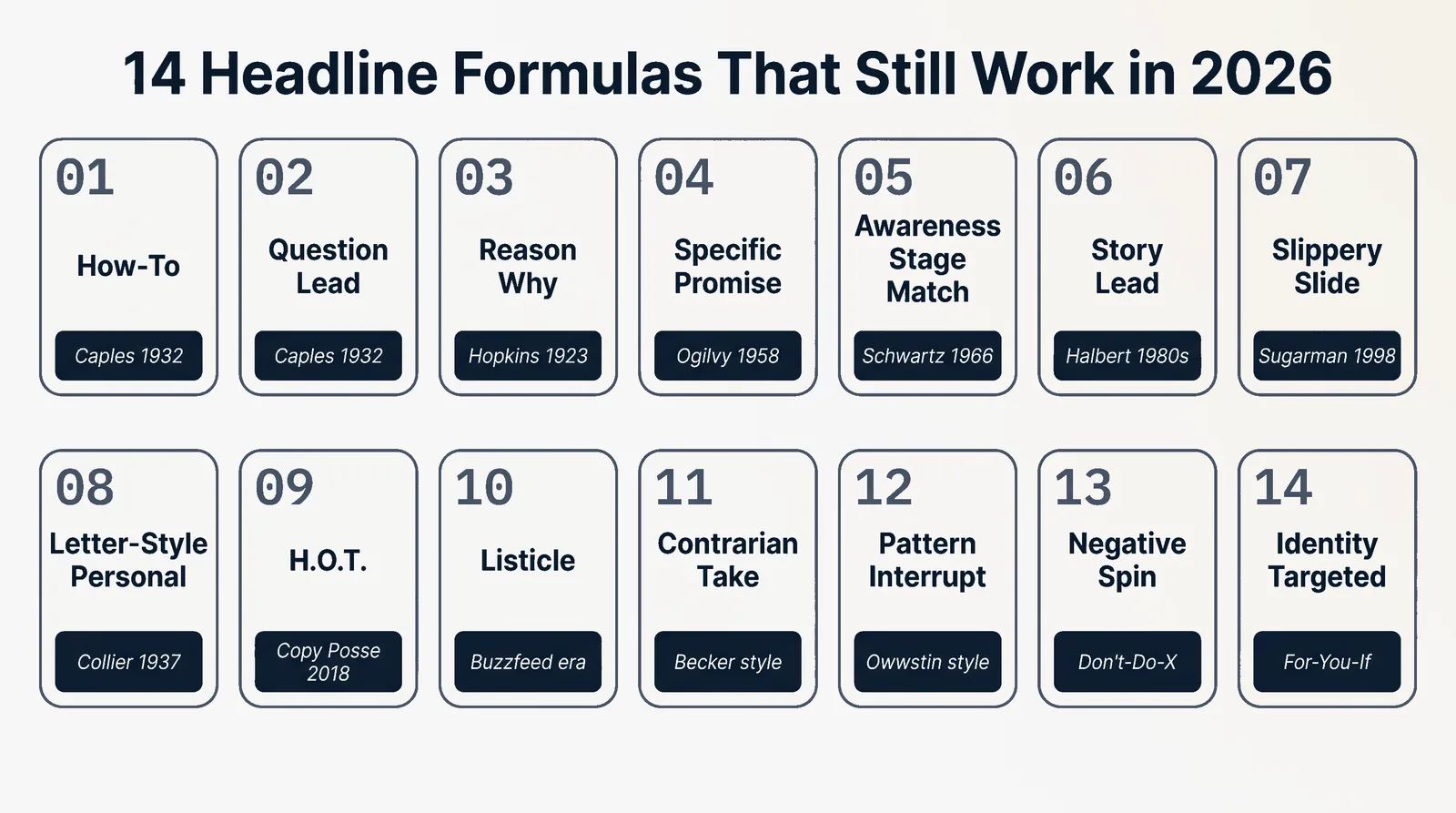
These are the 14 formulas I rotate through when I have to ship copy under pressure. Seven are classics from the canon (Caples, Ogilvy, Schwartz, Halbert, Sugarman, Collier, Hopkins). Seven are modern frames born of the social and SEO era (Listicle, Contrarian, Pattern Interrupt, Negative Spin, Time-Bound, Identity-Targeted, Awareness Mismatch).
For each formula you get: name, origin, fill-in-the-blank shape, 5 to 10 worked examples across niches, and a one-line rule for when to use it versus when to skip it.
Formula 1, The How-To (Caples)
Origin: John Caples, "Tested Advertising Methods" (1932). Possibly the most A/B tested formula in the history of direct response.
Shape: How to [achieve specific outcome] [in specific timeframe or without specific pain].
Examples:
- How to Write Cold Emails That Get a 40% Reply Rate in Under an Hour
- How to Lose 12 Pounds in 8 Weeks Without Cutting Carbs
- How to Book 30 Whitening Consults a Month for a Solo Dental Practice
- How to Negotiate a 25% Raise in One Conversation Without Sounding Pushy
- How to Set Up Google Analytics 4 in Under 20 Minutes (Even if GA Hates You)
- How to Onboard a New Hire in One Week Without Burning Yourself Out
- How to Get Your First 1,000 Email Subscribers Without Paid Ads
Use when: the outcome is concrete, the audience is solution-aware, and the timeframe is short enough to feel possible. Skip when: you cannot name a specific outcome or specific timeframe. The formula collapses into "How to be successful" if you cannot.
Formula 2, The Question (Caples / Cody)
Origin: John Caples, refined by Sherwin Cody's 1919 piano-lesson run with the headline "Do You Make These Mistakes In English?". One of the longest-running ads in American history (40 years).
Shape: Do you [make this mistake / face this fear / have this problem]?
Examples:
- Do You Make These Mistakes With Your Email Subject Lines?
- Are Your Facebook Ads Burning $200 a Day on Audiences That Will Never Buy?
- Have You Ever Caught Yourself Lowering Your Price Mid-Sales-Call?
- Do You Still Write Cold Emails Like It Is 2018?
- Why Does Your Sales Page Convert at 1.2% While Your Competitor Converts at 9%?
- Are You Reporting On Clicks While Your Client Pays For Conversions?
- Do You Spend More on Software Than On Outreach?
Use when: your audience would say yes to the question. The Cody insight: a yes answer hooks them into reading the body to learn the fix. Skip when: the answer is obviously no, or worse, "I do not know." Then the question becomes a Betteridge headline (any headline that ends in a question mark is one whose answer is probably no), and you lose them.
Formula 3, The Reason-Why (Hopkins)
Origin: Claude Hopkins, "Scientific Advertising" (1923). The reason-why frame insists that the headline names the specific mechanism the reader will get if they read further.
Shape: [Number] reasons [audience] [outcome] (and the [specific reason / mechanism] that does the work).
Examples:
- 5 Reasons Solo Agencies Stall at $15K (and the Pricing Move That Breaks the Plateau)
- 7 Reasons Your Cold Email Lands in Spam (and the One Header Fix That Pulls It Back)
- 3 Reasons Most Lead Magnets Convert Below 10% (and the Hook Move That Lifts You Past 30%)
- 9 Reasons Your YouTube CTR Is Stuck at 2% (and the Thumbnail Test That Doubles It)
- 4 Reasons Course Launches Flatline at $20K (and the Scarcity Frame That Pushes Past $80K)
- 6 Reasons B2B Sales Cycles Stretch to 90 Days (and the Discovery-Call Question That Cuts It to 30)
Use when: you can name a specific mechanism. The "and the X that does the work" clause is what makes the headline land; without it, you are running a generic listicle. Skip when: you do not actually know the mechanism. Generic reason-why headlines feel hollow.
Formula 4, The Specific Promise (Ogilvy)
Origin: David Ogilvy. The famous example: "At 60 Miles an Hour the Loudest Noise in this New Rolls-Royce Comes From the Electric Clock" (1958). The headline doubled Rolls-Royce's American sales in a year.
Shape: [Specific concrete detail] that proves [the larger claim].
Examples:
- The Cold Email That Booked 38 Discovery Calls in 30 Days (Subject Line Inside)
- The 9-Word Subject Line That Gets a 71% Open Rate on a Cold List
- The Onboarding SOP That Cut Our Client Churn From 22% to 4%
- The Sales Page Hero That Lifted Conversion From 1.4% to 6.8% on the Same Traffic
- The 14-Second TikTok Hook That Pulled 11 Million Views From a Standing Start
- The Pricing Page Tweak That Doubled Our Average Contract Value (No Code, Just Copy)
Use when: you have one specific, almost weirdly precise detail that telegraphs the whole story. The detail does the heavy lifting. Skip when: you are tempted to say "thousands of dollars" or "huge results" instead of naming the actual number. The Ogilvy frame breaks the moment you generalize.
Formula 5, The Awareness-Stage Match (Schwartz)
Origin: Eugene Schwartz, "Breakthrough Advertising" (1966). Schwartz's five awareness stages: Unaware, Problem-Aware, Solution-Aware, Product-Aware, Most-Aware. The headline's job is to match the stage.
Shape (varies by stage):
- Unaware: [Big provocative claim] (no product mention, no problem name)
- Problem-Aware: [Name the problem precisely]
- Solution-Aware: [Name the category of solution and the specific outcome]
- Product-Aware: [Name your product and the specific advantage]
- Most-Aware: [Name your product, the offer, and the deal]
Examples (one per stage):
- Unaware: Why the Best Year of Your Career Probably Starts at 4 a.m.
- Problem-Aware: Your Sales Page Converts at 1.4%. Mine Used to. Here Is What Changed.
- Solution-Aware: The Best Cold Email Tools for Reply Rates Above 30% (Honest Comparison)
- Product-Aware: Why Smartlead Still Beats Instantly for B2B Sequences in 2026
- Most-Aware: Smartlead Pro for $97/mo (Locked Until Friday)
Use when: you know exactly which stage your traffic is in. Cold paid traffic is usually Unaware or Problem-Aware. SEO search traffic is usually Solution-Aware or Product-Aware. Email broadcasts to your own list usually live in Product-Aware or Most-Aware. Skip when: you do not know your traffic source. Match-the-stage breaks if you guess wrong.
Formula 6, The Curiosity Gap (Halbert)
Origin: Gary Halbert. The Halbert formula: tease the answer hard enough that the reader cannot leave without finding out. Modern descendants: Buzzfeed, Upworthy, the entire YouTube ecosystem.
Shape: [Hint at the unexpected outcome] [without revealing the mechanism].
Examples:
- The Weird Email Subject Line That Gets Opened More Than "URGENT"
- What Happened When We Cut Our Welcome Sequence From 7 Emails To 1
- The One-Sentence Tweak to Our Sales Page That Doubled Trial Signups Overnight
- The Strange Reason Most Course Refunds Come From Buyers Who Never Watched a Lesson
- Why I Killed Our Best-Performing Lead Magnet Last Tuesday
- The Pricing Page Question We Asked That Killed 60% of Bad Trials Before They Started
Use when: the answer behind the curiosity is genuinely surprising. Halbert was emphatic about this: if the body delivers a boring answer, the gap headline burns the relationship. Skip when: the answer is obvious. The gap collapses on click.
Formula 7, The Slippery Slide (Sugarman)
Origin: Joe Sugarman, "The Adweek Copywriting Handbook." Sugarman's rule: the sole purpose of the first sentence is to get them to read the second sentence. The headline opens the slide.
Shape: [Short, intriguing, almost trivial-feeling first line that creates a pull to the next].
Examples:
- I Almost Did Not Send This Email.
- The Mistake Was Not What I Thought It Was.
- A $40,000 Lesson Wrapped In A Single Slack Message.
- I Bought The Course. Here Is What I Actually Got.
- One Question Saved My Agency Last Quarter. I Want To Tell You What It Was.
- The Sentence That Made My Wife Look Up From Her Phone.
Use when: you are writing email subject lines, sales pages, or long-form posts where the headline's only job is to earn the next line. Skip when: you need the headline to communicate the offer, the price, the deadline, or the niche. The slippery slide intentionally tells you almost nothing. That is the point.
Formula 8, The Letter-Style Personal (Collier)
Origin: Robert Collier, "The Robert Collier Letter Book" (1931). The letter-style headline reads like the start of a personal letter from a friend, not an ad.
Shape: [Direct, conversational opener that sounds like the start of a letter, addressed to one person].
Examples:
- Are You Still Thinking About Quitting Your Job This Year?
- I Have Been Watching Your Newsletter Grow. Here Is What I Notice.
- This Is The Last Email You Will Get From Me About The Course.
- I Need To Tell You About A Mistake I Almost Made.
- You Asked Me Three Weeks Ago About Pricing. Here Is The Honest Answer.
- I Wrote This Right After A Sales Call I Lost. You Will Want To Read It.
Use when: you are writing email broadcasts to a warm list, or a long-form sales page where the body is genuinely conversational. Skip when: you are running cold paid traffic. The letter-style headline only works on people who already know your voice.
Formula 9, The Listicle (Buzzfeed / Upworthy / SEO era)
Origin: Buzzfeed pioneered the modern listicle in 2006-2010. Upworthy operationalized it (every Upworthy post had 25 A/B-tested headline variants). Now the dominant format on blogs, LinkedIn carousels, and YouTube long-form.
Shape: [Number] [Power adjective] [Things / ways / tools / mistakes] [target audience] [should know / use / avoid] [outcome modifier].
Examples:
- 9 Cold Email Tools Every B2B Founder Should Test in 2026
- 21 Sales Page Mistakes That Kill Conversion (and the Fix For Each)
- 13 Hooks That Worked For Our Ads Last Month (Ranked by ROAS)
- 11 LinkedIn Posts That Each Pulled 100K+ Views (Decoded)
- 8 Pricing Page Templates That Beat the Default Stripe Layout
- 25 Subject Lines For SaaS Trial-To-Paid Conversion Sequences
Use when: the audience is scanning, the topic is researchable, and the value is in breadth. Odd numbers (3, 5, 7, 9, 11) generally outperform even numbers (the Talked About Marketing analysis is the cleanest source on this). Skip when: the value is in one deep insight, not a list. A list of 13 mediocre items beats a list of 4 strong items in click-through, and loses on read-through. Pick your battle.
Formula 10, The Contrarian Take (Becker / Owwstin)
Origin: Modern social era. Alex Becker's Twitter / Facebook posting style ("Unpopular opinion: ...") and Owwstin's mic-drop style codified this for the algorithm-driven feed.
Shape: [Contrarian or controversial claim that contradicts the conventional wisdom].
Examples:
- Most Cold Email "Best Practices" Are Quietly Killing Your Reply Rate
- SEO Is Not Dead. SEO Agencies Selling 2018 Tactics Are.
- Your Sales Page Does Not Need More Testimonials. It Needs A Better Hook.
- The "Personalize Everything" Cold Email Advice Is Wrong (Here Is The Data)
- Stop A/B Testing Button Color. Start A/B Testing The Hero Headline.
- Most Lead Magnets Are Built To Be Downloaded, Not Read. That Is The Bug.
Use when: you have a real position you can defend with data or experience. Skip when: you are being contrarian for the sake of clicks. The audience smells it instantly, and the platform punishes the next post.
Formula 11, The Pattern Interrupt (Owwstin / TikTok era)
Origin: Modern social. Owwstin's punchy style and the TikTok hook-or-die first second pushed this format into mainstream copy.
Shape: [Short, surprising, almost-non-sequitur statement that breaks the scroll rhythm].
Examples:
- Stop Writing Subject Lines. Start Writing Promises.
- Your Pricing Page Is The Headline.
- Most Founders Cannot Sell.
- Headlines Are Not Copy. They Are Bets.
- The Best Ad I Ever Wrote Took 12 Minutes.
- Do Not Hire A Copywriter. Hire A Headline Operator.
Use when: you need to stop the scroll on a fast feed (LinkedIn, Facebook organic, TikTok). Skip when: the surface allows for length. Pattern interrupts are weak in email subject lines (where they read as cryptic) and on Google Ads (where they ignore search intent).
Formula 12, The Negative Spin (Don't / Stop / Avoid)
Origin: Pre-classical (Hopkins used it in the 1920s, Halbert leaned on it heavily in the direct mail era). Modern data: negative-framed headlines outperform positive-framed by ~30% on average CTR (UPWORTHY/Nature study, 2026).
Shape: [Don't / Stop / Avoid] [common action] [until / unless / before] [specific qualifier].
Examples:
- Don't Send Another Cold Email Until You Read This
- Stop Hiring Generalist Copywriters Before Your Niche Is Locked
- Don't Launch The Course Before You Run The Free Workshop First
- Avoid The Top 3 Pricing Pages You Have Bookmarked. Here Is Why.
- Stop A/B Testing Until You Have Read The 90-Minute Statistical-Significance Guide
- Don't Discount Your Retainer. Bundle The Out-Of-Scope Work Instead.
Use when: the audience is about to make a mistake you can name. The negative frame triggers loss aversion (pre-loss feels worse than equal-magnitude gain). Skip when: you are stacking too many negative-framed headlines in a row. The pattern reads as sour after the second one.
Formula 13, The Time-Bound (Today / Now / Before)
Origin: Direct response classics (Halbert, Caples). Modern: every product launch, every webinar registration, every flash sale.
Shape: [Outcome] [today / this week / before X date / in the next Y minutes].
Examples:
- Get Your First Cold Email Reply By Friday
- The 7-Day Plan To Cut Your Email Send Time In Half
- Build Your First Lead Magnet This Weekend (Even If You Are Not A Designer)
- Lock In The 2025 Pricing Before Monday Midnight
- Run Your First Profitable Facebook Ad Before The End Of The Month
- The 90-Minute Sales Page Audit Every Founder Should Run Tonight
Use when: the outcome is genuinely achievable inside the timeframe (or you can defensibly claim it is). Skip when: the timeframe is invented. "Today" headlines lose trust fast if the body says "in 6 to 9 months."
Formula 14, The Identity-Targeted (For [Specific Person])
Origin: Eugene Schwartz's identification technique, modernized by every niche-defining ad of the 2010s and 2020s ("For freelancers who...", "For B2B founders selling to...").
Shape: For [specific identity / role / situation]: [outcome they want].
Examples:
- For Solo Agency Owners Stuck At $10K/mo: The 90-Day Plan To Hit $30K
- For B2B SaaS Founders Selling To Procurement: A Cold Email Template That Survives The Filter
- For Course Creators Who Have Tried Three Launches: The Pre-Launch Survey That Doubles Conversion
- For Ecommerce Brands With $500K ARR: The Email Flow That Adds 15% In 60 Days
- For Freelance Designers Who Hate Discovery Calls: The 6-Question Async Intake That Replaces Them
- For Ad Buyers Tired Of Meta's Black-Box Reporting: A 4-Tab Sheet That Actually Tells The Truth
Use when: your audience is genuinely narrow and you are willing to lose 90% of the market to land the 10% who fit perfectly. Skip when: your audience is broad. "For everyone who wants more sales" is not identity-targeted; it is fluff.
The rest of the Massive Impact library builds on patterns like this. See the full set at the Massive Impact resource library.
Part 3, Per-Platform Headline Recipes
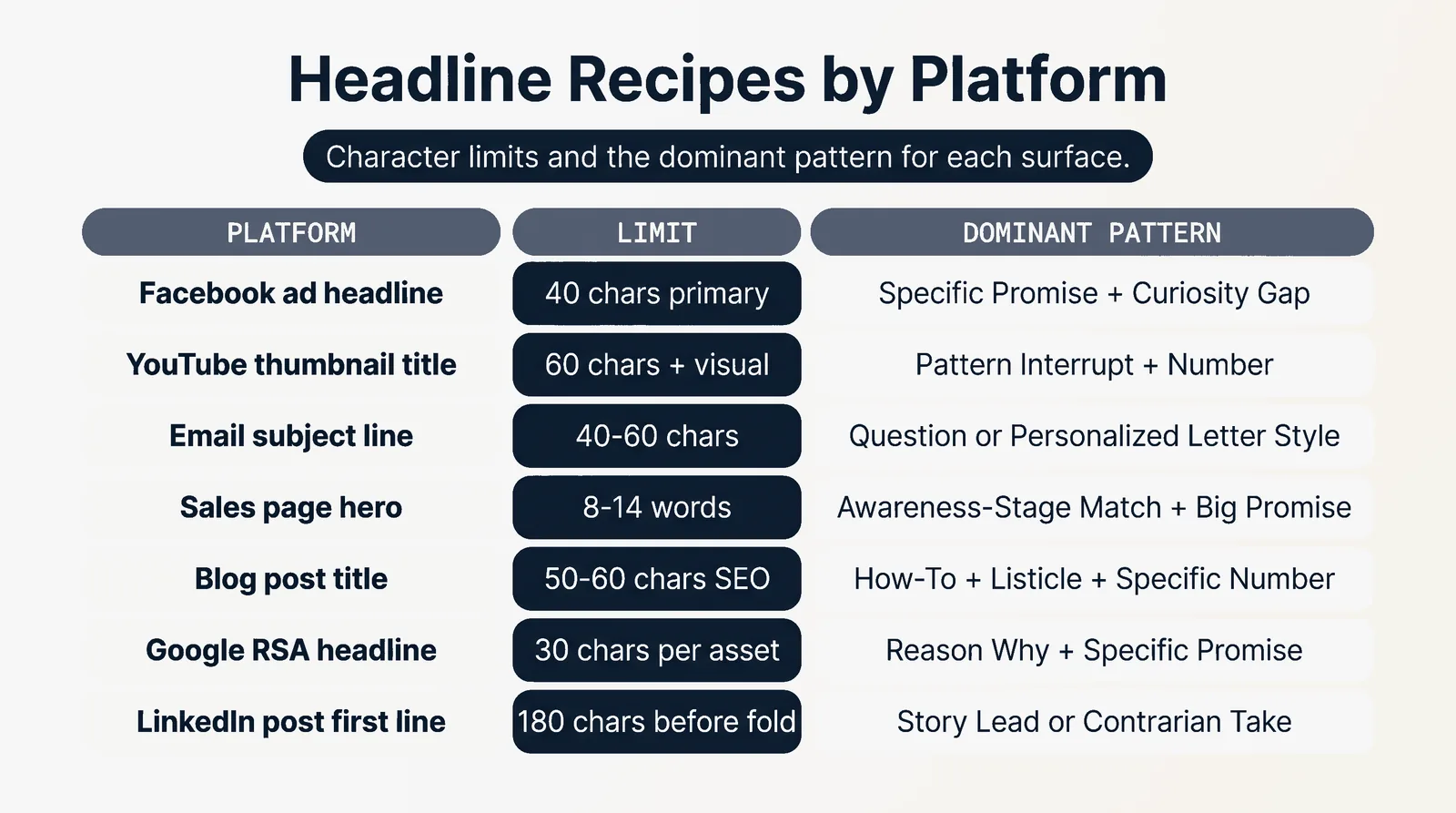
The same formula does not produce the same headline across platforms. Character limits, voice, the role of the surrounding visual, and the user's intent all shift. This part gives you the exact recipe per platform.
3.1, Facebook Ad Headline (40-character primary)
Specs: Headline field caps at 40 characters before truncation (Meta's recommendation). Primary text at 125 visible characters. Description at 30 characters.
Voice: Outcome-led, sentence case (sentence case ads outperform title case in Optmyzr's 2026 RSA study, and the same pattern holds on Meta), specific.
The 40-character constraint forces you to:
- Lead with the outcome, not the brand.
- Cut every adjective that does not move the meaning.
- Skip the verb if you can ("38 calls in 30 days" beats "Get 38 calls in 30 days").
Examples (worked under 40 chars):
- 38 dental consults a month, paid Meta ads (39)
- The cold email kit that gets 71% opens (38)
- $9 funnel that beats your $97 funnel (36)
- For B2B founders: 30 calls/week (31)
- Stop ad fatigue in 30 days (26)
- The retainer pitch that closes in 1 call (39)
- Trial-to-paid lift, no copy rewrite (34)
Skip these on Facebook ads: generic "discover" / "unlock" / "ultimate" headlines. The Adsuploader 2026 audit of 752,626 Meta ads found 5-word ad headlines and 19-word body copy as the median high-performer. Anything longer in the headline gets truncated, anything shorter loses the outcome.
3.2, YouTube Thumbnail Title (60 chars + visual integration)
Specs: Up to 100 chars technically, but 60 is the cutoff before mobile truncates. The title is responsible for ~50% of CTR (the thumbnail handles the other 50%). Brackets and parentheticals at the end (e.g., "(Step-by-Step)" or "[2026 Update]") are a reliable CTR booster (Subsub.io 2026 study).
Voice: Curiosity-led, specific number + payoff, parenthetical CTR booster at the end.
Examples (worked under 60 chars):
- I Tried 12 Cold Email Tools (One Beat Smartlead)
- The 9-Word Subject Line That Gets 71% Opens (Tested)
- $40K Course Launch In 11 Days (Full Funnel Breakdown)
- Why I Fired My Best Client (Honest Numbers)
- The Sales Page Hook That Doubled Our Conversion (Swipe)
- 7 Lead Magnets I Built In One Day (Ranked By Opt-In)
- I Spent $5K On Facebook Ads So You Don't Have To
Skip these on YouTube thumbnails: title-case-everything (Optmyzr data shows sentence case wins), all-caps screaming, and headlines that fight the thumbnail visual. The thumbnail-title pair is one piece of copy. If they say the same thing, you have wasted half. If they say complementary things, you stack the curiosity.
3.3, Email Subject Line (40-60 chars)
Specs: Most email clients (Gmail mobile, Outlook mobile) truncate at around 40 characters. iOS Mail shows about 60. Above 60 is dead weight.
Voice: Personal, conversational, no marketing jargon. The Cody insight: subject lines that read like a personal email from a friend out-perform branded broadcasts by 2x to 3x.
Examples (worked under 60 chars):
- Quick question about your pricing page (37)
- I almost did not send this (26)
- Re: the question you asked on Tuesday (38)
- The cold email I would not send to you (38)
- One number from yesterday's report (32)
- Bad news + a small fix (22)
- The pricing decision I am wrestling with (40)
- This is the last email about the workshop (41)
- Forward this to your designer (29)
- A confession about our last launch (34)
Skip these in subject lines: all-caps, multiple exclamation marks, the word "FREE" in caps (deliverability hit), and anything that smells like a brand broadcast. The Optimonster 2026 reddit thread (4-step A/B test sequence) confirmed: direct statements beat questions for B2B subject lines, and questions beat statements for B2C subject lines. Adjust by audience.
3.4, Sales Page Hero (8-14 words)
Specs: 8 to 14 words is the median high-converting range. Under 44 characters, ideally. The hero headline is responsible for ~80% of whether the visitor scrolls.
Voice: Outcome-promise, specific, message-matched to the ad or email that brought them. The single biggest conversion lever on the page (Replo 2026, multiple sources).
Examples (worked at 8-14 words):
- The cold email kit that books 38 discovery calls a month, on autopilot (13)
- A 7-day plan to cut your email send time in half (12)
- The $9 funnel that beats your $97 funnel on every metric (11)
- 200 swipe-ready headlines, 14 formulas, 7 platforms, one playbook (10)
- For solo agency owners stuck at $10K: the 90-day plan to hit $30K (14)
- The sales page hero that lifted our conversion from 1.4% to 6.8% (12)
- Stop guessing at headlines, start scoring them out of 100 (10)
Skip these in sales page heroes: headlines that bury the outcome inside an adjective ("The amazing tool that..."), headlines longer than 14 words (the eye gives up), and headlines that do not match the ad they came from. Message-match lifts conversion by 15% on its own (Digital Applied 2026).
3.5, Blog Post Title (50-60 chars for SEO)
Specs: Google truncates at around 60 characters. Below 50 is fine; above 60 gets the dot-dot-dot. The blog title is your CTR multiplier on every search result.
Voice: SEO-clear (the keyword in the first 5 words), curiosity at the end, listicle or how-to format if you can.
Examples (worked under 60 chars):
- 14 Headline Formulas That Beat ChatGPT in 2026 (52)
- How to Write a Sales Page Hero in Under 30 Minutes (51)
- The Cold Email Reply Rate Benchmark Nobody Cites (49)
- 200 Swipe Headlines, Ranked by Goal (35)
- Why Most Lead Magnets Convert Below 10% (39)
- The 9-Word Subject Line That Gets 71% Opens (43)
- A 30-Minute Headline Workflow That Beats Your Agency's (53)
Skip these in blog titles: keyword-stuffed nonsense ("Best Headline Formulas | Top Headlines | 2026 Headlines Guide"), brand-led titles ("WelcomeToMyBlog: A Comprehensive Look At..."), and titles that do not promise something specific. SEO and CTR pull in the same direction more often than not in 2026.
3.6, Google RSA Headline (30 chars per asset)
Specs: Up to 15 headlines per ad, each capped at 30 characters. Up to 4 descriptions at 90 chars. Google now reports per-asset CTR and conversion (rolled out late 2025). Sentence case wins (Optmyzr 2026 study).
Voice: Direct match to the search query, outcome-led, specific.
Examples (worked under 30 chars per line):
- 38 dental consults/month (24)
- Paid ads for solo dentists (26)
- 71% cold email open rate (24)
- $9 swipe vault, 200 hooks (25)
- Trial-to-paid +18% lift (23)
- Sales page audit in 90 min (26)
- Score headlines out of 100 (26)
- For B2B founders only (21)
Skip these on Google RSA: title-case-everything (reduces CTR per Optmyzr's analysis of millions of ads), pinning every headline (eliminates the RSA advantage), and writing 15 versions of the same headline (the system has no signal to test). Mix formulas: 2 outcome headlines, 2 audience-targeted headlines, 2 question headlines, 2 contrarian headlines, 2 numbers-led, plus a few brand and offer variants.
3.7, LinkedIn Post First Line (180 chars before truncation)
Specs: LinkedIn truncates the post at around 180 characters with a "...see more" link. The first 180 characters are your headline. Profile headline cap is 220 characters (separate field, not the post first line).
Voice: Direct, opinionated, specific. The LinkedIn algorithm rewards posts that generate meaningful comments, not just likes. Your first line decides whether they expand.
Examples (worked under 180 chars):
- I have written 4,000+ headlines for paid ads, sales pages, and emails. Most of them were mediocre. The ones that were not paid for almost everything else I have built. Here is the workflow.
- Most cold email "best practices" are quietly killing your reply rate. I tested 12 of them on a 50K-list. 8 lost. 3 broke even. 1 lifted reply rate by 31%. Here is which one.
- The pricing decision I almost got wrong cost me 3 retainers in Q1. I want to walk you through the math, the call I should have had, and the policy that prevents it now.
- Stop hiring generalist copywriters before your niche is locked. I learned this the slow way after burning $14K on three writers in a year. Here is the order I would do it in.
- I fired my best-paying client last week. I want to tell you why, and what I am replacing them with. The math is uglier than I thought it would be, and I am not sorry I did it.
Skip these on LinkedIn: corporate jargon, "I am thrilled to announce" openers, hashtag stacks, and headlines that do not earn the click. The "see more" expand is your conversion event. Earn it.
A library of platform-by-platform copy patterns is the next layer up. See the Massive Impact set at the Massive Impact resource library.
Part 4, The 200-Swipe Headline Vault
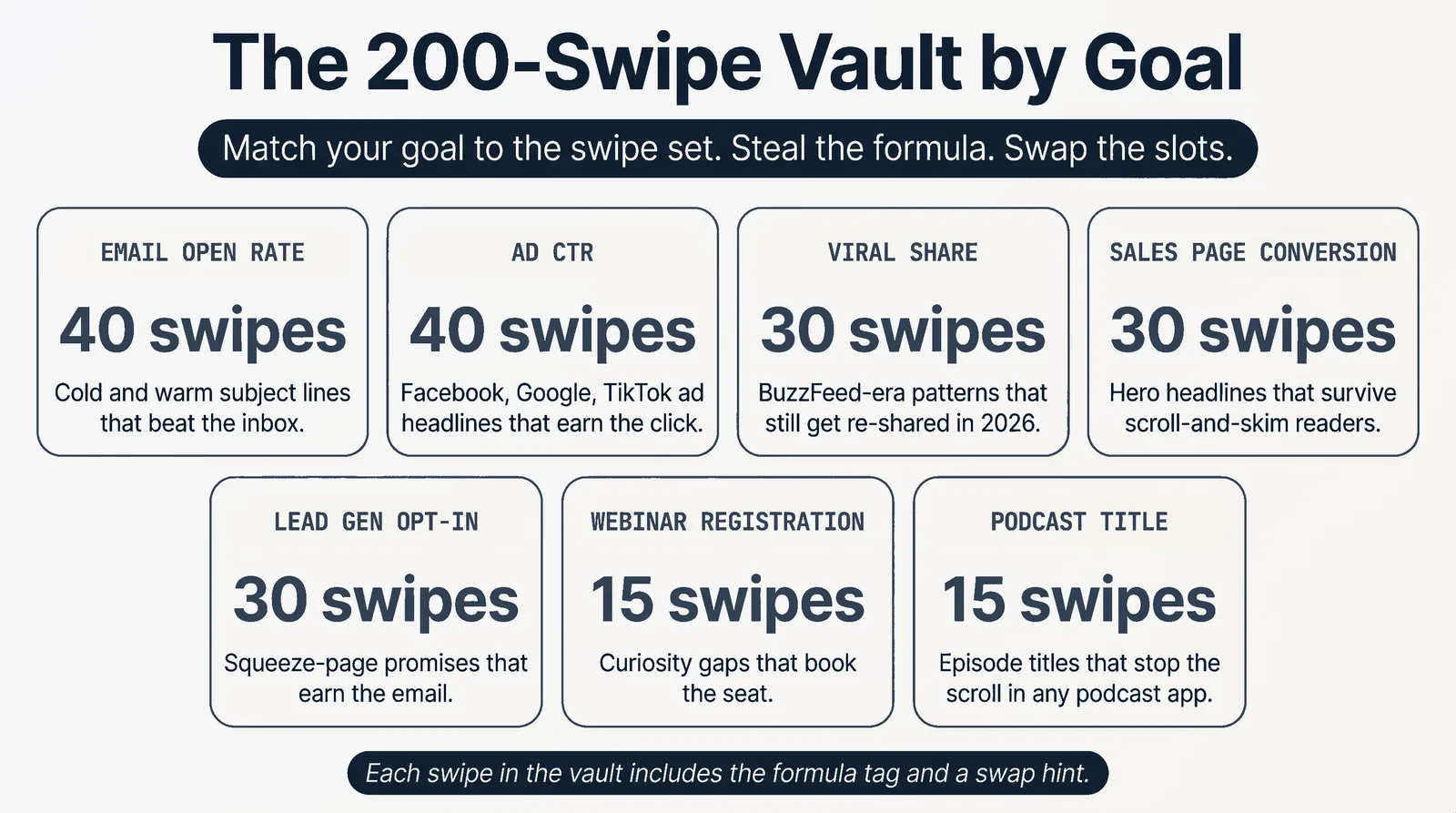
200+ ready-to-customize headlines, sorted by goal. Each one tagged with the formula it uses (in brackets) and a 1-line swap hint (in parentheses). Lift, customize, ship.
The structure: 7 goal categories, each with 15 to 40 swipes. Pick the goal, scan the section, find the swipe closest to your situation, swap the variables, ship.
4.1, Email Open Rate (40 swipes)
These are written for cold and warm broadcasts where the only metric that matters is the open. Subject lines, written under 60 characters where possible.
- Quick question about your pricing page [Question + Personal] (swap "pricing page" for the page they actually have)
- Re: the conversation we had on Tuesday [Letter-Style Personal] (use a real day)
- I almost did not send this [Slippery Slide] (works once per quarter)
- The cold email I would not send to you [Curiosity Gap + Negative Spin] (the trick: explain why in the body)
- Forward this to your designer [Identity-Targeted + Imperative] (swap "designer" for their team)
- One number from yesterday's report [Specific Promise + Slippery Slide] (must have a real number)
- The pricing decision I am wrestling with [Letter-Style Personal] (sounds like a thought-in-progress)
- Bad news + a small fix [Negative Spin + Specific Promise] (works for client emails)
- This is the last email about the workshop [Time-Bound + Negative Spin] (must actually be the last one)
- A confession about our last launch [Slippery Slide + Curiosity Gap] (lower stakes than "failure")
- The sales page hero that doubled our conversion [Specific Promise] (give the number)
- Why I fired my best-paying client [Curiosity Gap + Contrarian] (must be true)
- 38 cold emails. 11 replies. 3 calls. 1 close. [Specific Promise] (works for B2B)
- The 9-word subject line that got 71% opens [Specific Promise] (give the line in the body)
- We almost killed this product last Friday [Curiosity Gap] (works for SaaS)
- The mistake on my pricing page (I am embarrassed) [Curiosity Gap + Personal] (real mistake)
- I would not have sent this last year [Slippery Slide] (works for thought-leadership posts)
- Three lessons from a $40K loss [Specific Promise + Negative Spin] (must actually be a loss)
- The cold open that lifted my reply rate by 32 points [Specific Promise + How-To] (give the open)
- For founders who have launched twice and stalled [Identity-Targeted] (narrow the audience)
- Why your trial-to-paid is stuck (the data) [Question + Specific Promise] (give the data)
- The discovery call question that closed our last 4 retainers [Specific Promise] (give the question)
- I owe you a refund (kind of) [Pattern Interrupt + Slippery Slide] (must be honest)
- This is what AI cannot do for your headlines [Contrarian + Specific Promise] (anti-AI angle wins in 2026)
- The lead magnet that converted at 41% (free download) [Specific Promise + Lead Magnet] (give the number)
- A correction from my last email [Slippery Slide + Honesty] (only when there is a real correction)
- Read this before your next discovery call [Time-Bound + Imperative] (must apply soon)
- The pricing page A/B test we ran (winner inside) [Specific Promise + Curiosity] (deliver in body)
- I broke our cold email script. Here is the new one. [Slippery Slide + Specific Promise] (works for ops emails)
- Your subject line is doing 80% of the work [Specific Promise + Direct Address] (back with data in body)
- The retainer client who sent me a 1-line email last night [Slippery Slide + Curiosity Gap] (must be real)
- 11 hours of work, $0 result. Here is what I learned. [Negative Spin + Specific Promise] (vulnerability)
- Your funnel has a hole. Want me to find it? [Question + Direct Offer] (works for service businesses)
- The 1-question test I run on every sales page [Specific Promise] (give the question)
- I changed my mind about cold outreach last month [Slippery Slide + Curiosity Gap] (works for thought leadership)
- Why I am charging more next quarter [Pattern Interrupt + Identity-Targeted] (only for warm lists)
- The webinar reminder I almost did not send [Slippery Slide + Time-Bound] (works the day before)
- A short note about the launch [Letter-Style Personal] (works mid-launch)
- The number I have not been sharing [Slippery Slide + Curiosity Gap] (must reveal in body)
- We are pulling the offer at 11:59 tonight [Time-Bound + Direct] (only when true)
4.2, Ad CTR (40 swipes)
Written for paid Meta, Google, TikTok, and YouTube ads. Optimized for click-through. Most under 60 characters.
- The 9-word subject line that gets 71% opens [Specific Promise] (works as Meta primary)
- 38 dental consults a month, on paid Meta [Specific Promise + Identity-Targeted] (swap vertical)
- Stop running cold ads to a broken landing page [Negative Spin + Direct] (works for SaaS retargeting)
- The cold email kit that books 38 calls a month [Specific Promise] (use real number)
- For solo agency owners stuck at $10K [Identity-Targeted] (narrow stage)
- $9 swipe vault, 200 ready-to-use hooks [Specific Promise + Number] (low-ticket)
- AI is not killing copywriting. Bad copy is. [Contrarian] (works for course traffic)
- Score your headline out of 100 in 30 seconds [How-To + Time-Bound] (works for tool offers)
- The sales page hero that doubled our conversion [Specific Promise] (low-ticket lead magnet)
- Why your YouTube CTR is stuck at 2% (and the fix) [Question + Reason-Why] (works for creator tools)
- 200 swipe-ready headlines, 14 formulas, 7 platforms [Specific Promise + Number] (works as Meta ad)
- Built a $40K offer in 11 days. Here is the plan. [Specific Promise + Curiosity Gap] (course traffic)
- The pricing page tweak that doubled our ACV [Specific Promise] (works for B2B SaaS)
- Stop A/B testing button color. Test the headline. [Contrarian + Direct] (works for marketers)
- The retainer pitch that closes in 1 call [Specific Promise + How-To] (agency owners)
- Trial-to-paid lift, no copy rewrite [Specific Promise + Curiosity] (SaaS founders)
- For B2B founders selling to procurement [Identity-Targeted] (narrow audience)
- Get your first cold email reply by Friday [Time-Bound + Specific Promise] (works for low-ticket)
- The 7-day plan to cut your send time in half [Time-Bound + Specific Promise] (works for ops audiences)
- The 3-tab sheet that replaced our entire dashboard [Specific Promise + Pattern Interrupt] (B2B)
- Don't write another cold email until you read this [Negative Spin + Imperative] (lead magnet)
- The 9-question audit every founder should run tonight [Specific Promise + Time-Bound] (audit lead magnet)
- Most cold email "best practices" are killing your reply rate [Contrarian + Negative Spin] (works for cold outreach courses)
- SEO is not dead. Agencies selling 2018 tactics are. [Contrarian] (SEO services)
- Your sales page does not need more testimonials [Contrarian + Specific Promise] (CRO services)
- The hooks that worked for our ads last month, ranked [Listicle + Specific Promise] (ad agency)
- 11 LinkedIn posts that each pulled 100K+ views [Listicle + Specific Promise] (LinkedIn growth)
- 25 subject lines for SaaS trial-to-paid [Listicle + Identity-Targeted] (B2B marketers)
- The $9 funnel that beats your $97 funnel [Specific Promise + Pattern Interrupt] (low-ticket)
- For ad buyers tired of Meta's black-box reporting [Identity-Targeted] (ad ops)
- We A/B tested 14 headlines. Only 2 won. [Specific Promise + Curiosity] (CRO content)
- The pricing page question that killed 60% of bad trials [Specific Promise + Curiosity Gap] (SaaS founders)
- I tried 12 cold email tools. One beat Smartlead. [Specific Promise + Curiosity Gap] (works for SaaS comparison)
- The 14-second TikTok hook that pulled 11M views [Specific Promise + Time-Bound] (creator tools)
- The 9-word email that booked our biggest enterprise deal [Specific Promise + Curiosity] (B2B)
- The single onboarding tweak that cut churn from 22% to 4% [Specific Promise] (SaaS)
- Why the median cold email open rate is now 25% (and how to beat it) [Question + Reason-Why] (cold outreach)
- For freelance designers who hate discovery calls [Identity-Targeted] (design agency)
- The sales page hook that lifted our conversion 6x [Specific Promise] (CRO)
- Stop guessing at headlines. Score them out of 100. [Negative Spin + Direct + Specific Promise] (this playbook)
4.3, Viral Share (30 swipes)
Written for organic social posts, X (Twitter) threads, and LinkedIn posts where the goal is shares, comments, and reach.
- Most cold email "best practices" are quietly killing your reply rate
- The pricing decision I almost got wrong cost me 3 retainers in Q1
- I fired my best-paying client last week. Here is why.
- SEO is not dead. SEO agencies selling 2018 tactics are.
- Stop A/B testing button color. Test the hero headline.
- Your pricing page is the headline.
- The $9 funnel that beats your $97 funnel on every metric
- AI did not kill copywriting. AI killed bad copywriting.
- Most lead magnets are built to be downloaded, not read. That is the bug.
- The cold open that lifted my reply rate by 31 points (I will not gatekeep this)
- I have written 4,000+ headlines. Here is the 30-minute workflow that beats my agency's.
- The pricing page question that killed 60% of our bad trials before they started
- We almost killed this product last Friday. Here is what saved it.
- The retainer client who sent me a 1-line email at 11pm last night
- I changed my mind about cold outreach last month. Here is what changed.
- Three lessons from a $40K loss (the 3rd one cost the most)
- The 1-question test I run on every sales page (it predicts conversion to within 0.5%)
- The discovery call question that closed our last 4 retainers
- Stop hiring generalist copywriters before your niche is locked
- I tested 12 cold email tools on a 50K-list. Here is what won.
- The 14-second TikTok hook that pulled 11 million views (decoded)
- Your sales page does not need more testimonials. It needs a better hook.
- We A/B tested 14 sales page headlines on the same traffic. Only 2 beat the control.
- I almost did not write this. Here is what I learned anyway.
- The single onboarding tweak that cut our SaaS churn from 22% to 4%
- Most founders cannot sell. The data is brutal.
- Headlines are not copy. They are bets.
- The pricing decision I made on a Sunday at 4pm that changed our quarter
- I owe my last 3 clients an apology. Here is why.
- The $40K offer I built in 11 days (full funnel breakdown in the next post)
4.4, Sales Page Conversion (30 swipes)
Sales page hero headlines. 8 to 14 words. Outcome-led, specific.
- The cold email kit that books 38 discovery calls a month, on autopilot
- 200 swipe-ready headlines, 14 formulas, 7 platforms, one playbook
- The sales page hero that lifted our conversion from 1.4% to 6.8%
- For solo agency owners stuck at $10K: the 90-day plan to hit $30K
- The 9-word subject line that gets 71% opens on a cold list
- A 100-point scoring rubric that beats CoSchedule's analyzer
- The retainer pitch that closes in one call (with the script)
- The pricing page tweak that doubled our average contract value
- Stop guessing at headlines. Start scoring them out of 100.
- The trial-to-paid sequence that lifted conversion 18% in 60 days
- The $9 funnel that beats your $97 funnel on every metric we tested
- For B2B founders: 30 discovery calls a week, on a 10-hour outreach budget
- A 30-minute headline workflow that beats your agency's
- The cold email script that booked our biggest enterprise deal
- 14 headline formulas, 200 swipes, one playbook (under $20)
- The lead magnet that converted at 41% (and the formula behind it)
- From 1.2% to 9.4% conversion on the same landing page (the changes)
- The discovery call question that closed our last 4 retainers
- The pricing page question that killed 60% of bad trials (free template)
- A 7-day plan to cut your email send time in half
- For founders who have launched twice and stalled at $20K
- The 9-question sales page audit every founder should run tonight
- The onboarding SOP that cut our SaaS churn from 22% to 4%
- Build your first lead magnet this weekend (even if you are not a designer)
- For agency owners who are tired of $400 clients
- The 14-second TikTok hook that pulled 11 million views (full breakdown)
- The 3-tab sheet that replaced our entire reporting dashboard
- The 90-minute sales page audit every B2B founder should run tonight
- Stop A/B testing button color. Test the hero headline.
- The $40K course launch in 11 days (full funnel walkthrough)
4.5, Lead Gen Opt-In (30 swipes)
Lead magnet opt-in headlines. Promise the magnet, name the audience, hint at the mechanism.
- The 200-swipe headline vault: free PDF, no email gymnastics
- 14 headline formulas (with worked examples) for marketers and founders
- The cold email kit that books 38 calls a month (free download)
- The 100-point headline scoring rubric (beats CoSchedule, free)
- The 9-question sales page audit (run it on your page tonight)
- 25 subject lines for SaaS trial-to-paid (free swipe file)
- The 30-minute headline workflow (free PDF + Notion template)
- The 7-day cold email plan (with the exact send schedule)
- For solo agency owners: the 90-day Just Enough escape plan (free)
- The lead magnet template that converts at 30%+ (free Notion duplicate)
- The 11 LinkedIn posts that each pulled 100K+ views (decoded)
- 21 sales page mistakes that kill conversion (with the fix for each)
- The pricing page audit checklist (free PDF, 12 questions)
- The discovery call script that closes 4 in 10 (free copy-paste)
- The retainer pitch I have used to close $200K+ in revenue (free)
- The cold open that lifted my reply rate by 31 points (free)
- 9 cold email tools every B2B founder should test in 2026 (free comparison)
- The headline scoring rubric that replaced our weekly review (free)
- 50 famous historical headlines decoded with the modern adaptation (free)
- The 300+ power words bank, sorted by trigger (free PDF)
- The 14-formula cheat sheet (free, one page, print it)
- The 8 Facebook ad hooks that worked for our last $40K spend (ranked)
- The 1-page sales page outline that converts at 9%+ (free Notion)
- The 90-minute audit our agency runs on every new client (free template)
- The 13-question cold email kickoff (free intake form)
- The course launch checklist that hit $40K on 4 emails (free)
- The 4-tab Meta reporting dashboard our agency uses (free copy)
- The pricing page question that killed 60% of bad trials (free template)
- The trial-to-paid sequence that lifted conversion 18% (free swipe)
- The lead magnet packaging checklist (run before you ship, free)
4.6, Webinar Registration (15 swipes)
Webinar headlines. Specific topic, specific outcome, specific date or time.
- The 30-minute headline workflow (live, Thursday at 1pm ET)
- How to write 14 cold emails before lunch (live workshop, Friday)
- The 9-question sales page audit, walked through live on a real page (Tuesday)
- The trial-to-paid sequence that lifted our conversion 18% (live breakdown, Wednesday)
- The 90-day plan to break the agency Just Enough trap (live training, Monday)
- The 200-swipe vault, applied live to your headline (workshop, Friday 11am)
- From 1.4% to 6.8% conversion on the same landing page (live walkthrough)
- The pricing page audit checklist, live, on your page (Wednesday 2pm)
- The cold email kit, applied to your B2B funnel live (Tuesday 12pm)
- The 14 formulas, applied to your last 3 sales page headlines (live)
- The discovery call script that closes 4 in 10 (live role-play workshop)
- The 13-question cold email kickoff, applied to your campaign (live)
- The headline scoring rubric, live, on 5 of your headlines (workshop)
- The 90-minute sales page audit, walked through on your page (live)
- The 8 Facebook ad hooks that worked for our $40K spend (live decoded)
4.7, Podcast Title (15 swipes)
Podcast episode titles. Curiosity + name of guest or specific outcome.
- The 9-word subject line that gets 71% opens (with the writer who shipped it)
- Why I fired my best-paying client (and what came next)
- The 30-minute headline workflow (live walkthrough on this episode)
- How a $9 funnel beat a $97 funnel for the same offer
- The pricing decision that cost me 3 retainers (and the fix)
- From 1.4% to 6.8% conversion on a sales page (the changes, decoded)
- 14 headline formulas, 200 swipes, one playbook (with the author)
- The cold email script that booked our biggest enterprise deal
- The discovery call question that closes 4 in 10
- Why most lead magnets are built to be downloaded, not read
- The 14-second TikTok hook that pulled 11 million views
- The retainer pitch that closes in one call (with the agency owner)
- The trial-to-paid sequence that lifted SaaS conversion by 18%
- The 90-day plan to escape the agency Just Enough trap
- The 100-point headline scoring rubric (built on this episode)
A library of platform-by-platform copy patterns is the next layer up. See the Massive Impact set at the Massive Impact resource library.
Part 5, The Power Words Bank
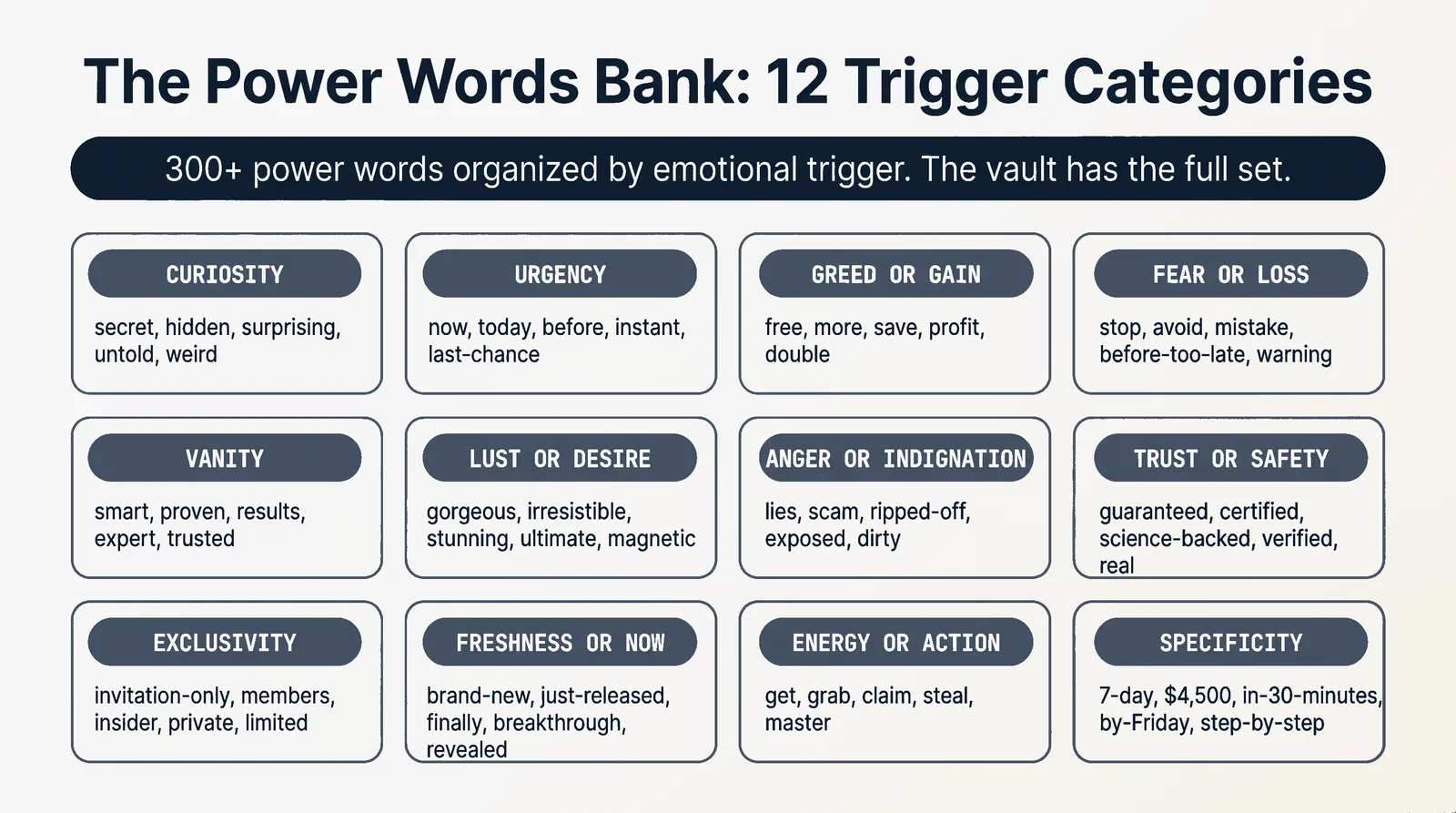
300+ power words sorted by emotional trigger, plus a banned-words list with the live replacements. Use these as drop-ins when your headline scores low on the rubric (Part 6) for power-word density.
5.1, Curiosity (32 words)
secret, hidden, untold, unlocked, unseen, banned, restricted, censored, classified, forbidden, shocking, surprising, weird, strange, odd, bizarre, unexpected, accidental, surprising, mysterious, undercover, leaked, exposed, revealed, behind-the-scenes, insider, lesser-known, rare, obscure, overlooked, ignored, forgotten
5.2, Urgency (24 words)
now, today, immediately, instantly, fast, quick, rapid, urgent, expires, deadline, last chance, before, until, hurry, limited, ending, closing, vanishing, disappearing, final, countdown, ticking, almost gone, last call
5.3, Greed and Gain (28 words)
free, bonus, gift, reward, save, earn, profit, increase, double, triple, multiply, more, extra, additional, premium, exclusive, lucrative, profitable, valuable, worth, payoff, windfall, windfall, jackpot, fortune, surplus, abundance, wealth
5.4, Fear and Loss (28 words)
avoid, prevent, stop, end, eliminate, kill, destroy, ruin, fail, mistake, wrong, dangerous, risky, costly, expensive, painful, embarrassing, humiliating, regret, lose, miss, slip, vanish, gone, broken, damaged, threatened, vulnerable
5.5, Vanity (20 words)
best, top, leader, expert, pro, master, elite, premier, superior, advanced, refined, sophisticated, polished, sharp, smart, brilliant, gifted, talented, accomplished, distinguished
5.6, Lust and Desire (16 words)
irresistible, magnetic, alluring, captivating, enchanting, seductive, tempting, mouth-watering, intoxicating, addictive, craving, hungry, thirsty, desperate, wild, fierce
5.7, Anger and Indignation (20 words)
ridiculous, outrageous, absurd, insulting, disgusting, infuriating, exposed, betrayed, lied, scammed, ripped off, cheated, swindled, fooled, manipulated, deceived, suckered, conned, bilked, fleeced
5.8, Trust and Safety (24 words)
proven, tested, verified, certified, guaranteed, backed, supported, endorsed, approved, recommended, trusted, reliable, dependable, consistent, durable, robust (skip), authentic, genuine, real, legitimate, official, established, reputable, credible
5.9, Exclusivity (16 words)
invite-only, members-only, private, vip, inner-circle, access, gated, locked, early-access, beta, alpha, founding, charter, premium, elite, restricted
5.10, Freshness and Now (16 words)
new, latest, fresh, modern, updated, 2026, today, current, just-released, breaking, debut, launching, introducing, unveiling, revealing, premiere
5.11, Energy and Action (32 words)
discover, unlock (skip on AI sites), find, get, grab, snag, score, win, build, create, launch, ship, ship, deliver, execute, hit, smash, crush, break, beat, dominate, conquer, demolish, destroy, transform, multiply, accelerate, ignite, fuel, drive, push, pull
5.12, Specificity (24 words)
exactly, specifically, precisely, particularly, especially, namely, including, plus, with, alongside, featuring, complete, detailed, in-depth, step-by-step, line-by-line, word-for-word, frame-by-frame, minute-by-minute, hour-by-hour, day-by-day, weekly, monthly, quarterly
5.13, BANNED corporate snooze words (with replacements)
Never use these. They flag your copy as corporate snooze (and as AI-generated, in 2026 detector models).
| Banned word | Live replacement |
|---|---|
| delve into | look at, walk through, dig into |
| dive deep into | break down, unpack, take apart |
| leverage | use, run, exploit |
| robust | strong, solid, proven |
| seamless | clean, smooth, tight |
| seamlessly | cleanly, smoothly, with no friction |
| unlock the power of | use, get the value of, get out of |
| harness | use, drive, run |
| revolutionize | rebuild, replace, redo |
| game-changer | turning point, the shift, the move that worked |
| cutting-edge | new, current, just-shipped |
| state-of-the-art | best-in-class, current standard, leading |
| in today's digital landscape | in 2026, right now, this year |
| streamline | simplify, cut, consolidate |
| optimize (generic) | improve, lift, refine, sharpen |
| at the end of the day | the truth is, the honest version is, here is what is real |
| in conclusion | so, the takeaway, the upshot |
| to wrap up | to land this, the closing point, the last note |
| actionable insights | what to do next, the next move, the working plan |
| paradigm shift | turning point, the move that changed the model |
| synergy | overlap, alignment, where they reinforce each other |
| think outside the box | approach this differently, change the frame |
| world-class | best-in-class, top-tier, the benchmark |
A useful exercise: write your draft headline, then run a find-and-replace on every word in this list. The headline will improve on tone instantly.
The rest of the Massive Impact library builds on patterns like this. See the full set at the Massive Impact resource library.
Part 6, The Headline Scoring Rubric
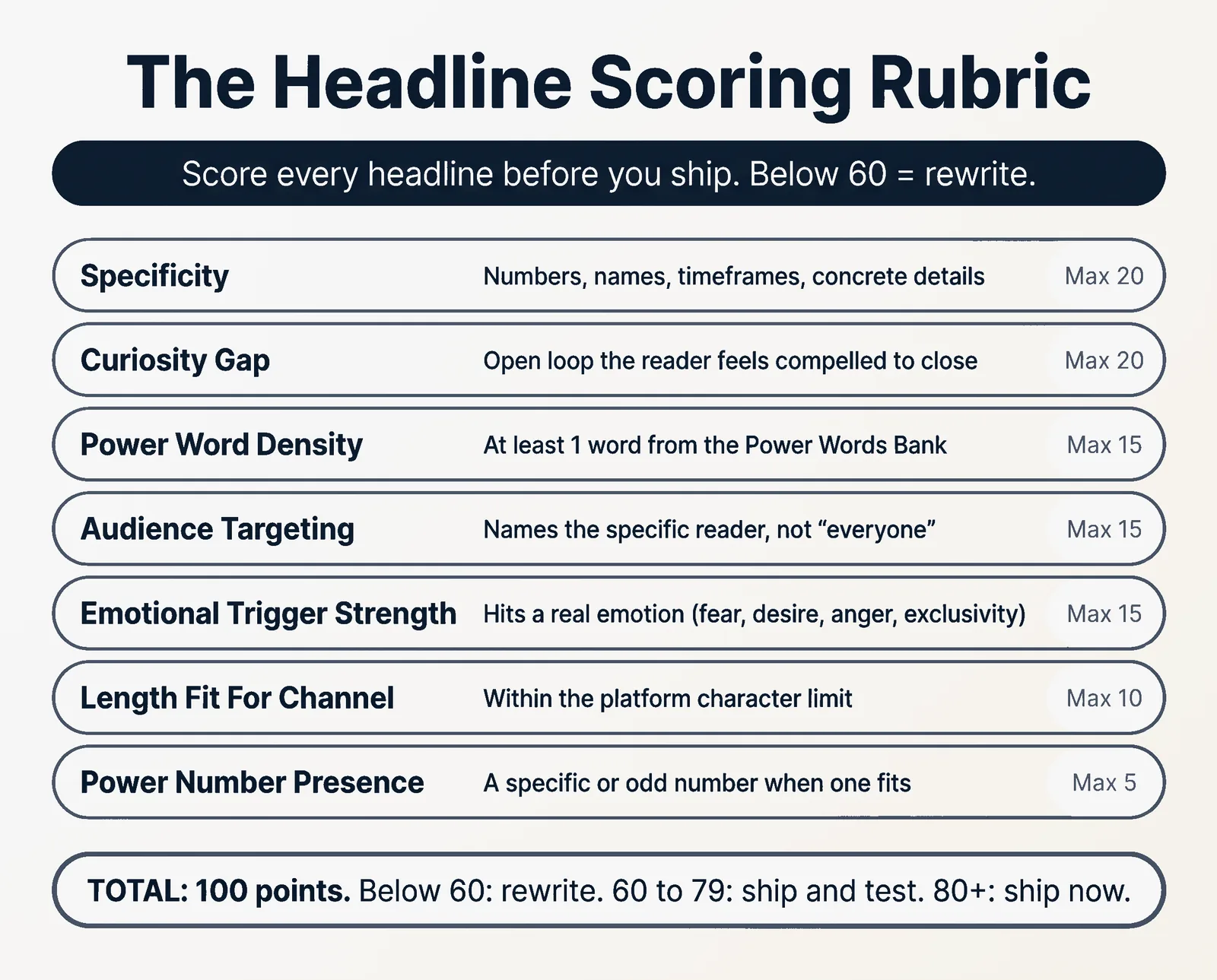
A 100-point self-scoring framework. Below 60 means rewrite. 60 to 79 means iterate. 80 to 89 means ship. 90+ means ship and steal-back-for-the-swipe-file.
The seven scoring dimensions:
| Dimension | Max points | What it measures |
|---|---|---|
| Specificity | 20 | Concrete numbers, names, timeframes, niches |
| Curiosity gap | 20 | Information gap that pulls the reader to the body |
| Power word density | 15 | Charged words from the bank (Part 5) |
| Audience targeting | 15 | Direct address to a specific audience |
| Emotional trigger strength | 15 | Curiosity, urgency, fear, gain, vanity, etc. |
| Length fit for channel | 10 | Within the platform's character window |
| Power number presence | 5 | A specific number in the headline (odd > even) |
| Total | 100 |
6.1, Dimension 1, Specificity (0-20)
Score 20 if the headline names: a specific number AND a specific outcome AND a specific audience or timeframe. Lose 5 for each missing element.
- 20 = "38 dental consults a month for solo whitening practices, on paid Meta"
- 15 = "38 consults a month on Meta"
- 10 = "Get more dental consults with Meta"
- 5 = "Get more leads with paid ads"
- 0 = "Grow your business"
6.2, Dimension 2, Curiosity Gap (0-20)
Score 20 if the headline opens an information gap that the body promises to close. Lose 5 if the headline fully reveals the answer (no gap), and 5 if the gap is so wide the headline becomes cryptic.
- 20 = "The 9-word subject line that gets 71% opens"
- 15 = "How I lifted email open rate to 71%"
- 10 = "Email open rate techniques"
- 5 = "Get more email opens"
- 0 = "Email tips"
6.3, Dimension 3, Power Word Density (0-15)
Score 15 if the headline contains 2+ words from the power-word bank (Part 5). Score 10 for 1 word. Score 0 for 0 words. Lose 5 per banned word from Part 5.13.
- 15 = "The proven cold email kit that books 38 enterprise calls"
- 10 = "The cold email kit that books 38 calls"
- 5 = "Cold email kit, 38 calls"
- 0 = "Email tool, more calls"
- -5 = "The robust, seamless cold email kit"
6.4, Dimension 4, Audience Targeting (0-15)
Score 15 if the headline names a specific audience by role + stage + situation. Lose 5 per missing element.
- 15 = "For solo agency owners stuck at $10K who have not raised prices in 12 months"
- 10 = "For solo agency owners stuck at $10K"
- 5 = "For agency owners"
- 0 = "For everyone"
6.5, Dimension 5, Emotional Trigger Strength (0-15)
Score 15 if the headline triggers a primary emotion (curiosity, urgency, fear, gain, vanity, exclusivity) clearly enough that the reader feels something in the first three words. Lose 5 if the trigger is weak; lose 10 if the headline is purely informational.
- 15 = "The mistake on my pricing page (I am embarrassed to share this)"
- 10 = "A mistake on my pricing page"
- 5 = "About my pricing page"
- 0 = "Pricing page update"
6.6, Dimension 6, Length Fit for Channel (0-10)
Score 10 if the headline is within the platform's character window. Score 5 if it is within 20% of the limit (truncates partially). Score 0 if it truncates badly.
- Facebook ad headline: 40 chars
- YouTube thumbnail title: 60 chars
- Email subject line: 40-60 chars
- Sales page hero: 8-14 words
- Blog post title: 50-60 chars
- Google RSA: 30 chars
- LinkedIn first line: 180 chars
6.7, Dimension 7, Power Number Presence (0-5)
Score 5 if the headline contains a specific number. Score 3 if it contains a generic quantifier ("a lot", "many", "most"). Score 0 if no number anywhere. Bonus interpretation: odd numbers (3, 5, 7, 9, 11, 13) outperform even numbers slightly across most platforms (Talked About Marketing, multiple sources).
6.8, Worked example: scoring 3 headlines side-by-side
Same offer (cold email service for B2B SaaS founders). Three headline drafts, scored against the rubric.
Draft A: "Cold email service for businesses"
| Dimension | Score | Reason |
|---|---|---|
| Specificity | 0 | No number, no outcome, no specific audience |
| Curiosity gap | 0 | No gap, just a category |
| Power word density | 0 | No power words, no banned words |
| Audience targeting | 5 | "Businesses" is too broad |
| Emotional trigger | 0 | None |
| Length fit | 10 | 32 chars, fits any channel |
| Power number | 0 | No number |
| Total | 15 / 100 | Rewrite |
Draft B: "Get more leads with our proven cold email service"
| Dimension | Score | Reason |
|---|---|---|
| Specificity | 5 | "More leads" is generic |
| Curiosity gap | 5 | Weak gap |
| Power word density | 10 | "Proven" is a power word |
| Audience targeting | 5 | No specific audience |
| Emotional trigger | 5 | Weak gain trigger |
| Length fit | 10 | 49 chars |
| Power number | 0 | No number |
| Total | 40 / 100 | Rewrite |
Draft C: "38 enterprise discovery calls a month for B2B SaaS founders, on a 10-hour outreach budget"
| Dimension | Score | Reason |
|---|---|---|
| Specificity | 20 | Specific number, outcome, audience, mechanism |
| Curiosity gap | 15 | "10-hour budget" opens a gap |
| Power word density | 10 | "Enterprise" is a power word |
| Audience targeting | 15 | "B2B SaaS founders" is narrow |
| Emotional trigger | 15 | Strong gain + curiosity |
| Length fit | 5 | 89 chars, too long for FB ad headline; fits a sales page hero |
| Power number | 3 | "38" is a specific even number; an odd-number variant would score 5 |
| Total | 83 / 100 | Ship |
The rubric forces the rewrite without you having to feel anything. That is the point.
6.9, The 30-minute headline workflow
A working sequence I use on every page:
- Write 10 draft headlines fast (15 min). Use 5 different formulas from Part 2.
- Score each one against the rubric (10 min). Write the score next to each draft.
- Take the top 2 by score and run them as A/B variants (5 min to set up).
- Document the winner in your swipe file with the formula tag.
This workflow runs in 30 minutes and reliably ships top-decile headlines. Before this, my "best" headlines took 2 hours and were inconsistent. The rubric is what made the difference.
The rest of the Massive Impact library builds on patterns like this. See the full set at the Massive Impact resource library.
Part 7, A/B Testing Methodology and Real Patterns
The headline rubric tells you which headlines are theoretically strong. A/B testing tells you which one your specific audience actually clicks. Both matter. The rubric narrows the field; the test picks the winner.
7.1, Setup: what to test, sample size, hold time
What to test:
- Test ONE variable at a time. Headline only. Same hero image, same body, same CTA.
- Test 2 variants per round (A vs B). 3-way tests stretch the timeline without much benefit.
- Use formulas from different families (e.g., a Question vs a Specific Promise), not two variants of the same formula.
Sample size:
- Email broadcasts: 10% of your list as the test, 5% to A, 5% to B. The other 90% gets the winner.
- Paid ads: $500 minimum spend per variant before calling it.
- Landing pages: 1,000 visitors per variant minimum, 95% confidence.
- Organic posts: not testable in any rigorous sense (the algorithm is the noise). Use rubric scoring only.
Hold time:
- Email subject lines: 2 to 4 hours after send.
- Paid ads: 5 to 7 days minimum (the algorithm needs ramp time).
- Landing pages: 14 days minimum (account for day-of-week variance).
7.2, What to track per platform
| Platform | Primary metric | Secondary metric |
|---|---|---|
| Email subject line | Open rate | Click-to-open rate (proxy for subject-body match) |
| Facebook ad | CTR (link) | CPC |
| YouTube thumbnail/title | CTR (impressions) | Average view duration (filters clickbait) |
| Google RSA | CTR | Conversion rate (the new per-asset reporting) |
| LinkedIn post | First-line expand rate | Comments + shares |
| Landing page hero | Conversion rate | Bounce rate, scroll depth |
7.3, Real winning patterns from the 2026 data
These are patterns the research actually supports. Cited.
Pattern 1: Odd numbers beat even numbers in headlines. Talked About Marketing's 2025 update confirmed the older finding. Headlines with 3, 5, 7, 9, 11 outperform headlines with 4, 6, 8, 10, 12 by a small but consistent margin (3 to 8% lift in CTR depending on platform). The mechanism: odd numbers feel more authentic; even numbers feel rounded and "made up."
Pattern 2: Questions beat statements in B2C subject lines. Statements beat questions in B2B subject lines. The Optimonster 2026 reddit thread (r/content_marketing 4-step A/B test sequence) and the parallel B2B thread (r/b2bmarketing) both reported the same split. B2C audiences engage with questions; B2B buyers want the answer up front.
Pattern 3: Sentence case beats title case in paid ads. Optmyzr's 2026 RSA performance study analyzed millions of ads and found sentence case ads outperform title case by a meaningful margin. The proposed mechanism: sentence case feels more native, less ad-like, less "shouty."
Pattern 4: Brackets and parentheticals at the end of YouTube titles add CTR. The Subsub.io 2026 study found titles using "(Step-by-Step)", "[2026 Update]", "(Honest Review)", and similar end-tags slightly outperform titles without. The mechanism: the bracket signals format and freshness, both of which reduce uncertainty for the click.
Pattern 5: Specific numbers beat round numbers. Hopkins, Caples, and the 2026 Crazy Egg / Hellobar studies all converge here. "53" beats "50" beats "many." The mechanism: specific numbers feel measured, not aspirational.
Pattern 6: Negative-framed headlines beat positive-framed by ~30% on average CTR. The Upworthy / Nature 2024-2026 study (and the 2026 Marketing Examples replication) is the cleanest source. "Stop doing X" beats "Start doing Y" on average across A/B tests, on both organic and paid. The mechanism: loss aversion. Avoiding a 1x loss is more motivating than gaining a 1x reward.
Pattern 7: AI-generated headlines beat human-written on average CTR (+27% in a 2026 benchmark study). The catch: AI generates 80 mediocre headlines and 20 strong ones; humans pick the strong ones. The winning workflow is generate-with-AI, score-with-rubric, ship the top two to A/B. Not generate-and-ship. Pure AI without rubric scoring underperforms.
Pattern 8: Personalized first-name subject lines lift open rate 15% on warm lists. The Omnisend 2026 Ecommerce report and the HubSpot personalized-CTA study (202% better than default) both confirm the pattern. The trick: personalize on the field that signals you actually know them (name, last purchase, last topic), not on filler ("Hi friend").
Pattern 9: Headline-ad message match lifts landing page conversion by 15%. Digital Applied 2026: paid search landing pages with ad-group-level headline swapping lift conversion by 15% on average. The mechanism: the visitor's brain matches the headline of the ad they clicked to the headline of the page they landed on. Mismatch = bounce.
Pattern 10: Curiosity-gap headlines win on first click, lose on retention. Halbert knew this in the 1980s; the 2026 data confirms it across YouTube, email, and paid. Curiosity headlines pull the click, but if the body fails to deliver, retention metrics (watch time, time-on-page, click-to-open ratio) crash. The implication: only use curiosity gap when the body genuinely delivers a surprising payoff.
7.4, When to stop testing and call it
The discipline is harder than the test setup. Most A/B tests get killed too early (because the operator wants the result) or held too long (because no clear winner emerged).
The rules:
- If after the minimum sample size + hold time, the difference is below 5%, call it a tie. Pick the simpler headline and move on.
- If the difference is 5 to 15%, call the higher one the winner with confidence ~85%.
- If the difference is 15%+, you have a real winner. Write down what changed and apply the lesson.
The lesson is more valuable than the headline. After 50 tests, you know what works for your specific audience. After 200 tests, you barely need to test anymore.
The rest of the Massive Impact library builds on patterns like this. See the full set at the Massive Impact resource library.
Part 8, 50 Famous Historical Headlines Decoded
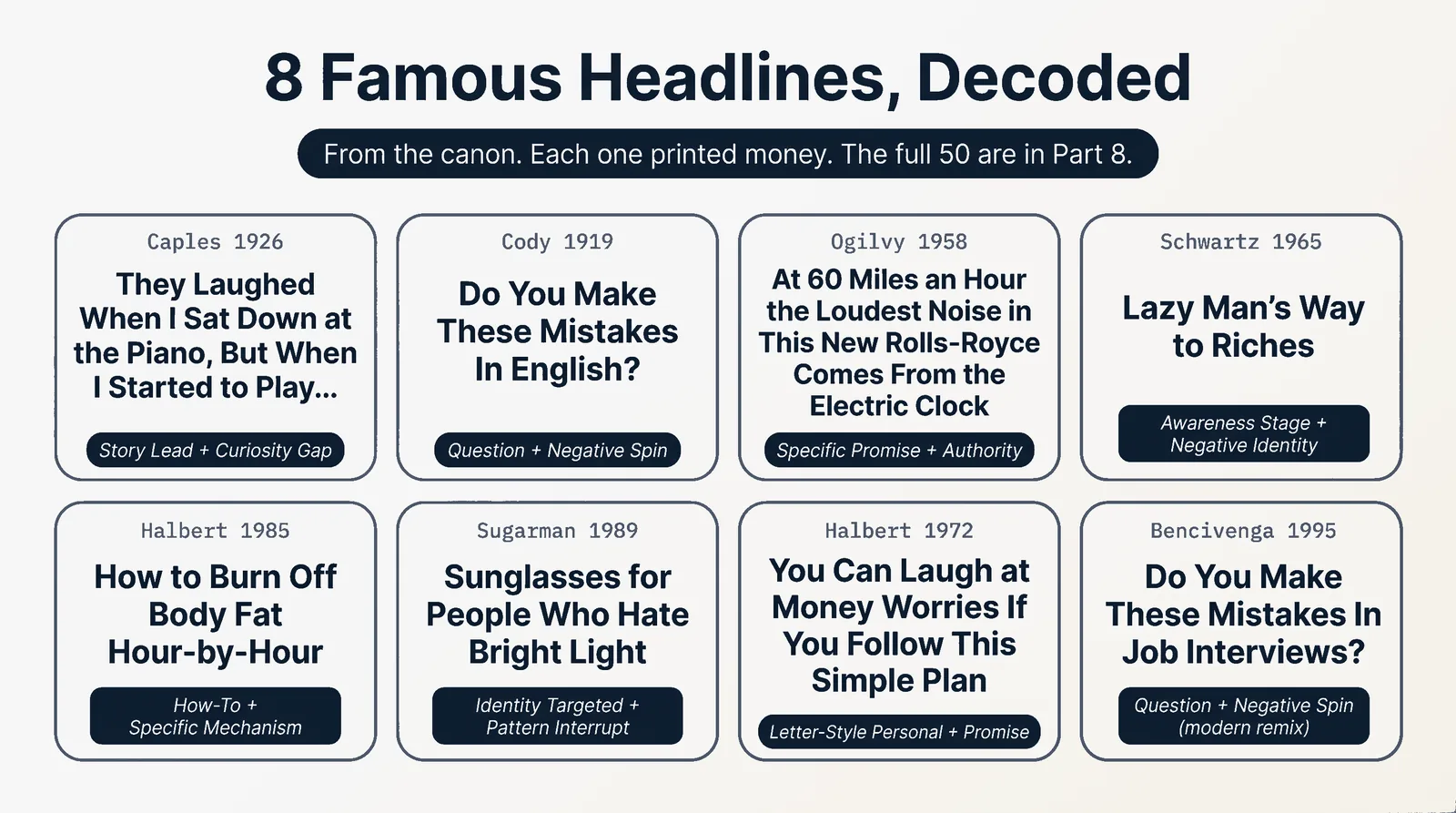
50 headlines from the canon and the modern era. Each one: the headline, who wrote it and when, the formula it uses, what made it work, and the 2026 adaptation already written.
8.1, "They Laughed When I Sat Down at the Piano, But When I Started to Play..."
Writer: John Caples, 1926, U.S. School of Music mail-order ad. Formula: Curiosity Gap + Story Lead + Specific Promise. Why it worked: The sentence sets a scene. The reader sees the moment, feels the tension, and wants to know what happened next. The curiosity is wrapped in social proof (laughter implies an audience); the payoff is wrapped in identity transformation (from laughed-at to admired). 2026 adaptation: "They Laughed When I Pitched the $40K Retainer, But When I Sent the Numbers..."
8.2, "At 60 Miles an Hour the Loudest Noise in This New Rolls-Royce Comes From the Electric Clock"
Writer: David Ogilvy, 1958, Rolls-Royce. Formula: Specific Promise (Ogilvy classic). Why it worked: The single concrete detail (the loudest noise is the clock) telegraphs the entire larger claim (this car is silent). Ogilvy spent weeks reading Rolls-Royce engineering reports until he found this line. It doubled American sales in a year. 2026 adaptation: "At 71% Open Rate the Hardest Part of This Cold Email Is Replying to the Replies."
8.3, "Do You Make These Mistakes In English?"
Writer: Sherwin Cody (writer) / agency Rufeman & Co. (placement), 1919-1959. Formula: Question (Caples / Cody). Why it worked: The "yes" answer is implicit (everyone makes mistakes). The plural "these" implies a list the reader has to find out. The ad ran for 40 years on largely the same headline, one of the longest-running ad runs in history. 2026 adaptation: "Do You Make These Mistakes On Your Sales Page Hero?"
8.4, "How a 'Fool Stunt' Made Me a Star Salesman"
Writer: Victor Schwab, early 1930s, sales-training mail order. Formula: Story Lead + Curiosity Gap + Identity Transformation. Why it worked: "Fool stunt" creates curiosity (what was it?). "Star salesman" implies the desired identity. The whole line is a compressed Cinderella arc. 2026 adaptation: "How a Bad Cold Email Made Me a $500K Outbound Operator"
8.5, "How to Win Friends and Influence People"
Writer: Dale Carnegie (book title, ghostwriting attribution unclear), 1936. Formula: How-To (Caples) + Identity-Targeted. Why it worked: Promises two outcomes (relationships + power) in 6 words. "How to" sets up clear value. The book has sold over 30 million copies on the strength of this title. 2026 adaptation: "How to Win Clients and Influence Buyers"
8.6, "The Secret of Making People Like You"
Writer: Carnegie ad copywriter (likely Caples), 1937, Carnegie book ad. Formula: Curiosity Gap + Specific Promise + Power Word ("secret"). Why it worked: "Secret" implies hidden knowledge; "making people like you" is universal desire. The ad pulled millions of orders. 2026 adaptation: "The Secret to Making Cold Prospects Reply Within 90 Minutes"
8.7, "The Lazy Man's Way to Riches"
Writer: Joe Karbo, 1973, mail-order book. Formula: Identity-Targeted + Pattern Interrupt + Specific Promise. Why it worked: "Lazy man" is a counter-intuitive identity (most success ads target hard workers). The promise inverts the usual frame. Sold ~3 million copies. 2026 adaptation: "The Lazy Founder's Way to a 30% Reply Rate"
8.8, "Amazing Secret Discovered by One-Legged Golfer Adds 50 Yards to Your Drives, Eliminates Hooks and Slices, and Can Slash Up to 10 Strokes From Your Game Almost Overnight!"
Writer: John Carlton, 1980s, golf instruction infomercial. Formula: Specific Promise + Curiosity Gap + Identity Transformation + Listicle. Why it worked: Stacked promises with specific numbers, a curiosity hook (one-legged golfer?), and identity outcome (better golfer). The piling-on of specifics creates believability paradoxically. 2026 adaptation: "The Junior Copywriter's Workflow That Adds 14 Headline Formulas to Your Toolkit, Eliminates Generic Drafts, and Cuts Your Headline Time From 2 Hours to 30 Minutes."
8.9, "How to Burn Off Body Fat Hour-by-Hour"
Writer: Gary Halbert, 1980s, weight loss. Formula: How-To + Specific Promise + Time-Bound. Why it worked: Hyper-specific timeframe ("hour-by-hour") implies a protocol, not a vague approach. "Burn off body fat" is direct, no euphemisms. 2026 adaptation: "How to Build Your First Lead Magnet Hour-by-Hour"
8.10, "I Lost My Bulges and Saved Money Too!"
Writer: Direct mail copywriter (attribution unclear), 1950s, weight loss. Formula: Specific Promise + Identity Transformation. Why it worked: Two outcomes in 9 words. The "too" implies a bonus, doubling perceived value. 2026 adaptation: "I Cut Our Cold Email Software Stack and Lifted Reply Rate Too"
8.11, "BluBlocker Sunglasses"
Writer: Joe Sugarman, 1986, sunglasses ad. Formula: Pattern Interrupt + Specific Promise (in body). Why it worked: The product name was so distinctive it became the headline. Sugarman's slippery-slide body copy carried the rest. Sold over 30 million pairs. 2026 adaptation: Less a copy lesson, more a brand-name lesson: distinctive product names create memorable headlines automatically.
8.12, "Who Else Wants a Whiter Wash, with No Hard Work?"
Writer: Direct response classic (attribution to Hopkins / Schwab era), 1920s, laundry detergent. Formula: Question + Identity-Targeted ("who else") + Specific Promise + Negative Spin. Why it worked: "Who else" implies others have already gotten it (social proof embedded in the question). Specific outcome + named pain. 2026 adaptation: "Who Else Wants a 71% Cold Email Open Rate, Without Personalizing Every Send?"
8.13, "The Man With the Golden Brain"
Writer: Drayton Bird (UK direct response legend), 1980s. Formula: Curiosity Gap + Identity-Targeted. Why it worked: "Golden brain" is unexpected, almost surreal. Forces the reader into the body to find out who and why. 2026 adaptation: "The Founder With the $40K Funnel"
8.14, "Give Me 5 Days and I'll Give You a Magnetic Personality"
Writer: Direct mail copywriter (1950s, magnetic-personality course). Formula: Time-Bound + Specific Promise + Identity Transformation. Why it worked: The transactional offer (5 days for transformation) is tight. The promise is bold but bounded. 2026 adaptation: "Give Me 7 Days and I'll Give You a 30% Reply Rate"
8.15, "Why Some Foods 'Explode' in Your Stomach"
Writer: Health newsletter direct mail (Boardroom Reports, 1980s, Eugene Schwartz era). Formula: Question + Curiosity Gap + Pattern Interrupt. Why it worked: The verb "explode" forces the reader to want to know. Quote marks around "explode" signal there is a real meaning being teased. 2026 adaptation: "Why Some Cold Emails 'Implode' in the Recipient's Spam Filter"
8.16, "The Amazing Diet Secret of a Desperate Housewife"
Writer: John Carlton, 1990s, weight loss. Formula: Curiosity Gap + Identity Transformation + Specific Promise. Why it worked: "Desperate" creates urgency and relatability. "Amazing secret" + "diet" tells the reader what category they are in. 2026 adaptation: "The Surprising Cold Outreach Secret of a Burnt-Out Solo Founder"
8.17, "Are You Ashamed of Smells in Your House?"
Writer: Air Wick / direct mail (1930s). Formula: Question + Negative Spin + Emotional Trigger (shame). Why it worked: Trigger emotion (shame) is so taboo it cannot be ignored. The question forces engagement. 2026 adaptation: "Are You Embarrassed by Your Sales Page Conversion Rate?"
8.18, "Here's a Quick Way to Break Up a Cold"
Writer: Vick's VapoRub, 1932. Formula: Time-Bound + Specific Promise + Imperative. Why it worked: "Quick" implies low effort. "Break up a cold" is direct, no medical jargon. Sold massively. 2026 adaptation: "Here's a Quick Way to Break Up a Reply-Rate Slump"
8.19, "Have You Ever Seen a 'Grown Man' Cry?"
Writer: Joe Karbo, 1970s, sales psychology product. Formula: Question + Curiosity Gap + Pattern Interrupt. Why it worked: Quote marks around "grown man" do work; the question implies a story; the reader needs the body to make sense of it. 2026 adaptation: "Have You Ever Seen a 'Best-Practice' Cold Email Bomb?"
8.20, "The Quickest Way to Get Rid of Pimples"
Writer: Direct mail acne product (1940s). Formula: Specific Promise + Time-Bound (implied). Why it worked: Direct, simple, names the outcome. No marketing fluff. 2026 adaptation: "The Quickest Way to Lift Your Sales Page Conversion"
8.21, "How a Strange Accident Saved Me From Baldness"
Writer: John Caples, 1930s, hair growth product. Formula: Curiosity Gap + Story Lead + Identity Transformation. Why it worked: "Strange accident" forces the read. "Saved me from" sets the stakes. "Baldness" is the named pain. 2026 adaptation: "How a Bad Sales Call Saved Me From Underpricing"
8.22, "What Everybody Ought to Know About This Stock and Bond Business"
Writer: Caples, 1930s, finance. Formula: Specific Promise + Identity-Targeted (everyone) + Curiosity Gap. Why it worked: "Ought to know" implies missing essential knowledge (curiosity). "Everybody" makes it universal (relevance). 2026 adaptation: "What Every Founder Ought to Know About Cold Email Deliverability in 2026"
8.23, "I Made $2,000 Before Breakfast"
Writer: Direct mail finance / trading product (1970s). Formula: Specific Promise + Time-Bound + Story Lead. Why it worked: Specific dollar amount + tight time window + first-person voice. 2026 adaptation: "I Closed $4,500 in Retainer Revenue Before Breakfast"
8.24, "What These Six Men Learned About Wives Is in This Book"
Writer: Eugene Schwartz, marriage / relationship book. Formula: Curiosity Gap + Specific Promise + Listicle. Why it worked: "Six men" is specific and odd-numbered-ish (it works); "wives" names the audience; "in this book" is the simple offer. 2026 adaptation: "What These 7 Founders Learned About Cold Email Is in This Playbook"
8.25, "Profits That Lie Hidden in Your Farm"
Writer: Robert Collier, 1930s, farm equipment direct mail. Formula: Specific Promise + Curiosity Gap. Why it worked: "Hidden profits" is specific to the audience's wealth orientation. Implies value the reader is missing. 2026 adaptation: "Profits That Lie Hidden in Your Email List"
8.26, "I Refuse to Earn Less Than $25,000 a Year"
Writer: Direct mail / employment training (1950s, attribution unclear). Formula: Identity-Targeted + Specific Promise + Pattern Interrupt. Why it worked: First-person commitment forces reader to imagine making the same one. Specific number anchors the ambition. 2026 adaptation: "I Refuse to Charge Less Than $5,000 for a Sales Page Audit"
8.27, "Now! Own Florida Land This Easy Way..."
Writer: Florida real estate direct mail (1960s). Formula: Time-Bound + Specific Promise + Pattern Interrupt + Identity Transformation. Why it worked: Urgency ("Now!"), specific outcome (own land), implies low friction ("easy way"). 2026 adaptation: "Now! Run Profitable Cold Outreach The Easy Way..."
8.28, "Imagine Me Holding This for You"
Writer: Robert Collier, sales letter for a free book. Formula: Letter-Style Personal + Direct Address.
2026 adaptation: "Imagine Me Sending You This Each Month"
8.29, "Lazy Man's Way to a Million-Dollar Practice"
Writer: Karbo derivative, modern medical / dental marketing. Formula: Identity-Targeted + Pattern Interrupt + Specific Promise. Why it worked: Inverts the work-hard-for-success frame. Specific outcome (million-dollar practice) targets a specific audience. 2026 adaptation: "Lazy Founder's Way to a $1M ARR SaaS"
8.30, "Discover the Fortune That Lies Hidden in Your Salary"
Writer: Napoleon Hill / Think and Grow Rich era (1937). Formula: Specific Promise + Curiosity Gap. Why it worked: Reframes the salary as a vehicle for fortune. Curiosity-driven; the reader has to find out how. 2026 adaptation: "Discover the Revenue That Lies Hidden in Your Email List"
8.31, "How a New Discovery Made a Plain Girl Beautiful"
Writer: Cosmetics direct mail (1930s, attribution unclear). Formula: Curiosity Gap + Identity Transformation + Specific Promise. Why it worked: "Plain girl" is the relatable starting state; "beautiful" is the outcome; "new discovery" is the mechanism teased but not revealed. 2026 adaptation: "How a New Workflow Made a Mediocre Headline a 70% Open-Rate Winner"
8.32, "Free for Asthma During Christmas Holidays"
Writer: Direct mail asthma medication (1920s). Formula: Time-Bound + Free + Specific Promise. Why it worked: "Free" + holiday timing + named pain (asthma) created urgency without screaming. 2026 adaptation: "Free Lead Magnet Audit Through End of Q2"
8.33, "Here's a Letter from a Reader"
Writer: Schwartz, Halbert, and many others, 1960s onward. Formula: Letter-Style Personal + Slippery Slide. Why it worked: Implies social proof and intimacy. The reader expects another reader's voice (less ad-like). 2026 adaptation: "Here's an Email I Got from a Reader Yesterday"
8.34, "Do You Have These Symptoms of Nerve Exhaustion?"
Writer: Direct mail health (1930s). Formula: Question + Listicle (implied) + Negative Spin. Why it worked: "These" implies a list, forcing engagement. "Nerve exhaustion" was a fashionable diagnosis. 2026 adaptation: "Do You Have These 7 Symptoms of a Stalled Solo Agency?"
8.35, "When Doctors Feel Rotten, This Is What They Do"
Writer: Direct mail health product (1940s). Formula: Specific Promise + Curiosity Gap + Authority. Why it worked: "Doctors" provides authority (they should know). "Rotten" is colloquial, relatable. "What they do" implies a procedure. 2026 adaptation: "When Top Copywriters Feel Stuck, This Is What They Do"
8.36, "Here's What Doctors Do When They Feel Rotten"
Writer: Variation on 8.35. Formula: Same. Why it worked: Slight rewording, same psychology. Headlines are often re-tested with minor word-order changes. 2026 adaptation: "Here's What Top Copywriters Do When They Run Out of Ideas"
8.37, "How a Strange New Vitamin Discovery Turned a Worn-Out Couple Into 'Tigers' Again"
Writer: Eugene Schwartz, 1960s, vitamin direct mail. Formula: Specific Promise + Curiosity Gap + Identity Transformation + Pattern Interrupt. Why it worked: Quote marks around "tigers" earn attention; "worn-out couple" is the target identity; "strange new" + "discovery" = compounded curiosity. 2026 adaptation: "How a Strange New Cold Open Turned a Worn-Out Cold List Into 'Hot' Replies Again"
8.38, "How $100,000 Income Came to Me When I Stopped Looking for Money"
Writer: Self-help direct mail (1950s). Formula: Specific Promise + Pattern Interrupt + Curiosity Gap. Why it worked: The contradiction (stopped looking, yet got it) creates immediate curiosity. 2026 adaptation: "How $200K in Cold Inbound Came When I Stopped Doing Outbound"
8.39, "The Summer Job That Got Me Into Harvard"
Writer: Modern direct response / Boardroom Reports era. Formula: Specific Promise + Identity Transformation + Story Lead. Why it worked: Specific identity (Harvard), specific mechanism (summer job), implied story (how?). 2026 adaptation: "The Side Project That Got Me My First $10K Retainer"
8.40, "He Took the Risk Out of Stocks. Now I Make 18% a Year."
Writer: Boardroom Reports investment newsletter (1980s, Schwartz era). Formula: Story Lead + Specific Promise + Authority + Number. Why it worked: "He" is a credible authority (the editor). "I" is the reader-relatable voice. Specific number (18%) anchors the promise. 2026 adaptation: "She Took the Guesswork Out of Cold Email. Now I Get a 31% Reply Rate."
8.41, "Bald Heads Forbidden!"
Writer: Hair growth direct mail (1940s). Formula: Pattern Interrupt + Negative Spin + Curiosity Gap. Why it worked: Confounding 2-word headline forces engagement. The pattern interrupt does almost all the work. 2026 adaptation: "Mediocre Headlines Forbidden!"
8.42, "He Read One Book a Week. After 5 Years, He Was a Millionaire."
Writer: Modern self-help (Tim Ferriss / James Clear era, 2010s). Formula: Story Lead + Specific Promise + Identity Transformation + Specificity. Why it worked: Compressed Cinderella arc. Specific cadence (one book a week) is achievable; specific outcome (millionaire) is aspirational. 2026 adaptation: "He Wrote 10 Cold Emails a Day. After 90 Days, He Closed Three Six-Figure Deals."
8.43, "I Lost 20 Pounds Eating Pizza"
Writer: Modern diet direct response (Atkins / keto era, 2000s). Formula: Specific Promise + Pattern Interrupt + Curiosity Gap. Why it worked: The contradiction (pizza + weight loss) is impossible-feeling. Forces curiosity. 2026 adaptation: "I Tripled My Reply Rate by Writing Worse Cold Emails"
8.44, "Don't Let a Stuffy Nose Ruin Your Christmas"
Writer: Vick's VapoRub direct mail (1930s). Formula: Negative Spin + Time-Bound + Identity-Targeted. Why it worked: Loss aversion (don't let X ruin Y). Holiday timing makes it urgent. Specific pain (stuffy nose). 2026 adaptation: "Don't Let a Bad Sales Page Headline Kill Your Black Friday Launch"
8.45, "Buy a Used House? Yes, Some Are Better Than New"
Writer: Real estate direct mail (1950s). Formula: Question + Pattern Interrupt + Contrarian. Why it worked: Counter-intuitive claim earns the body read. 2026 adaptation: "Hire a Junior Copywriter? Yes, Some Beat the Veterans"
8.46, "The 25 Best Lessons I've Learned in 25 Years of Selling"
Writer: Jeffrey Gitomer / Brian Tracy era (2000s). Formula: Listicle + Authority + Specific Promise + Number Match. Why it worked: Number match (25 + 25) creates symmetry; authority (25 years) earns the read. 2026 adaptation: "The 14 Best Headlines I've Written in 14 Years of Copywriting"
8.47, "How to Write a Sales Letter That Hooks Like a Tongue and Sells Like Mad"
Writer: Gary Halbert, 1980s, copywriter promo for his own work. Formula: How-To + Specific Promise + Pattern Interrupt. Why it worked: "Hooks like a tongue" is bizarre and visceral. "Sells like mad" doubles the outcome. 2026 adaptation: "How to Write a Cold Email That Lands Like a Friend's Note and Closes Like an Enterprise Deal"
8.48, "What Happens in Vegas, Stays in Vegas"
Writer: R&R Partners (Las Vegas tourism agency), 2003. Formula: Pattern Interrupt + Story Lead + Implied Promise. Why it worked: Implied permission to behave differently. Cultural-meme adoption made it self-marketing. 2026 adaptation: Less a copy lesson, more a brand-platform lesson: the right line creates its own marketing.
8.49, "I Will Teach You to Be Rich"
Writer: Ramit Sethi, 2009, book + brand. Formula: Direct Promise + Identity Transformation + First-Person Authority. Why it worked: "I will" makes it personal commitment. "Teach you" implies low effort relative to the outcome. "Be rich" is the unhedged target. 2026 adaptation: "I Will Teach You To Write Cold Emails That Reply"
8.50, "Most Days I Wake Up Wondering If I'll Lose Everything Today"
Writer: Modern viral X / LinkedIn post (anonymized, 2024). Formula: Slippery Slide + Vulnerability + Pattern Interrupt. Why it worked: Vulnerability bypasses sales-resistance. Direct first-person disclosure. Earns the body read. 2026 adaptation: "Most Mornings I Wake Up Wondering If My Best Cold Email Is Already Burnt Out"
These 50 are not exhaustive. The Legendary Copywriting Swipes Vault holds 149 named-attribution swipes from 14 of the master copywriters (Ogilvy, Caples, Schwartz, Halbert, Sugarman, Collier, Hopkins, Karbo, Eichler, Martin, Sackheim, Bird, Weckesser, Bencivenga, Suarez), plus 600+ unattributed direct response swipes across 26 verticals. Build your own decoded vault as you go: every time you save a swipe, write the formula tag and the 2026 adaptation in the same row. The act of decoding is what teaches you to write originals.
What to read next
If this playbook helped, here are the adjacent playbooks in the Massive Impact library:
- The Just Enough Trap Playbook (P32) for the 60 mistakes most agency owners and freelancers make on the way to building a real practice. Pairs with this playbook because copy is the lever that breaks Stage 1 and Stage 2 plateaus.
- The Viral Post DNA Vault (P04) for the deconstructed structures of high-performing organic posts. Pairs with the LinkedIn first-line section in Part 3.
- The Meta Ads Playbook (P26) for the campaign and audience side of paid Meta. Your headline lives inside this larger system.
- The Google Ads Playbook (P27) for the campaign mechanics behind Google RSA. Pairs with the 30-character headline section in Part 3.
- The Low-Ticket Funnel Playbook (P29) for the mechanics behind selling a $9 swipe vault, a $27 audit, or a $97 mini-course. Your headlines are the frontline of these funnels.
The full Massive Impact library lives at the Massive Impact resource library. New playbooks ship monthly.
The rest of the guide is yours, free.
Enter your email to keep reading and get the PDF to keep.
No spam. One email unlocks every Massive Impact resource.
“It's nice to have a professional that knows the escape room market, knows what good websites are, knows what converts.”
The service behind this
More from the library
