

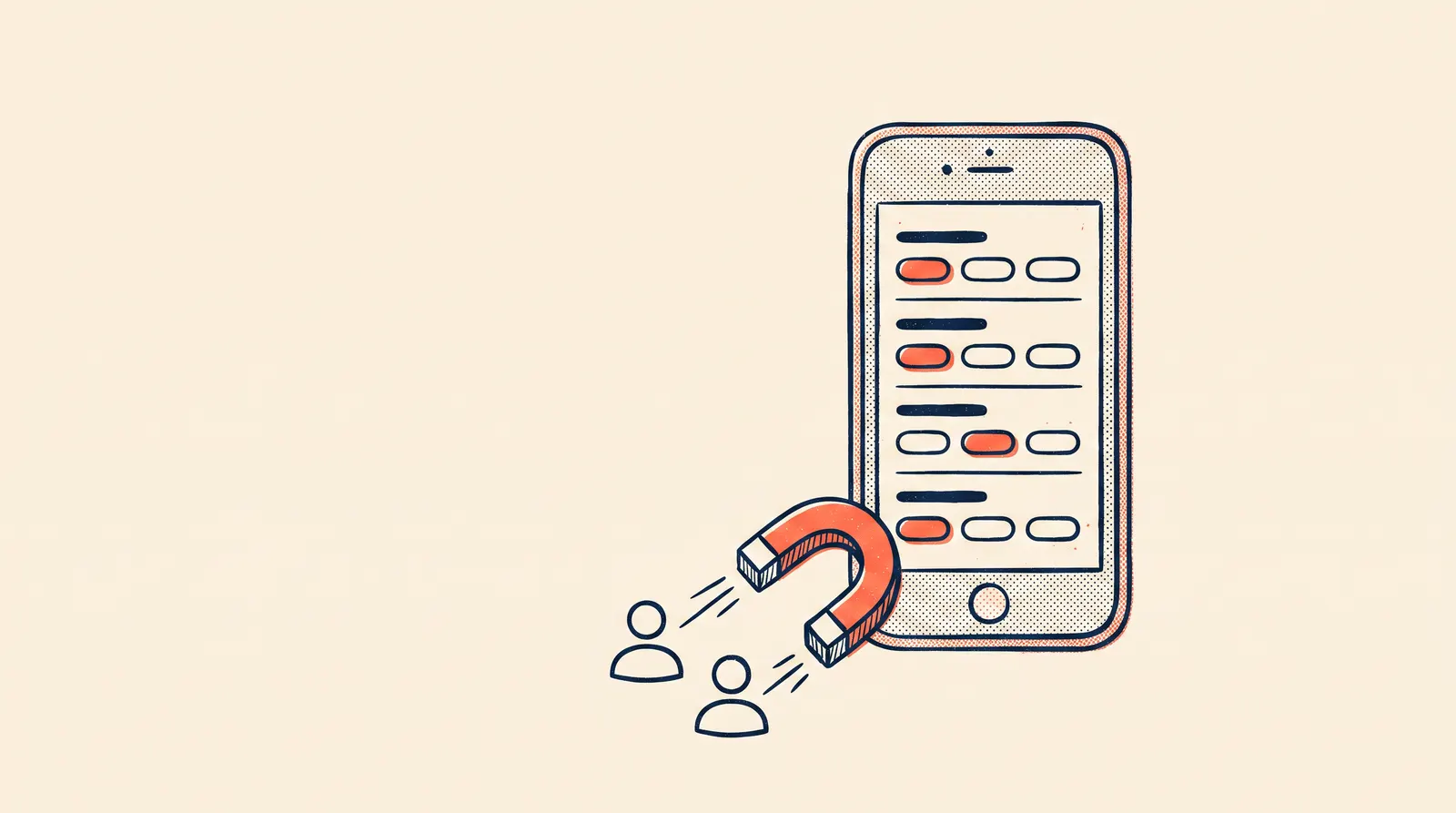

Turn a stranger into a lead with one good question.
Why a form loses and a quiz wins
A form asks you to give. A quiz offers to tell you something. Same fields, opposite feeling.
The evidence for the mechanism is better than the evidence for any particular multiple, so it is worth separating the two.
What is well established. Baymard Institute, whose checkout research runs to hundreds of thousands of hours of usability testing across the top-grossing US and EU sites, found that the average checkout in 2024 runs 5.1 steps and 11.3 form fields, and that 17% of users have abandoned a purchase because the process was too complicated.
The finding that matters most for you is the one people miss: the number of steps has less impact on performance than the total number of fields. Splitting a form across more screens does not hurt. Asking for more things does.
That is the entire case for the quiz, from independent research, in one sentence. A quiz is a form with the same number of answers spread across more steps, and each step showing less. Fewer fields visible at once, same information collected.
What is weaker. You will see claims that quizzes convert three to four times better, or sixteen times better. Those come from quiz and form vendors measuring their own product category. Typeform, looking at 2.6 million of its own forms, reported 47.3% completion for conversational formats against 21.5% for traditional ones. Treat that as directional. The direction is consistent everywhere it has been measured. The exact multiple is not, and anyone quoting a precise figure is quoting a vendor.
Build the quiz because the mechanism is sound, not because a number on a landing page promised you 4x.
The three-step framework
Every lead quiz that works has the same shape.
1. The hook. A question they already want answered.
"Which [X] is right for you?" beats "Get a free quote", because one of them is about them. The hook is the only thing standing between a stranger and the first tap, and a first tap is most of the battle.
Test it like this: read the hook aloud to someone outside your business. If they ask "what does that mean?", it is not a hook. If they answer it, it is.
2. The answers. Three to five easy taps.
Each answer quietly reveals where that person is: just looking, comparing, ready to buy. You are qualifying them while they experience being helped. That is not a trick, it is what a good salesperson does in the first thirty seconds of a conversation.
Keep options to a single line each. The moment someone has to read a paragraph to choose, the tap becomes a decision, and decisions are where people leave.
3. The result. The answer they came for, gated behind an email.
Make it specific to what they picked. A generic PDF after five personal questions feels like a bait and switch, and it teaches people that your emails are not worth opening. That costs you far more later than the address was worth.
The rule that makes it work
Every question must be one they would want answered even if you were selling nothing.
The moment a question exists purely to fill a field in your CRM, people feel it. Asking for company size in a quiz about whether their roof needs replacing is the tell. Ask it later, in the conversation, when it is relevant.
Designing the questions
Ask what changes the answer. If a question does not change what you tell them at the end, cut it. Most quizzes are two questions longer than they need to be, and each extra one costs completions.
Order them easy to hard. The first question should be almost thoughtless, because its only job is to get the first tap. Save anything requiring recall or judgement for question three, once they are committed.
Never make them type if they can tap. Baymard's finding about perceived effort applies here directly: the visible cost of a step, not its actual cost, is what makes people leave. A tap costs nothing. A text field with a keyboard sliding up costs a lot.
Ask for the email last, and say why. "Where should we send your result?" works. A bare email field at the start does not, because at that point you have given them nothing.
Four hooks that work for local service businesses
Adapt the shape, not the words.
| Business | Hook | What the answers reveal |
|---|---|---|
| Roofing | "How much life is left in your roof?" | Age, symptoms, urgency |
| Dental | "Which treatment actually fits what you want to fix?" | Cosmetic or clinical, budget band |
| Law | "Do you have a case worth pursuing?" | Matter type, timeline, readiness |
| Fitness | "What is actually stopping your progress?" | Goal, history, coaching fit |
Each of these is a question the person has already asked themselves. That is the only test that matters.
Build yours
- My quiz hook, the question they already want answered:
- Question 1, and its options, the easy first tap:
- Question 2, and its options:
- Question 3, and its options, the one that changes what I tell them:
- The result I deliver, and why it is worth an email address:
- The offer that follows the result, and what happens if they take it:
What to do with the answers
The answers are more valuable than the email address, and most businesses throw them away.
Someone who picked "just looking" and someone who picked "need this fixed this month" should not get the same follow-up. Tag them by their answers and send the ready ones straight to a human, today. The MIT and InsideSales research on lead response found contacting within five minutes rather than thirty made a lead 21 times more likely to qualify. A quiz that identifies a ready buyer and then drops them into a seven-day drip is a quiz working against you.
The rest go into the nurture sequence, and stay there until they are ready.
The common failure
Building a beautiful quiz and gating a worthless result.
The quiz is the easy part. The result is what earns the address, and if the result is a PDF that could have been a paragraph, everything downstream gets harder: opens, replies, bookings. Spend most of your effort on what they get, not on the form that gets it.
The rest of the guide is yours, free.
Enter your email to keep reading and get the PDF to keep.
No spam. One email unlocks every Massive Impact resource.
“Now we can see through the different sections and the forms, we can see a clearer path of how that lead becomes an actual booking.”
The service behind this
