

PLAYBOOK / COPYWRITING
253 Legendary Copywriting Swipes
The annotated swipe vault for 2026. 253 vintage long-form ads from 1905 to 2011. The 8 master copywriters who wrote most of them. The 10 patterns that repeat across every winning ad in history. The Top 50 broken down line by line. Modern translations for Facebook, LinkedIn, sales pages, email, and TikTok.

The annotated swipe vault for 2026. 253 vintage long-form ads from 1905 to 2011. The 8 master copywriters who wrote most of them. The 10 patterns that repeat across every winning ad in history. The Top 50 broken down line by line. Modern translations for Facebook, LinkedIn, sales pages, email, and TikTok.
Who this is for
Working copywriters. Founders writing their own copy. Agency owners building a house style. Content creators who need a real swipe file in 2026 and not a Pinterest board.
The swipe file is the only piece of $50,000 IP every working copywriter owns and almost nobody studies right. Most files sit in a Dropbox folder, get opened twice a year when a project stalls, and never compound into the skill they were supposed to compound into. This playbook is the operating manual that fixes that.
I have used the same 250-ish swipes for the last seven years. I have shipped Facebook ads, sales pages, cold emails, and webinar scripts off the back of them. The first three years I used them wrong (verbatim copy, no filing, no pattern study). Year four was the year the file started paying me back. The difference was a workflow, not a different file.
Brought to you by Massive Impact. Massive Impact is a free lead magnet library for founders, marketers, and operators. Playbooks, prompts, frameworks, and checklists at the Massive Impact resource library. Browse the full set at the Massive Impact resource library.
What is in this playbook
- Part 1, How to Use a Swipe File
- Part 2, The 8 Copywriters, Briefly
- Part 3, The 26 Category Map
- Part 4, The 10 Patterns That Repeat Across All 253 Swipes
- Part 5, The Top 50 Swipes, Annotated
- Part 6, Modern Translation Templates
- Part 7, The Daily Swipe Workflow
- Part 8, The Full Index
Part 1, How to Use a Swipe File
A swipe file is a private collection of ads, headlines, sales letters, and emails that have proven they sell. A working copywriter does not write from a blank page. A working copywriter pulls from the file, finds a structural match for the project on the desk, and adapts. That is the whole craft. The file is the craft library.
Most swipe-file owners do four things wrong. They copy verbatim. They never read the body. They file by author instead of category. And they never run the test that decides whether a swipe is worth keeping at all. Here are the five rules that fix that.
Rule 1, Study the pattern, not the verbatim
The Caples 1926 headline reads "They Laughed When I Sat Down at the Piano, But When I Started to Play!" Almost every swipe-file owner knows the line. Almost nobody can name the pattern, which is: social-proof opener (laughed), curiosity gap (but when), specific moment (started to play). That pattern works in 2026 if you write "They rolled their eyes when I quit my W-2, but when the first stripe hit." It does not work if you literally rewrite it as "They Laughed When I Sat Down at the Spreadsheet."
The pattern is portable. The words are not.
Rule 2, Modernize the language
Vintage ads use vintage syntax. Sentences are longer. Punctuation is heavier. The reader of 1959 had patience the reader of 2026 does not have. Take the pattern, then write the line in the rhythm of a 2026 caption. If you are translating Hopkins (who wrote in long, oratorical sentences), break his thought into three short ones. If you are translating Halbert (who already wrote in the punchy 1980s phone-call rhythm), you can stay closer to his cadence.
Rule 3, Swipe the hook and the structure, not the voice
The hook is the first 50 words. The structure is the order the argument is built in. Those two things are public domain. The voice belongs to the original writer and you cannot fake it without sounding like a tribute act.
Your client is hiring you because they want their voice on the page, not Halbert's. Halbert sells the framework that lets you write the page. He does not write the page for you.
Rule 4, File by category, not by author
Every swipe-file owner who organizes by author ends up with a file they cannot use. When you sit down to write a vitamin sales page, you do not need "everything Schwartz wrote." You need "every vitamin sales page that worked, regardless of who wrote it." The bundle that ships with this playbook is organized into 26 categories for that reason. Trust the category. Cross-reference by author second.
Rule 5, Run the 100-year test before swiping anything new
Before you add a new ad to the file, ask one question. Will this hook still work in 100 years? Most modern ads fail. They are too tied to a platform mechanic, a 2026 cultural reference, or a fad product category. The ones that pass are the ones built on durable human desires (look better, feel safer, earn more, belong, be respected, be desired, beat the rich kid).
The 253 swipes in this bundle all pass the 100-year test by being already 30 to 120 years old and still legible. That is the survivor's bias you want.
Why most swipe-file owners use them wrong
They copy lines instead of patterns. They file by author. They never run the daily reps. They confuse "I have a big swipe file" with "I have a big skill." The file is potential energy. The reps convert it.
Part 2, The 8 Copywriters, Briefly
The 253 swipes lean on eight names. One paragraph each. Era, signature pattern, and what they teach the 2026 writer.
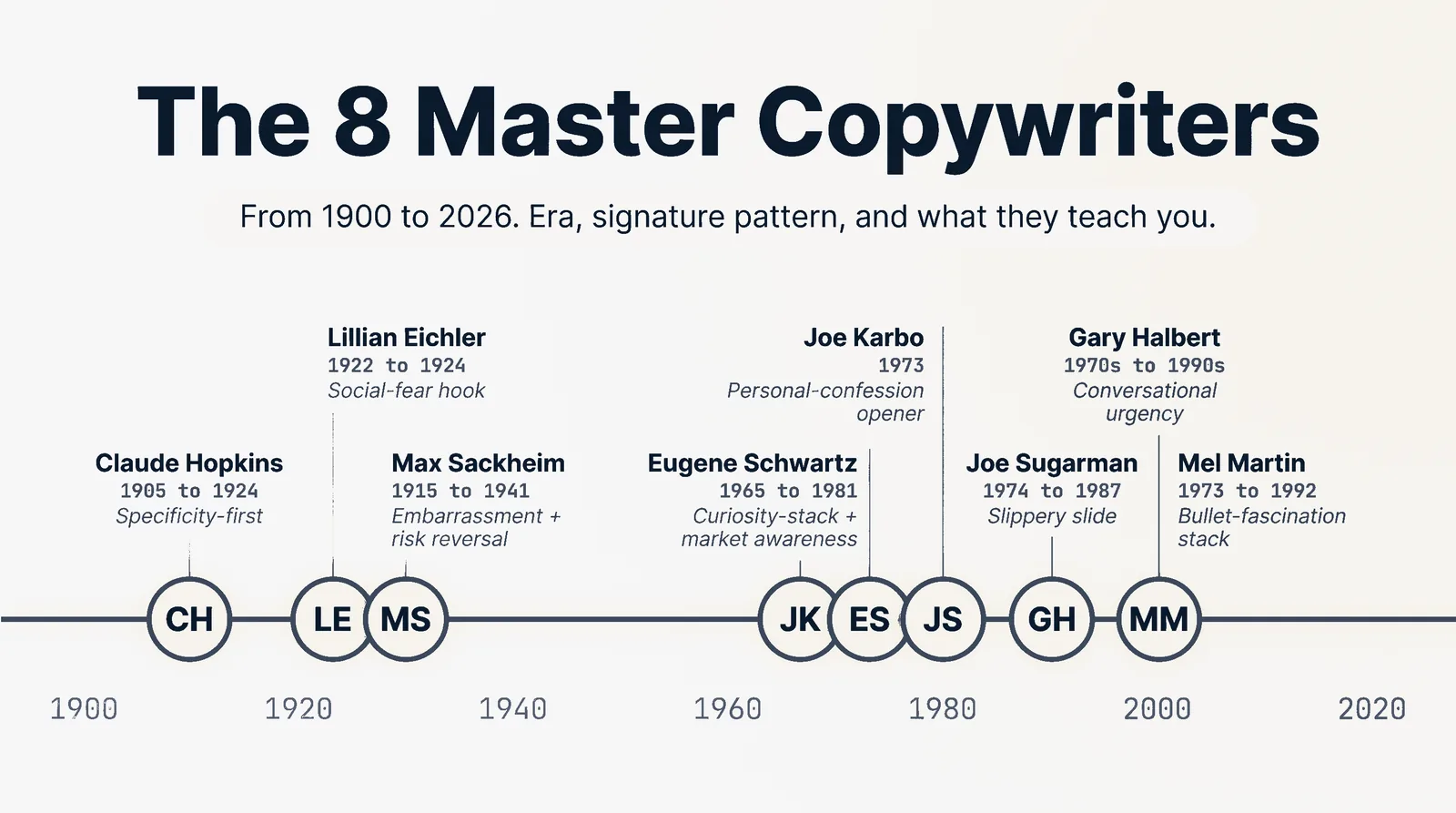
Claude Hopkins (1866 to 1932)
The father of measurable advertising. Wrote for Bissell carpet sweepers, Pepsodent toothpaste, Schlitz beer, Palmolive shave cream, Goodyear tires, between roughly 1905 and 1924. His signature pattern is specificity-first. The famous Schlitz beer ad explained, in detail, how the beer was sterilized, how the bottles were washed four times, how the brewery's water came from a 4,000-foot artesian well. Every other beer brewed the same way. Schlitz was the only one that said it. The lesson for 2026: the marketer who explains the obvious wins. Read his book "Scientific Advertising" once a year.
Gary Halbert (1938 to 2007)
The story-and-letter master of direct mail. Best known for "The Coat of Arms" letter that ran for years and pulled cold buyers off a list of 70 million households, and for the "Amazing Diet Secret of a Desperate Nerd From Ohio" sales letter. Wrote for Tova Borgnine cosmetics, Berry Trim, the Key West College of Millionaires, and dozens of small-list mailers. His signature pattern is conversational urgency. Reads like a letter from a friend who knows something you do not. The 2026 lesson: write to one buyer, write at a 4th-grade reading level, never start with the company.
Eugene Schwartz (1927 to 1995)
The thinking copywriter's copywriter. Wrote 13 winning Boardroom mailers including "Food Is Your Best Medicine" and "Aches and Pains Disappear," ran a fortune-making business writing one ad a week, then spending the rest of the week reading. His signature pattern is curiosity-stack and market-awareness staging. He wrote the book "Breakthrough Advertising," which is still the only $300 used paperback in the copywriting world. The 2026 lesson: the buyer is not at one stage of awareness, they are at five. Write to the stage they are actually in. The opener you use for "I have never heard of this product" is the wrong opener for "I have tried three competitors already."
Joe Sugarman (1938 to 2022)
The mail-order entrepreneur who built JS&A and BluBlocker sunglasses with long-form magazine ads. Wrote the "Pet Personal Computer," the "Sinclair Micro TV," the "BluBlocker" full-page New York Times ads. His signature pattern is the slippery slide. Every sentence is engineered to make the reader read the next sentence. He wrote a book called "The Adweek Copywriting Handbook" that lays out the slide explicitly. The 2026 lesson: the only job of any sentence is to keep the eye on the page for one more sentence. Test your copy by reading sentence one, then asking whether sentence two is impossible to skip.
Max Sackheim (1890 to 1982)
The cofounder of the Book of the Month Club, which he sold by direct mail starting in 1926. Wrote "Do You Make These Mistakes in English?" (one of the most famous headlines ever written, sold a self-improvement book for 50 years), the "How It Feels to Earn $1,000 a Week" Pelman Institute mailers, and the BOMC "It Costs You Nothing to Examine" letters. His signature pattern is the embarrassment hook plus the no-risk frame. The 2026 lesson: the buyer is afraid of two things, looking stupid and losing money. Address both before you address the product.
Joe Karbo (1925 to 1980)
A one-hit-wonder of incredible magnitude. Wrote a single full-page ad called "The Lazy Man's Way to Riches" and ran it from 1973 onward, selling more than 3 million copies of his $10 book by direct response. The ad is a personal confession (I am lazy, I do not work hard, here is what I do instead) wrapped around a no-risk money-back frame. His signature pattern is the personal-confession opener. The 2026 lesson: a confession that the buyer suspects is true about themselves disarms every defense they have. Open with the thing they are quietly afraid is true about them.
Lillian Eichler (1902 to 1988)
The copywriter behind the Book of Etiquette mailers (1922 to 1924), one of the earliest direct-mail bestsellers. Wrote "Has This Ever Happened to You?" and "Gives Poise and Charm" and "Both Are Embarrassed." Her signature pattern is the social-fear hook. Each ad opens with a tiny social-mistake scene the reader has lived through. The 2026 lesson: status anxiety sells in every century. The reader will never admit they care about looking foolish at a dinner party, and they will buy the book that promises they will not.
Mel Martin (1939 to 2014)
The Boardroom Inc. magalog king. Wrote dozens of fact-stacked mailers for Boardroom Reports, Bottom Line Personal, and the Bicyclist's Guide series. His signature pattern is the bullet-fascination stack. Each mailer was hundreds of curiosity-driven bullets ("What airlines do not want you to know about exit-row seats. Page 47.") that pulled the reader into a book-of-secrets purchase. The 2026 lesson: bullets are not summary, they are the sale. Learn to write a bullet that opens a loop the reader cannot close without buying.
The supporting cast
Inside the 74 Copywriting Legends ads you will also find David Ogilvy (Rolls-Royce, 1959), John Caples (They Laughed When I Sat Down, 1926, plus the Famous Writers School), Gary Bencivenga (Do You Make These Mistakes in Job Interviews, 1995), Drayton Bird (Bullworker 2, 1978), Ben Suarez (Jackie's Horoscope, 1985), Victor Schwab (How to Win Friends), Bud Weckesser, Ralph Ginzburg, Ted Nicholas (Form Your Own Corporation), and the JS&A staff (BoneFone, Home Library Computer, Sinclair Micro TV).
Part 3, The 26 Category Map
253 swipes across 26 categories. For each category: the count, why it still matters in 2026, and the signature swipe to study first.
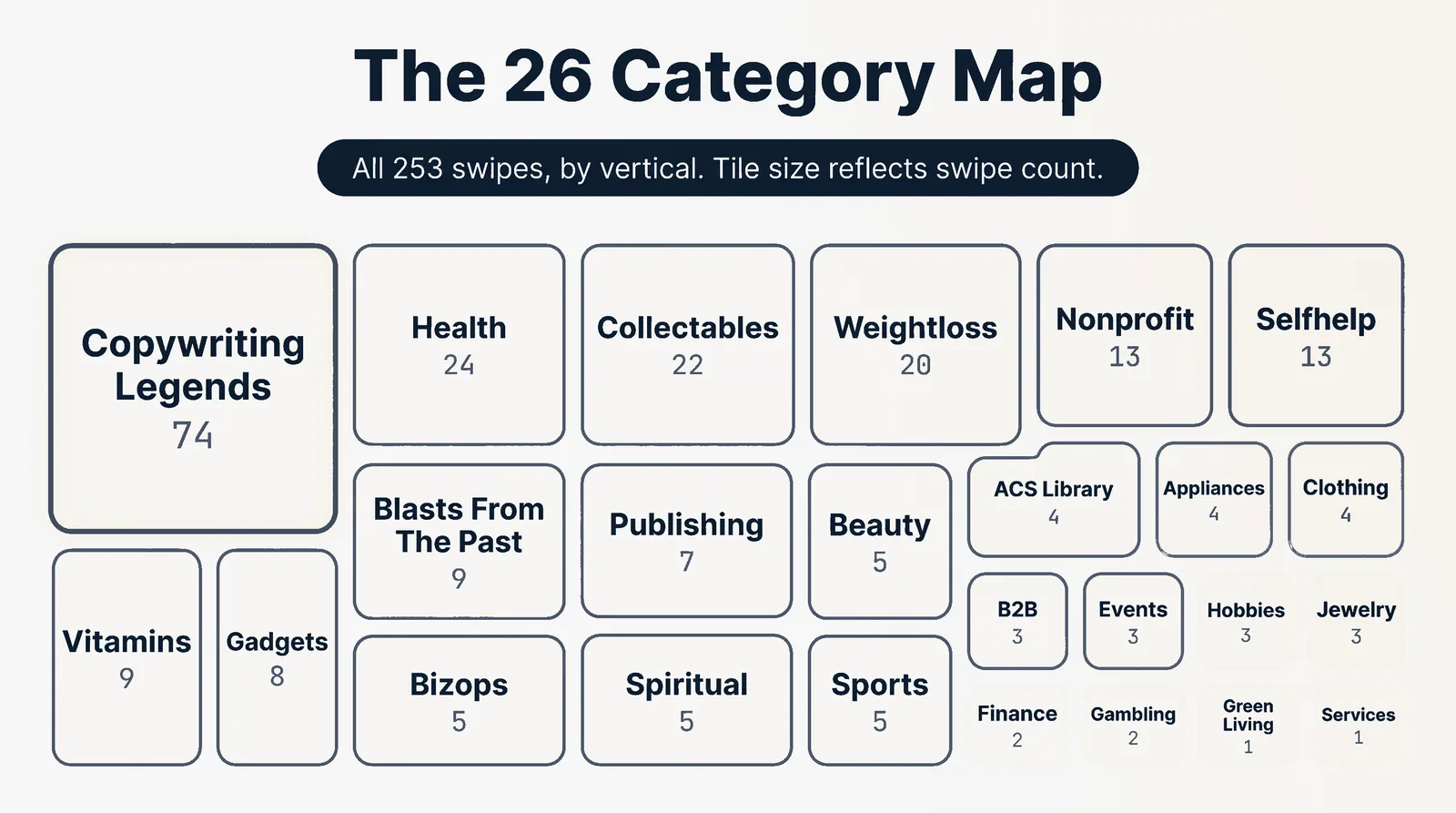
Copywriting Legends (74). The flagship folder. Hopkins, Halbert, Schwartz, Sugarman, Sackheim, Karbo, Eichler, Martin, plus Ogilvy, Caples, Bencivenga, Bird, Suarez, Schwab, Weckesser, Ginzburg, Nicholas. Why it matters in 2026: every modern direct-response style is a derivative of one of these eight voices. Start here: Caples, "They Laughed When I Sat Down."
Health (24). Vintage and modern medical-adjacent direct response. Asprin, Vicks, Pepto-Bismol, Bayer, Anahist, plus modern brain and joint and prostate and memory plays. Why it matters in 2026: the health buyer's psychology has barely moved. Pain, fear, hope, embarrassment. Same buttons. Start here: "Doctor Discovers Cure for Psoriasis" (1988).
Collectables (22). Coins, watches, sculpted figurines, sterling-silver tomahawks, commemorative jewelry. Why it matters in 2026: the entire NFT and collectible-resale market is a digital reskin of this exact category. Scarcity language and craftsmanship language sell the same way they did in 1990. Start here: "Mint Adds 6 to State Quarter Series."
Weightloss (20). A category where the same promise has been made for 100 years. Astro-Trimmer, Grapefruit Diet, Liquid Patch, Slimforce, Trimball. Why it matters in 2026: the GLP-1 era has not killed the category, it has expanded it. The hooks and the embarrassment frames still work. Start here: "Dumpy to Dazzling in 21 Days" (1985).
Nonprofit (13). Sally Struthers and the Christian Children's Fund. Sierra Club. Smile Train. Avon Breast Cancer Walk. Simon Wiesenthal Center. Why it matters in 2026: nonprofit copy is a master class in emotional pacing without compromising on the ask. Start here: Sally Struthers Christian Children's Fund (1985).
Selfhelp (13). Nightingale Conant, ICS adult education, LaSalle, Mark Haroldsen, Zig Ziglar audio sales. Why it matters in 2026: every modern info-product launch (cohort courses, subscriptions, 12-month coaching containers) descends from this category. Start here: "48 Ways to Get Know-How Most Men Do Not Have" (1965).
Vitamins (9). Foodform, ProFemma, Tibetan Secret, Resveratrol, Amidren, the Coq10 magalog. Why it matters in 2026: supplement direct-response is a $50 billion industry built on these mailer formats. Start here: the Coq10 Conspiracy magalog.
Blasts From The Past (9). Beltone hearing aid, Betty Crocker, Bosco, Brillo, Brylcreem, Listerine for dandruff. Why it matters in 2026: brand voice and tone of confidence in 1947 advertising will quietly upgrade your CPG and consumer-product writing. Start here: Listerine for Dandruff (1939).
Gadgets (8). Heathkit Christmas Catalog, Pet Personal Computer, the Brilliant Bridge Camelot. Why it matters in 2026: every Kickstarter copy doc is descended from this folder. Start here: the Pet Personal Computer (1978).
Publishing (7). Boardroom magalogs, Stansberry Research crisis-mailers, Soundview Executive Books. Why it matters in 2026: the entire newsletter-and-substack economy is a direct-line descendant. Start here: the Boardroom Bottom Line Health magalog.
Beauty (5). Hydroxatone, HairMax, Capilong, EB5. Skincare and haircare direct response on Facebook and TikTok runs on the same psychology. Start here: "Erase 10 Years in 10 Minutes."
Bizops (5). "How I Made $1,000,000 in Five Years," "How to Get Rich," Kevin Cameron's business opportunity. Every Twitter make-money-online thread is a recycled bizop ad. Start here: "How I Made $1,000,000 in Five Years" (1930).
Spiritual (5). Maria Duval's 33 Wishes, Madame Olga, Astral Reading 500 People, Rub the Buddha for Money. The largest direct-response operation in mailer history was a spiritual mailer (Maria Duval, $200M+). Start here: "33 Wishes."
Sports (5). "Add 15 to 20 Yards to Your Tee Shot," Matt Furey's Combat Conditioning, Yubiwaza. Instructional-improvement copy transfers cleanly to modern fitness funnels. Start here: Combat Conditioning.
The smaller folders. Appliances (4), B2B (3), Clothing (4), Food (4), ACS Library (4). ACS Library is the four foundational books (Hopkins, Robert Collier, Haldeman-Julius). Start there if you have not read them.
The thin folders. Events (3), Hobbies (3), Jewelry (3), Finance (2), Gambling (2), Green Living (1), Services (1). Each has at least one swipe worth a serious read. Start with Mother Earth Summer Seminars (1980), the great-European-beer ad (1984), the Stauer 1935 Speedster Watch.
Part 4, The 10 Patterns That Repeat Across All 253 Swipes
Read the file once and the patterns disappear. Read the file four times and they emerge as the entire craft. Here are the 10.
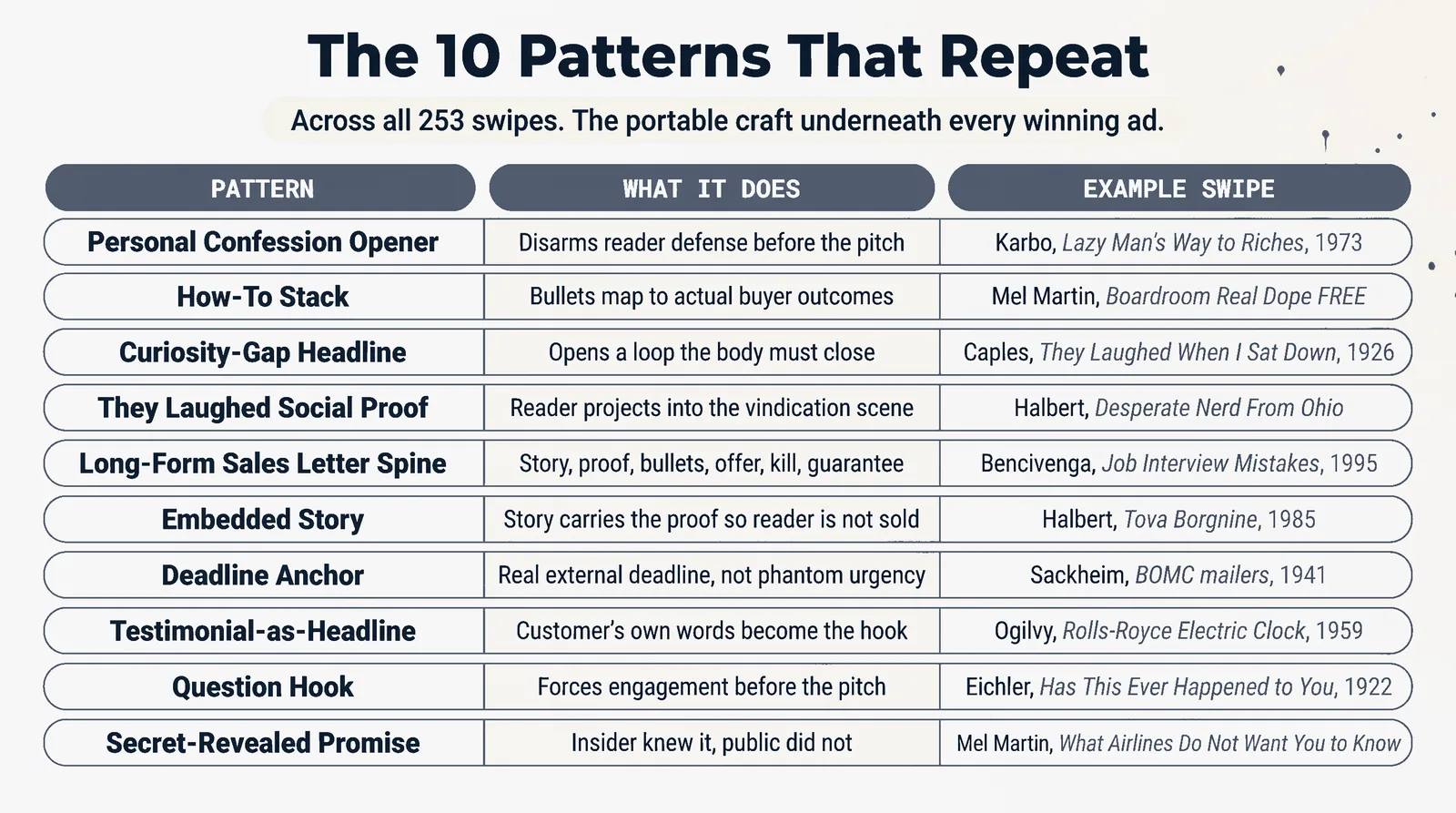
Pattern 1, The personal confession opener
The writer admits something embarrassing or unflattering about themselves in the first 50 words. Disarms the reader's defense. Builds trust before the pitch.
Example swipes: Joe Karbo, "The Lazy Man's Way to Riches" (1973). Halbert, "Amazing Money-Making Secret of a Desperate Nerd From Ohio." Bud Weckesser, "If You're Creative" (1976).
What to copy: open with the thing your buyer is quietly afraid is true about themselves. Not the thing you wish was true about you.
Pattern 2, The "how to" stack
A bullet list of how-to outcomes that map to the buyer's actual desires. Each bullet is a curiosity-loop close enough to feel reachable, far enough to feel new.
Example swipes: Mel Martin's Boardroom mailers (Real Dope FREE, Bicyclist's Guide). The Selfhelp ICS mailer. "48 Ways to Get Know-How."
What to copy: write 30 bullets, keep the 10 best. The ones that survive are the ones the buyer cannot stop thinking about.
Pattern 3, The curiosity-gap headline
A headline that opens a loop the reader needs the body copy to close. Specific enough to feel real, vague enough to demand the click.
Example swipes: Caples, "They Laughed When I Sat Down at the Piano, But When I Started to Play!" Sackheim, "Do You Make These Mistakes in English?" Bencivenga, "Do You Make These Mistakes in Job Interviews?"
What to copy: the gap is between something the reader expects (laughed, mistakes) and a counter-expected outcome (started to play, hired). The body fills the gap.
Pattern 4, The "they laughed" social proof
A specific scene where the narrator was mocked or doubted by a named group, then vindicated. Reader projects themselves into the narrator's shoes.
Example swipes: Caples, "They Laughed When I Sat Down" (1926). The 1930 "Snickered When I Got Up to Speak" Caples ripoff. The Halbert "Desperate Nerd From Ohio" letter.
What to copy: the doubters need to be specific (the in-laws, the boss, the ex-wife, the lab partner). The win needs to be public. The reader is buying the moment of vindication.
Pattern 5, The long-form sales letter spine
A 4,000 to 12,000 word letter that opens with story, transitions through proof, builds a stack of bullets, makes the offer, dismisses every objection, and closes with risk reversal. Same skeleton across decades.
Example swipes: Karbo, "The Lazy Man's Way to Riches." Halbert, "Amazing Diet Secret." Bencivenga, "Do You Make These Mistakes in Job Interviews." Suarez, "Jackie's Horoscope" (1985).
What to copy: the spine. Story, proof, fascinations, offer, objection-kill, guarantee, P.S. Use it for sales pages, webinar replays, and long emails.
Pattern 6, The embedded story
A complete short story is built into the middle of the long-form letter. The story carries the proof so the reader does not feel sold to.
Example swipes: Halbert, "Tova Borgnine Amazing New Formula" (1985). Sugarman, "Atari Explodes" (1986). Schwartz, "One Day With This Man Will Make You Rich" (Joe Cossman profile).
What to copy: the story should be true, named, dated, and concrete. Real characters, real moments. Fictionalized "imagine if" stories do not move the same way.
Pattern 7, The deadline anchor
The offer expires. The price goes up. The bonus disappears. The reader is told a specific reason the deadline is real (not "we are pulling this offer in 24 hours" but "the printer is running the next batch on the 14th").
Example swipes: Sackheim BOMC mailers, "It Costs You Nothing to Examine" (1941). The Stansberry Research Crisis 2011 mailer. Most of the Boardroom magalogs.
What to copy: tie the deadline to a real, external event. Printer schedule, regulatory change, supplier price hike. Phantom deadlines train the buyer to ignore future ones.
Pattern 8, The testimonial-as-headline
A direct quote from a customer is the headline. The body of the ad is the customer's story, expanded.
Example swipes: David Ogilvy's Rolls-Royce ad (1959, "At 60 miles an hour the loudest noise in this new Rolls-Royce comes from the electric clock"). Most of the Sugarman product launches. The Hopkins Liquozone "I'm Well" ad (1905).
What to copy: the headline should sound like something a real customer would say at a dinner party. Not marketing language inside quote marks. A real quote.
Pattern 9, The question hook
A direct question to the reader that they cannot answer no to. Forces engagement before the pitch.
Example swipes: Eichler, "Has This Ever Happened to You?" (1922). Eichler, "Are You the Kind of Guest?" (1923). Sackheim, "Do You Make These Mistakes in English?"
What to copy: the question must produce a specific yes from the reader's own life. "Have you ever made an embarrassing mistake at a dinner party?" works. "Are you tired of being broke?" does not (the answer is "I am not engaging with that").
Pattern 10, The secret-revealed promise
The headline promises an unknown piece of information. The body delivers it. The buyer pays for the part the body does not deliver.
Example swipes: "Amazing Diet Secret" (Halbert). "Tibetan Secret" (Vitamins folder). "Brain Oxygen Boosting Miracle" (Procera AVH). "What Airline Don't Want You to Know" (Mel Martin Boardroom).
What to copy: the secret has to feel like an insider knew it and the public did not. Industry insider, doctor, ex-employee, retired executive. Anonymous sources flat-out work.
Part 5, The Top 50 Swipes, Annotated
Format for each entry: title, copywriter, year, vertical, pattern, what to swipe, what NOT to copy, modern equivalent.
1. They Laughed When I Sat Down at the Piano | Caples | 1926 | Selfhelp | Curiosity gap + they-laughed proof. Swipe the structure (mock to vindicate). Do not copy the piano metaphor in 2026. Modern: "They rolled their eyes when I quit my W-2."
2. Do You Make These Mistakes in English? | Sackheim | 1920s | Selfhelp | Question hook + embarrassment. Swipe the question form. Do not literally use English. Modern: "Do you make these mistakes in cold email?"
3. The Lazy Man's Way to Riches | Karbo | 1973 | Bizops | Personal confession. Swipe the entire opener move. Do not copy the body verbatim, it reads dated. Modern: "The Lazy Founder's Way to a $10K Month."
4. Rolls-Royce Electric Clock | Ogilvy | 1959 | Cars/Luxury | Testimonial-as-headline + specificity. Swipe the specific-detail-as-claim. Do not pretend you have a luxury budget. Modern: "At full load, the loudest noise in this stack is the disk write."
5. Amazing Diet Secret of a Desperate Nerd From Ohio | Halbert | 1980s | Weightloss | Personal confession + secret reveal. Swipe the self-deprecation. Do not say "amazing." Modern: "How a Burned-Out Founder Lost 22 Pounds in 90 Days."
6. Tova Borgnine Amazing New Formula | Halbert | 1985 | Beauty | Celebrity-attached embedded story. Swipe the named-source frame. Do not buy a celebrity. Modern: a real founder's documented before-and-after.
7. Schlitz Beer Sterilization | Hopkins | 1911 | Food/Beverage | Specificity-as-marketing. Swipe the explain-the-obvious move. Modern: "Every SaaS encrypts at rest. Here is why ours actually does."
8. Pepsodent Teeth You Envy | Hopkins | 1922 | Health | Envy-trigger + simple before/after. Swipe the envy hook. Modern: "The inbox-zero pattern other founders quietly envy."
9. Bissell Carpet Sweeper | Hopkins | 1913 | Appliances | Demonstration in print. Swipe the show-the-mechanism move. Modern: a 30-second TikTok of the product working.
10. Goodyear No-Rim-Cut Tires | Hopkins | 1911 | Automotive | Problem-named, solution-named. Swipe the named-problem hook. Modern: "The Pixel-Perfect Crash. Why 80% of mobile checkouts fail."
11. Liquozone "I'm Well" | Hopkins | 1905 | Health | Testimonial-as-headline. Swipe the customer-words-as-headline pattern. Modern: a verbatim quote from a real customer email.
12. Has This Ever Happened to You? | Eichler | 1922 | Selfhelp | Question hook + embarrassment scene. Swipe the question opening into a tiny scene. Modern: "Have you ever opened a founder DM and not known what to say?"
13. Both Are Embarrassed | Eichler | 1922 | Selfhelp | Social-fear hook. Swipe the two-character embarrassment frame. Modern: "Your client just asked a question. Your team has not heard of it."
14. Gives Poise and Charm | Eichler | 1922 | Selfhelp | Aspirational outcome stack. Swipe the outcome-as-promise frame. Modern: "Gives founder confidence in any boardroom."
15. The Book of the Month Club, It Costs You Nothing | Sackheim | 1941 | Publishing | Risk reversal + deadline. Swipe the no-risk frame. Modern: "Try it free for 14 days. Cancel from the dashboard."
16. How It Feels to Earn $1,000 a Week | Sackheim | 1918 | Selfhelp | Aspirational testimonial. Swipe the in-the-moment aspiration. Modern: "How it feels to ship a $50K month after 18 months of zeros."
17. Pelman, Afraid to Face the Truth | Sackheim | 1925 | Selfhelp | Confrontation hook. Swipe the called-out frame. Modern: "Afraid your retainer client is about to leave?"
18. The 3D Sound Experience | Sugarman | 1983 | Gadgets | Slippery slide + product demo. Swipe the sentence-by-sentence pull. Modern: a long-form Twitter thread that builds tension.
19. Atari Explodes | Sugarman | 1986 | Gadgets | Embedded story + news hook. Swipe the news-style framing of a product launch. Modern: a Substack note that reads like a news brief.
20. The Pet Personal Computer | JS&A | 1978 | Gadgets | Long-form magazine ad. Swipe the explain-everything approach. Modern: a 4,000-word product page.
21. The Sinclair Micro TV | JS&A | 1978 | Gadgets | Curiosity headline + specs body. Swipe the size-of-thing-versus-power hook. Modern: "The whole CRM in 3 keyboard shortcuts."
22. The BoneFone | JS&A | 1979 | Gadgets | Naming-the-product-as-headline. Swipe the made-up word as memorable handle. Modern: a product name worth tweeting.
23. The Alarm Clock With a Brain | Sugarman | 1974 | Gadgets | Personification + benefit. Swipe the metaphor-as-product-name move. Modern: "The CRM with a memory."
24. The Brain Drops Calculator | Sugarman | 1974 | Gadgets | Naming + curiosity. Swipe the unexpected metaphor. Modern: "The Slack alert with a backbone."
25. The Digital Watch Breakthrough | Sugarman | 1977 | Gadgets | Newness frame + scarcity. Swipe the breakthrough framing. Modern: "The inbox-triage protocol nobody is talking about."
26. Form Your Own Corporation for Under $50 | Ted Nicholas | 1977 | Selfhelp | Specific dollar promise. Swipe the price-as-headline. Modern: "Launch your LLC in 11 minutes."
27. Bullworker 2 | Drayton Bird | 1978 | Sports | Long-form direct mail + before/after. Swipe the body-photos-as-proof move. Modern: a documented founder transformation.
28. Do You Make These Mistakes in Job Interviews? | Bencivenga | 1995 | Selfhelp | Question hook. Swipe the Sackheim pattern updated. Modern: "Do you make these mistakes in client onboarding?"
29. Launch Your Own Business Without Quitting | Bencivenga | 1980 | Bizops | Permission frame. Swipe the no-quitting safety frame. Modern: "Build your agency on the side without losing your salary."
30. Jackie's Horoscope | Ben Suarez | 1985 | Spiritual | Celebrity + fortune-telling frame. Swipe the named-figure-as-anchor. Modern: a named-founder case study with specific months and dollars.
31. China Reveals | Halbert | 1980s | Bizops | Geopolitical secret hook. Swipe the geographic-secret frame. Modern: "Berlin Reveals. The 4-step founder protocol selling on EU LinkedIn."
32. Berry Trim | Halbert | 1988 | Weightloss | Story-driven supplement letter. Swipe the founder-discovers-the-formula story. Modern: a SaaS founder's discovered-the-loop story.
33. Boxtops Into Gold | Halbert | 1980s | Bizops | Conversion hook. Swipe the transform-trash-into-money frame. Modern: "Turn old client emails into a $5K product."
34. Collect Social Security at Any Age | Halbert | 1974 | Selfhelp | Loophole hook. Swipe the bypass-the-rule frame. Modern: "Trigger the Stripe payout schedule on any plan."
35. Do Not Read This Unless You Are Already Rich | Halbert | 1980s | Bizops | Reverse psychology hook. Swipe the exclusion-as-invitation move. Modern: "Do not subscribe unless you are already running a 7-figure agency."
36. Open Letter to Pro Models | Halbert | 1980s | Beauty | Letter-format ad. Swipe the open-letter form. Modern: "An open letter to first-time founders."
37. Dr. Shoop's Restorative, Just To Prove | Hopkins | 1905 | Health | Free-trial-as-proof frame. Swipe the prove-it-yourself move. Modern: a 14-day free SaaS trial framed as scientific proof.
38. Palmolive Shave Cream Five New Joys | Hopkins | 1924 | Beauty | Outcome-stack. Swipe the named-benefit-list. Modern: "5 new wins your sales team did not know they needed."
39. My Farewell Car | Hopkins | 1912 | Automotive | Sentimental-product-launch. Swipe the founder-emotion-attached-to-product. Modern: a closing letter to the V1 of a product before V2 ships.
40. Famous Writers School | Caples | 1960s | Selfhelp | Aspirational career frame. Swipe the named-legacy-faculty as authority. Modern: "Built by a team that includes 3 ex-Stripe engineers."
41. The Robert Collier Letter Book | ACS Library | 1931 | ACS Library | Reference text. Swipe the chapter structure for any sales-letter you write. Modern: a numbered framework PDF.
42. Scientific Advertising | Hopkins | 1923 | ACS Library | Reference text. Swipe the principle-by-principle structure. Modern: a 30-page founder operating manual.
43. The First Hundred Million | Haldeman-Julius | 1928 | ACS Library | Reference text. Swipe the headline-testing methodology. Modern: a 10-headline split-test on every cold email.
44. Real Dope FREE | Mel Martin | 1980s | Publishing | Bullet-fascination stack. Swipe the secret-list-as-bait. Modern: "27 founder loops nobody is shipping yet."
45. Bicyclist's Guide | Mel Martin | 1980s | Sports | Niche-bullet stack. Swipe the niche-deep-bullet frame. Modern: "The 41 Stripe error codes every SaaS founder should memorize."
46. What Airlines Do Not Want You to Know | Mel Martin | 1992 | Selfhelp | Insider-secret frame. Swipe the industry-insider-spills frame. Modern: "What ad agencies do not want you to know about retainer pricing."
47. The Coq10 Conspiracy | Vitamins | 2003 | Vitamins | Magalog conspiracy frame. Swipe the medical-establishment-hides frame, ethically. Modern: "The cold-email conspiracy. Why deliverability rules are designed to fail you."
48. 53 Amazing Secrets That Let You Collect Social Security | Finance | 1993 | Finance | Bullet-stack + government loophole. Swipe the loophole frame. Modern: "11 SaaS billing structures the IRS treats more favorably than the rest."
49. Sally Struthers Christian Children's Fund | Nonprofit | 1985 | Nonprofit | Personal-portrait nonprofit ask. Swipe the one-named-child frame. Modern: a single customer's story replaces the broad case study.
50. Stansberry Research Crisis 2011 | Publishing | 2011 | Publishing | Long-form fear-of-missing-out + deadline + insider authority. Swipe the spine in full. Modern: a long-form essay-style sales page with named macro events as anchor.
Part 6, Modern Translation Templates
Five classic swipe lines. Each one rewritten for five 2026 channels. Original on top, translation underneath.
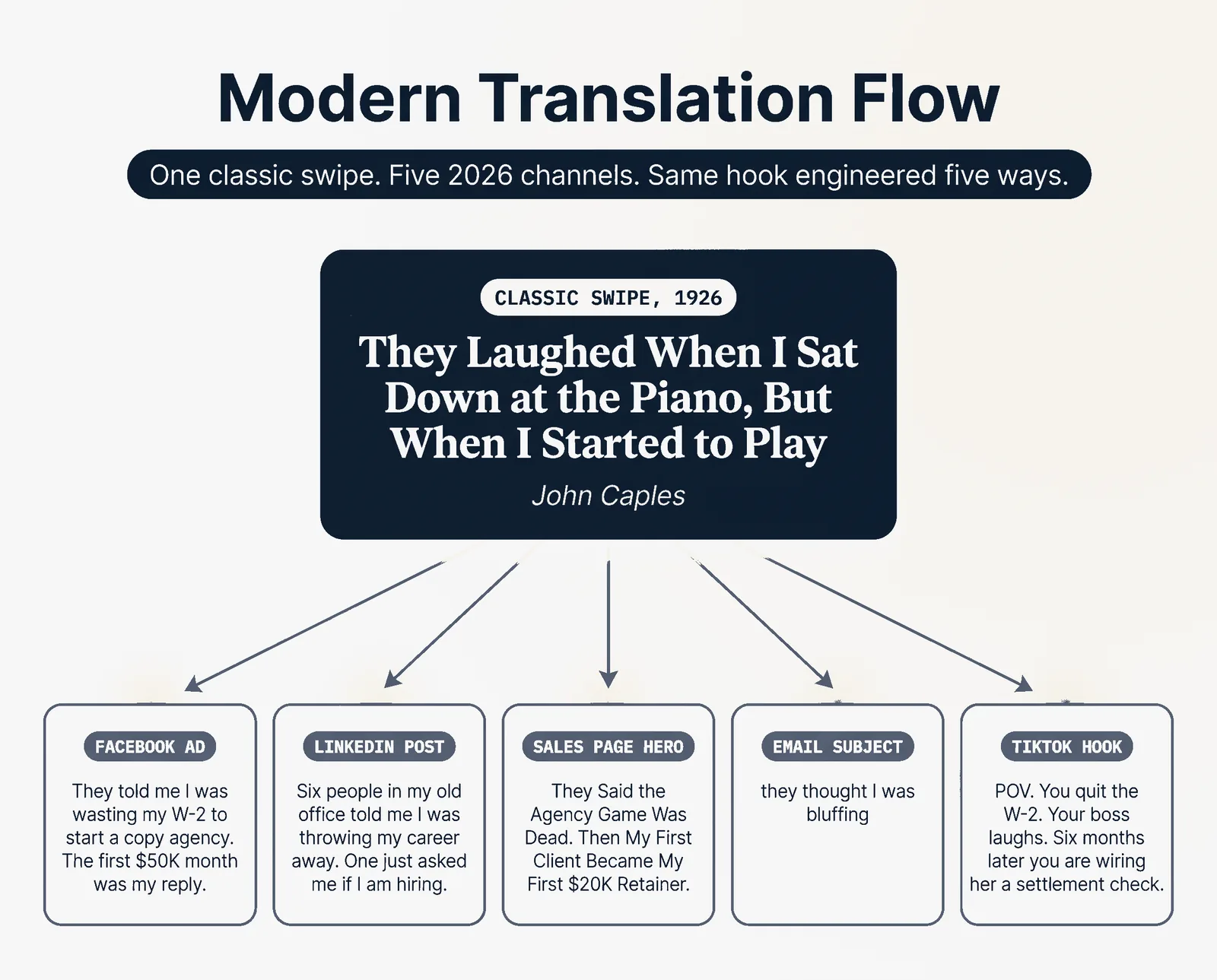
Translation 1, Caples 1926
Original headline: "They Laughed When I Sat Down at the Piano, But When I Started to Play!"
- Facebook ad: "They told me I was wasting my W-2 to start a copy agency. The first $50K month was my reply. Read the breakdown."
- LinkedIn post: "Six people in my old office told me I was throwing my career away. One of them just asked me if I am hiring. Here is what I built in 18 months."
- Sales page hero: "They Said the Agency Game Was Dead. Then My First Client Became My First $20K Retainer."
- Email subject line: "they thought I was bluffing."
- TikTok hook script: "POV. You quit the W-2. Your boss laughs. Six months later you are wiring her a settlement check."
Translation 2, Sackheim "Do You Make These Mistakes in English?"
Original headline: "Do You Make These Mistakes in English?"
- Facebook ad: "Do you make these mistakes in cold email? 9 in 10 founders do, and the inbox punishes them for it."
- LinkedIn post: "Three cold-email mistakes I see in every founder's outbound. The third one is killing your reply rate. Comment 'list' for the breakdown."
- Sales page hero: "Do You Make These 7 Mistakes in Your First-Touch Sales Email?"
- Email subject line: "you are doing this wrong (most are)."
- TikTok hook script: "Three mistakes in your cold emails that are tanking your reply rate. Number two will make you mad."
Translation 3, Karbo "Lazy Man's Way to Riches"
Original headline: "The Lazy Man's Way to Riches"
- Facebook ad: "I am a lazy founder. I do not work weekends. I do not do daily standups. I do four things on a Tuesday and ship Friday. Here is the system."
- LinkedIn post: "Confession. I built my agency on 25 hours a week. Here are the 4 systems that bought me back the other 40."
- Sales page hero: "The Lazy Founder's Way to a Real Agency. 25 Hours, 6 Clients, $80K MRR."
- Email subject line: "the lazy founder protocol."
- TikTok hook script: "How I built a 6-figure agency on 25 hours a week. I am not a workaholic. I am the opposite."
Translation 4, Halbert "Amazing Diet Secret"
Original headline: "The Amazing Diet Secret of a Desperate Nerd From Ohio"
- Facebook ad: "The cold-email hack of a burned-out founder from Sacramento. 22 reply-rate, no AI tricks. The breakdown is in the link."
- LinkedIn post: "Real talk. I was a desperate founder in Sacramento 2 years ago. Here is the one cold-outbound move that changed everything."
- Sales page hero: "The Brutally Honest Outbound Playbook of a Burned-Out Founder Who Almost Quit Last Year."
- Email subject line: "the desperate-founder cold-email move."
- TikTok hook script: "I was 2 weeks from quitting. Then I tried this one cold-email move. Now my agency is at 60 grand a month."
Translation 5, Sugarman "Slippery Slide"
Original principle: every sentence is engineered to make the reader read the next one.
- Facebook ad opener: "I am about to tell you the part of the agency game nobody puts in the playbook."
- LinkedIn post opener: "There is a thing nobody tells you about the first 6 months of running an agency."
- Sales page hero opener: "There is a question every founder asks at month 14 that nobody answers honestly."
- Email subject line: "the part nobody puts in the playbook."
- TikTok hook script (first 3 seconds): "There is a thing about agency money that nobody on this app will tell you."
Part 7, The Daily Swipe Workflow
The file is the asset. The workflow is what makes the asset compound. Here is the daily practice that turns 253 swipes into a real craft skill in 30 days.
The morning study (10 minutes)
One swipe per morning. Pick by category, not by author. Read the full ad, not just the headline. Then write three notes in your own swipe journal.
- The hook (the first 50 words, what move is being made)
- The pattern (which of the 10 patterns from Part 4)
- The transferable line (one sentence you can adapt to a current project)
10 minutes. Daily. Skip a day and the practice resets.
The application (during the work day)
Every time you sit down to write a real piece of copy (a Facebook ad, a sales page, an email, a webinar slide), open your swipe journal first. Find the morning's pattern. Apply it to the live project. Even if you do not use the line in the final draft, the act of trying forces the pattern into muscle memory.
The swipe is for the project on the desk.
The filing (end of week)
Friday afternoon, 20 minutes. Open your swipe journal. Pull the 5 best lines you wrote that week. File them in your own pattern library, organized by hook type (confession opener, question hook, secret reveal, etc.). After 6 months you will have your own version of this swipe file, except every line in it is a line that worked in a 2026 project.
This is how a working copywriter compounds. Not by reading more swipe files. By generating their own.
The 30-day swipe practice plan
- Days 1 to 7. One swipe a morning from Copywriting Legends. Goal: see the patterns emerge.
- Days 8 to 14. One swipe a morning from Health, Weightloss, or Vitamins. Goal: study high-emotion hooks.
- Days 15 to 21. One swipe a morning from Selfhelp, Bizops, or Spiritual. Goal: study aspirational hooks.
- Days 22 to 28. Pick freely from Collectables, Gadgets, Publishing, Nonprofit. Goal: study niche-specific patterns.
- Days 29 to 30. Reread your own swipe journal. Pick the 5 lines worth keeping forever. Start your own pattern library.
After 30 days the swipe file is no longer a Dropbox folder. It is a working asset.
Part 8, The Full Index
The bundled ZIP that ships with this playbook contains all 253 PDFs in the same folder structure as the source. Top-level: 26 category folders. Inside Copywriting Legends: 8 named subfolders for the 8 master copywriters, plus the loose Bencivenga, Bird, Caples, Ogilvy, Schwab, Suarez, Nicholas, and Weckesser ads.
How the index is organized in the ZIP
Legendary-Copywriting-Swipes/
  ACS Library/                       (4 PDFs)
  Appliances/                        (4 PDFs)
  B2B/                               (3 PDFs)
  Beauty/                            (5 PDFs)
  Bizops/                            (5 PDFs)
  Blasts From The Past/              (9 PDFs)
  Clothing/                          (4 PDFs)
  Collectables/                      (22 PDFs)
  Copywriting Legends/               (74 PDFs)
    Eichler/                         (7 PDFs)
    Halbert/                         (10 PDFs)
    Hopkins/                         (8 PDFs)
    J Sanda/                         (3 PDFs)
    Karbo/                           (1 PDF)
    Martin/                          (6 PDFs)
    Sackheim/                        (10 PDFs)
    Schwartz/                        (6 PDFs)
    Sugarman/                        (12 PDFs)
    [loose at top: Bencivenga, Bird, Caples, Ogilvy, Schwab, Suarez, Nicholas, Weckesser]
  Events/                            (3 PDFs)
  Finance/                           (2 PDFs)
  Food/                              (4 PDFs)
  Gadgets/                           (8 PDFs)
  Gambling/                          (2 PDFs)
  Green Living/                      (1 PDF)
  Health/                            (24 PDFs)
  Hobbies/                           (3 PDFs)
  Jewelry/                           (3 PDFs)
  Nonprofit/                         (13 PDFs)
  Publishing/                        (7 PDFs)
  Selfhelp/                          (13 PDFs)
  Services/                          (1 PDF)
  Spiritual/                         (5 PDFs)
  Sports/                            (5 PDFs)
  Vitamins/                          (9 PDFs)
  Weightloss/                        (20 PDFs)
How to work the file in practice
The Top 50 in Part 5 are the explicit must-reads. Read those first (one per day, then you have a 50-day starter program built in).
For the other 203, treat the categories as your filter. When you sit down to write a vitamin sales page, open the Vitamins folder and read every ad in it. When you write a coin or NFT-style scarcity offer, open Collectables. When you write an aspirational self-improvement page, open Selfhelp.
Filename convention is consistent: [Copywriter or brand]-[product or angle]-[year].pdf for most files. Year is included on the historical ads so you can date-stamp the era.
What is not in the bundle
A handful of modern direct-response pieces are not in the bundle for licensing reasons (Agora Financial mailers, modern Boardroom magalogs, current GLP-1 long-form sales pages). The 253 in the bundle are all old enough or commonly circulated enough that copywriters have been studying them in private files for decades.
If you want to add modern swipes to your own file, run the 100-year test from Part 1. The ad has to be built on a durable human desire. If the ad relies on a 2026 platform mechanic that may not exist in 2032, do not file it.
The closing thought
The 8 copywriters who wrote most of these ads are dead or retired. Their files are still doing work in every direct-response funnel running in 2026. You inherit the file by reading it. You inherit the skill by writing through it.
Read one ad a morning. Write through it during the day. File the best line on Friday. In 30 days you have a working asset. In 12 months you have a craft.
Get to work.
The rest of the guide is yours, free.
Enter your email to keep reading and get the PDF to keep.
No spam. One email unlocks every Massive Impact resource.
“You gave me a structure that I could work with when I didn't even understand that structure was lacking.”
The service behind this
More from the library
