

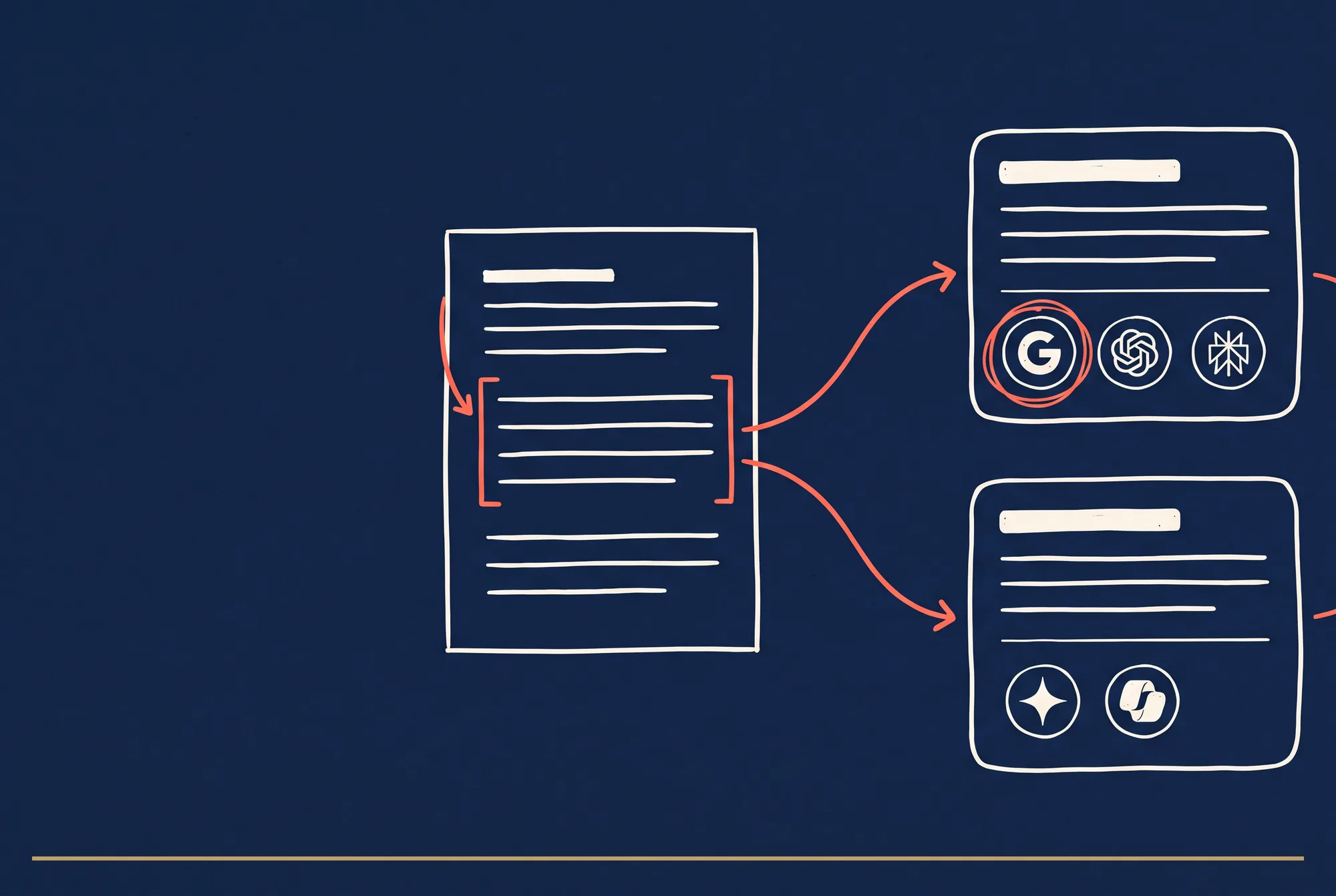

AI Overviews now show on more than half of Google searches. Entertainment queries saw 528% growth in AI Overview presence. Two-thirds of consumers do not fact-check AI sources before choosing a business.
The page-level rules, the 4-tier query framework, and the worked example for getting cited by ChatGPT, Perplexity, Gemini, and Google AI Overviews.
What's actually in this playbook
Four parts, structured the way you actually optimize a site for AI search.
Part 1 covers the AI search shift, the difference between AEO and GEO, and what changed in how citations get awarded. Part 2 is the 9 universal AEO rules every page must follow. Part 3 is the 4-tier query framework that tells you which of your keywords AI Overviews will show on. Part 4 is a worked example end to end plus a 32-question audit checklist for any existing page.
If you only have ten minutes, skim Part 2 and apply the universal rules to your single most important page. Most teams see citation lift within 4 weeks just from that.
Part 1, The AI Search Shift and AEO vs GEO
What changed
Three structural shifts in the past 18 months changed search.
Shift 1, AI Overviews arrived in Google. Google now shows an AI-generated answer at the top of more than half of search results pages. The answer is built from named, cited sources. Users get the answer without clicking. The brands that get cited get the visibility; the rest get pushed below the fold.
Shift 2, ChatGPT, Perplexity, Gemini, and Copilot routed informational searches around traditional results entirely. ChatGPT alone is 88% more likely than Google to be used for informational searches. 58% of users have replaced traditional search with AI tools for service discovery. The AI assistant gives the answer; the user takes it.
Shift 3, Trust shifted from "links to sources" to "what AI told me." 67% of consumers do NOT fact-check AI sources before choosing a local business. The AI's recommendation is treated as the truth. Whoever AI cites gets the customer.
The new ranking signal: extractability
Traditional SEO ranks pages by relevance, authority, and link graph. AI search adds a fourth signal: extractability. Can the AI lift a quotable answer cleanly from your page?
A page can rank #1 organically and still not get cited by AI if the content is not formatted for extraction. A page can rank #5 organically and get cited heavily if the content is structured for clean extraction. Extractability is now its own ranking surface.
The good news: extractability is a writing and structure problem, not an authority problem. You can earn it on every page in a week.
AEO vs GEO
The terms get used interchangeably. They are not the same.
AEO (Answer Engine Optimization) targets third-party AI platforms: ChatGPT, Perplexity, Gemini (the standalone product), Copilot, and any future AI assistant that returns answers based on web content. AEO covers what gets cited when a user asks an AI directly.
GEO (Generative Engine Optimization) targets Google specifically: AI Overviews at the top of Google SERPs, AI Mode, Featured Snippets, and the various AI features Google ships into search results. GEO is about getting cited inside Google's AI features, not by external AIs.
The page-level rules overlap heavily. The distinction matters when you start measuring (different platforms, different tracking) and when you decide which optimizations to prioritize.
Why both matter
If you only optimize for traditional Google rankings, you lose the citations to whoever optimized for AEO and GEO. If you only optimize for AI Overviews and ignore organic ranking, you lose because 99% of AI citations come from top-10 organic results. Organic ranking is the entry ticket. AEO and GEO are how you get cited once you are eligible.
The playbook below covers both. The universal rules in Part 2 apply equally. The query-tier framework in Part 3 helps you pick which queries to chase first.
What a successful AEO/GEO program looks like
Three signals you are doing it right:
Branded queries return your full answer in the AI Overview, citing your domain. Search "[your brand] pricing" or "[your brand] reviews" and the AI Overview should pull from your own pages.
Category queries name your brand in the answer. Search "best [category] in [city]" or "[category] for [use case]" and your brand should appear in the AI's recommendation list.
Long-tail informational queries pull quotes from your content. Search a question your blog answers and the AI Overview should quote your page.
Hit all three and your organic traffic rebuilds around the new SERP shape rather than collapsing under it.
The rest of the Massive Impact library builds on patterns like this. See the full set at the Massive Impact resource library.
Part 2, The 9 Universal AEO Rules
These rules apply to every page on your site. Skip a rule and the page becomes harder to extract from. Apply all 9 and the page becomes consistently citable across AEO and GEO.
Rule 1, The Direct Answer Block (DAB)
Place a 40-to-60 word factual summary immediately after the H1, before any other content.
The DAB is the passage AI extracts and quotes when answering questions about the page topic. It must contain the most important facts in a self-contained block: who or what the page is about, where it is, what it offers, what makes it credible.
Example DAB for a local business homepage:
Acme Coffee Roasters is a specialty coffee company in Portland, Oregon, rated 4.9 on Google with 1,840 reviews. Acme roasts single-origin beans from 12 countries and ships nationwide. The Portland flagship cafe serves espresso, pour-over, and pastries seven days a week from 6:30 AM to 8:00 PM.
The DAB hits the four core data points: name, location, what it does, credibility marker. Everything an AI needs to cite it correctly.
Rule 2, Entity naming
Use the full proper brand name at least 3 times per page. Never rely solely on "we" or "our service."
AI assistants build a knowledge graph of entities mentioned on a page. If your brand name is replaced by pronouns throughout, the AI has no entity to cite. The page exists; the entity does not.
Three placements that consistently work:
- The DAB (Rule 1)
- A standalone "About [Brand]" section
- The closing paragraph or CTA
Rule 3, Fact density
Include a statistic, number, date, or named entity every 150 to 200 words.
AI extracts factual claims much more reliably than opinion. A page that says "we have great service" is unquotable. A page that says "we serve 1,200 customers per week with an average response time under 4 minutes" is quotable in three different ways.
The fact density target is roughly one quotable fact per short paragraph. Star ratings, review counts, years in business, group capacity, success rates, hours, locations, prices, named team members, named partners, named clients all qualify.
Rule 4, Short paragraphs
Two to three sentences per paragraph. Maximum.
AI ignores walls of text. A 6-sentence paragraph buried in the middle of a page reduces extractability for the entire page, not just that section. Break long paragraphs even when it interrupts the prose flow.
The visual cue: every paragraph fits in a single screen on mobile without scrolling.
Rule 5, Structured headings (H2 and H3)
Use question-based H2s and H3s that match real user queries.
Bad H2: "Our Approach"
Good H2: "How does Acme Coffee source its beans?"
The good version mirrors how a user types a question into ChatGPT. AI maps the question to your H2 and pulls the answer from the section below it.
A common test: pick an H2, paste it into Google or ChatGPT. If the search returns relevant content, the H2 is well-shaped. If the search returns nothing, the H2 is too internal-jargon-heavy.
Rule 6, Lists and tables
AI extracts lists and tables far more reliably than prose.
Whenever you have data that fits a comparison, a sequence, or a set of options, structure it as a list or a table. Pricing tiers, feature comparisons, hours by day, locations, team members, FAQ answers all benefit from being structured.
A specific example: pricing.
Bad (prose):
Our basic plan is $19 per month and includes up to 5 users. The pro plan is $49 per month and includes 20 users with priority support. Enterprise pricing is custom.
Good (table):
| Plan       | Price/month | Users | Support     |
|------------|-------------|-------|-------------|
| Basic      | $19         | 5     | Standard    |
| Pro        | $49         | 20    | Priority    |
| Enterprise | Custom      | 100+  | Dedicated   |
The table is extracted cleanly. The prose version often gets misquoted (the AI confuses Basic and Pro pricing).
Rule 7, FAQ section with FAQPage schema
Every page should have 4 to 8 FAQs at the bottom, marked up with FAQPage JSON-LD schema.
Two reasons:
- Direct extraction. AI assistants pull answers from FAQ blocks more reliably than from any other page format. A well-placed FAQ section is the highest-citation-yield content per word on the page.
- Featured snippets. Google's traditional Featured Snippet feature pulls from FAQ schema almost exclusively now. The same schema that helps AEO helps GEO.
Pick the FAQs from your actual support tickets and your sales call objections. Generic FAQs ("Where are you located?") are wasted slots.
Rule 8, Last-updated dates visible on every page
Display a "Last updated: [date]" line on every page, visibly. Update it (and the underlying content) at least once per quarter.
Pages not updated quarterly lose AI citations at roughly 3x the rate of pages updated regularly. AI assistants weight recency heavily, both for factual claims and for source trustworthiness.
The mechanism: "Last updated" dates feed into both AI source-trust signals and Google's freshness signal for AI Overviews. Stale content shifts citations to whichever competitor updated more recently.
Rule 9, No filler
Cut marketing fluff. AI ignores keyword stuffing and prefers factual, neutral, authoritative language.
The phrases that mark filler in AI parsing:
- "We pride ourselves on..."
- "Industry-leading..."
- "Best-in-class..."
- "Cutting-edge..."
- "Innovative solutions..."
- "Take your business to the next level..."
Every one of those phrases gets discounted by AI as marketing noise. Replace with specific, factual statements:
| Filler | Specific replacement |
|---|---|
| Industry-leading service | 4.9 stars across 1,840 reviews |
| Cutting-edge technology | Built on PostgreSQL 16 with 99.95% uptime |
| Innovative solutions | The first roastery in Portland to use the Loring smartroaster |
The replacement is always available. It is harder to write because you have to know your specifics. That difficulty is what makes the page citable.
Why all 9 rules matter together
You can apply 7 of these and still see modest results. The compounding happens when all 9 are present on the same page.
A page with the DAB, entity naming, fact density, and FAQ schema, but with long paragraphs and no last-updated date, gets cited occasionally but loses citations to competitors who hit all 9. The marginal improvement from applying the last 2 rules is often the difference between "cited sometimes" and "cited consistently."
This pattern is one piece of a wider toolkit. Adjacent playbooks at the Massive Impact resource library.
Part 3, The 4-Tier Query Framework and AI Overview Probability
Not every keyword you target will trigger an AI Overview. Predicting which queries will is the difference between optimizing the right pages first and wasting effort on pages that will never get cited.
The 4-tier framework maps user intent to AI behavior. It works for any niche.
Tier 1, High-intent transactional queries
Queries with clear purchase or commitment intent. The user is choosing among options.
Examples (across categories):
- "Best [category] in [city]" (e.g., "best escape rooms in Boise")
- "[Category] near me"
- "[Category] for [specific use case]"
- "How much does [service] cost in [city]"
AI behavior: AI typically returns a list of 3 to 7 named businesses or products with brief one-line descriptions, ratings, and a recommendation.
Pages to target: category landing pages, location hub pages, pricing pages, comparison pages.
Hit rate: AI Overview triggers on roughly 60 to 80% of Tier 1 queries.
Tier 2, Experience and event queries
Queries focused on a specific occasion or experience type.
Examples:
- "Best [activity] for birthday parties in [city]"
- "[Activity] for team building"
- "Best [activity] for date night in [city]"
- "[Activity] for groups of [size]"
AI behavior: AI returns a curated list filtered for the specific use case, often with pros and cons per option.
Pages to target: use-case landing pages (team building, birthday parties, date nights, corporate events), occasion-specific guides.
Hit rate: AI Overview triggers on roughly 50 to 70% of Tier 2 queries. Higher when the occasion is calendar-driven (holidays, summer activities, weekend plans).
Tier 3, Informational and discovery queries
Queries where the user is researching, not ready to buy.
Examples:
- "How do [things] work?"
- "What is [concept]?"
- "Are [products] good for [use case]?"
- "[Activity] tips for first-timers"
- "Things to do in [city] on a [day/condition]"
AI behavior: AI returns a comprehensive answer to the question, often citing multiple sources for different aspects of the answer.
Pages to target: blog posts, FAQ pages, "how X works" explainer pages, evergreen guides.
Hit rate: AI Overview triggers on 80 to 95% of Tier 3 queries. This is the highest-volume tier and the highest-trigger-rate tier. It is also the tier most teams under-invest in because it does not directly drive revenue.
Tier 4, Comparison and decision queries
Queries where the user is comparing two or more options head-to-head.
Examples:
- "[Brand A] vs [Brand B]"
- "[Category A] or [category B] for [use case]"
- "Which [product] is the best [attribute]?"
- "[Brand] reviews"
- "Is [brand/product] worth it?"
AI behavior: AI returns a structured comparison with pros and cons per option, often pulling from review sentiment.
Pages to target: versus pages (Brand A vs Brand B), reviews and testimonials pages, "is X worth it" content.
Hit rate: AI Overview triggers on roughly 70 to 85% of Tier 4 queries. The clearest path to getting your brand named in citations is showing up in comparison answers.
AI Overview probability table
A simplified table you can use to prioritize. Rough probabilities based on field testing across multiple verticals.
| Query type | Examples | AI Overview probability |
|---|---|---|
| Local business / "best X in Y" | "best dentist in Austin" | 70 to 85% |
| Pricing inquiries | "how much does X cost" | 60 to 80% |
| Use-case landing | "X for birthday parties" | 50 to 70% |
| Informational ("how does X work") | "how do escape rooms work" | 80 to 95% |
| FAQ-style ("are X good for Y") | "are escape rooms good for kids" | 75 to 90% |
| Comparison ("X vs Y") | "Stripe vs Square" | 70 to 85% |
| Branded ("[brand] reviews") | "Acme Coffee reviews" | 60 to 80% |
| Pure navigational | "[brand] login" | 5 to 15% |
| Pure transactional ("buy X") | "buy iPhone 15" | 10 to 25% |
The pattern: the more answer-shaped the query, the more likely AI Overview triggers. Pure transactional and pure navigational queries skip the AI Overview because the user is past the research phase.
Where to invest first
Three rules for picking the first 5 pages to optimize.
Rule 1, Start with Tier 1 + Tier 4
Tier 1 (high-intent transactional) drives the closest revenue. Tier 4 (comparison) is the easiest to win because most competitors do not have a real comparison page. Get cited in comparison answers and you appear in shoplists for the same buyer.
Rule 2, Cover all 4 tiers, not just the highest-revenue one
Optimizing only Tier 1 is the most common mistake. The buyer may search a Tier 3 informational query weeks before they search Tier 1. If you are not cited in the Tier 3 answer, the buyer learns about you from a competitor before they ever look up your category.
Cover all 4 tiers, weighted toward the queries you can actually win.
Rule 3, Map every page to one query tier
Every page on your site should know which tier it serves. A page that tries to serve two tiers (a "what is X and where to buy it" hybrid) typically loses to a focused page in either tier. Split when in doubt.
Tracking AI Overview presence
Two ways to track whether your pages are being cited.
Manual sample. Once a week, search 10 of your target queries directly in Google. Note whether an AI Overview appears, and whether your domain is among the cited sources. Cheap, low-volume, surfaces directional changes.
Automated tracking. Tools like Otterly.ai, AthenaHQ, Profound, and Peec AI track AI Overview citations across hundreds of queries. Use these once you have proven the optimization works on a small sample and want to scale tracking.
The metric to watch: percentage of your target queries where your domain appears in the AI Overview citation list. Baseline that number, then track it weekly.
Part 4, A Worked Example and the 32-Question Audit Checklist
A worked example: optimizing one page from scratch
Note on this example. The page below is illustrative. The structure and rules are real; the brand and specifics are constructed for demonstration. Apply the structure to your own real pages.
The setup. A small specialty coffee roaster with two cafe locations and a national online store. Targeting Tier 1 query "best coffee roaster in Portland" and Tier 2 query "specialty coffee for offices in Portland."
The page. The Portland cafe location hub: /portland/.
Step 1, Write the Direct Answer Block
Acme Coffee Roasters operates two specialty coffee cafes in Portland, Oregon. The flagship cafe at 1820 NW 23rd Avenue serves espresso, pour-over, and pastries seven days a week from 6:30 AM to 8:00 PM. Acme roasts single-origin beans from 12 countries and ships nationwide. The Portland cafes are rated 4.9 on Google with 1,840 reviews combined.
Hits the four DAB elements: name (Acme Coffee Roasters), location (Portland, OR), what (specialty coffee with two cafes), credibility (4.9 stars, 1,840 reviews, single-origin from 12 countries).
Step 2, Add entity naming throughout
The full brand name "Acme Coffee Roasters" appears in:
- The DAB
- An "About Acme Coffee Roasters" section midway down the page
- The closing CTA ("Visit Acme Coffee Roasters at our Portland flagship")
Three placements. Confirms the entity to AI.
Step 3, Hit fact density
Every short paragraph carries a quotable fact:
- "Acme's flagship Portland cafe seats 38 customers across the main floor and the back garden."
- "Acme sources beans from 12 countries including Ethiopia, Colombia, Honduras, Guatemala, Brazil, Costa Rica, Kenya, Rwanda, Burundi, Indonesia, Peru, and Mexico."
- "The corporate coffee subscription serves 84 Portland-area offices with weekly bean deliveries starting at $128 per month."
- "Acme has been roasting in Portland since 2014 and won a Roaster of the Year award from Coffee Review in 2022."
Star ratings, review counts, capacities, country counts, customer counts, prices, founding year, awards. One quotable fact per short paragraph.
Step 4, Structure with question-based H2s
H1: Acme Coffee Roasters in Portland, Oregon
[DAB]

H2: Where can I find Acme Coffee in Portland?
[Locations table with addresses, hours, phone numbers]

H2: What does Acme Coffee serve?
[Espresso menu, pour-over options, pastry partnerships]

H2: How does Acme source its beans?
[Single-origin sourcing, farm relationships, roasting process]

H2: Does Acme Coffee deliver to offices?
[Corporate subscription details, pricing, included services]

H2: What makes Acme different from other Portland roasters?
[Three concrete differentiators with named comparisons]

H2: Frequently asked questions
[6 to 8 FAQs with FAQPage schema]
Every H2 mirrors a real query someone could type into Google or ChatGPT. AI maps the question to the H2 and pulls the answer from below.
Step 5, Use lists and tables wherever possible
- Locations as a table (address, hours, phone, parking notes)
- Bean origins as a list with country and tasting notes
- Subscription tiers as a table (price, frequency, included beans)
- FAQ as a structured list with FAQPage schema
Step 6, Add the FAQ section with schema
Six FAQs pulled from actual support tickets and sales conversations:
{
  "@context": "https://schema.org",
  "@type": "FAQPage",
  "mainEntity": [
    {
      "@type": "Question",
      "name": "What are Acme Coffee Roasters' Portland hours?",
      "acceptedAnswer": {
        "@type": "Answer",
        "text": "The flagship cafe at 1820 NW 23rd Avenue is open daily from 6:30 AM to 8:00 PM. The second location at 4400 SE Hawthorne Boulevard is open 7:00 AM to 7:00 PM."
      }
    },
    {
      "@type": "Question",
      "name": "Does Acme Coffee deliver to offices in Portland?",
      "acceptedAnswer": {
        "@type": "Answer",
        "text": "Yes. Acme's corporate subscription delivers freshly roasted beans to 84 Portland-area offices weekly, starting at $128 per month for a 5-pound bag."
      }
    }
  ]
}
Two more questions plus answers for each FAQ. Each answer is a complete sentence the AI can quote without modification.
Step 7, Add the last-updated date
A visible "Last updated: April 24, 2026" line in the footer of the page (and ideally near the H1).
Step 8, Cut the filler
Before:
Acme Coffee Roasters takes pride in delivering industry-leading specialty coffee experiences. Our cutting-edge roasting techniques and innovative sourcing approach have positioned us as the premier coffee destination in Portland.
After:
Acme Coffee Roasters has roasted in Portland since 2014. The team sources single-origin beans directly from farms in 12 countries and uses a Loring smartroaster (the first in Portland) for batch roasting. The two cafes are rated 4.9 on Google with 1,840 reviews.
Same paragraph length. Different extractability. The "before" version contains zero quotable facts. The "after" version contains six.
The 32-question audit checklist
Run this on any existing page. Each question is yes-or-no. The score tells you where to invest.
Direct Answer Block (rules 1 to 4)
- Does the page have a 40-to-60 word factual summary immediately after the H1?
- Does that summary include the brand name?
- Does that summary include a location (if relevant)?
- Does that summary include a credibility marker (rating, count, year, award)?
Entity naming (rule 5 to 8)
- Does the full brand name appear at least 3 times on the page?
- Is the brand name used in the DAB?
- Is the brand name used in a midpage section header or about block?
- Is the brand name used in the closing CTA or footer?
Fact density (rules 9 to 12)
- Does every short paragraph contain at least one quotable fact (number, date, named entity)?
- Does the page include at least one specific star rating or review count?
- Does the page include at least one specific year or date?
- Does the page include at least one specific named partner, customer, or supplier?
Paragraph length (rules 13 to 14)
- Is every paragraph 3 sentences or fewer?
- Are there zero paragraphs that exceed half a mobile screen?
Headings (rules 15 to 18)
- Is at least one H2 phrased as a real-user question?
- Do the H2s collectively cover the top 3 questions a buyer would ask?
- Are the H2s scannable (clear topic from the heading alone)?
- Do H3s nest logically under their H2 parents?
Lists and tables (rules 19 to 21)
- Does the page use at least one table for comparison data (pricing, features, locations, hours)?
- Does the page use lists for sequences and option sets rather than prose?
- Are list items short and parallel in structure?
FAQ schema (rules 22 to 25)
- Does the page have an FAQ section with 4 to 8 questions?
- Are the FAQs marked up with FAQPage JSON-LD schema?
- Are the FAQ questions phrased as real user queries?
- Are the FAQ answers self-contained (quotable without context)?
Freshness (rules 26 to 27)
- Does the page display a visible "Last updated" date?
- Has the page been substantively updated within the past 90 days?
Filler check (rules 28 to 30)
- Has all marketing fluff (industry-leading, cutting-edge, innovative, etc.) been removed?
- Has every claim been replaced with a specific, verifiable fact?
- Are there zero phrases that read as keyword stuffing?
Cross-page consistency (rules 31 to 32)
- Does the brand name appear identically across all pages (no abbreviations, no variations)?
- Do all pages have the same structural skeleton (DAB, structured H2s, FAQ block, last-updated date)?
How to use the checklist
Score the page out of 32. Three thresholds:
- 24 to 32: the page is AI-ready. Track citations weekly and refine.
- 16 to 23: the page has the bones. Fix the missing rules in priority order (DAB, entity naming, fact density first).
- Below 16: the page is a rewrite. Apply all 9 universal rules from Part 2 and re-audit.
Most existing pages score in the 8 to 16 range on first audit. Getting to 24+ takes 2 to 4 hours per page. The lift in citations typically shows within 3 to 6 weeks of publishing the updated page.
Closing
The AEO and GEO Playbook is 9 universal rules, 4 query tiers, and a 32-question audit. Apply it to your most important pages first; expand from there.
If you only do three things from this playbook:
- Add a Direct Answer Block to every page that does not have one. This single change alone produces the biggest citation lift.
- Convert your prose pricing and feature comparisons to tables. AI extracts tables far more reliably than prose.
- Run the 32-question audit on your top 5 pages this week. Fix anything below 24 out of 32.
Built more like this at the Massive Impact resource library.
The rest of the guide is yours, free.
Enter your email to keep reading and get the PDF to keep.
No spam. One email unlocks every Massive Impact resource.
“We saw a huge improvement in our SEO, overtaking our competitors, and our Google Ads performance also saw a big boost.”
The service behind this
More from the library
