

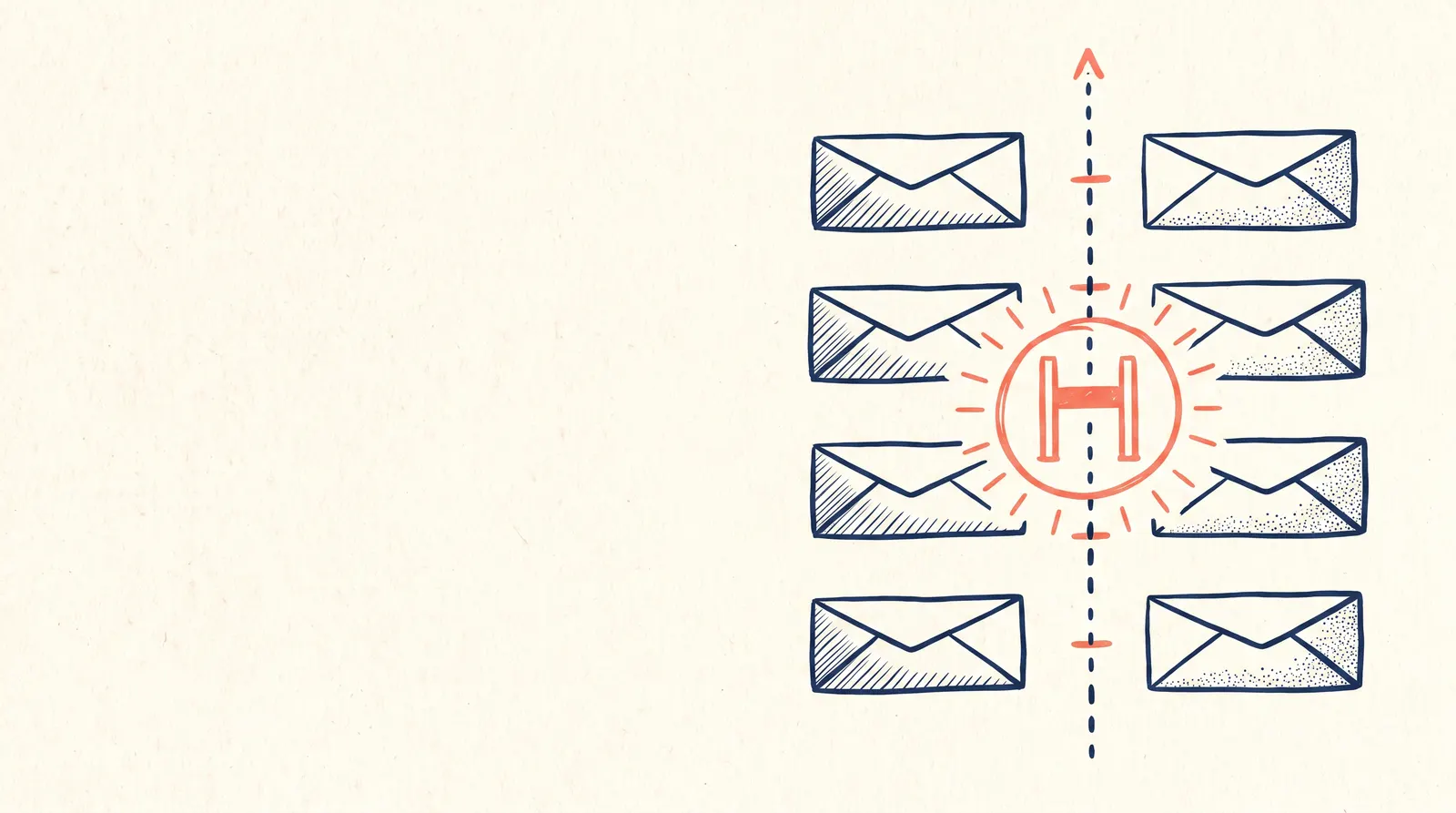

Set up follow-up that runs while you sleep.
Most of the people who find you are not buying today
Chet Holmes put roughly 3% of any market in buying mode at a given moment, with the other 97% somewhere between open and unaware. That split comes from The Ultimate Sales Machine, and it is a planning rule of thumb rather than a measured constant, but the shape of it holds: the people who find you today are mostly not ready today.
Which leaves two options. Talk only to the 3%, and compete with everyone else for the same small group. Or capture the rest and stay useful until they are ready.
The second is what follow-up is for. Not nagging. Staying remembered by someone who will need you in six weeks.
Speed matters more than sequence
Before any of the sequence below, one thing outranks all of it.
The MIT and InsideSales study of six companies, more than 15,000 leads and over 100,000 call attempts found that contacting a lead within five minutes rather than thirty made them 100 times more likely to be reached and 21 times more likely to qualify.
Two things worth being precise about, because this statistic gets mangled constantly.
It is often misattributed to Harvard. It is MIT and InsideSales, published 2007. There is a separate Harvard Business Review study from 2011 that audited 2,241 companies, found an average first-response time of 42 hours, and found firms responding within an hour were seven times more likely to qualify a lead than those who waited one more hour.
It is about outbound contact, not email automation. The 100x figure is connect rate on a phone call. It does not mean your Day 0 email must arrive in five minutes, though it should arrive immediately anyway.
The practical version for a local business: if someone fills in a form during working hours, a human should be in touch that hour. The sequence below runs underneath that, it does not replace it.
The four-message sequence
Four messages. Not fourteen. The goal is to stay useful and stay remembered, not to fill an inbox until someone unsubscribes.
Send these automatically after someone opts in. Keep them short and human. No templates that sound like a company wrote them.
Day 0, Deliver
Give them exactly what they asked for, immediately, plus a warm hello from a person. No pitch.
The only job of this email is to prove you do what you said you would. Someone just traded you their email address on the promise of a thing. Ship the thing, fast, with no conditions attached.
Say who you are in one line. Say what is coming next in one line, so the following emails are expected rather than a surprise. That single sentence is most of the difference between a sequence people read and a sequence people report as spam.
Day 1, The problem
Name the problem they are feeling, in their own words.
Not your service. Their problem. If they read only this one message and nothing else, they should come away feeling that you understand their situation better than the competitor whose email is also sitting in that inbox.
This is where the words from your customer research earn their keep. If you have done the clarity work, you already have the exact phrases they use. Use them, not your industry's.
Day 3, The proof
One short story about someone like them.
A real result, a real name where you have permission, a real number. One specific story beats five generic testimonials, because a story has a before, and the before is where your reader currently is.
Publish ratios, percentages and rankings. Never a client's raw revenue or private spend. If you cannot name them, anonymise by industry, and never pair a named result with an anonymised one in the same breath.
Day 7, The invite
A clear, low-pressure next step.
Say exactly what happens if they take it. "A fifteen-minute call where we look at your site and tell you the first thing we would change" is an invitation. "Book a consultation" is a mystery, and people do not agree to mysteries.
Give one option, not three. A choice between a call, a quote and a newsletter is a decision, and a decision at this stage is a reason to close the tab.
What happens after day 7
The four messages do their job and then stop. What you do next depends on what they did.
They replied or booked. They are out of the sequence and into a real conversation. Make sure your automation actually stops, because nothing undoes a good first impression like a nurture email arriving the day after a human spoke to them.
They opened but did nothing. They are interested and not ready. Move them to whatever you send monthly. One useful thing a month keeps you present without costing you attention.
They opened nothing at all. Let them go. A list of people who do not open is not an asset, it is a deliverability problem, and it drags down whether your emails reach the people who do want them.
Write yours
Fill these in with your own words. If a line sounds like a company wrote it, rewrite it as though you were typing it to one person you actually know.
- Day 0, the subject line, and the one sentence saying what is coming next:
- Day 1, their problem in their words, not yours:
- Day 3, the proof story, one person, one result, one number you can stand behind:
- Day 7, the invite, and exactly what happens if they take it:
The rule that keeps this honest
If a message would not be worth sending on its own, cut it.
A three-message sequence that earns the open is worth more than a nine-message sequence that trains people to ignore your name. Every message is spending a small amount of the goodwill you earned when they gave you their address. Spend it on things worth reading.
The rest of the guide is yours, free.
Enter your email to keep reading and get the PDF to keep.
No spam. One email unlocks every Massive Impact resource.
“I like that every time I need to follow up on something, the replies from your staff are already there for me.”
The service behind this
