

PLAYBOOK / GROWTH
The 2026 Customer Acquisition Bible
The synthesis of Meta, Google, TikTok, low-ticket funnels, and SaaS funnels. Cross-channel attribution, blended CAC math, AI agents, three audience swimlanes, and the 90-day launch plan for SaaS, professional services, and local businesses on $500 to $10,000 monthly budgets.

The synthesis of Meta, Google, TikTok, low-ticket funnels, and SaaS funnels. Cross-channel attribution, blended CAC math, AI agents, three audience swimlanes, and the 90-day launch plan for SaaS, professional services, and local businesses on $500 to $10,000 monthly budgets.
Who this is for
Solo founders, in-house growth operators, and agency builders running paid acquisition stacks across SaaS, professional services, and local businesses in 2026. Budgets between $500 and $10,000 per month. Three audience swimlanes covered: SaaS (B2B and prosumer), professional services (doctors, dentists, lawyers, advisors, home services), and local businesses (restaurants, fitness, salons, real estate).
This is a tactical reference, not a survey. Eight parts. Use Part 2 to pick your channel mix, then drop into the relevant single-channel playbook (P26 to P30) for the per-platform tactical depth.
What is in this playbook
- Part 1, The 2026 Customer Acquisition Reality
- Part 2, Channel Mix Decision Tree by Vertical x Budget
- Part 3, Cross-Channel Attribution Stack
- Part 4, Acquisition Math Across All Channels
- Part 5, AI Agents in 2026 Acquisition
- Part 6, The Three Audience Swimlanes (SaaS / Pro Services / Local)
- Part 7, The Compliance Master List
- Part 8, The 90-Day Launch Plan + 15 Failures
Part 1, The 2026 Customer Acquisition Reality
The five-channel paid acquisition stack changed materially in the last twelve months. The synthesis matters because no single channel works in isolation in 2026.
The cross-channel shifts
| Surface | Shift | Date | Synthesis implication |
|---|---|---|---|
| Meta | Andromeda + Adaptive Ranking | Q1 2026 | Creative is the lever; Meta + Google together delivers durable acquisition |
| AI Max replaces DSA, PMax Channel Performance Timeline | Q1 to April 2026 | Google captures intent Meta cannot; pair them | |
| TikTok | USDS Joint Venture restructuring | Jan 22, 2026 | Platform stable; non-ecom workable for 50% of verticals |
| iOS attribution | 7-day click + 1-day view standard | Jan 12, 2026 | Server-side + offline conversion + MMM is the durability layer |
| Stripe | $15 + $15 chargeback fee | Mid-2025 | Continuity copy must survive dispute monitoring |
| FTC Click-to-Cancel | Vacated, ANPRM reissued | Jul 2025 to Jan 2026 | State enforcement (CA, NY) still applies |
| Amazon Prime settlement | $2.5B FTC settlement | Sep 2025 | Subscription clarity bar reset for SaaS continuity |
| AI agents | Operational in lead qualification, outbound, creative | Through 2025 to 2026 | New layer in the funnel, not a replacement |
What stays the same
- The brand-search defense layer is still mandatory before non-brand prospecting
- The activation moment in the first session still drives most of the trial outcome
- Creative is the largest lever on Meta and TikTok; bid + audience are the largest levers on Google and LSA
The rest of the Massive Impact library builds on patterns like this. See the full set at the Massive Impact resource library.
Part 2, Channel Mix Decision Tree by Vertical x Budget
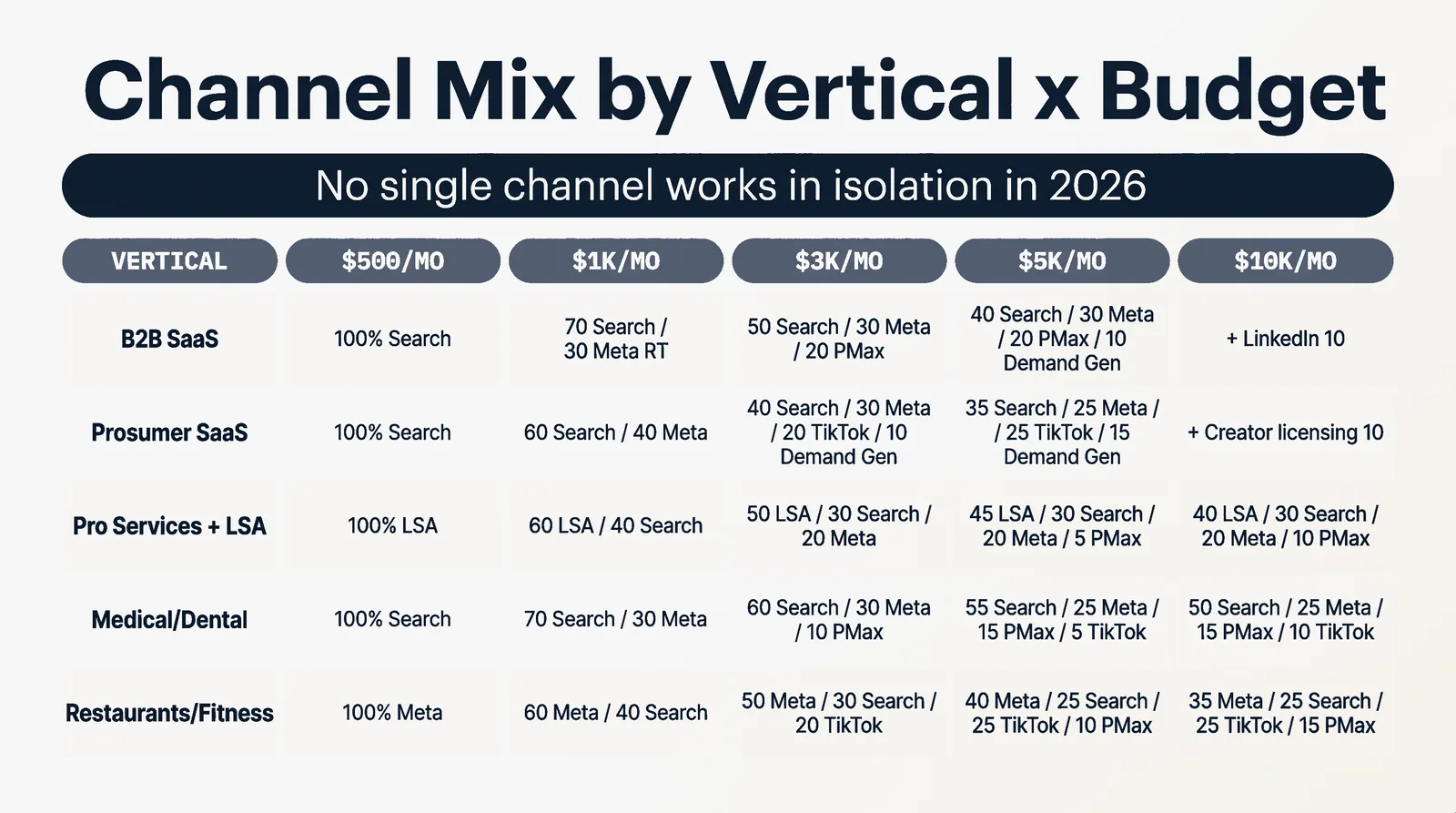
The 5x5 grid below maps channel allocation by audience and budget tier. Use it to set your starting mix, then read the relevant single-channel playbook for tactical depth.
B2B SaaS
| Monthly budget | Channel mix |
|---|---|
| $500 | 100% Google Search (brand defense + 5 to 8 high-intent commercial keywords) |
| $1,000 | 70% Google Search + 30% Meta (retargeting only) |
| $3,000 | 50% Google Search + 30% Meta (prospecting + RT) + 20% PMax |
| $5,000 | 40% Google Search + 30% Meta + 20% PMax + 10% Demand Gen RT |
| $10,000 | 35% Google Search + 25% Meta + 20% PMax + 10% Demand Gen + 10% LinkedIn (where ICP is sharp enough to justify) |
Note: TikTok skipped for B2B SaaS unless the founder is the brand (Cal.com, Beehiiv, Gumroad style).
Prosumer SaaS / AI tools
| Monthly budget | Channel mix |
|---|---|
| $500 | 100% Google Search (brand + competitor + alternative terms) |
| $1,000 | 60% Google + 40% Meta |
| $3,000 | 40% Google + 30% Meta + 20% TikTok Spark Ads + 10% Demand Gen RT |
| $5,000 | 35% Google + 25% Meta + 25% TikTok + 15% Demand Gen RT |
| $10,000 | 30% Google + 25% Meta + 25% TikTok + 10% Demand Gen + 10% influencer / creator licensing |
Professional services (lawyers, financial advisors, accountants)
| Monthly budget | Channel mix |
|---|---|
| $500 | 100% Google LSA (where eligible) OR 100% Google Search with tight geo + call assets |
| $1,000 | 60% Google LSA + 40% Google Search |
| $3,000 | 50% LSA + 30% Google Search + 20% Meta (retargeting) |
| $5,000 | 45% LSA + 30% Google Search + 20% Meta + 5% PMax with geo + store visits |
| $10,000 | 40% LSA + 30% Google Search + 20% Meta + 10% PMax |
Medical and dental practices
| Monthly budget | Channel mix |
|---|---|
| $500 | 100% Google Search (no LSA for most healthcare; dentistry can use LSA) |
| $1,000 | 70% Google Search + 30% Meta (HIPAA-safe pixel, Lead Form objective) |
| $3,000 | 60% Google Search + 30% Meta + 10% PMax with brand exclusion |
| $5,000 | 55% Google Search + 25% Meta + 15% PMax + 5% TikTok (cosmetic dentists, medspas only) |
| $10,000 | 50% Google + 25% Meta + 15% PMax + 10% TikTok (where vertical permits) |
Home services (HVAC, plumbing, roofing, cleaning)
| Monthly budget | Channel mix |
|---|---|
| $500 | 100% Google LSA |
| $1,000 | 60% LSA + 40% Google Search |
| $3,000 | 50% LSA + 30% Google Search + 20% Meta (Lead Form) |
| $5,000 | 45% LSA + 30% Google Search + 20% Meta + 5% PMax |
| $10,000 | 40% LSA + 25% Google Search + 20% Meta + 10% TikTok (visual transformations) + 5% PMax |
Restaurants, fitness, retail
| Monthly budget | Channel mix |
|---|---|
| $500 | 100% Meta (Lead Form for fitness; Engagement + Offer for restaurants) |
| $1,000 | 60% Meta + 40% Google Search (city-name modifiers) |
| $3,000 | 50% Meta + 30% Google Search + 20% TikTok Spark Ads (geo-fenced) |
| $5,000 | 40% Meta + 25% Google Search + 25% TikTok + 10% PMax with store visits |
| $10,000 | 35% Meta + 25% Google + 25% TikTok + 15% PMax with store visits |
Real estate (agents and projects)
| Monthly budget | Channel mix |
|---|---|
| $500 | 100% Meta (Lead Form with qualifiers) |
| $1,000 | 60% Meta + 40% Google Search (project-name and neighborhood-name terms) |
| $3,000 | 50% Meta + 30% Google Search + 20% TikTok (walkthroughs) |
| $5,000 | 40% Meta + 25% Google + 25% TikTok + 10% PMax with property feed |
| $10,000 | 35% Meta + 25% Google + 25% TikTok + 15% PMax |
This pattern is one piece of a wider toolkit. Adjacent playbooks at the Massive Impact resource library.
Part 3, Cross-Channel Attribution Stack
iOS attribution windows narrowed to 7-day click + 1-day view in January 2026. Pixel-only setups now report ~40% accuracy. Server-side + offline conversion + first-party data is the durability layer.
The 2026 attribution stack
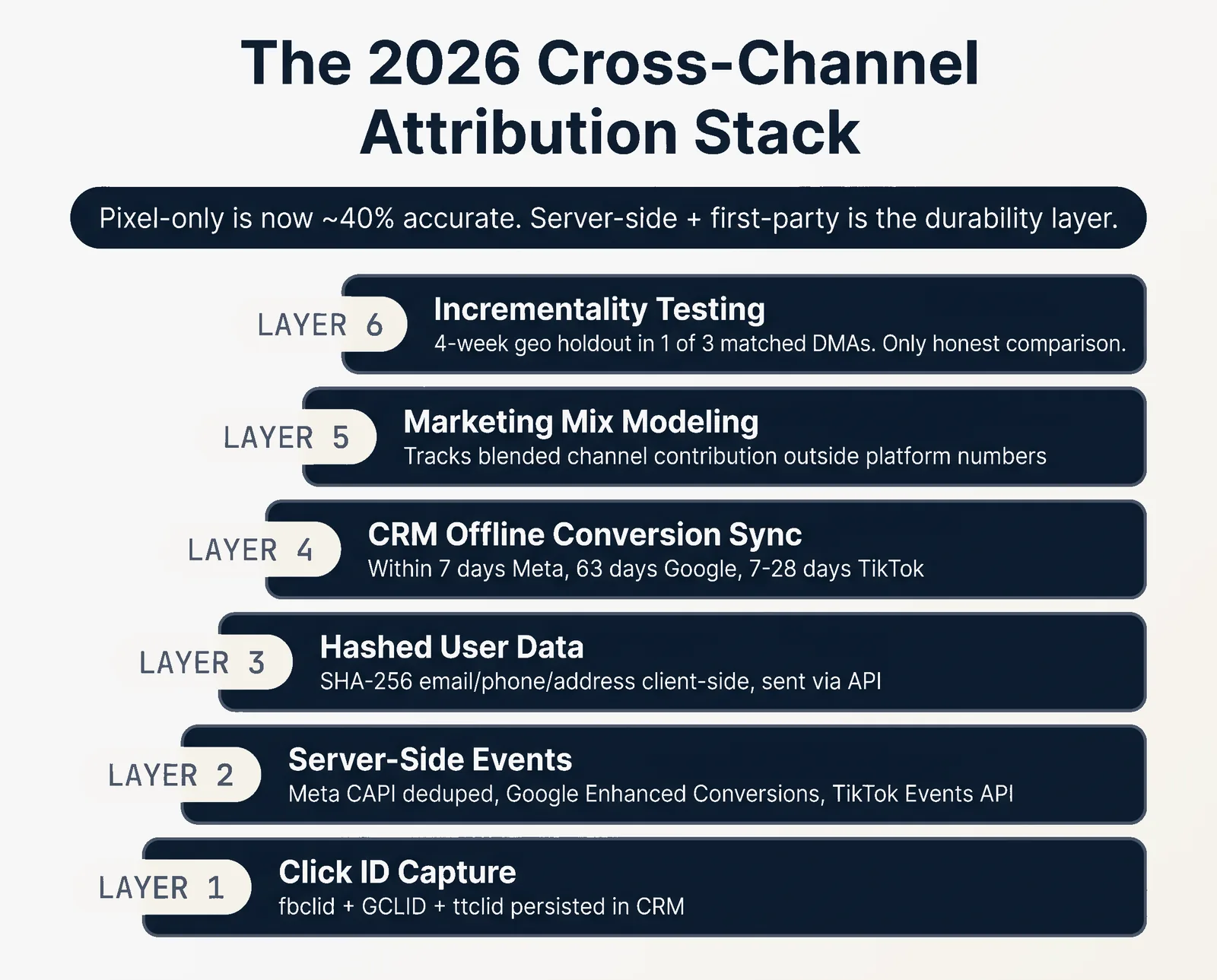
Layer 1, Click ID capture
├── Meta: fbclid in URL parameters
├── Google: GCLID in URL parameters
├── TikTok: ttclid in URL parameters
└── Persist all three in CRM as separate fields on every form submit

Layer 2, Server-side event sending
├── Meta CAPI deduped via event_id (Pixel + CAPI)
├── Google Enhanced Conversions + Offline Conversion API
├── TikTok Events API (first-class, can run server-side only)

Layer 3, Hashed user-provided data
├── SHA-256 email, phone, address client-side before sending
├── Pass to all three platforms via their respective APIs

Layer 4, CRM offline conversion sync
├── Meta: Offline Conversion Upload via Conversions API
├── Google: Offline Conversion Imports via Google Ads API
├── TikTok: Offline Events upload via Events API
└── Upload within attribution window: Meta 7 days, Google 63 days, TikTok 7 to 28 days

Layer 5, Marketing Mix Modeling (MMM)
├── Tracks blended channel contribution outside platform-reported numbers
├── Reconciles platform over-attribution
├── Required when MTA accuracy degrades below 60% (most accounts in 2026)

Layer 6, Incrementality testing
├── Geo holdout: turn off a channel in 1 of 3 matched DMAs for 4 weeks
├── Conversion lift studies: Meta + Google native tools at scale
├── The only honest way to compare channels in 2026
Multi-channel deduplication
When the same buyer touches Meta, Google, and direct, every platform claims credit. To deduplicate:
- Use a single source of truth: CRM with first-touch and last-touch attribution stamped at form submit
- Use a position-based attribution model in CRM (e.g., 40% first-touch, 40% last-touch, 20% middle)
- Reconcile platform-reported revenue against CRM revenue weekly
- When platform-reported is more than 30% above CRM, you are double-counting
Marketing Mix Modeling (MMM) for the small operator
You do not need a $50K MMM consultant. The basic version:
- Spend by channel by week, last 12 months
- Conversion volume by week, last 12 months
- Run linear regression with channel spend as inputs and conversions as output
- Coefficient per channel = approximate marginal contribution
- Refresh quarterly
Tools that do this for under $300/mo: Recast (limited tier), Northbeam (entry plans), open-source LightweightMMM by Google.
Incrementality testing for the small operator
Run a 4-week geo holdout test:
- Pick 3 matched DMAs with similar baseline performance
- Turn off the test channel in 1 of the 3
- Measure conversion delta vs the matched DMAs
- Calculate true incremental contribution
Most operators discover their best-reported channel was overstating contribution by 30 to 60%. The "worst" channel often has the highest incremental lift because it reaches audiences others miss.
More patterns like this across the Massive Impact library at the Massive Impact resource library.
Part 4, Acquisition Math Across All Channels
The math from each single-channel playbook (P26 Part 6, P27 Part 8, P28 Part 8, P29 Part 2, P30 Part 3) consolidated into one cross-channel reference.
Blended CAC formula
Blended CAC = Total acquisition spend (all channels + tools + content) / New customers acquired
Most operators only count platform spend. To get true blended CAC, include:
- Platform ad spend (Meta + Google + TikTok + LinkedIn)
- Tool stack costs (CRM, attribution, automation, landing page builder)
- Creative production (in-house or outsourced)
- Sales and SDR labor (allocated %)
- Content marketing (allocated %)
Most accounts find their reported CAC is 30 to 60% understated when they add the operational layers.
Payback period
CAC payback months = CAC / (Monthly Gross Profit per Customer)
| Vertical | Healthy payback (2026) |
|---|---|
| Prosumer SaaS at $19/mo | 3 to 4 months |
| B2B SaaS SMB at $99/mo | 4 to 9 months |
| B2B SaaS mid-market $1,500/mo | 12 to 18 months |
| Professional services first transaction | 1 to 3 months |
| Local first-visit | 1 to 4 months |
| Restaurant, fitness | 1 visit (single-transaction recovery) |
LTV by vertical (with reasonable retention)
| Vertical | Average LTV (2026) |
|---|---|
| Dental patient (7 years retention) | $4,400 to $5,600 |
| Family lawyer (single matter) | $3K to $15K |
| PI lawyer (single case) | $5K to $50K+ |
| HVAC customer (5 years retention) | $4,000 to $8,000 |
| Restaurant regular (3 years, 24 visits/year, $35 ticket) | $2,520 |
| Fitness studio member (24 months) | $1,200 to $2,400 |
| B2B SaaS customer (3 years, NRR 110%) | $4,500 to $8,000 (at $99 ACV) |
NRR engineering for SaaS (carried from P30)
| Lever | Lift on NRR |
|---|---|
| Annual price escalator (3 to 7%) | +3 to 7% |
| Seat-based pricing with team growth | +5 to 15% |
| Usage-based with cap upgrades | +10 to 25% |
| Cross-sell into adjacent product | +5 to 30% |
| Reactivation of churned at 30 days | +1 to 5% |
Refund-survivable margin for low-ticket (carried from P29)
Net AOV after refunds = AOV x (1 - refund rate)
A $47 tripwire with 14% refunds nets $40.42 average. Your CAC on that tripwire must be below $40.42 minus fulfillment costs.
Part 5, AI Agents in 2026 Acquisition
AI agents moved from novelty to operational layer in 2025 to 2026. Below are the practical applications, with what works and what does not.
Lead qualification AI
What works:
- AI chat agents on landing pages handling first 3 to 5 turns of qualification (collecting use case, budget tier, timeline)
- AI scoring leads against historical close-rate data, prioritizing top 20% for sales follow-up
- AI handling routine "do you take new patients?" / "do you offer X service?" inquiries 24/7
What does not:
- AI replacing the closing call for high-ticket service (lawyers, financial advisors)
- AI handling complex objections that require human empathy
- AI on cold outbound for B2B SaaS at any deal size above $20K ACV
Tools to consider: Intercom Fin, ChatBase, Voiceflow, custom agents on Anthropic Claude or OpenAI APIs.
Voice agents for lead handling
What works:
- Inbound call answering for service businesses with predictable inquiry patterns (medspa, dentist, HVAC)
- Outbound voicemail follow-up on form-submitted leads who did not pick up
- Appointment booking and rescheduling
What does not:
- Cold outbound voice (high spam-flag rate, low response)
- Negotiation or pricing conversations
- Empathy-required first conversations (medical complaints, legal intake)
Tools to consider: Bland.ai, Vapi, Air.ai, Synthflow.
AI ad creative production
What works:
- Static ad variants (Meta Imagine, Google Performance Max asset generation)
- Hook variant generation for testing (10 to 20 variants per concept)
- Caption and copy variants for A/B testing
What does not:
- Founder-to-camera replacement (no AI substitute for the founder POV creative archetype that wins on TikTok and Meta)
- Customer testimonial replacement (synthetic testimonials carry compliance risk and read inauthentic)
- Brand voice across multiple platforms without human editing pass
Tools to consider: Meta Imagine + Llama-based ad generation native in Ads Manager. Google Performance Max asset generation. Symphony Creative Studio (TikTok native). Midjourney v8.1 + Nano Banana Pro for static.
AI in outbound
What works:
- AI-personalized outbound emails based on prospect's public footprint (LinkedIn, company blog, recent news)
- AI lead enrichment + segmentation
- AI follow-up sequencing
What does not:
- Pure AI cold outreach without human review (low conversion, deliverability issues from bulk patterns)
- AI-written outbound without specific signal beyond "you work at company X"
Tools to consider: Clay, Smartlead, Instantly with AI variants.
Where to start with AI in your acquisition stack
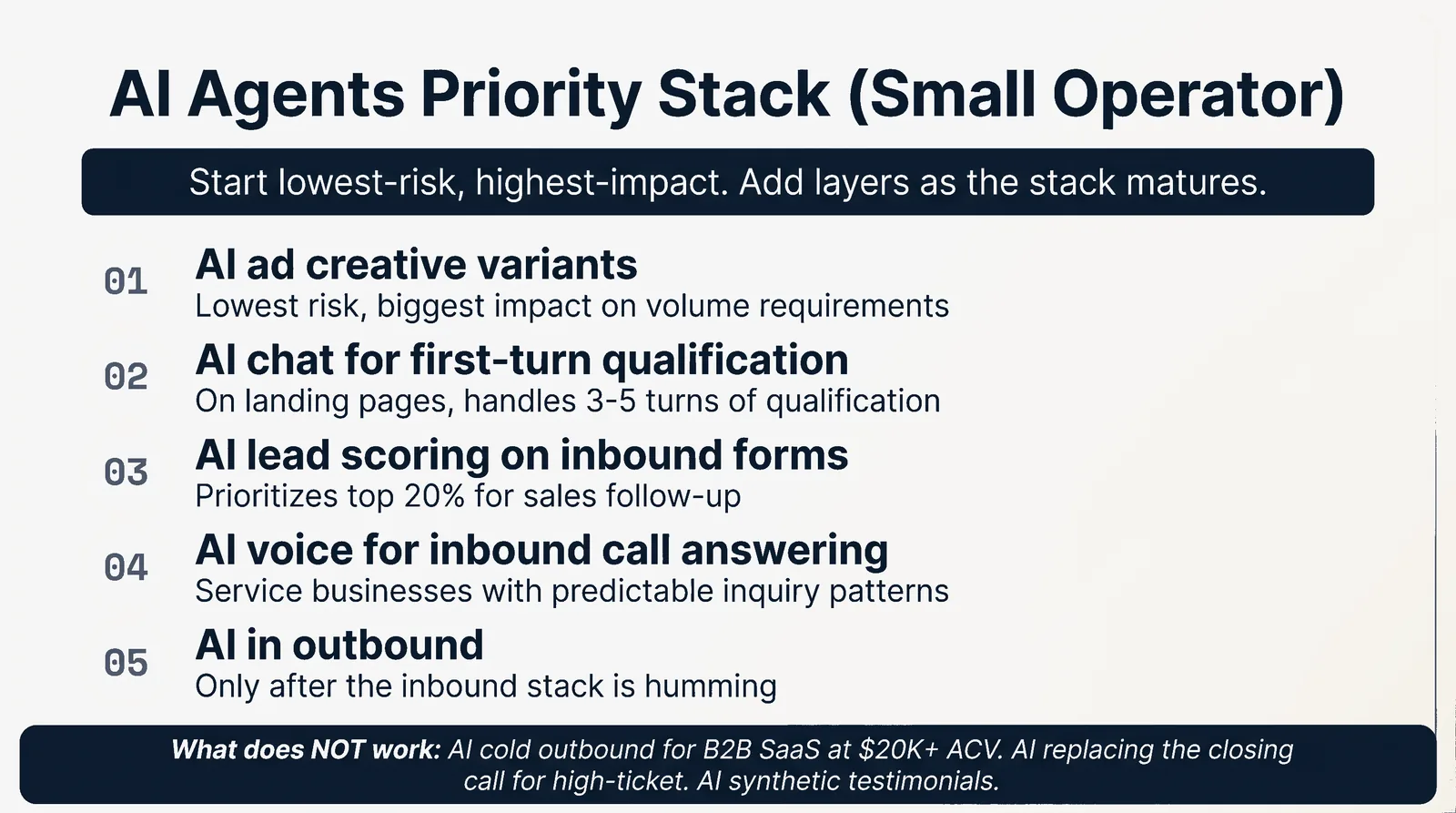
Priority order for the small operator in 2026:
- AI ad creative variants (lowest risk, biggest impact on volume requirements)
- AI chat for first-turn qualification on landing pages
- AI lead scoring on inbound forms
- AI voice for inbound call answering (services with predictable inquiry patterns)
- AI in outbound (only after the inbound stack is humming)
Part 6, The Three Audience Swimlanes
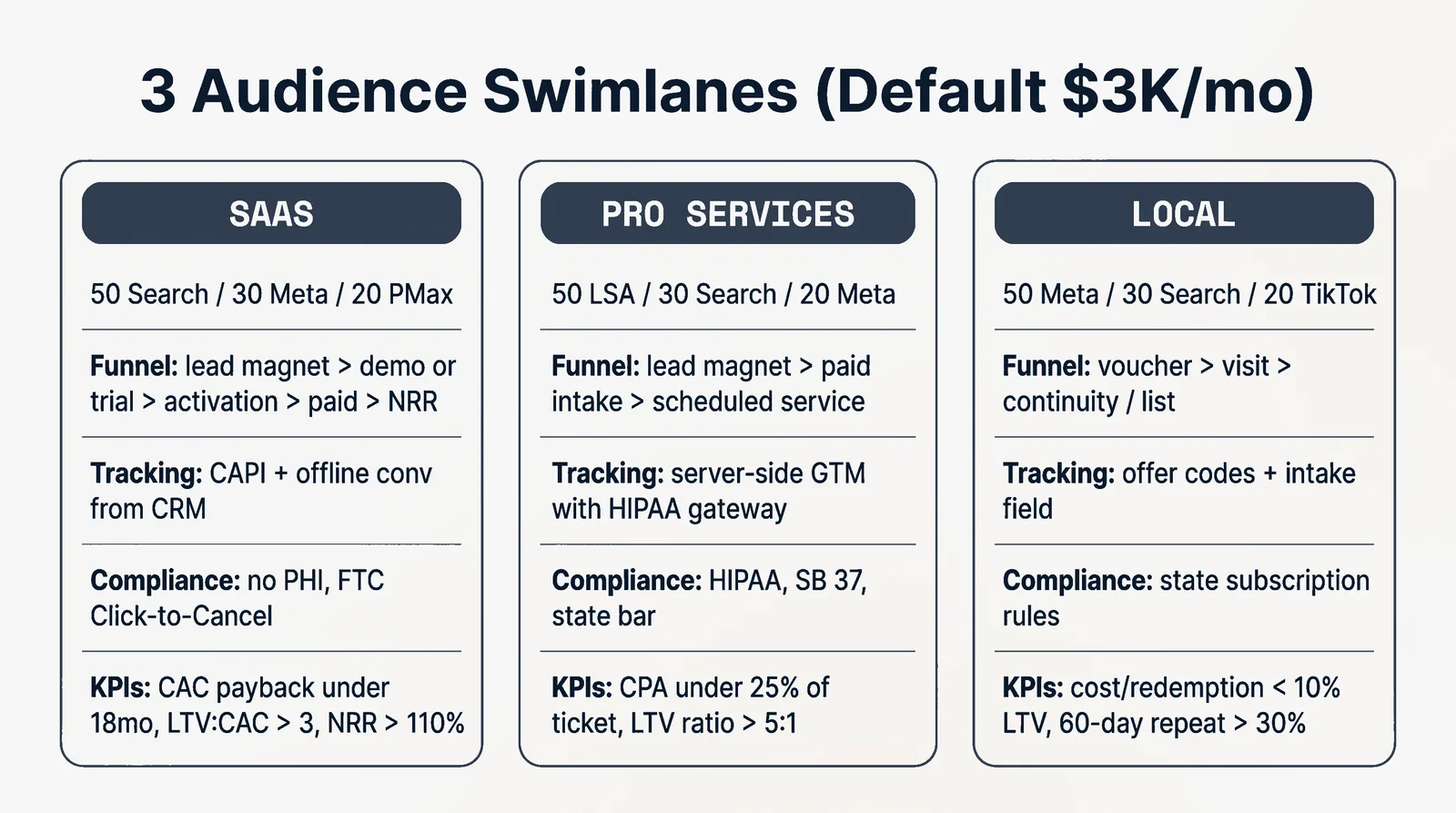
SaaS swimlane (one-page reference)
Channel mix (default $3K/mo): 50% Google Search + 30% Meta + 20% PMax. TikTok added at $5K/mo if founder is on camera. LinkedIn added at $10K/mo if ICP is sharp.
Funnel: lead magnet > demo OR $1 paid trial OR opt-out trial > activation event in first session > 14-day email sequence > paid > expansion (NRR engineering).
Tracking: Pixel + CAPI + Enhanced Conversions + offline conversion sync from CRM. GCLID + ttclid + fbclid persisted in CRM.
Compliance: No PHI to platforms (HealthTech). FTC Click-to-Cancel state-level. Amazon Prime settlement copy clarity.
KPIs: CAC payback under 18 months, LTV:CAC > 3, NRR > 110%, activation rate > 50% of signups.
Read in detail: P26 (Meta), P27 (Google), P30 (SaaS funnel).
Professional services swimlane (one-page reference)
Channel mix (default $3K/mo): 50% Google LSA (where eligible) + 30% Google Search + 20% Meta. PMax added at $5K/mo. TikTok added only for medspa, cosmetic dentistry, fitness, home services with visual transformation potential.
Funnel: lead magnet (eBook on process timelines, free assessment) OR direct LSA / Lead Form > paid intake $47 to $97 OR free consult > scheduled service.
Tracking: Server-side GTM with HIPAA gateway for medical. GCLID + Enhanced Conversions for Google. Meta CAPI with no condition-named URLs.
Compliance: HIPAA for medical (no BAA from Meta, Google, TikTok). California SB 37 for attorneys (named lawyer + bar # + CA office). State bar fitness for ad copy. Specialty-specific restrictions on TikTok health verticals.
KPIs: Cost per booked appointment under 25% of average ticket value. LTV ratio > 5:1 against patient/client lifetime value. Lead-to-booked conversion > 60% (well-qualified).
Read in detail: P26 (Meta), P27 (Google + LSA), P28 (TikTok where vertical fits).
Local business swimlane (one-page reference)
Channel mix (default $1.5K/mo): 50% Meta + 30% Google Search (city-name modifiers) + 20% TikTok Spark Ads (geo-fenced). PMax with store visits added at $3K/mo.
Funnel: First-visit voucher $10 to $20 OR trial class $1 to $20 OR first-visit deposit > in-person service > membership / continuity / list-building for repeat.
Tracking: Unique offer codes + "How did you hear about us" intake field for cross-channel reconciliation (most local businesses cannot run server-side at scale).
Compliance: Meta + Google + TikTok ad standards. State subscription cancellation rules for membership models.
KPIs: Cost per first-visit redemption under 10% of LTV. Repeat visit rate > 30% within 60 days. SMS + email opt-in rate > 70% of first-visit redemptions.
Read in detail: P26 (Meta local), P27 (Google local + LSA where eligible), P28 (TikTok geo-fenced), P29 (offer mechanics).
Part 7, The Compliance Master List
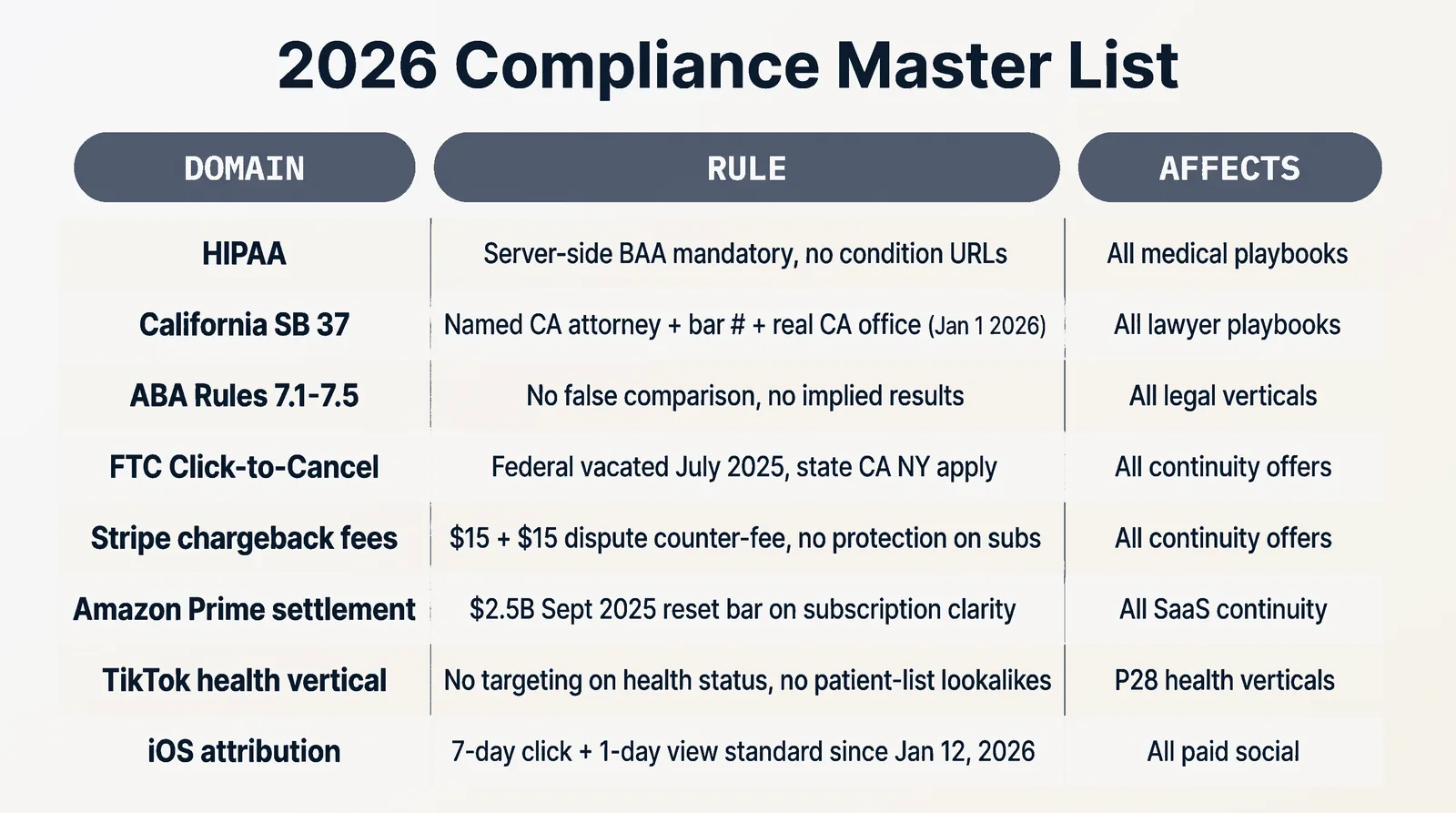
| Domain | Rule | Citation | Affected playbooks |
|---|---|---|---|
| HIPAA | No BAA from Meta, Google, TikTok | Federal | P26 medical, P27 medical, P28 medical |
| HIPAA | Server-side gateway with BAA mandatory | Federal | All medical |
| California SB 37 | Named CA attorney + bar # + real CA office in every CA-targeted ad | California, eff Jan 1, 2026 | P26 lawyers, P27 lawyers, P28 lawyers |
| ABA Rules 7.1 to 7.5 | No false comparative claims, no implied results, no specialization claims unless certified | ~90% of US states | All legal verticals |
| FTC Click-to-Cancel | Vacated July 2025, ANPRM Jan 30, 2026 | Federal status uncertain | P29 continuity, P30 SaaS continuity |
| California SB-313 | Online cancellation for online subscriptions | California | P29 continuity, P30 SaaS continuity |
| Stripe chargeback fees | $15 + $15 dispute counter-fee | Mid-2025 | P29 continuity, P30 SaaS continuity |
| Stripe Chargeback Protection | Excludes subscription transactions | Mid-2025 | P29 continuity, P30 SaaS continuity |
| Amazon Prime settlement | $2.5B FTC, reset subscription clarity bar | September 2025 | P29 continuity, P30 SaaS continuity |
| TikTok health vertical | No targeting on health status, no lookalikes from patient lists, audited | 2026 enforcement | P28 health |
| Meta health vertical | Restrictions tightened, no condition-named events, awareness-objective only for sensitive | Through 2026 | P26 health |
| Meta financial vertical | Special Ad Categories, restricted creative, disclosures required | Through 2026 | P26 finance |
| Google Ads HIPAA | Not HIPAA compliant, no BAA, server-side GTM mandatory | Through 2026 | P27 medical |
| iOS attribution | 7-day click + 1-day view standard | Jan 12, 2026 | All paid social |
The rest of the Massive Impact library builds on patterns like this. See the full set at the Massive Impact resource library.
Part 8, The 90-Day Launch Plan + 15 Common 2026 Failures
The 90-day launch plan
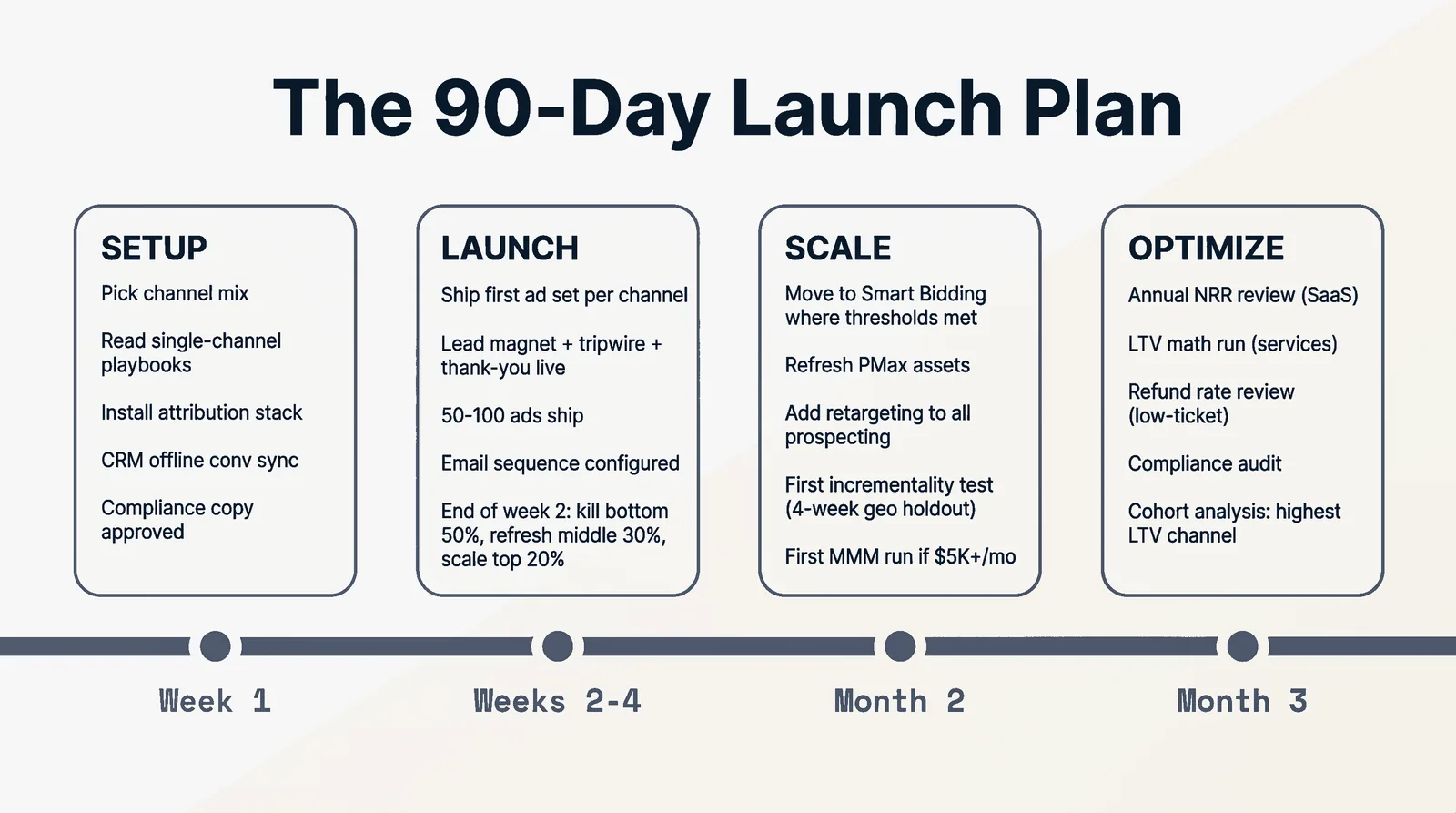
Week 1, Setup
- Pick channel mix from Part 2 by vertical and budget
- Read the relevant single-channel playbooks (P26 to P30) for your stack
- Install attribution stack from Part 3 (Pixel + CAPI for Meta, Enhanced Conversions for Google, Pixel + Events API for TikTok)
- CRM offline conversion sync configured for downstream events (MQL, SQL, Closed-Won, Customer Lifetime Spend)
- First-party data audit: do you capture and persist GCLID, ttclid, fbclid on every form?
- Compliance copy approved by counsel where applicable (HIPAA, SB 37, state bar, FTC continuity)
Weeks 2 to 4, Launch
- Ship the first ad set in each campaign type per architecture (P26 Part 2, P27 Part 3, P28 Part 3)
- Lead magnet + tripwire + thank-you page live (per P29 if low-ticket, per P30 if SaaS)
- First 50 to 100 ads across all platforms per platform-specific creative cadence
- Email sequence configured for the funnel type (P29 Part 6 for low-ticket, P30 Part 7 for SaaS trial)
- First-week review at end of week 2: kill bottom 50% of ads, refresh middle 30%, scale top 20%
Month 2, Scale
- Move ad sets to Smart Bidding where conversion thresholds are met (P26 Part 5, P27 Part 6, P28 Smart+)
- PMax asset libraries refreshed if any campaigns are running below 30 conv/week
- Add retargeting layer to all prospecting campaigns
- First incrementality test: pick one channel, run 4-week geo holdout
- Compare platform-reported CPA vs CRM-reported CPA. Reconcile to the larger.
- First MMM run if account spends above $5K/mo across channels
Month 3, Optimize
- Annual NRR review for SaaS (P30 Part 4)
- LTV math run for service businesses (P26 Part 6)
- Refund rate review for low-ticket (P29 Part 2)
- Compliance audit: any new state-level FTC equivalents? Any creative violations to fix?
- Second incrementality test on a different channel
- Cohort analysis: which channel produces the highest LTV customers?
The 15 most common 2026 acquisition failures
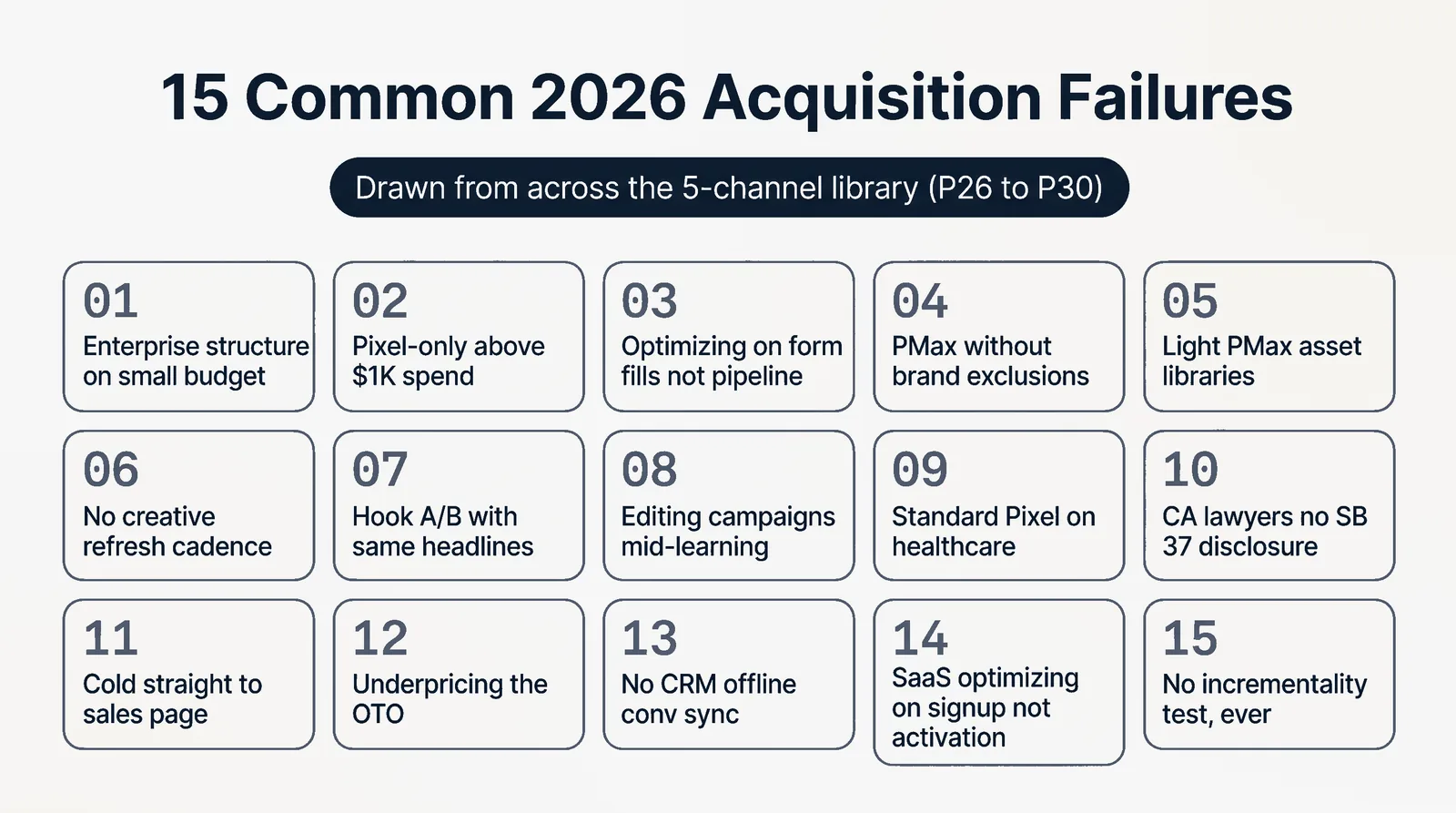
Drawn from across P26 to P30 and the cross-channel synthesis:
Running enterprise account structures on small budgets. Five campaigns at $6/day each will never escape learning. Fix: consolidate to fit the per-campaign event floor.
Pixel-only attribution above $1,000/month spend. Lose 60% of signal. Fix: server-side CAPI, Events API, Enhanced Conversions on day one.
Optimizing on form fills not pipeline. 57% of B2B SaaS spend wasted on search terms that never convert. Fix: pipe SQL or Closed-Won as primary conversion event.
Running PMax without brand exclusions. Cannibalizes Search at worse Quality Scores. Fix: brand exclusions on PMax always when separate brand campaign exists.
Light PMax asset libraries. AI cannot optimize what you do not feed it. Fix: 15+ of every asset type before launch.
No creative refresh cadence. UGC fatigues in 14 to 18 days, static in 3 to 4 weeks. Fix: scheduled weekly creative production minimum.
Hook A/B tests that are actually two near-identical headlines. Meta and TikTok 2026 algorithms need real concept variation. Fix: two contrasting concepts per test.
Editing campaigns mid-learning phase. Resets the 50-event clock every time. Fix: 7-day no-touch rule on new campaigns; 20% max budget changes after.
Healthcare advertisers running standard Pixel. HIPAA exposure, federal violation. Fix: server-side gateway with BAA, no condition-named URLs.
California lawyers without SB 37 disclosures. Effective January 2026. Fix: named attorney + CA bar # + real CA office in every ad and form.
Cold traffic straight to sales page. Lead magnet warming first lifts conversion materially. Fix: lead magnet + tripwire on thank-you page + email sequence.
Underpricing the OTO. $97 OTO behind a $27 tripwire is wasted runway. Fix: OTO 3 to 7x tripwire price.
No CRM offline conversion sync. Missing 30 to 50% SQL volume lift on platform optimization. Fix: configure offline conversion sync within 60 days of click.
Optimizing on signup volume not activation rate (SaaS). Signup is vanity. Activation predicts paid. Fix: dashboard activation as primary acquisition KPI.
No incrementality test, ever. Every channel claims credit; you do not know which one is incremental. Fix: 4-week geo holdout test every quarter.
What to read next
Each of the five single-channel playbooks goes deep on its surface:
- P26 The 2026 Meta Ads Playbook, account architecture, audience recipes, 8 creative archetypes, bidding tree, HIPAA + SB 37 compliance, day 1/7/30 checklists.
- P27 The 2026 Google Ads Playbook, channel selection tree, account architecture, keyword build sheets, PMax recipe, Smart Bidding tree, LSA tactical guide, funnel math.
- P28 The 2026 TikTok Ads Playbook, vertical fit decision tree, Spark Ads strategy, 10 creative archetypes, audience recipes, compliance, funnel math.
- P29 The 2026 Low-Ticket Funnel Playbook, funnel math first, 7-step architecture, page-by-page specs, vertical plays, 7-day buyer email sequence.
- P30 The 2026 SaaS Customer Acquisition Funnel Playbook, model decision tree, five trial models compared, conversion math, activation mechanics, 14-day trial sequence.
The full Massive Impact library lives at the Massive Impact resource library.
The rest of the guide is yours, free.
Enter your email to keep reading and get the PDF to keep.
No spam. One email unlocks every Massive Impact resource.
“It's just a no-brainer where you're like, look at these numbers, look at the figures.”
The service behind this
