


Account architecture, audience recipes, creative templates, bidding rules, and compliance snippets for SaaS, professional services, and local businesses running budgets between $300 and $5,000 per month.
Who this is for
Solo founders, in-house marketers, and agency operators running Meta Ads in 2026. Budget between $10 and $200 a day. Verticals covered: B2B SaaS, prosumer SaaS, doctors, dentists, lawyers (with state bar and California SB 37 notes), home services, restaurants, fitness, real estate.
This is a tactical reference, not a survey. Eight parts. Hit the part you need on the day you need it.
What is in this playbook
- Part 1, The 2026 Meta Reality
- Part 2, Account Architecture by Budget Tier
- Part 3, Audience Recipes per Vertical
- Part 4, Creative Templates with Hook Formulas
- Part 5, Bidding and Budget Decision Tree
- Part 6, Funnel Math and Offer Economics
- Part 7, Compliance Snippets (HIPAA, SB 37, State Bar)
- Part 8, Launch + Day 7 + Day 30 Checklists
Part 1, The 2026 Meta Reality
Meta deployed the Andromeda retrieval algorithm in Q1 2026 on NVIDIA GH200 chips. The system now matches users to ads roughly 100x faster and tests 10,000x more variants in parallel than the 2024 stack. Combined with the Adaptive Ranking Model, creative is now the primary lever and targeting is the secondary one.
If you only have time to read one section before you launch, this is it.
The shifts that changed what you ship
| Shift | Date | What it means for your account |
|---|---|---|
| Andromeda + Adaptive Ranking Model | Q1 2026 | Ship 50 to 100 ads a month. Concept variation beats hook A/B. |
| Advantage+ threshold dropped 50 to 25 weekly conversions | Q1 2026 | ASC and Advantage+ Leads are now usable below $2K/mo |
| Click-through attribution redefined | March 2026 | Only true link clicks count. Engage-through is a separate metric. |
| Healthcare Pixel restrictions phased through 2026 | Jan 2025 to 2026 | Pixel-only setups now leak PHI risk. Server-side CAPI is the floor. |
| California SB 37 in force | Jan 1, 2026 | CA-targeted attorney ads need named lawyer + real CA office address |
| CAPI deduped via event_id | All of 2025 to 2026 | Pixel-only attribution is around 40% accurate. CAPI lifts it to 75%+. |
| AI creative tools native in Ads Manager | Late 2025 | Static and copy variants generate inside Meta. No third-party tool needed. |
What stays the same
- Creative is still the largest lever, more so now than before
- Broad + Advantage+ Audience is still the default starting point
- The 50-event learning phase is still the gate to stable performance
- Frequency above 4 still tanks CTR, especially on retargeting
The rest of the Massive Impact library builds on patterns like this. See the full set at the Massive Impact resource library.
Part 2, Account Architecture by Budget Tier
The single most expensive mistake at small-budget scale is running an enterprise account structure on $30 a day. Five campaigns at $6/day each will never escape the learning phase. One campaign at $30/day will.
The learning-phase floor
Meta needs roughly 50 conversion events in 7 days per ad set to exit the learning phase and stabilize. If your average CPA is $20, that ad set needs to spend at least $1,000 in 7 days, or about $143/day. If your CPA is $5, the floor is around $36/day.
Decision rule: divide your daily budget by your expected CPA times 7. If the answer is less than 50, consolidate ad sets until it is greater than 50.
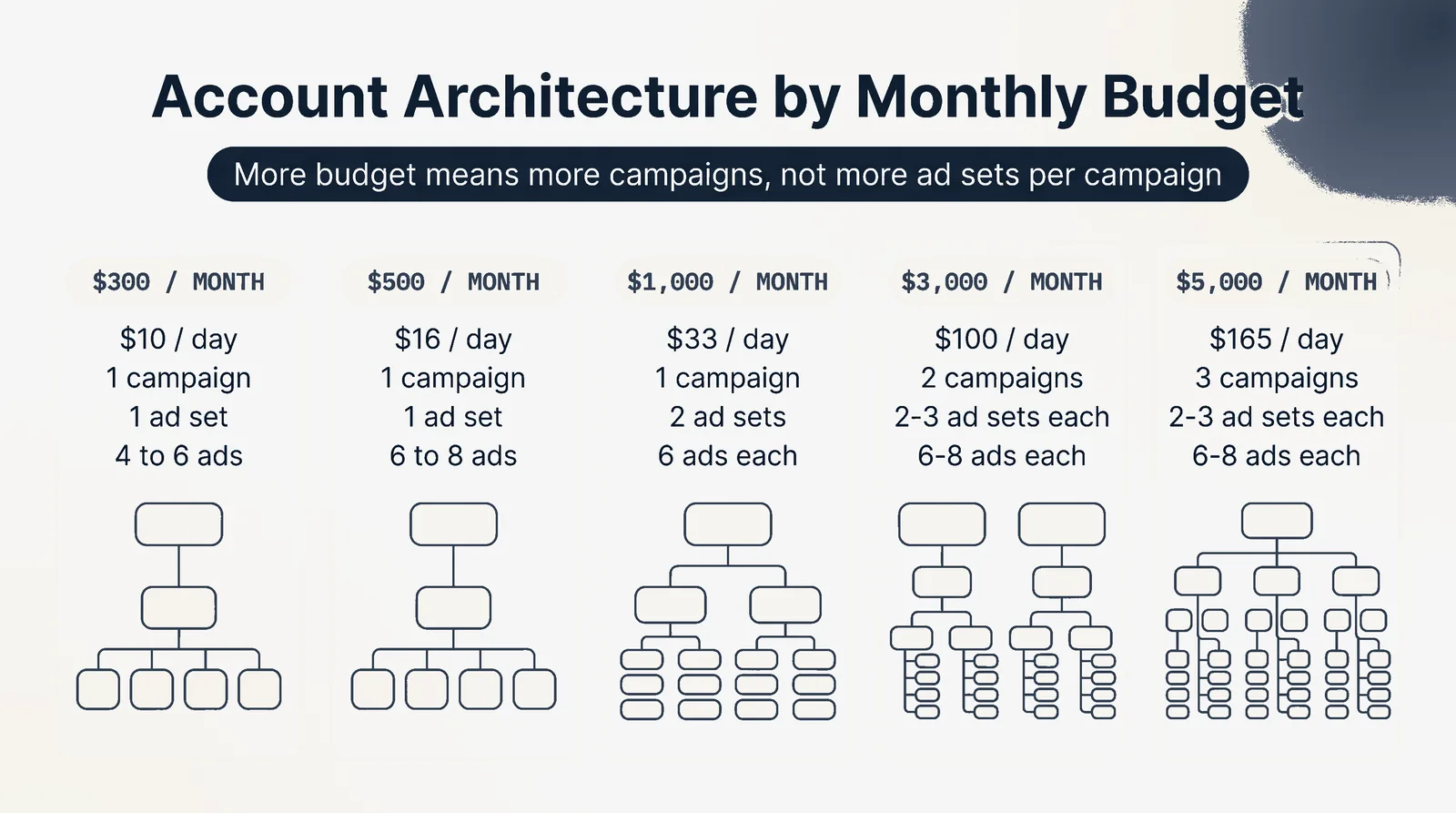
Architecture by tier
| Monthly budget | Daily budget | Campaigns | Ad sets per campaign | Ads per ad set | Bid strategy |
|---|---|---|---|---|---|
| $300 | $10 | 1 | 1 | 4 to 6 | Highest Volume / Lowest Cost |
| $500 | $16 | 1 | 1 | 6 to 8 | Highest Volume / Lowest Cost |
| $1,000 | $33 | 1 | 2 | 6 each | Highest Volume + 1 cost cap test |
| $3,000 | $100 | 2 | 2 to 3 | 6 to 8 each | CBO with min/max spend caps |
| $5,000 | $165 | 3 | 2 to 3 each | 6 to 8 each | CBO + 1 manual ABO testing campaign |
What each campaign does
$300 to $500 / month: one always-on conversion campaign, broad + Advantage+ Audience expansion, single ad set, 4 to 8 ads. Refresh creative weekly. No retargeting until the prospecting campaign clears 50 weekly conversions.
$1,000 / month: one prospecting campaign (broad), one warm retargeting ad set inside it (90-day site visitors plus video viewers above 50% completion). Still single campaign, two ad sets.
$3,000 / month: split into two campaigns, prospecting and retargeting. Creative testing runs inside the prospecting campaign as a third ad set with smaller budget cap. Move winners up.
$5,000 / month: three campaigns. Prospecting (CBO), retargeting (CBO with sequenced creative), and a dedicated manual ABO testing campaign at $30 to $50/day for new concepts.
CBO settings that prevent budget dumping
When you turn CBO on, set the per-ad-set minimum spend at 10 to 15% of campaign budget and the maximum at 40 to 50%. Without these caps, Meta routinely dumps 80 to 90% of the budget into one ad set, kills exploration, and locks you into a single creative.
This pattern is one piece of a wider toolkit. Adjacent playbooks at the Massive Impact resource library.
Part 3, Audience Recipes per Vertical
Each recipe is a copy-paste audience build string. Treat the interest stack as a starting seed, not a fixed list. Meta Advantage+ Audience expansion will broaden it automatically.
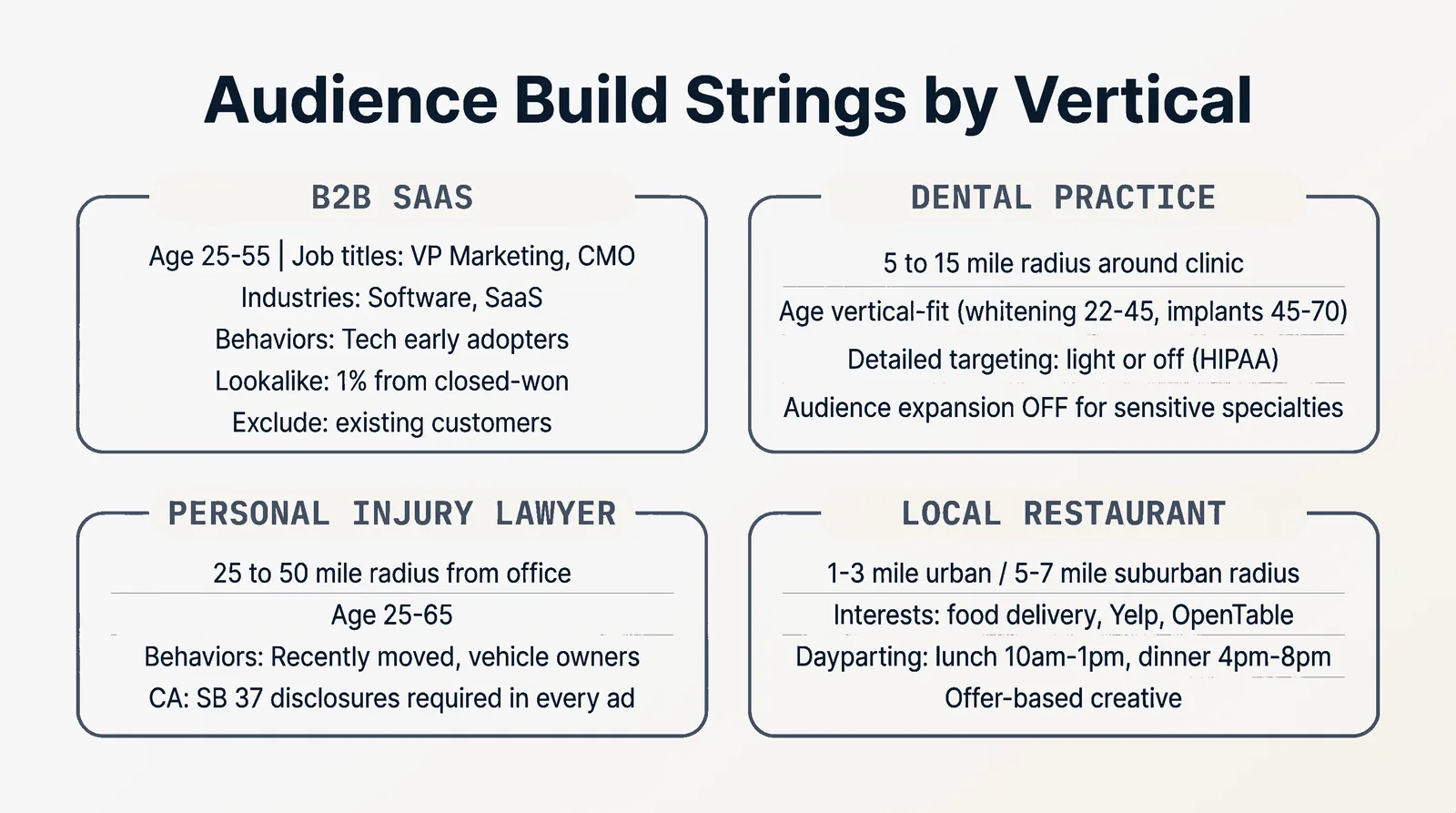
B2B SaaS
Cold prospecting (broad-leaning):
- Locations: target country / state list
- Age: 25 to 55
- Gender: All
- Detailed targeting (used as Advantage+ signal):
- Job titles: VP Marketing, Head of Growth, CMO, Marketing Manager, Director of Demand Gen
- OR Industries: Software, Computer software, Marketing and advertising
- OR Behaviors: Small business owners, Technology early adopters
- Audience expansion: ON
- Exclusions: existing customer list, last 60-day site visitors
Lookalike layer (when prospecting clears 50 conv/week):
- Source: closed-won customers from CRM (last 180 days, deduped by company)
- LAL %: 1% in country of focus, 2% if seed below 1,000 contacts
- Stack two LALs: closed-won 1% + demo-booked 1% as separate ad sets
Retargeting:
- 30-day site visitors excluding pricing page
- 30-day pricing page visitors (separate, sequenced creative)
- Last 60-day video viewers above 75%
- Lead form openers who did not submit (last 30 days)
- Exclude: trial signups, paid customers
Prosumer SaaS
Cold prospecting:
- Detailed targeting:
- Interests: ChatGPT, Notion, Figma, productivity tools, Indie Hackers, Product Hunt
- OR Behaviors: Engaged shoppers, Technology early adopters
- Age: 22 to 45
- Audience expansion: ON
Retargeting:
- 14-day site visitors (shorter window than B2B)
- Trial signups who did not activate (custom event)
- Free users above 30 days, no upgrade
Medical and dental practices
Cold prospecting:
- Locations: 5 to 15 mile radius around each office
- Age: vertical-appropriate (dental whitening 22 to 45, implants 45 to 70, pediatric dentistry parents 28 to 45)
- Detailed targeting kept light or off (HIPAA caution, see Part 7)
- Optimize for traffic or awareness, not conversion to landing page (use Lead Form on Meta or HIPAA-safe redirect)
- Audience expansion: OFF for sensitive specialties
Retargeting:
- 30-day site visitors (only if HIPAA-compliant pixel setup is in place)
- Engagement custom audience: people who interacted with the page in 365 days
Lawyers
Cold prospecting (personal injury, family, criminal defense):
- Locations: 25 to 50 mile radius from office, exclude irrelevant ZIPs
- Age: 25 to 65
- Detailed targeting:
- PI: Behaviors include Recently moved, Frequent travelers, Vehicle owners
- Family: Life events Recently engaged, Recently married, Recently divorced
- Criminal: keep light, use broad geo + creative to qualify
- Lead Form OR conversion-optimized landing page (Part 4)
- California targeting: SB 37 disclosures required in every ad and form (see Part 7)
Retargeting:
- 30-day site visitors
- Engagement custom audience 90-day
- Exclude: filed-case clients
Home services (HVAC, plumbing, roofing, cleaning)
Cold prospecting:
- Locations: 15 to 30 mile radius
- Age: 30 to 65, slight skew female for cleaning, slight skew male for roofing
- Detailed targeting:
- Behaviors: Homeowners, Recently moved
- Demographics: Household income above $75K (where available)
- Audience expansion: ON
- Seasonal layering: HVAC sequences differ summer vs winter, see Part 4
Retargeting:
- 30-day site visitors
- Form-openers no-submit
- Exclude: jobs completed in last 12 months (suppress until renewal cycle)
Restaurants
Cold prospecting:
- Locations: 1 to 3 mile radius urban / 5 to 7 mile radius suburban
- Age: vertical-fit (casual dining 25 to 65, brunch spot 25 to 45, fine dining 35 to 70)
- Detailed targeting:
- Interests: Food delivery, Yelp, Local restaurants, OpenTable
- Dayparting: lunch ads 10 AM to 1 PM, dinner ads 4 PM to 8 PM
- Use offer-based creative (see Part 4)
Retargeting:
- Engagement audience 90-day
- Page video viewers above 50%
Fitness studios and gyms
Cold prospecting:
- Locations: 5 to 8 mile radius
- Age: 22 to 55, narrow if specialty (yoga 25 to 55, CrossFit 22 to 45)
- Detailed targeting:
- Interests: Fitness apparel brands (Lululemon, Nike), MyFitnessPal, Peloton, gym names of competitors
- Life events: Recently moved (likely to seek a new gym)
- Audience expansion: ON
- Trial offer creative (free first class, $1 first week, see Part 4)
Retargeting:
- 30-day site visitors
- Trial signups no-conversion (sequenced 7-day reminder series)
Real estate (agents and developers)
Cold prospecting:
- Locations: 20 to 45 km around the property or development, not the office
- Age: vertical-fit (first-time buyer 25 to 38, luxury 40 to 65, downsizers 55 to 75)
- Detailed targeting:
- Behaviors: Likely to move, Engaged shoppers
- Income tier matched to property price band
- Life events: Recently engaged, Recently married, New baby (for upsizers)
- Lead form with qualifiers (price band, timeline, financing status)
Retargeting:
- Site visitors past 30 days
- Property page visitors (specific listings)
- Open house RSVPs no-show
More patterns like this across the Massive Impact library at the Massive Impact resource library.
Part 4, Creative Templates with Hook Formulas
The 4-3-2 testing structure (4 hooks x 3 visuals x 2 CTAs = 24 variants per concept) is still the workhorse, but Meta's 2026 Adaptive Ranking Model rewards real concept variation, not subtle hook A/B. Two contrasting hooks per concept beats five iterative variants.
Eight archetypes win in 2026. Each one below has a hook formula, a body template, and a CTA bank. Fill the slots and the ad is written.
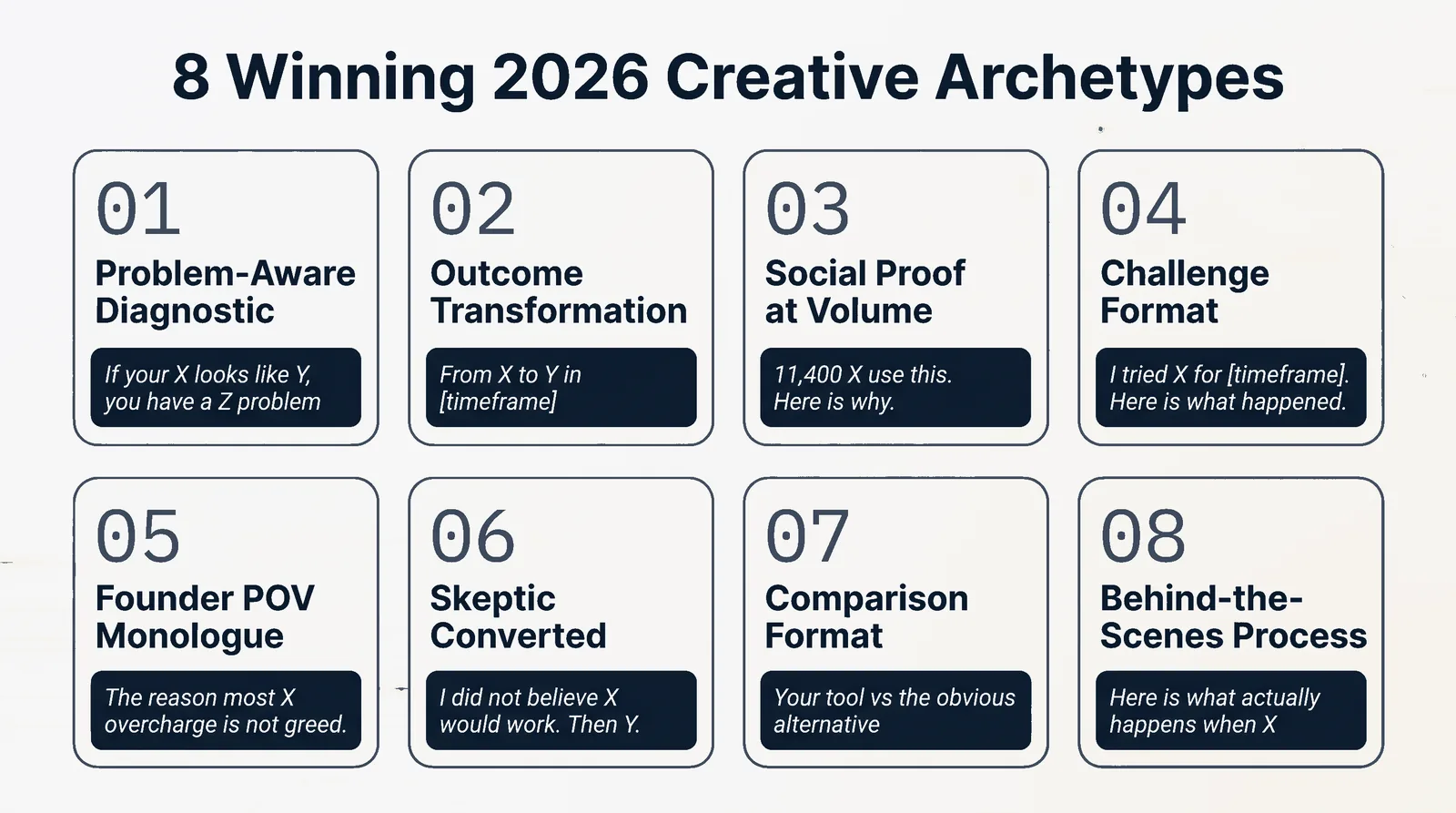
Archetype 1, Problem-aware diagnostic
Used by: SaaS, dentists, law firms, financial advisors.
Hook formula: "If your [thing] looks like [specific symptom], you have a [name of the underlying problem]."
Examples:
- "If your sales calendar has more than three reschedules a week, you do not have a calendar problem. You have a no-show problem."
- "If your cleanings cost less than $150 in [city], your dentist is undercharging. Here is what that probably means for your insurance."
Body template: Three-symptom checklist, then one-sentence diagnosis, then offer.
CTA bank: "Take the 60-second diagnostic." "See your score." "Book a free assessment."
Archetype 2, Outcome transformation
Used by: dentists (whitening, aligners), fitness, home services, SaaS.
Hook formula: "From [starting state] to [end state] in [specific timeframe]."
Examples:
- "From 12 leads a month to 38 in 60 days. No new ad spend."
- "From bottle-feeding twice a night to sleeping through in nine days."
Body template: Before snapshot, intervention named, after snapshot, social proof line, CTA.
CTA bank: "See the case study." "Get the playbook." "Book your consult."
Archetype 3, Social proof at volume
Used by: B2B SaaS, dentists, legal, home services.
Hook formula: "[Big specific number] [target audience] use this. Here is why."
Examples:
- "11,400 home service businesses use this scheduling tool. Here is the one feature that drives 80% of the love."
- "4,800 personal injury cases settled by this firm. The intake question that doubled the case-acceptance rate."
Body template: Volume claim, mechanism in one sentence, two specific outcomes, CTA.
CTA bank: "See the same playbook they use." "Get our intake checklist." "Apply to work with us."
Archetype 4, Challenge format
Used by: prosumer SaaS, fitness, productivity tools.
Hook formula: "I tried [thing] for [specific timeframe]. Here is what happened."
Examples:
- "I tried writing my newsletter with [tool] for 30 days. Subscriber growth doubled."
- "I let an AI book my dentist appointments for a month. Three of them double-booked. Here is the workflow that fixed it."
Body template: Setup, day-by-day moments, surprise insight, recommendation, offer.
CTA bank: "Get the same setup." "Read the full breakdown." "Try it free."
Archetype 5, Founder POV monologue
Used by: SaaS, professional services, local businesses where the owner is the brand.
Hook formula: Direct camera, opens with: "[Surprising statement about your industry]."
Examples:
- "The reason most dentists overcharge for whitening is not greed. It is the supply contract they signed twelve years ago."
- "Most agencies want you to think Meta Ads are complicated so you keep paying them. They are not. Here is the entire workflow in 90 seconds."
Body template: Opener, the contrarian insight, the demo (screen, hands, in-the-shop footage), the offer.
Production notes: Captioned (90% of feed views are sound-off), portrait 9:16 for Reels and Stories, 4:5 for feed. Keep it under 45 seconds.
CTA bank: "DM me [keyword]." "Book a free 15-minute call." "Get the workflow."
Archetype 6, Skeptic-converted testimonial
Used by: SaaS, services where buyer is wary.
Hook formula: "I did not believe [claim] would work. Then [specific outcome]."
Examples:
- "I did not believe a $97 course could replace my $4,000-a-month consultant. Then it produced our biggest month of pipeline."
- "I did not think AI could write better legal intake. Until I read the conversion data from the second month."
Body template: Skepticism stated, the moment of conversion, the proof, the offer.
CTA bank: "Try it for 14 days." "Read the case study." "Book a no-pressure call."
Archetype 7, Comparison format
Used by: SaaS competitor conquest, services vs DIY, gyms vs at-home apps.
Hook formula: "[Your category] vs [the obvious alternative]: a head-to-head."
Examples:
- "ClickFunnels vs GoHighLevel: where each one actually wins. Real-world side-by-side."
- "Local PI lawyer vs the big TV firm: what your settlement check actually looks like, before vs after fees."
Body template: Category named, three pivot points, table or list visual, recommendation, offer.
CTA bank: "See the full comparison." "Try our side." "Book a 1-on-1 walk-through."
Archetype 8, Behind-the-scenes process
Used by: professional services (especially medical, dental, legal), restaurants, home services.
Hook formula: "Here is what actually happens when [moment of service]."
Examples:
- "Here is what actually happens when your roof gets inspected. Three things contractors hope you never ask."
- "Here is what actually happens during a cavity filling, in 90 seconds. Why the new resin matters."
Body template: Voice-over plus walkthrough video, three specific moments, what the customer should look for, offer.
CTA bank: "Book your inspection." "Get a free second opinion." "See pricing."
Hook patterns that punch across all eight
| Pattern | Example |
|---|---|
| Pattern interrupt + specificity | "Three signs your [vendor] is overcharging you." |
| Contrarian opener | "Stop posting on Instagram." |
| Result-first numeric | "$28,300 in new revenue from one Meta campaign." |
| Named-customer drop | "How [Local Business Name] doubled bookings in a quarter." |
| Question with stakes | "Are you paying double for a service that costs your neighbor half?" |
| Time-sensitive trigger | "Tax-time loophole that closes April 15." |
Creative refresh cadence
| Format | Fatigue point | Refresh cadence |
|---|---|---|
| UGC video | 14 to 18 days | New variants every 7 to 10 days |
| Static / single image | 21 to 28 days | New variants every 14 days |
| Polished video | 30 to 45 days | New variants every 21 days |
| Carousel | 21 to 35 days | New variants every 14 days |
The rest of the Massive Impact library builds on patterns like this. See the full set at the Massive Impact resource library.
Part 5, Bidding and Budget Decision Tree
Bid strategy is a function of two things: how many conversion events the ad set produces per week, and how stable your CPA needs to be.
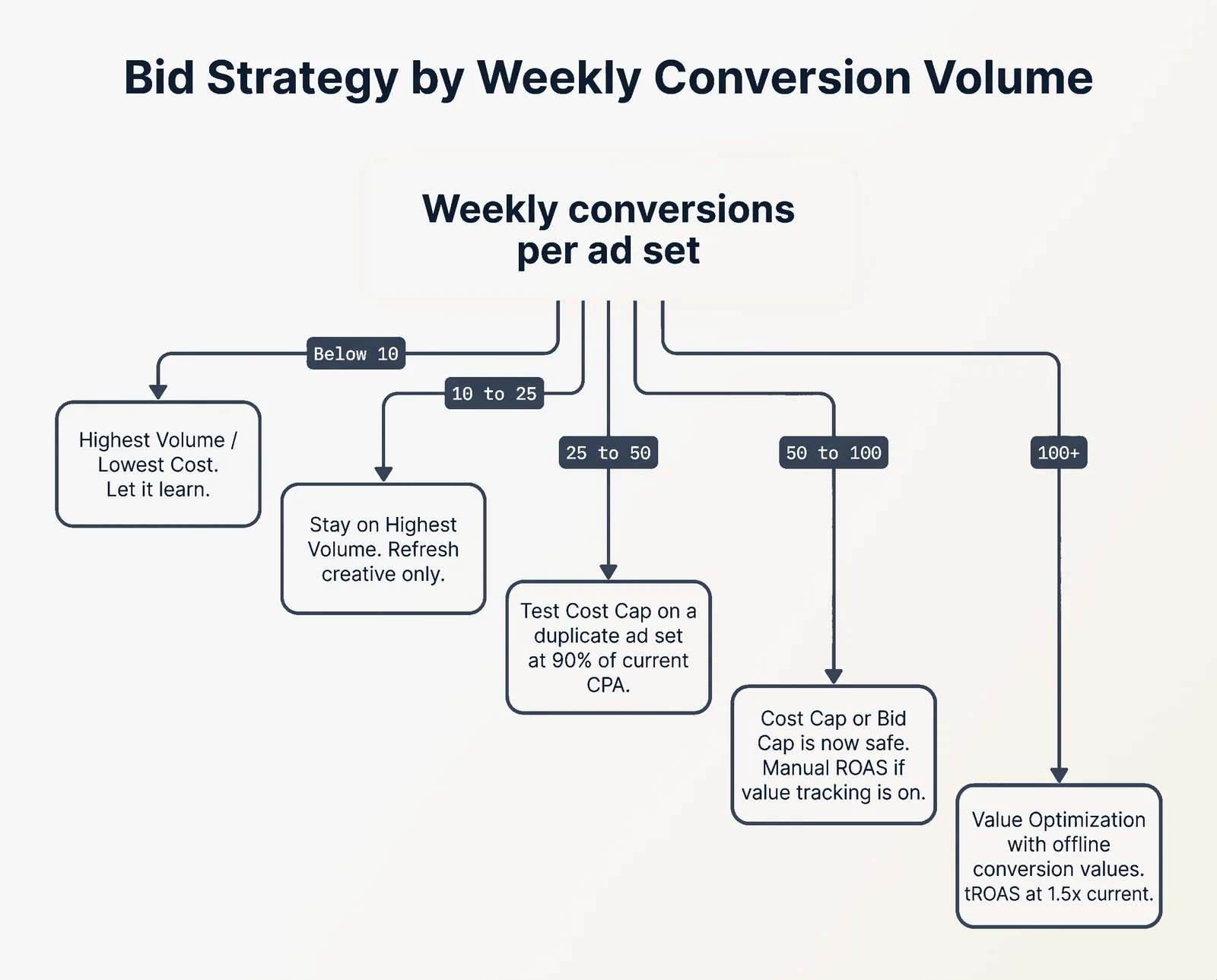
Decision tree by weekly conversion volume
Weekly conversions per ad set
│
├── Below 10 → Manual nothing. Use Highest Volume (Lowest Cost). Let it learn.
│
├── 10 to 25 → Stay on Highest Volume. Refresh creative, do not change bid strategy.
│
├── 25 to 50 → Test Cost Cap on a duplicate ad set at 90% of current CPA.
│
├── 50 to 100 → Cost Cap or Bid Cap is now safe. Manual ROAS if value tracking is on.
│
└── 100+ → Value Optimization with offline conversion values. Set tROAS at 1.5x current.
The 20-30% rule
When scaling spend on a winning ad set, increase the daily budget by no more than 20 to 30% every 2 to 3 days. Larger jumps reset the 50-event learning phase and inflate CPA for 5 to 7 days while it relearns.
When to kill an ad
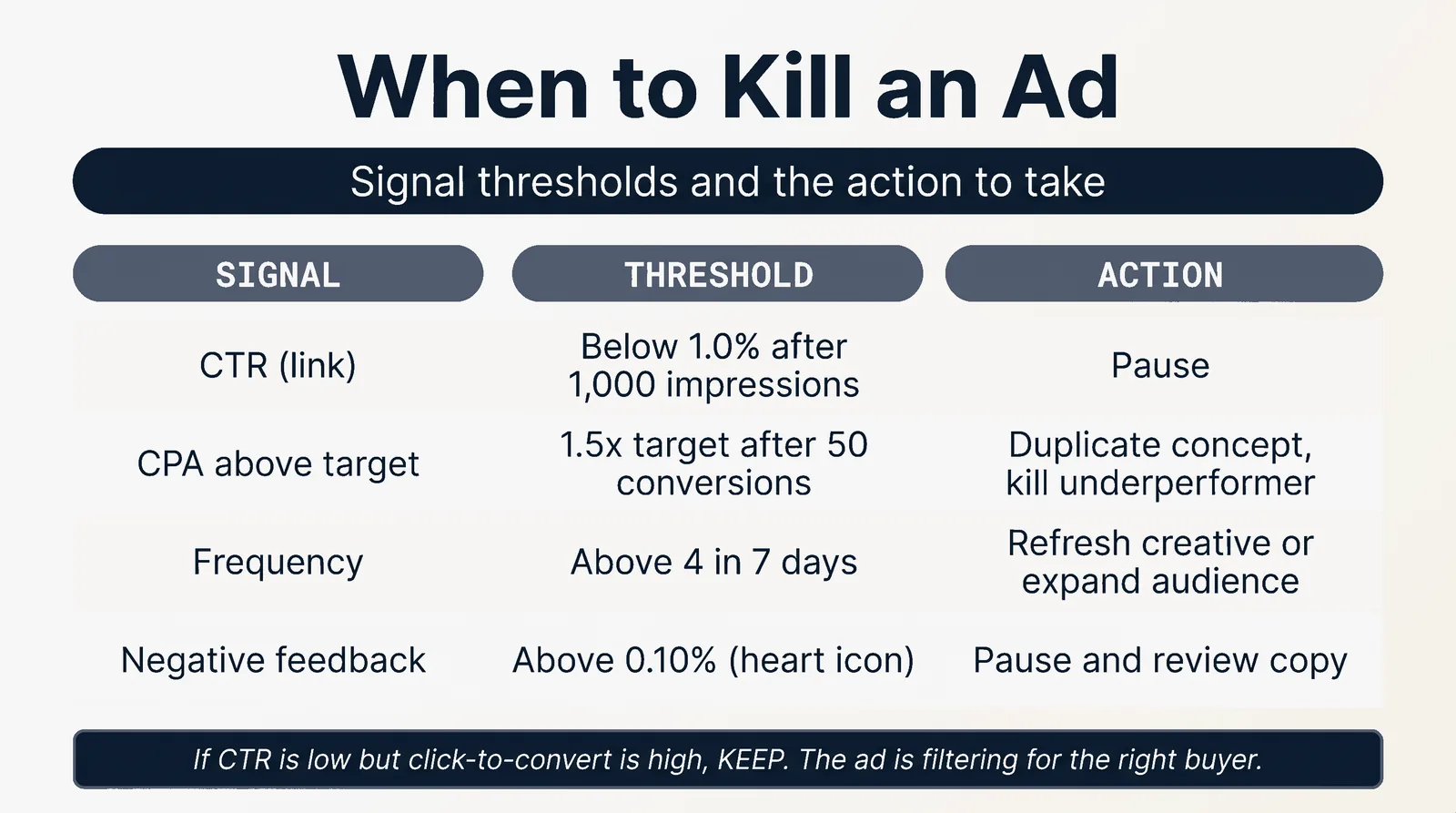
| Signal | Threshold | Action |
|---|---|---|
| CTR (link) | Below 1.0% after 1,000 impressions | Pause |
| CPA above target | 1.5x target after 50 conversions in ad set | Duplicate creative concept, kill underperformer |
| Frequency | Above 4 in 7 days | Refresh creative or expand audience |
| Negative feedback | Above 0.10% (heart icon in Ad Center) | Pause and review copy for irritants |
When to keep an ad you would normally kill
If CTR is low but conversion rate from clicks is unusually high, it is filtering for the right buyer. Keep it. Look at click-to-convert (sometimes called "post-click conversion rate") as the second-tier metric, not just CTR.
Learning phase recovery
If you reset learning by mistake (changed budget by more than 20%, edited creative, swapped objective):
- Stop touching the ad set for 7 days
- Do not duplicate to "skip" learning - duplicate ad sets relearn from scratch too
- If you must intervene, raise the budget once at the 7-day mark, not before
This pattern is one piece of a wider toolkit. Adjacent playbooks at the Massive Impact resource library.
Part 6, Funnel Math and Offer Economics
If your CAC is more than your offer can pay back inside 90 days for SaaS or 30 days for services, no amount of ad-platform tactics will save you. Math first.
The CAC budget formula
Maximum sustainable CAC = AOV x Gross Margin % x CAC allocation %
Where CAC allocation % is what fraction of gross profit you are willing to spend to acquire one customer. SaaS: typically 40 to 60% (long payback acceptable). Services: 20 to 40%. Restaurants and high-frequency local: 5 to 15%.
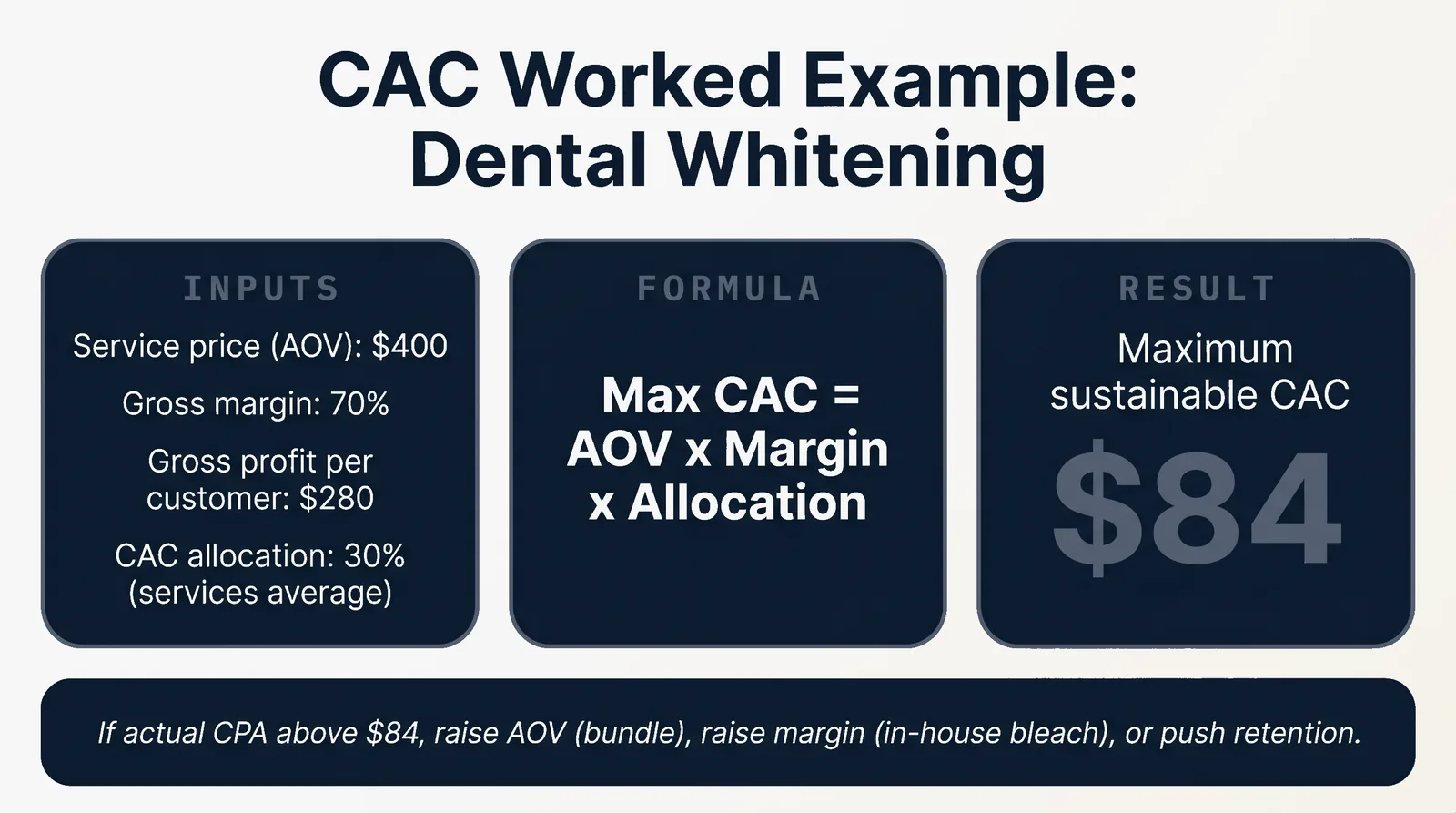
Worked example, dental whitening:
- Service price (AOV): $400
- Gross margin: 70%
- Gross profit per customer: $280
- CAC allocation: 30% (services average)
- Maximum sustainable CAC: $84
So a dentist running Meta for whitening should target a $84 CPA on first customer. If actual CPA is $120, the math fails. Either raise AOV (bundle whitening + cleaning at $475), raise margin (in-house bleaching kit), or push retention to make the LTV math work.
Breakeven CPL by close rate
If you generate leads, your CPL ceiling is a function of your close rate.
Maximum CPL = Maximum CAC x Close Rate
Worked example, personal injury law firm:
- Average case value: $12,000
- Margin (after costs): 35%
- Gross profit per case: $4,200
- CAC allocation: 25%
- Maximum CAC per signed case: $1,050
- Close rate (lead to signed): 8%
- Maximum CPL: $84
If your Meta lead form is producing leads at $32 CPL but only 4% close, real CAC is $800, which is inside budget. If the same leads at $32 CPL only close at 2%, real CAC is $1,600 and you are losing money on each one.
Tactical follow-on: track close rate by ad set. The cheap ad sets sometimes produce uncloseable junk; the more expensive ones close at 3x. Your true cost is CPL divided by close rate, not CPL alone.
LTV math for service businesses
LTV = Average ticket x Visits per year x Years retained
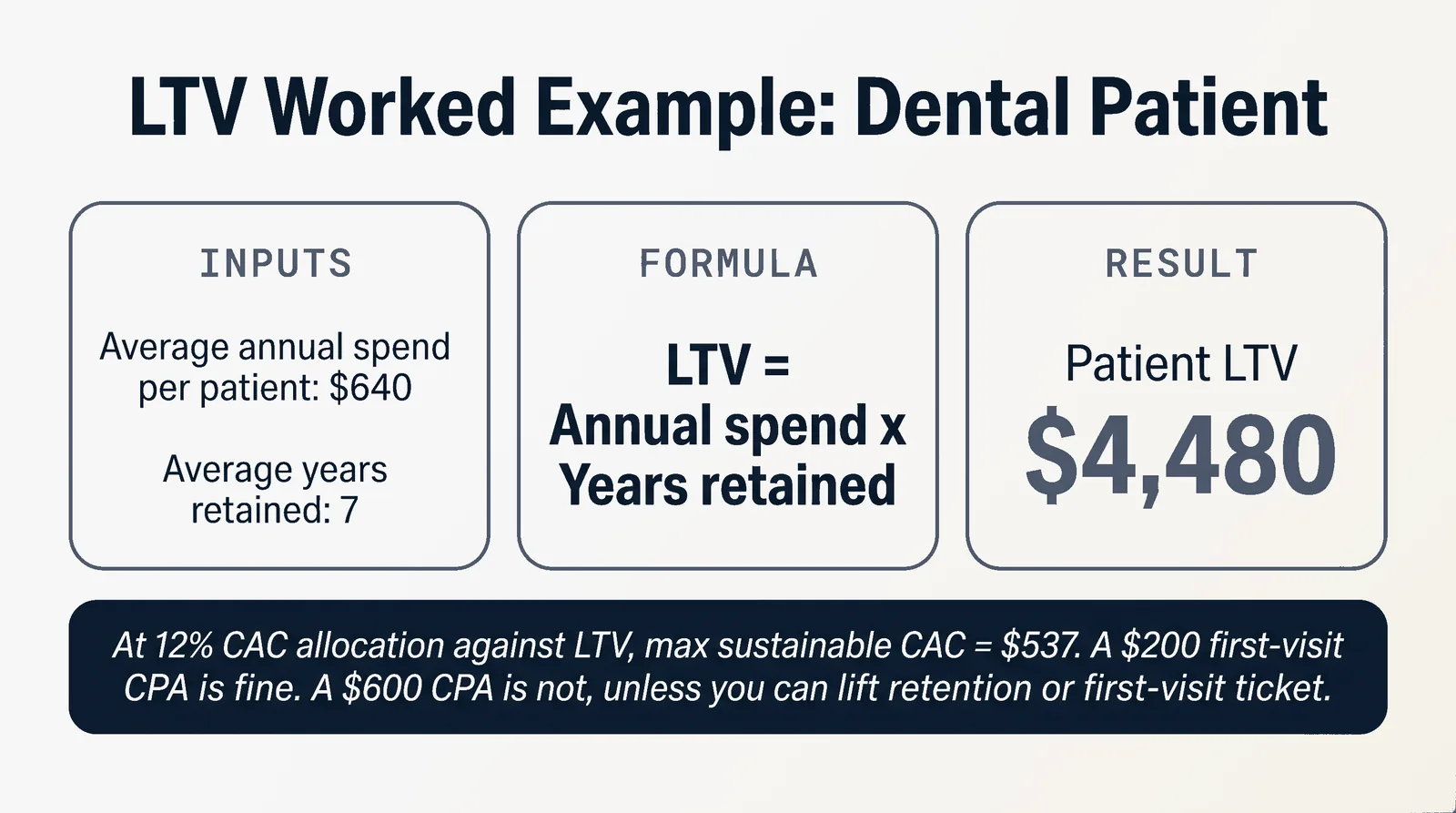
Worked example, dental practice:
- Average annual spend per patient: $640 (cleanings + procedures)
- Average years retained: 7
- Patient LTV: $4,480
- CAC allocation against LTV: 12%
- Maximum sustainable CAC: $537
This is why a $200 first-visit CPA is fine for dentistry but disastrous for a one-off teeth-whitening kit.
Payback period for SaaS
CAC payback months = CAC / (Monthly ARR x Gross Margin %)
Worked example, B2B SaaS:
- ACV (annual contract value): $1,200
- Monthly ARR: $100
- Gross margin: 80%
- Monthly gross profit: $80
- Acceptable CAC: $480 (6-month payback)
- Acceptable CAC: $960 (12-month payback)
Healthy SMB SaaS payback in 2026 is 12 to 18 months. Above 24 months and a small operator runs out of cash before customers pay back. Mid-market SaaS can stretch payback to 24 to 30 months on the back of NRR above 110%.
Refund-survivable margin for low-ticket
Low-ticket front-end offers ($27 to $97) typically run 8 to 18% refund rates in 2026. Build the math:
Net AOV after refunds = AOV x (1 - refund rate)
A $47 tripwire with 14% refunds nets $40.42 average. Your CAC on that tripwire must be below $40.42 minus fulfillment costs. Bump and OTO are the levers that make the math work, not the front-end offer alone.
Part 7, Compliance Snippets
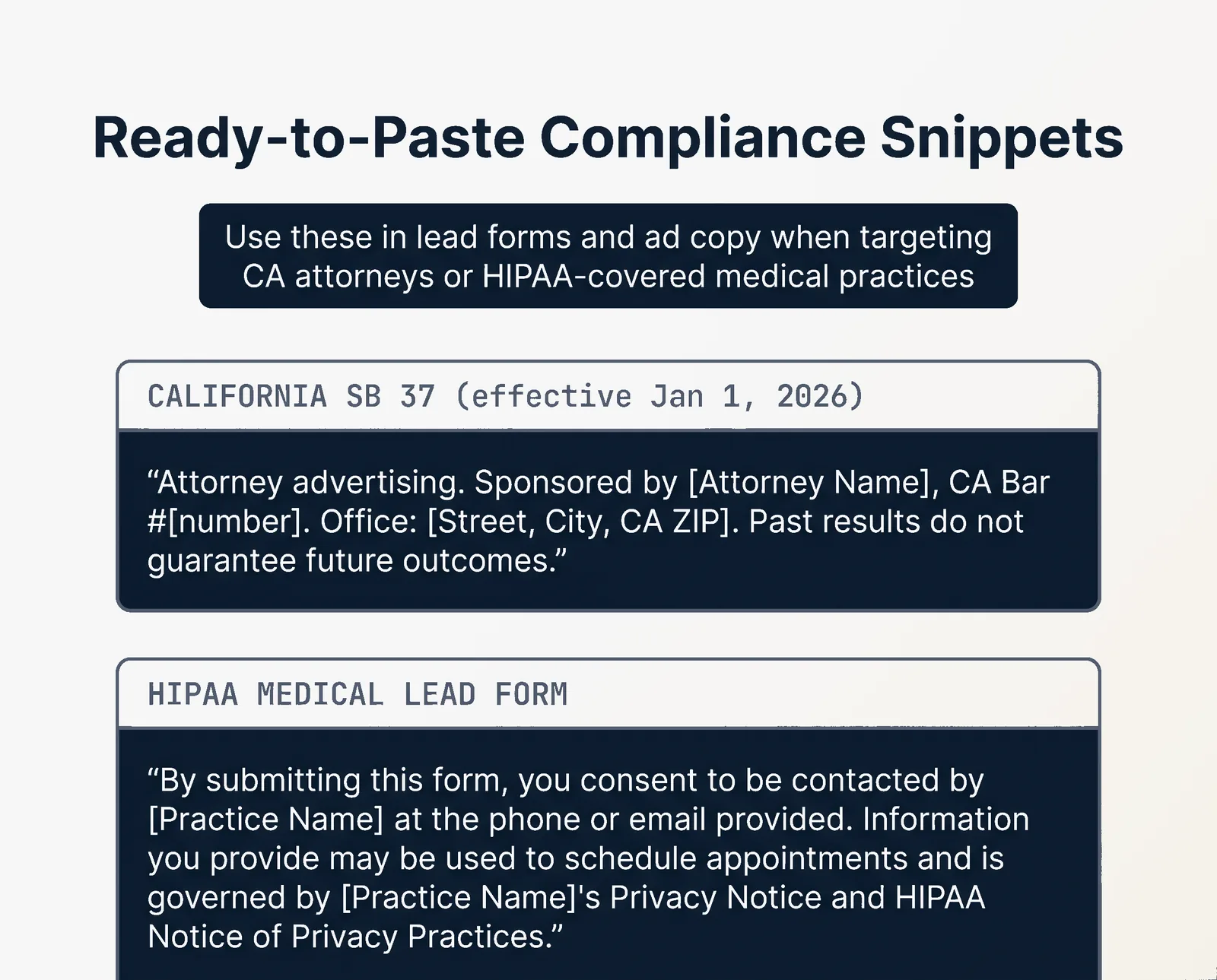
HIPAA-safe Pixel and CAPI for medical and dental
Meta does not sign a Business Associate Agreement. Standard Pixel implementations leak PHI through URL parameters, form field captures, and event names. Do not rely on Meta's "limited data use" toggle alone.
The 2026 minimum:
- Server-side gateway with a BAA (Freshpaint, Analytics Toolkit, Sentry-style proxy)
- Strip all form-field data before transmission. Pass only hashed identifiers (email, phone) plus event names
- Avoid condition-named URLs. Use neutral slugs like
/consultand/appointment, not/depression-treatmentor/std-screening - Optimize for awareness or traffic, not conversion-to-PHI page
- Reconcile real conversions inside HIPAA-safe analytics (PostHog Cloud EU, Heap with BAA, or your EHR analytics layer) and import as offline conversions to Meta
Copy snippet for medical lead forms (Meta Lead Ads):
By submitting this form, you consent to be contacted by [Practice Name] at the phone or email provided. Information you provide may be used to schedule appointments and is governed by [Practice Name]'s [Privacy Notice] and [HIPAA Notice of Privacy Practices].
Pixel events to NEVER fire from a medical site:
- Page views with condition names in the URL
- Custom events that include diagnosis information in event parameters
- Form submission events with PII in field values
California SB 37 (effective January 1, 2026) for attorneys
Every Meta ad, lead form, and landing page targeted to California must:
- Identify a specific licensed California attorney by name
- Disclose a real California office address (not a virtual office or PO box)
- Disclose the attorney's California Bar Number
- Avoid implied results and implied superiority claims
Compliance snippet for ad copy:
Attorney advertising. Sponsored by [Attorney Name], CA Bar #[number]. Office: [Street, City, CA ZIP]. Past results do not guarantee future outcomes.
Lead form thank-you snippet:
This form does not create an attorney-client relationship. [Attorney Name] (CA Bar #[number]) will contact you to discuss your matter. Communications via this form are not confidential until an engagement letter is signed.
State bar copy fitness (ABA Model Rules 7.1 to 7.5)
About 90% of US states mirror ABA Rules 7.1 to 7.5. Three quick fitness tests for ad copy:
| Test | Pass | Fail |
|---|---|---|
| Comparative claim | "Experienced PI attorney serving [city]" | "The best PI lawyer in [city]" |
| Implied result | "We pursue full compensation" | "Get the maximum settlement" |
| Specialization | "Practice focuses on personal injury" | "PI specialist" (unless certified) |
Some states require specific disclaimers (Florida, New York, Texas). Run final copy past the firm's compliance counsel before launch.
Meta health and finance vertical restrictions
| Vertical | Restriction in 2026 | Workaround |
|---|---|---|
| Mental health, addiction, weight loss | Targeting age 18+, no condition-implication | Optimize for awareness or website traffic, not conversion |
| Cosmetic procedures | No before/after of patient body | Show provider, instruments, technique |
| Cryptocurrency | Pre-approval required, restricted geos | Hire compliance counsel; expect long review times |
| Loans and credit | Disclosures required, restricted creative | Use Meta's Special Ad Categories |
Part 8, Launch + Day 7 + Day 30 Checklists
Launch day
- Pixel + CAPI deduped via event_id verified in Events Manager (deduplication score above 70%)
- Conversion event marked as primary in Events Manager
- Account-level brand safety: news content opt-out, sensitive content default, age-gate set
- Two-factor authentication on the ad account
- Spending limit set to weekly cap (prevents runaway charges if a card glitch hits)
- Three to four UTM-tagged URLs ready (one per ad concept)
- Compliance copy in lead form (HIPAA, SB 37, state bar where applicable)
- Audience saved with clear naming convention (
v1-broad-en-US,v1-LAL-1pct-CW) - At least 6 ads in the first ad set, at least 4 distinct creative concepts (not 6 hook variants of one concept)
- First-day budget set per Part 2 architecture
Day 7 review
- Did the ad set hit 50 conversions in 7 days? If no, consolidate or extend to 14 days before judging
- Frequency below 4? If above, schedule creative refresh in next 7 days
- CPA within 1.5x of target? If above, kill bottom 50% of ads, do not change bid strategy yet
- CTR above 1.0%? If below across the ad set, the issue is creative or audience, not bid
- First retargeting audience size above 1,000? If yes, ship retargeting ad set
- CRM offline conversions piping back to Meta? If no, fix this week (biggest single account fix)
Day 30 review
- Scale winning ads by 20 to 30% every 2 to 3 days, not all at once
- Duplicate winning concept into new audience (lookalike from converters or new geo)
- Refresh underperformers; if a concept lost 50% of its CTR vs week 1, kill it not refresh it
- Cost-per-result by ad set vs cost-per-result by creative concept: which one is the bigger lever for you this month
- Compare Meta-reported CPA vs CRM-reported CPA. The gap between them is your iOS attribution loss. Tune on the larger of the two as your truth
- Budget reallocation review: pull 20% from the lowest-performing ad set and add to the highest. Avoid total budget changes above 30% in a single move
The 10 most common 2026 failures and the fix
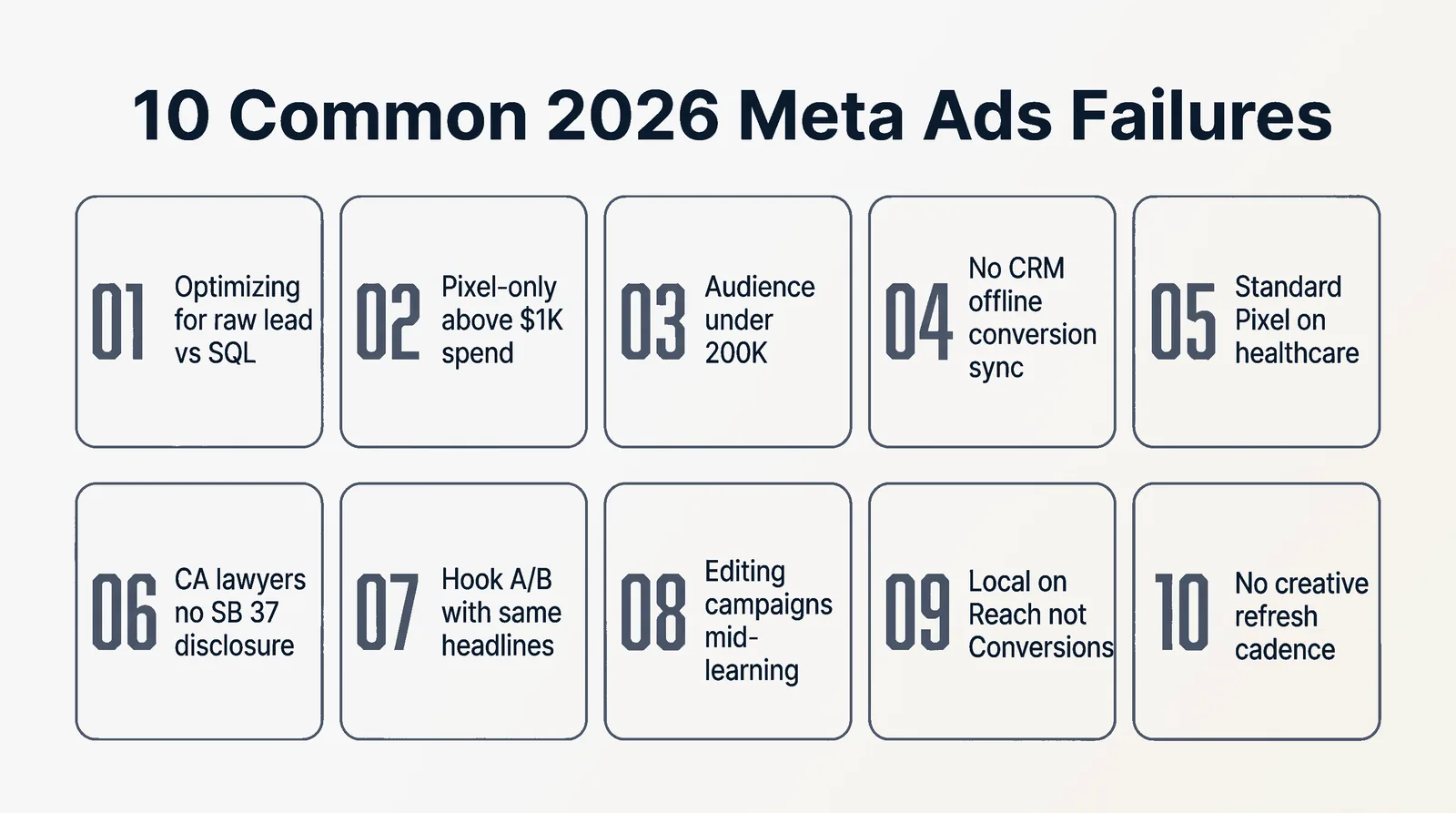
Optimizing for raw lead instead of SQL or booked appointment. Trains Meta on the wrong signal from day one. Fix: pipe SQL or appointment-booked back as the primary conversion event.
Pixel-only attribution above $1,000/month spend. You lose around 60% of signal. Fix: install CAPI deduped via event_id this week.
Audience size under 200,000 prospects. The algorithm starves and CPA inflates. Fix: broaden interests, expand radius, or layer in audience expansion.
No CRM offline conversion sync for SaaS or services. Missing the 30 to 50% SQL volume lift. Fix: pipe CRM events to Meta via Conversions API or a CRM connector.
Healthcare advertisers running standard Pixel events. HIPAA exposure and audit risk. Fix: server-side CAPI through a HIPAA-compliant gateway. Strip form fields. Use neutral URL slugs.
California lawyers without SB 37 disclosures in lead forms. Effective January 2026. Fix: add the attorney name, CA bar number, office address snippet to every ad and lead form.
Hook A/B tests that are actually two near-identical headlines. Meta's 2026 model needs real concept variation. Fix: ship two contrasting concepts per test, not five iterations of one.
Editing campaigns mid-learning phase. Resets the 50-event clock every time. Fix: budget changes above 20% only after the 7-day mark.
Local advertisers running Reach instead of Conversions. Wastes 40 to 60% of spend on people who will never convert. Fix: switch to a Sales or Leads objective unless you are doing pure brand-awareness with a separate measurement plan.
No creative refresh cadence. UGC fatigues in 14 to 18 days, static in 3 to 4 weeks. Fix: scheduled weekly creative production, even if it is one new ad per week.
What to read next
- The 2026 Google Ads Playbook (P27) for the search and Performance Max counterpart to this Meta playbook
- The 2026 TikTok Ads Playbook (P28) for the third leg of paid social for SaaS, services, and local in 2026
- The Low-Ticket Funnel Playbook (P29) for the offer side of these ads, where ad creative plus tripwire plus OTO plus continuity make the math work
The full Massive Impact library lives at the Massive Impact resource library.
The rest of the guide is yours, free.
Enter your email to keep reading and get the PDF to keep.
No spam. One email unlocks every Massive Impact resource.
“You guys actually have everything in one package, SEO, Facebook Ads, Google Ads, and even website maintenance.”
The service behind this
More from the library
