


Funnel math, 7-step architecture, page-by-page specs, vertical plays, the buyer email sequence, and 2026 compliance for SaaS, professional services, and local businesses.
Who this is for
Solo founders, in-house marketers, and agency operators building low-ticket funnels in 2026 for non-ecommerce verticals. The playbook covers SaaS (paid trials, lifetime deals, annual upfront), professional services (paid intake, mini-consults, low-ticket info products), and local businesses (first-visit vouchers, trial classes, list-building offers).
This is a tactical reference. Eight parts. The first part you read should be Part 2, Funnel Math, because most low-ticket offers fail on math, not creative.
What is in this playbook
- Part 1, The 2026 Low-Ticket Funnel Reality
- Part 2, Funnel Math First
- Part 3, The 7-Step Funnel Architecture
- Part 4, Page-by-Page Specs
- Part 5, Vertical Plays (SaaS / Professional Services / Local)
- Part 6, The 7-Day Buyer Email Sequence
- Part 7, Tracking + Compliance
- Part 8, Pricing Psychology + 10 Failures
Part 1, The 2026 Low-Ticket Funnel Reality
The price ladder migrated upward. The standard tripwire was $7 in 2015, $27 to $47 by 2020, and $47 to $97 in 2026 because click costs and audience saturation killed the math at lower prices. Hormozi himself now warns against defaulting to low prices.
What changed in the last twelve months:
| Shift | Date | Implication |
|---|---|---|
| Tripwire price ceiling raised | Through 2025 to 2026 | $47 to $97 is the new normal for cold traffic offers |
| iOS attribution windows narrowed | Jan 12, 2026 | 7-day click + 1-day view standard. Less hurt for low-ticket impulse buys (1-day click captures most), but still 50% to 70% data gaps on iOS |
| Stripe chargeback fees | Mid-2025 | $15 base + $15 dispute counter-fee. Subscription transactions excluded from Chargeback Protection. |
| FTC Click-to-Cancel rule | Vacated July 2025 by Eighth Circuit, reissued as ANPRM Jan 30, 2026 | Federal status uncertain. State equivalents (CA, NY) still apply. |
| Meta enforcement | 2025 to 2026 | Stricter against income claims, get-rich-quick framing, aggressive medical/financial claims |
| Cold ad to tripwire pattern | Declining | Cold ad to lead magnet to tripwire on thank-you page now wins |
What stays the same
- Without bumps and OTOs, the math fails. A standalone tripwire cannot cover paid acquisition.
- The buyer is hottest in the first 72 hours after purchase. Most operators waste it.
- Charm pricing (ending in 7) still beats round numbers for low-ticket. Round numbers ($97, $197, $497) still signal authority for premium.
The rest of the Massive Impact library builds on patterns like this. See the full set at the Massive Impact resource library.
Part 2, Funnel Math First
If the math does not work on a calculator, no creative or copy can save the funnel. Run the numbers before you build the pages.
The four numbers that decide everything
1. CPL (cost per lead, from the lead magnet)
2. Tripwire conversion rate (% of leads who buy the front-end)
3. AOV (average order value, including bumps and OTOs)
4. Refund rate
The breakeven formula
Net front-end revenue per lead = (Tripwire CR x AOV) - (Refund rate x AOV)
Funnel survives paid traffic if: Net front-end revenue per lead >= CPL
Worked example A, $47 tripwire (no bump, no OTO)
- CPL: $4
- Tripwire CR: 5%
- AOV: $47
- Refund rate: 14%
- Net front-end revenue per lead: ($0.05 x $47) - ($0.05 x $47 x 0.14) = $2.35 - $0.33 = $2.02
- Funnel result: LOSING $1.98 per lead
This is the classic standalone-tripwire failure. Do not run a $47 standalone tripwire on cold traffic.
Worked example B, $47 tripwire + $17 bump + $197 OTO
- CPL: $4
- Tripwire CR: 5% (front-end alone)
- Bump take rate: 35% of buyers (+$5.95 to AOV)
- OTO take rate: 12% of buyers (+$23.64 to AOV)
- Effective AOV: $47 + $5.95 + $23.64 = $76.59
- Refund rate (blended): 14%
- Net front-end revenue per lead: ($0.05 x $76.59) x (1 - 0.14) = $3.29
Still losing $0.71 per lead on the front end. But...
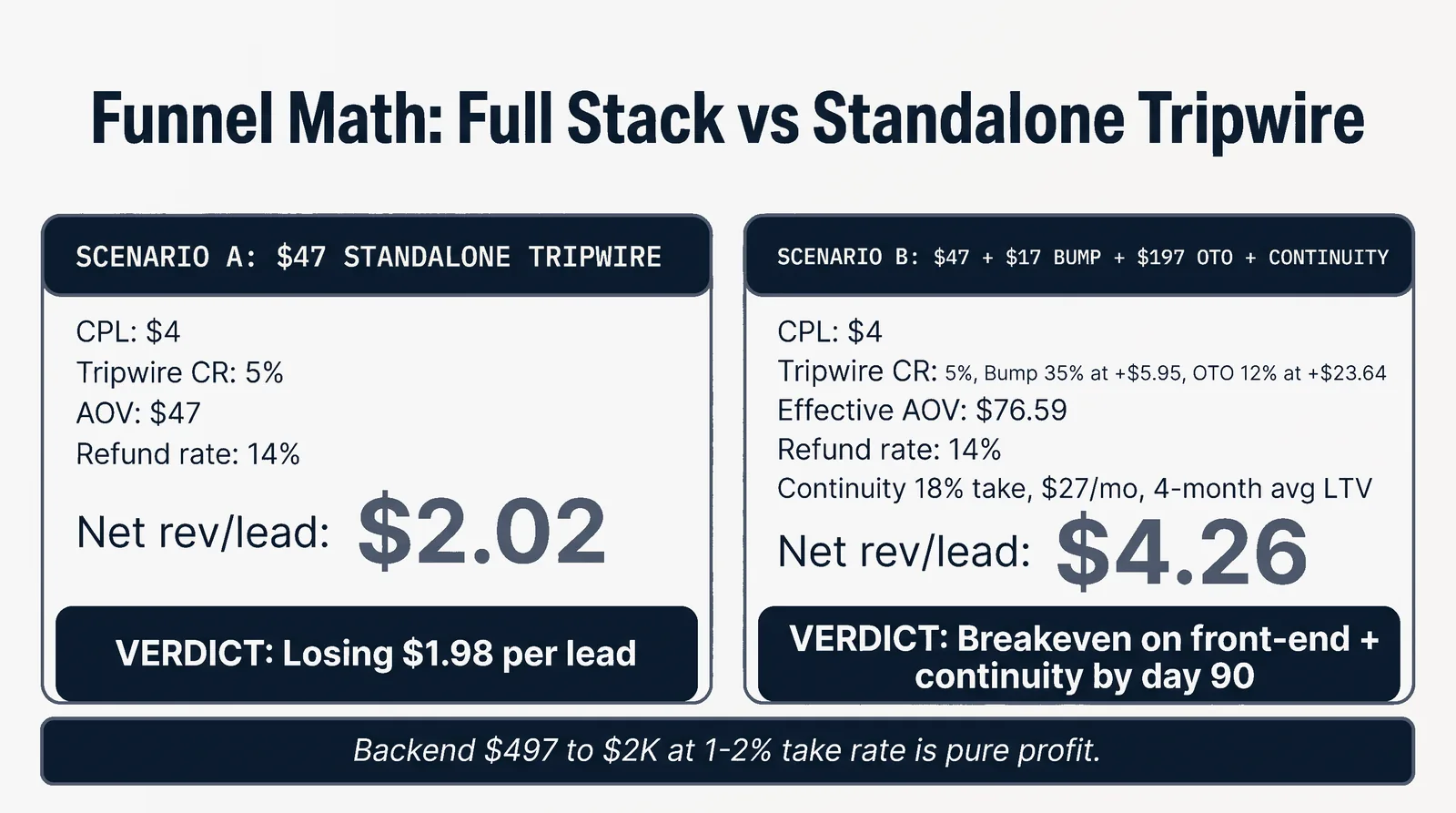
Worked example C, full stack with continuity
Same as B, plus:
- Continuity offer at $27/mo, 18% take rate at OTO point, average 4-month lifetime
- Continuity revenue per lead: 0.05 x 0.18 x $27 x 4 = $0.97
Total per lead: $3.29 + $0.97 = $4.26 vs $4 CPL.
Funnel breaks even on front-end + continuity inside 90 days. Backend ($497 to $2,000 + offer at 1 to 2% take rate) is pure profit.
The high-ticket backend math
Most low-ticket funnels make their money on the backend, not the front-end. Worked example:
- 1,000 leads at $4 CPL = $4,000 spend
- 50 tripwire buyers (5% CR) producing $76.59 AOV = $3,830 front-end revenue
- 9 continuity subscribers (18% of 50) producing $108 LTV = $972 continuity revenue
- 1 high-ticket buyer (2% of tripwire buyers, $1,500 program) = $1,500 backend revenue
- Total revenue: $6,302
- Net profit on $4,000 spend: $2,302 (57% ROAS)
This is why low-ticket funnels exist. Not for the $47 sale, for the buyer-acquisition mechanics.
The CAC budget formula (carried from P26)
For every offer in the funnel:
Maximum sustainable CAC = AOV x Gross Margin % x CAC allocation %
Use this to set the maximum acceptable CPL on each tier of the funnel.
This pattern is one piece of a wider toolkit. Adjacent playbooks at the Massive Impact resource library.
Part 3, The 7-Step Funnel Architecture
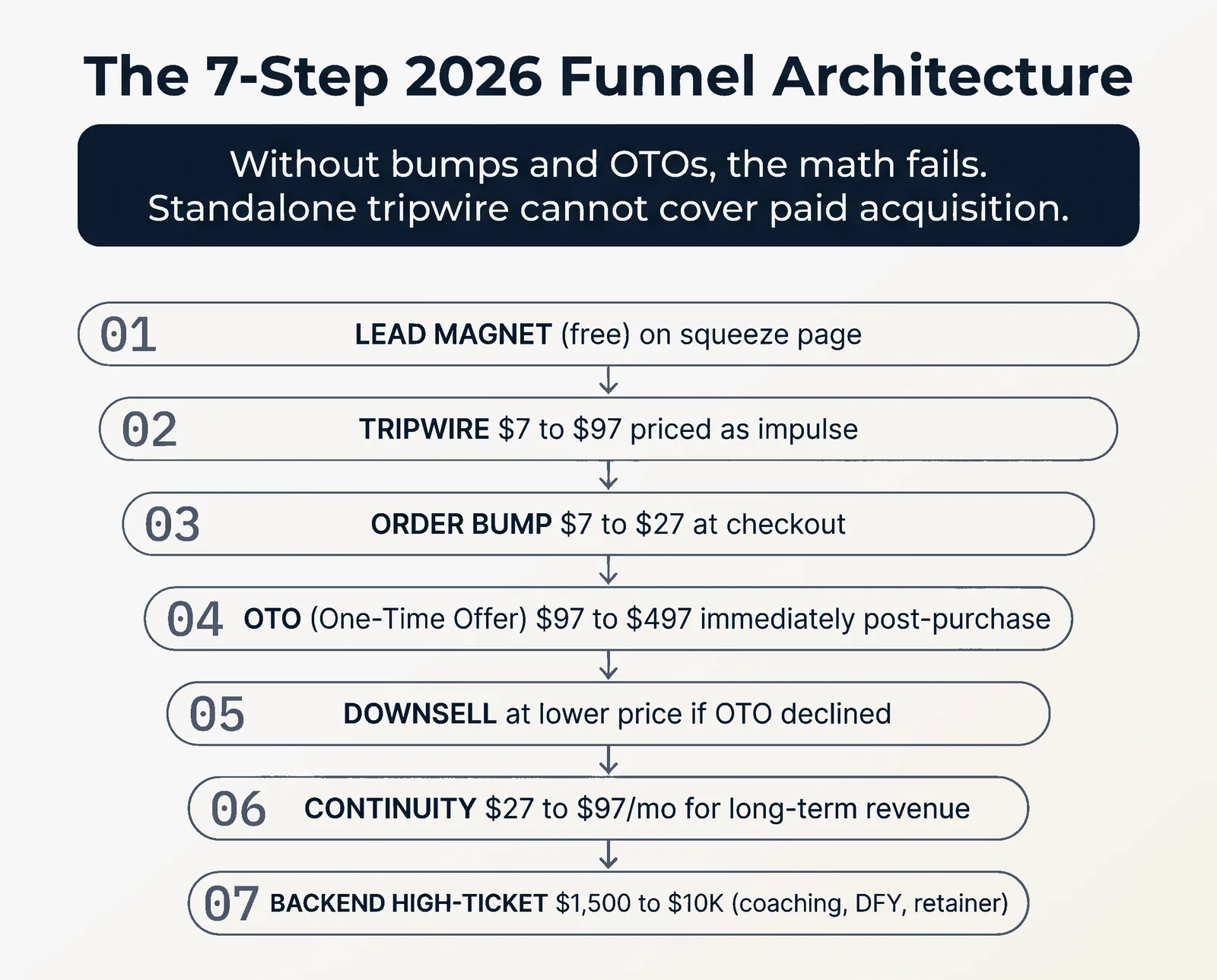
The full 2026 stack:
1. Lead magnet (free) on a squeeze page
   ↓
2. Tripwire / front-end offer at $7 to $97 priced as impulse
   ↓
3. Order bump at $7 to $27 added at checkout
   ↓
4. OTO (One-Time Offer) at $97 to $497 immediately post-purchase
   ↓
5. Downsell at lower price if OTO declined (50 to 60% of OTO)
   ↓
6. Continuity at $27 to $97/mo for long-term revenue
   ↓
7. Backend high-ticket at $1,500 to $10K (coaching, done-for-you, agency retainer)
Conversion benchmarks at each step (2026)
| Step | Cold benchmark | Warm benchmark |
|---|---|---|
| Squeeze opt-in | 8% to 15% | 25% to 45% |
| Tripwire conversion | 1.5% to 3% | 4% to 8% |
| Order bump take rate | 25% to 35% | 30% to 45% |
| OTO take rate | 8% to 14% | 12% to 22% |
| Downsell take rate (of declined OTOs) | 15% to 30% | 18% to 35% |
| Continuity take rate (at OTO point) | 12% to 20% | 18% to 30% |
| Backend conversion (over 90 days) | 1% to 2% | 3% to 5% |
Dollar ranges by step (2026)
| Step | Range | Mode |
|---|---|---|
| Tripwire | $7 to $97 | $47 |
| Order bump | $7 to $27 | $17 |
| OTO | $97 to $497 | $197 |
| Downsell | $47 to $147 | $97 |
| Continuity | $27 to $97/mo | $47/mo |
| Backend | $1,500 to $10K | $2,500 |
More patterns like this across the Massive Impact library at the Massive Impact resource library.
Part 4, Page-by-Page Specs
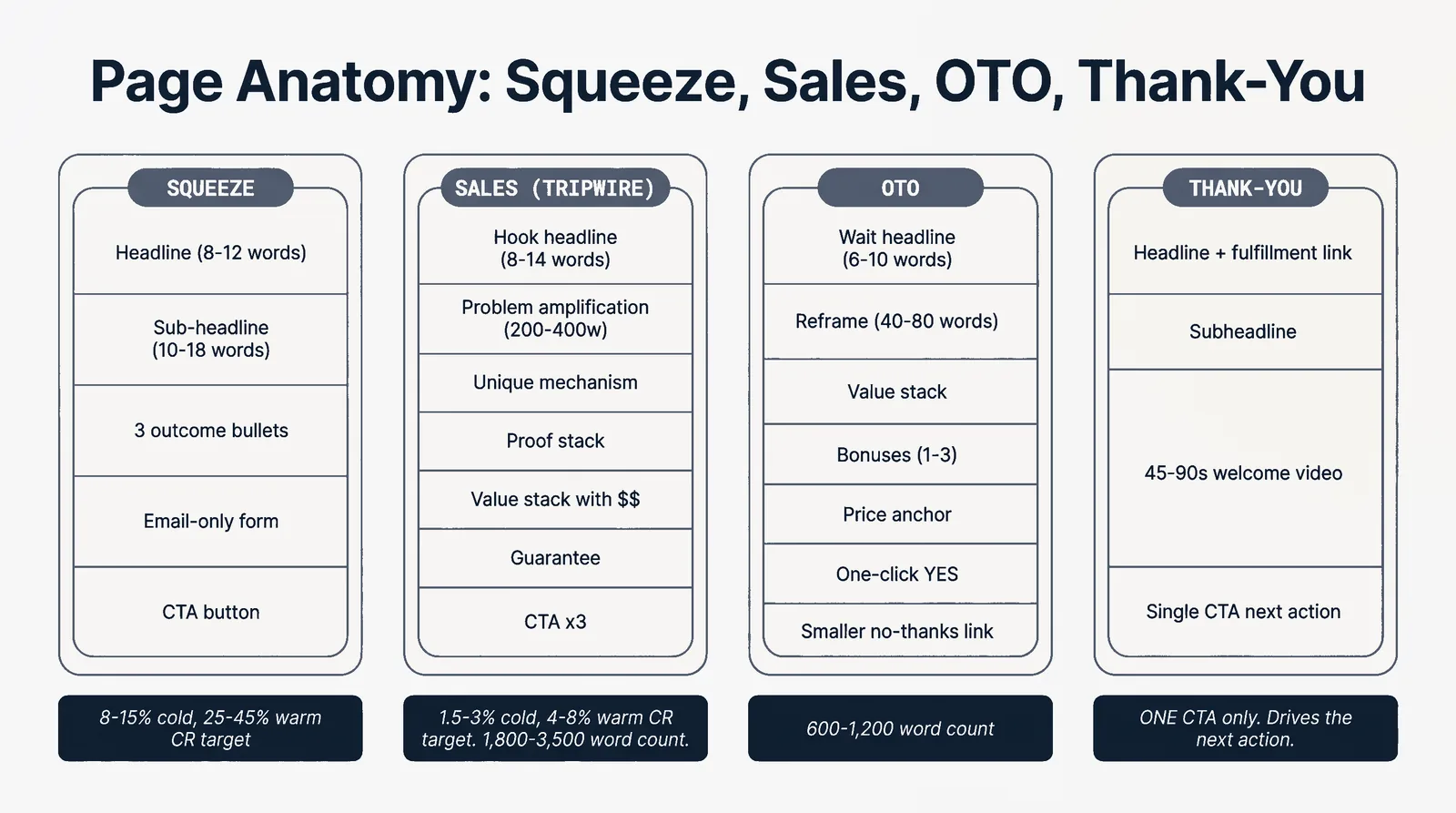
Squeeze page
Copy template:
- Headline: "[Outcome] in [Time-bound]" (8 to 12 words)
- Sub-headline: "Free [format]. No fluff." (10 to 18 words)
- Bullet list: 3 outcome-led promises, each starting with a verb
- Form: email only on cold, email + first name on warm
- Button: "Get the [format]" or "Send it to me" (3 to 5 words)
Conversion target: 8% to 15% cold, 25% to 45% warm.
Sales page (tripwire)
Copy template:
- Hook headline: 1 sentence, 8 to 14 words, names a specific outcome or contrarian truth
- Sub-headline: 1 sentence, 12 to 22 words, sets up the problem the offer solves
- Problem amplification: 3 to 5 paragraphs (200 to 400 words total) walking through the pain in detail
- Unique mechanism: 1 paragraph naming what makes this different (the proprietary method, the shortcut, the framework name)
- Proof stack: 3 to 6 testimonials with photos and outcome metrics, plus volume claim ("4,200 customers")
- Offer reveal: visual stack listing what is included with retail value of each
- Value stack total: real dollar number that is at least 5x the offer price
- Guarantee: 30-day, 60-day, or "double refund" framing
- Urgency: real deadline (cohort start, price increase, limited bonus)
- CTA: button repeated 3 times throughout the page (after value stack, after guarantee, in footer)
Word count: 1,800 to 3,500 words for cold traffic, 800 to 1,500 for warm.
Conversion target: 1.5% to 3% cold, 4% to 8% warm.
Order page
Order bump copy template:
- Checkbox label (12 to 22 words): "[Benefit]: also get [bump deliverable] for just [$X] more (a [$Y] value, today only)."
Example:
- "[Yes, add the Done-For-You Templates]: also get the 14-day email sequence in editable Notion + Airtable for just $17 more (a $97 value, today only)."
OTO page (Hormozi-style stack, 2026 restraint version)
Copy template:
- Wait headline: 1 sentence, 6 to 10 words ("Wait, your order is not finished yet")
- Reframe: 1 paragraph (40 to 80 words) explaining why this is the natural next step, NOT an upsell
- Value stack: 3 to 5 deliverables with retail value of each
- Bonuses: 1 to 3 fast-action bonuses (today only)
- Price anchor: cross out higher number, show OTO price
- One-click yes button: "Add to my order for $[X]" (no re-entering payment)
- "No thanks" link: smaller, at the bottom
Word count: 600 to 1,200 words.
2026 restraint rule: the over-stacked Hormozi style is now pattern-matched as scammy. Three to five real deliverables outperform 12 padded ones.
Downsell page
Copy template:
- Hook: "We get it, [OTO price] is a stretch right now"
- Reframe: "Here is the smaller version that still solves [specific problem]"
- Single deliverable + 1 bonus
- Price: 50 to 60% of OTO price
- Button + smaller no-thanks
Thank-you page
Copy template:
- Headline: "You are in. Here is your [fulfillment link]."
- Subheadline: "Watch this 90-second video before you start."
- Embedded video: founder welcome (45 to 90 seconds). Sets expectations, names the next action.
- Single CTA: book a call, join the community, or watch the welcome video.
Critical: do NOT add multiple CTAs. The thank-you page has one job: drive the single next action that compounds buyer engagement.
Part 5, Vertical Plays
SaaS
Working plays:
- $1 paid trial with auto-conversion at day 7 or 14. The friction of entering a card matters more than the dollar amount. Opt-out trial conversion: 48.8% vs opt-in 18.2%.
- Annual upfront discount as the "low-ticket" entry. 12 months for the price of 8 to 10. AOV is high but commitment is high too.
- One-time license fee for prosumer SaaS. Where users hate subscriptions. Prosumer tools (Notion templates, AI prompt packs, Figma kits) sell well at $47 to $97 one-time.
- Lifetime deals on AppSumo as a 30 to 90 day launch tactic only. Over $113M in cumulative payouts to SaaS partners. AppSumo AI Week in February 2026 drove the latest wave. Treat as launch traction, not permanent pricing.
When SaaS low-ticket fails:
- Pure self-serve with no human follow-up
- Complex products that need onboarding the buyer cannot do alone
- Lifetime deals treated as permanent pricing instead of launch tactic
Professional services
The classic services funnel is lead magnet to free consultation. The 2026 version inserts a paid intake step.
Working plays:
- $47 to $97 mini-consultation. Lawyers, consultants. Pays for ad spend AND qualifies seriously.
- $27 to $47 PDF or mini-course as a positioning tool. Pre-sells the doctor or attorney as expert before the consult.
- $47 to $97 workshop or webinar. Entry to a $5K to $25K engagement.
- The "do you take new patients" funnel. Dentists, home services. Ad-to-form is a paid first-visit deposit.
Compliance constraints:
- HIPAA: medical practices cannot use Venmo, PayPal, Zelle, or Apple Pay for patient payments. Use a processor that signs a BAA: Square, Helcim, PaymentCloud.
- Bar trust accounts: state bar trust-account rules block standard Stripe checkout for retainers. Use IOLTA-compatible processors: LawPay, ClientCredit.
Local businesses
Local funnels build a list as the long-term asset, not a single transaction. The 2026 version treats SMS + email together because algorithm-driven social keeps shrinking organic reach.
Working plays:
- First-visit voucher at $10 to $20. Restaurant entree, oil change, cleaning service. The voucher is the tripwire.
- New customer discount funnel with mandatory phone + email opt-in. Builds the list while delivering the discount.
- List-building offer like a trial yoga class or free intro session priced at $1 to $20.
- Subscription model for repeat services. Gyms and salons defaulting to tiered monthly memberships (casual / committed / premium). 70% of salons increased tech investment for recurring billing in 2026.
- Voucher platforms. Your Local Experiences (UK, launched February 2026) bundles local deals into a single browse-and-buy experience. New region-specific platforms emerging through 2026.
Part 6, The 7-Day Buyer Email Sequence
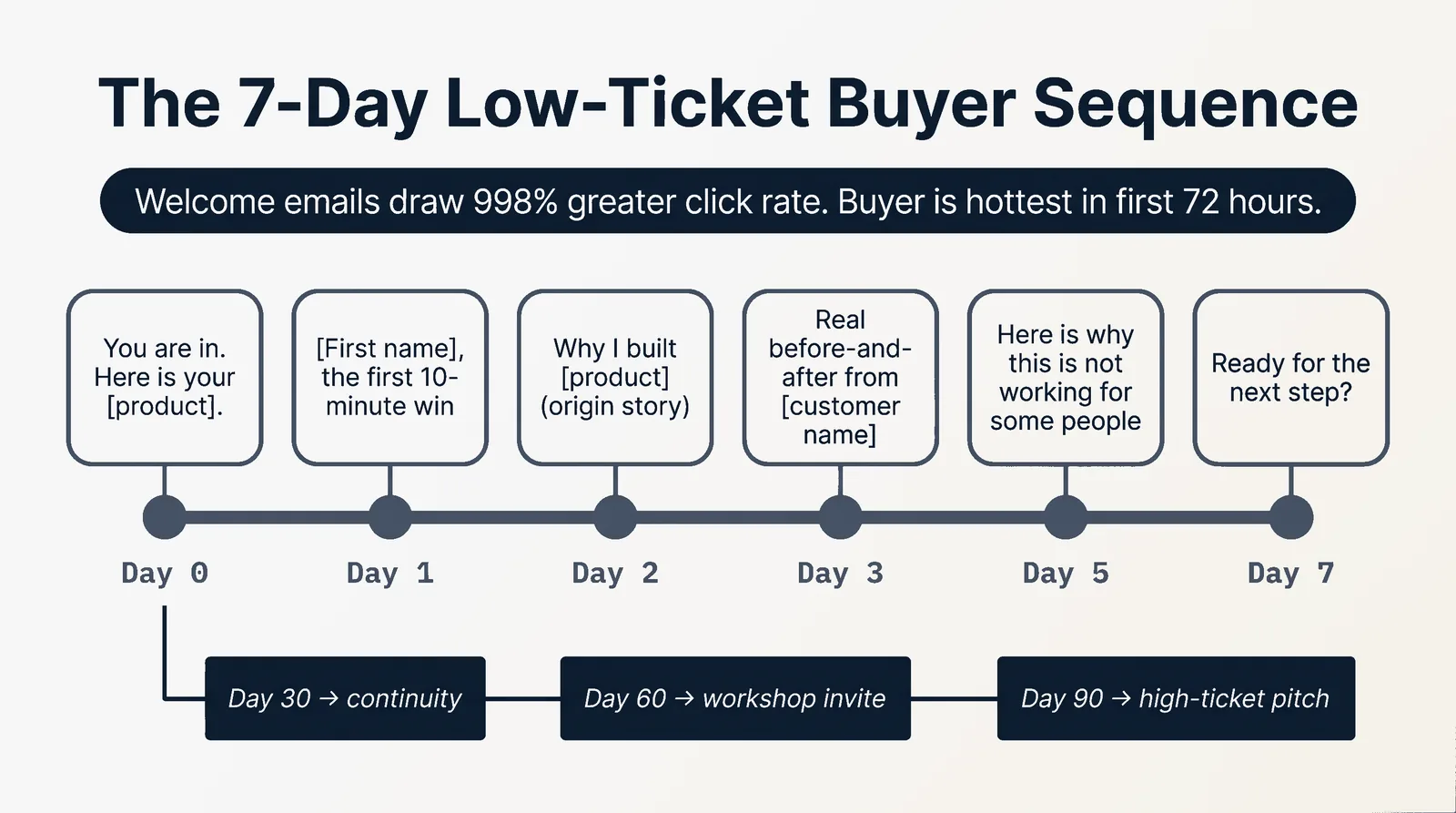
Welcome emails draw 998% greater click rate than promo emails and average 11% conversion rate. The 7-day buyer is hottest in the first 72 hours.
Subject lines + body templates
Day 0 (immediate after purchase):
- Subject: "You are in. Here is your [product]."
- Body (4 short paragraphs):
- Confirm purchase + access link / login
- The ONE thing to do in the next 10 minutes
- Set expectation: "I will email you tomorrow with [specific topic]"
- Sign-off + reply prompt: "Hit reply and tell me [one specific question]"
Day 1:
- Subject: "[First name], the first 10-minute win"
- Body (3 short paragraphs):
- Hook on a specific outcome
- The 10-minute action that gets the win
- Reply prompt or soft CTA to community / next step
Day 2:
- Subject: "Why I built [product] (origin story)"
- Body (4 to 6 paragraphs):
- The moment that triggered the build
- The specific frustration with existing options
- The version 1 you scrapped and why
- What [product] does differently
- Soft CTA to OTO or community
Day 3:
- Subject: "Real before-and-after from [customer name]"
- Body (3 paragraphs + screenshot):
- Specific case study setup
- What they did with the product
- Specific outcome with numbers
- Soft CTA to OTO
Day 5:
- Subject: "Here is why this is not working for some people"
- Body (4 paragraphs):
- Acknowledge that 10 to 20% will not get results
- Name the 3 specific reasons it does not work
- The one thing they can do to fix the most common reason
- Soft CTA to community or live training
Day 7:
- Subject: "Ready for the next step?"
- Body (4 to 6 paragraphs):
- Recap what they should have accomplished by now
- Name what is next: bigger result, faster path, more support
- Specific OTO or ascension offer
- Limited-time bonus or deadline
- Single CTA button + "no, just learning for now" link
The 30/60/90 expansion path
After day 7, the buyer enters the long-term ascension sequence:
- Day 30: introduce the continuity offer if they have not bought yet
- Day 60: invite to a workshop, live training, or community event
- Day 90: pitch the high-ticket backend offer (coaching, done-for-you, retainer)
The buyers who consume the low-ticket and engage with emails 4 to 6 are the ones who convert to high-ticket. The asset is engagement data, not the email blast.
Part 7, Tracking + Compliance
iOS attribution post-January 2026
On January 12, 2026 Meta removed the 7-day view and 28-day view attribution windows. The new standard is 7-day click + 1-day view. Low-ticket impulse buys are less hurt than considered purchases (1-day click captures most low-ticket conversions), but data gaps still reach 50% to 70% on iOS-heavy audiences.
Tactical fix:
- CAPI + Pixel deduped via event_id is now mandatory
- Reconcile platform-reported revenue against Stripe-reported revenue weekly
- Tune on the larger of the two as your truth
FTC Click-to-Cancel rule status
The FTC's "Click-to-Cancel" rule was vacated by the Eighth Circuit in July 2025, then reissued as an Advance Notice of Proposed Rulemaking on January 30, 2026. Federal status uncertain through 2026.
State equivalents that still apply:
- California: SB-313 requires online cancellation for online subscriptions
- New York: similar rules
- Several other states with active enforcement
Tactical fix: even if not federally required, build the "one-click cancel" flow. It reduces chargebacks materially and is cheaper than disputes.
Stripe chargeback rules
Stripe chargeback fees changed in mid-2025:
| Cost | Amount |
|---|---|
| Base chargeback fee | $15 |
| Dispute counter-fee | $15 (mid-2025 addition) |
| Total per disputed transaction | $30 |
Subscription/recurring transactions are explicitly excluded from Stripe Chargeback Protection. You carry that risk yourself. A chargeback ratio approaching 1% triggers monitoring; above 1% sustained risks account suspension.
Tactical fix for continuity offers:
- Crystal-clear terms on the order page (charge frequency, charge amount, when first charge, when next charge)
- Pre-billing reminder email 3 to 5 days before each renewal
- One-click cancel link in every email
- Dispute-prevention copy on the cancel page: "Refund the last charge?" before completing cancellation
Continuity copy that survives chargeback monitoring
Order page snippet:
By clicking the button below, you agree to be charged $[X] today and $[Y] every [period] starting [date]. You can cancel anytime by [specific method, one click]. We will email you 5 days before each renewal.
Pre-billing reminder email:
Meta ad standards 2026
Stricter enforcement against:
- "Make money online" framing
- Get-rich-quick claims
- Aggressive medical claims (covered in P26 HIPAA section)
- Aggressive financial claims (Special Ad Category required)
Tactical fix: soften copy. Replace "make $10K in 30 days" with "what 3,400 customers built in 30 days." Use customer outcomes, not aspirational projections.
Part 8, Pricing Psychology + 10 Common Failures
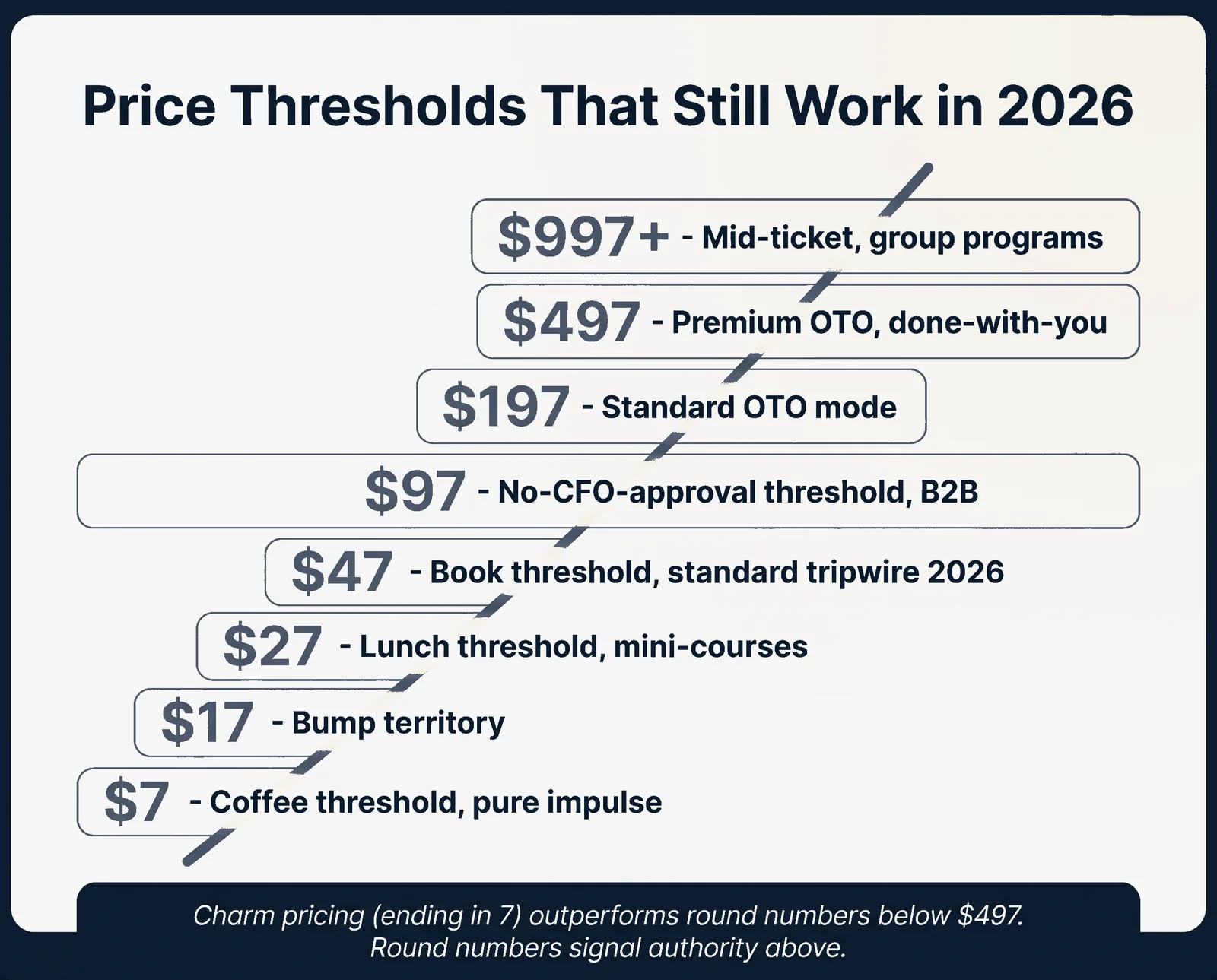
Price thresholds that still work in 2026
| Price | Threshold | When to use |
|---|---|---|
| $7 | Coffee threshold | Pure impulse buys, low fulfillment cost, list-building |
| $27 | Lunch threshold | Light-but-real digital products, mini-courses |
| $47 | Book threshold | Standard tripwire 2026, info products with substance |
| $97 | No-CFO-approval threshold | B2B, expense without sign-off |
| $197 | Standard OTO mode | Natural OTO from $47 to $97 tripwire |
| $497 | Premium OTO | Implementation, done-with-you tier |
| $997 | Mid-ticket | Group programs, accelerator |
| $2,500+ | High-ticket backend | 1-on-1 coaching, done-for-you retainer |
Charm pricing vs round numbers
- Ending in 7 outperforms round numbers for low-ticket: $47 beats $50, $97 beats $100
- Round numbers signal authority for premium: $497, $997, $2,500 read as established programs
- $7, $17, $27 still work for impulse threshold
The $1 trial mechanic
The $1 trial converts 2 to 3x better than free because:
- Card entry is the friction, not the dollar
- The buyer commits behaviorally
- Auto-conversion to full price at day 7 or 14 captures the buyer who forgot
- Refund liability is low (most do not refund $1)
The 10 most common 2026 failures
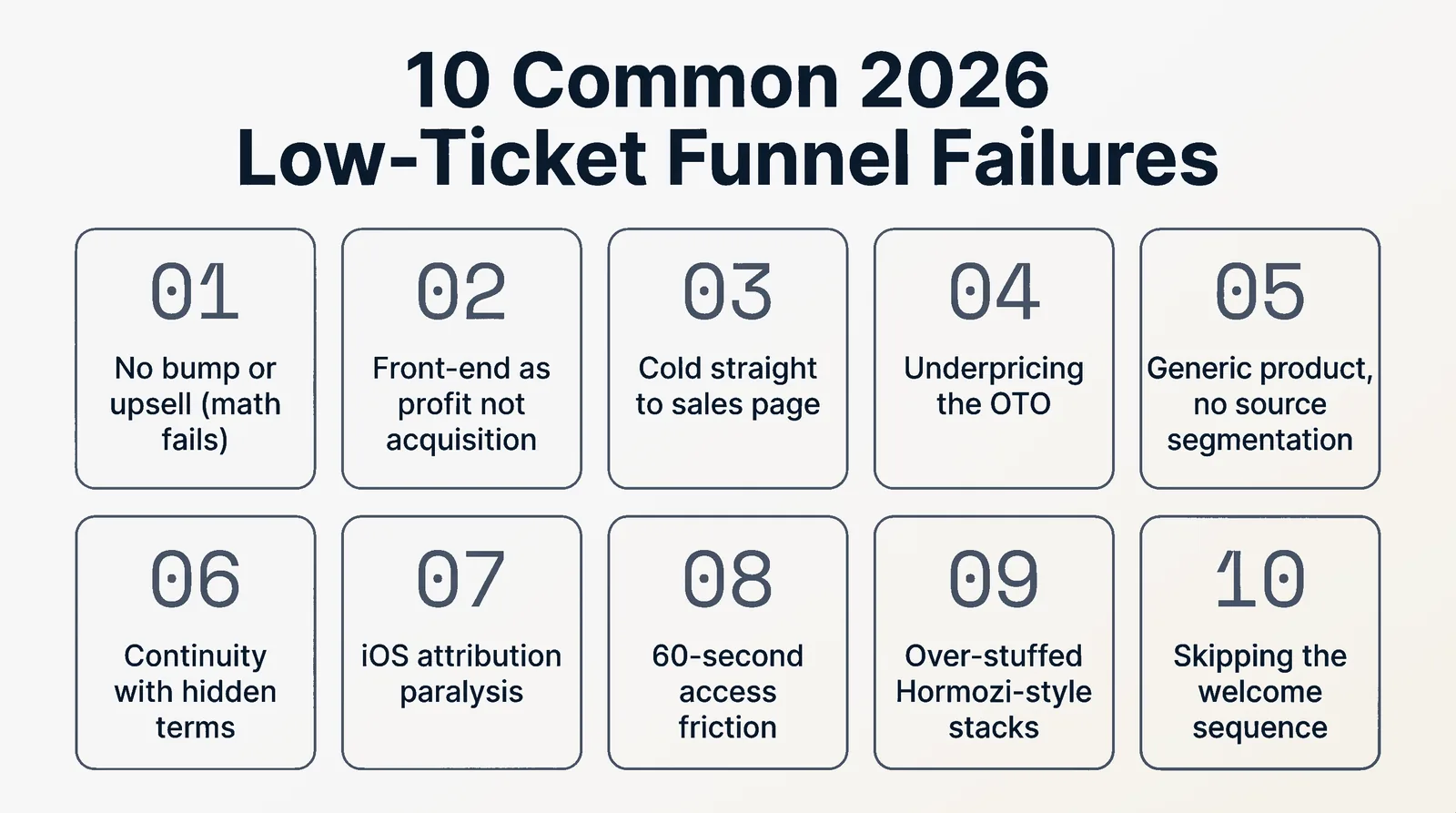
No bump or upsell. The math fails at $27 alone with paid traffic. Fix: never run a standalone tripwire on cold traffic.
Treating the front-end as profit instead of customer acquisition. Every dollar should be reinvested. Fix: budget the entire front-end revenue back into ads for the first 90 days.
Cold traffic straight to sales page without warming via lead magnet first. Fix: lead magnet first, tripwire on the thank-you page, email sequence with a real deadline.
Underpricing the OTO. A $97 OTO behind a $27 tripwire is wasted runway. Fix: OTO should be 3 to 7x the tripwire price.
Generic product, no segmentation. One tripwire for all sources. In 2026 you need source-specific tripwires (Meta vs Google vs TikTok vs email).
Continuity with hidden terms triggering Stripe chargebacks. Fix: crystal-clear terms, easy cancellation, pre-billing reminder emails.
iOS attribution paralysis. Making decisions on platform-reported ROAS only. 50%+ of iOS conversions missing. Fix: reconcile against Stripe revenue weekly.
No fulfillment friction reduction. Buyer cannot access the product in 60 seconds, refund rate spikes. Fix: instant access, single login link in the welcome email.
Over-stuffed Hormozi-style stacks that read as scammy. 2026 buyers are pattern-matching against this. Fix: 3 to 5 real deliverables with real value, not 12 padded ones.
Skipping the welcome sequence. Buyer is hottest in first 72 hours and most operators waste it. Fix: ship the 7-day sequence in Part 6 before the funnel goes live.
What to read next
- The 2026 Meta Ads Playbook (P26) for the cold traffic side of this funnel
- The 2026 Google Ads Playbook (P27) for high-intent search to the squeeze or sales page
- The SaaS Customer Acquisition Funnel Playbook (P30) for the SaaS-specific funnel mechanics including PLG, freemium, reverse trial, and NRR-driven expansion
The full Massive Impact library lives at the Massive Impact resource library.
The rest of the guide is yours, free.
Enter your email to keep reading and get the PDF to keep.
No spam. One email unlocks every Massive Impact resource.
“We've basically doubled what we were doing. I mean, the numbers speak for themselves.”
The service behind this
More from the library
