


What's real, what's hype, and what to do this year as AI agents start to shop.
Last verified: 21 September 2026 · 20 minute read · No technical background needed
Who this guide is for
Business owners, marketers and anyone responsible for being found online, who keep hearing that "AI agents will do the shopping" and want to know what's real, what's hype, and what to do about it this year.
By the end you'll know: the difference between what's happening now and what's still being built, who's building the plumbing, what the numbers actually say, and a practical checklist for being chosen by an AI rather than skipped.
In one sentence
Agentic commerce is when an AI does some or all of the shopping for a person: finding options, comparing them, and increasingly completing the purchase.
The analogy that makes it click
Think of a personal shopper.
Today, most people search, click around, compare and buy. More and more, they ask an AI: "find me a good escape room for six people on Saturday under $200." The AI reads the options and recommends a few.
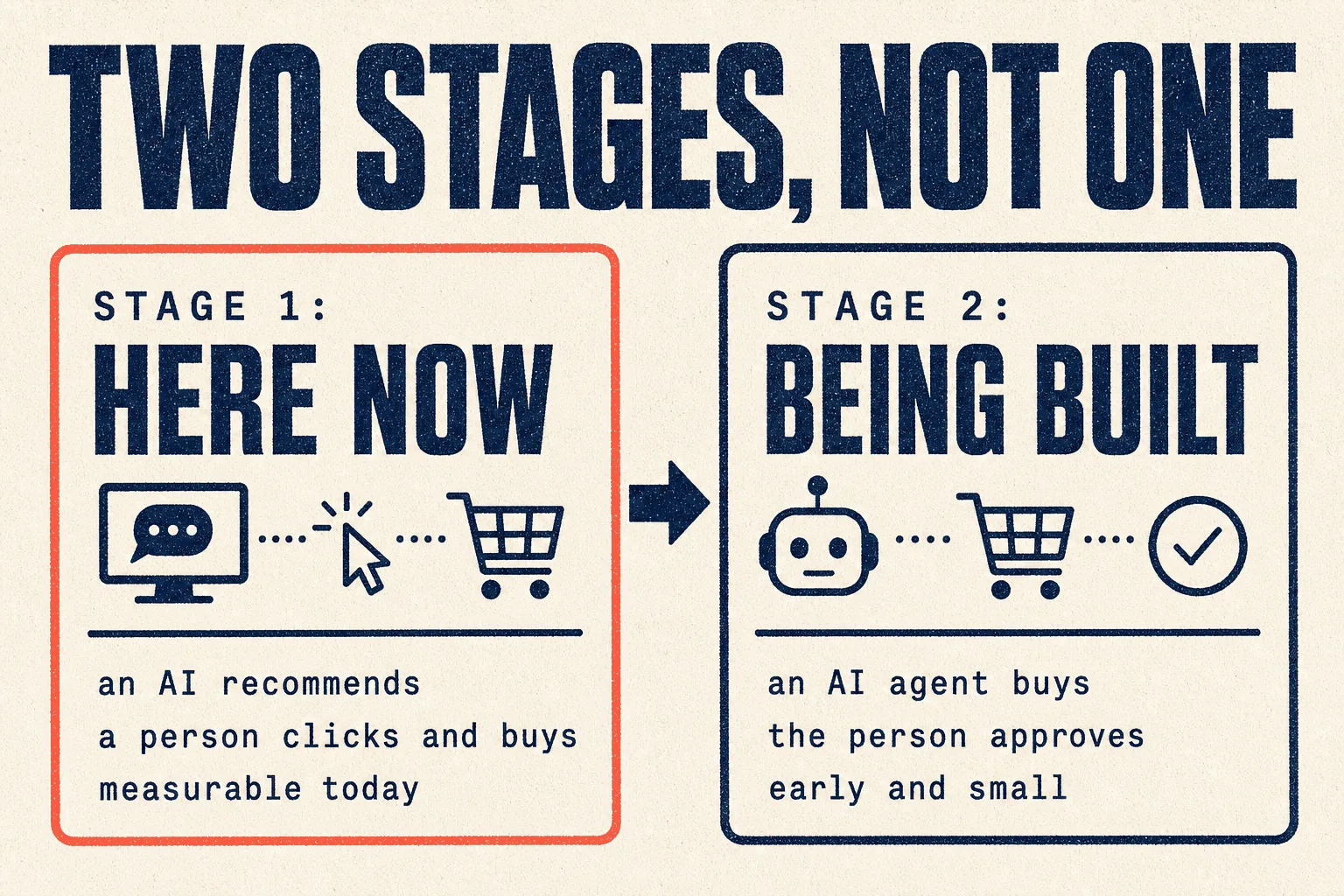
That's stage one: the AI is the personal shopper who recommends, and the person still makes the booking.
Stage two is the personal shopper who books it for you: finds, chooses, pays, and hands you the confirmation.
Stage one is here now, and measurable. Stage two is being built right now, and still small. Most articles blur them together. This guide doesn't.
Stage one: AI recommends, a person buys
This is the part with real data behind it. All the figures below are from Adobe Analytics, which measures traffic across hundreds of retail sites. Note what Adobe is measuring: people clicking a link from an AI tool to a shop, not bots purchasing.
The growth, including how it's slowing
| Period | AI-referred traffic to US retail sites | Source |
|---|---|---|
| July 2025 | up 4,700% on the year before | Adobe, via Retail Brew |
| 2025 holiday season | up 693% | Adobe |
| May 2026 | up 138% | Adobe, via Digital Commerce 360 |
| Oct 2024 to May 2026 | 14 times higher overall | Adobe, via Digital Commerce 360 |
Read that honestly. The famous 4,700% figure came from a tiny starting point, and growth has slowed as the base has grown. It's still more than doubling each year. It's a real trend, just not the explosion the headline suggests.
Where it matters most: it converts
This is the number worth remembering.
| What Adobe found | |
|---|---|
| May 2026 | AI-referred shoppers converted 54% better than other traffic |
| A year earlier | they converted at roughly half the rate of other traffic |
| 2025 holiday season | 31% better conversion, 45% more time on site, 13% more pages, and 33% less likely to leave immediately |
In plain terms: people who arrive from an AI recommendation now buy more often than people who arrive any other way. That flipped in about a year.
Beyond retail
Adobe's 2025 holiday data showed AI-driven traffic rising across industries: travel up 539%, financial services 266%, tech and software 120%, media 92%.
Stage two: the AI buys for you
This is the part being built, and it's genuinely early.
A journalist in the research asked publicly for people who use AI to shop regularly, to interview them. The thread got one real reply. And an analyst tracking this traffic warned (45 votes):
"Attribution from the interactions to real revenue is messy. Most agentic commerce metrics I see lack proper control groups."
So be sceptical of anyone quoting big numbers for AI buying. What exists is the plumbing, and that's worth understanding because it decides who gets to sell.
Who's building the plumbing
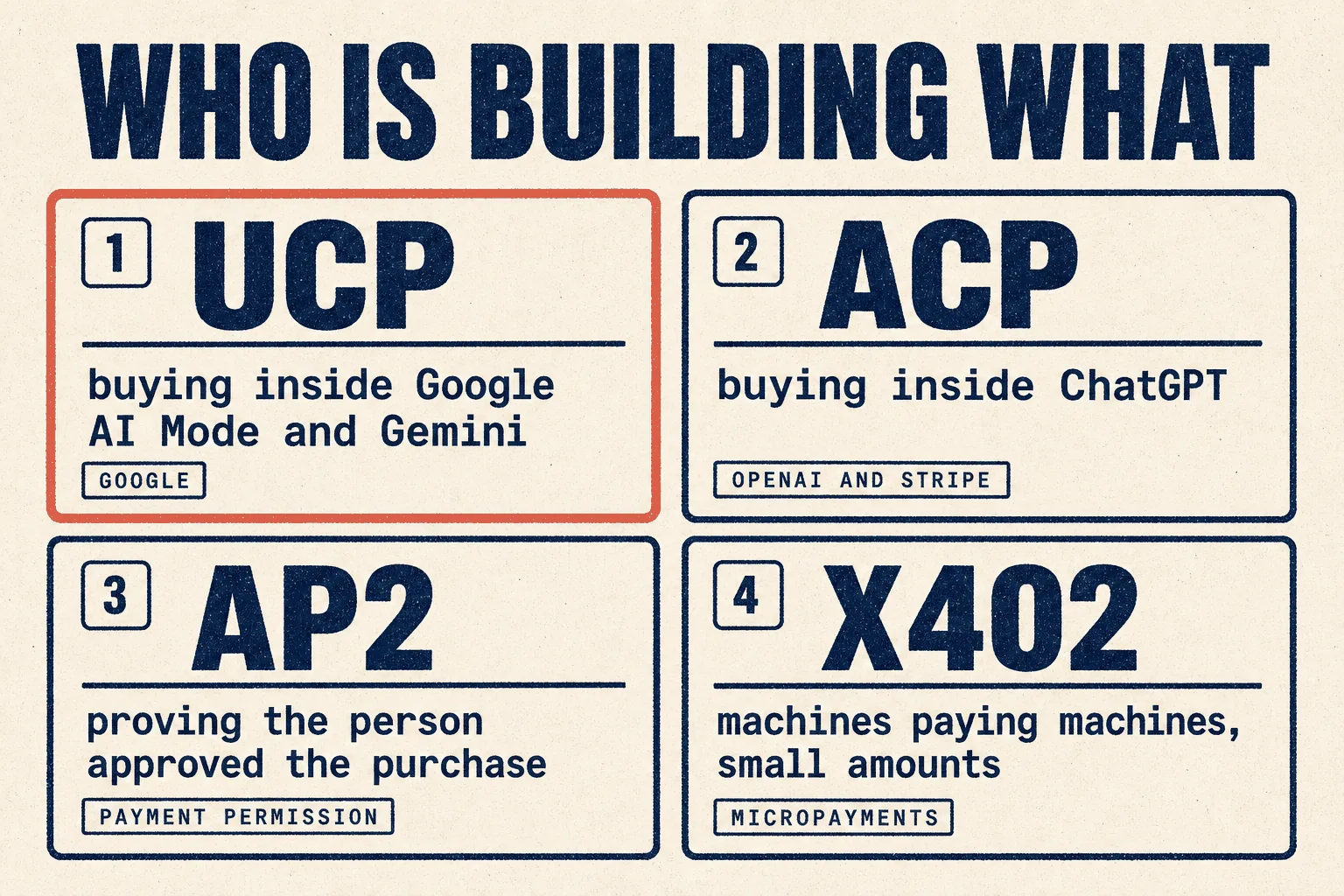
Four open standards matter. Each solves a different problem.
UCP: buying inside Google (the one to watch)
The Universal Commerce Protocol is Google's. Its own description:
"Adopt UCP to enable agentic actions on AI Mode in Google Search and Gemini, starting with direct buying."
Three things make it the most important one for most businesses:
- It uses your existing Google Merchant Center shopping feeds.
- You stay the merchant of record, keeping your customer data and relationships.
- It's expanding beyond shopping, with lodging and food listed as next.
ACP: buying inside ChatGPT
The Agentic Commerce Protocol is maintained by OpenAI and Stripe. ChatGPT was the first platform to use it, and Stripe the first payment provider. Like UCP, the business stays the merchant of record and can accept or decline each transaction.
If you already use Stripe, Stripe's own documentation covers how to take part.
AP2: proving the person agreed
The Agent Payments Protocol answers the obvious worry: how does a shop know a human actually approved what their AI is buying? It sets out to solve three problems, in its own words:
| Problem | The question |
|---|---|
| Authorisation | did the person give the agent authority for this specific purchase? |
| Authenticity | does the request reflect what the person actually wanted? |
| Accountability | if it goes wrong, who's responsible? |
It works alongside UCP and Google's agent-to-agent protocol.
x402: machines paying machines
x402 reuses an old, unused web code, "402 Payment Required", so software can pay software per request. It was started by Coinbase and is now an open standard whose members include Shopify, Ripple and the Solana Foundation.
Its own live dashboard, read on 21 September 2026, showed for the previous 30 days:
| Transactions | 75.41 million |
| Volume | $24.24 million |
| Buyers | 94,060 |
| Sellers | 22,000 |
Do the division: that's about 32 cents per transaction. This is overwhelmingly software paying for small things, like one API call or one piece of data. It's real and growing. It's not people's agents buying sofas.
What this means for being found online
The shift in one line: you used to optimise for a person scanning a page. Now you're also optimising for an AI reading it on their behalf.
An AI doesn't care about your hero image. It reads prices, availability, policies, reviews and structured information, compares options in seconds, and recommends on criteria. If it can't read your offer cleanly, you're not on the shortlist.
A practical checklist
| Action | Why | |
|---|---|---|
| ☐ | Keep a clean, complete Google Merchant Center feed | it's what UCP draws on for AI Mode and Gemini |
| ☐ | Use structured data for products, prices, availability, reviews and business details | machine-readable facts are what AIs compare |
| ☐ | State prices, policies and availability plainly on the page | vague pages lose to clear ones |
| ☐ | Earn reviews on the platforms AIs read | they lean on third-party evidence |
| ☐ | Measure AI referral traffic separately in your analytics | it converts differently, so you need to see it |
| ☐ | If you're on Stripe, read its agentic commerce docs | ACP participation runs through it |
| ☐ | Don't chase every protocol yet | UCP and ACP are where the buyers are |
For local and service businesses
Stage two is further off for services than for products. But stage one already applies: when someone asks an AI for "the best escape room near me" or "a dentist open on Saturdays," the business with clear hours, prices, availability and reviews is the one it can recommend with confidence. Note that UCP's own roadmap lists lodging and food next, so hospitality is closer than most.
Mistakes to avoid
❌ Mistake 1: quoting 4,700% as if it's today's number
It's from July 2025, off a tiny base. The current figure is roughly doubling a year.
❌ Mistake 2: confusing AI referrals with AI purchases
Adobe measures people clicking links. That's stage one, not agents buying.
❌ Mistake 3: trusting agentic-commerce revenue claims without a control group
Correlation with existing demand is easy to mistake for new sales.
❌ Mistake 4: waiting until stage two arrives
Stage one already converts better than other traffic. The work that wins stage one (clean data, clear pages, good reviews) is the same work stage two will need.
❌ Mistake 5: implementing every protocol
Start with the ones attached to where people actually shop: Google and ChatGPT.
Best practices
✅ Treat clear, structured information as a sales asset, not SEO admin
✅ Keep your Merchant Center feed accurate
✅ Track AI referral traffic on its own
✅ Be sceptical of big numbers, check what's actually being measured
✅ Watch UCP's roadmap if you're in hospitality or food
If you run a marketing or SEO agency
This is the guide that turns into client work.
| Service | Why clients will need it |
|---|---|
| Merchant Center and feed hygiene | the direct route into Google's AI buying |
| Structured data audits | machine-readable facts are what AIs compare |
| AI referral analytics | clients can't see what they don't measure, and this traffic converts best |
| "Can an AI recommend you?" audits | the stage-one question, answerable today |
| Review and citation strategy | AIs lean on third-party evidence |
Verdict
Stage one is 🟢 here now. Stage two is 🟡 worth watching.
Based on Adobe Analytics data, the protocols' own documentation, and x402's live dashboard. Every figure here is linked to its source.
Stage one is real and measurable. AI-referred shoppers now convert 54% better than other traffic, a reversal in a year. That's a reason to act today.
Stage two is early. The plumbing is being laid by Google, OpenAI, Stripe and others, but people's agents buying things on their own is still small and hard to measure.
The good news is that the same work wins both. Clear, accurate, structured information about what you sell, at what price, and when.
This week: check what an AI says when you ask it for your own product or service in your area. If you're not recommended, the checklist above is where to start.
Sources
Adobe Analytics data
- AI-driven traffic surges across industries, Adobe, holiday 2025 data
- Adobe: AI-referred traffic to retail sites doubles in a year, Digital Commerce 360, June 2026
- Gen AI drives a 4,700% surge in traffic to shopping sites, Retail Brew, August 2025
The protocols, from their own sites, checked 21 September 2026
- Universal Commerce Protocol and UCP on Google
- Agentic Commerce Protocol and its specification repository
- Agent Payments Protocol
- x402, including the live 30-day dashboard
Community reports
- Is agentic commerce bringing real growth or is it another AI trend? (45 votes)
- Anyone use agentic AI for shopping?
Part of The Agent Guides by Massive Impact. Illustrations generated in-house. No third-party screenshots or marks reproduced.
The rest of the guide is yours, free.
Enter your email to keep reading and get the PDF to keep.
No spam. One email unlocks every Massive Impact resource.
“We saw a huge improvement in our SEO, overtaking our competitors, and our Google Ads performance also saw a big boost.”
The service behind this
More from the library
