


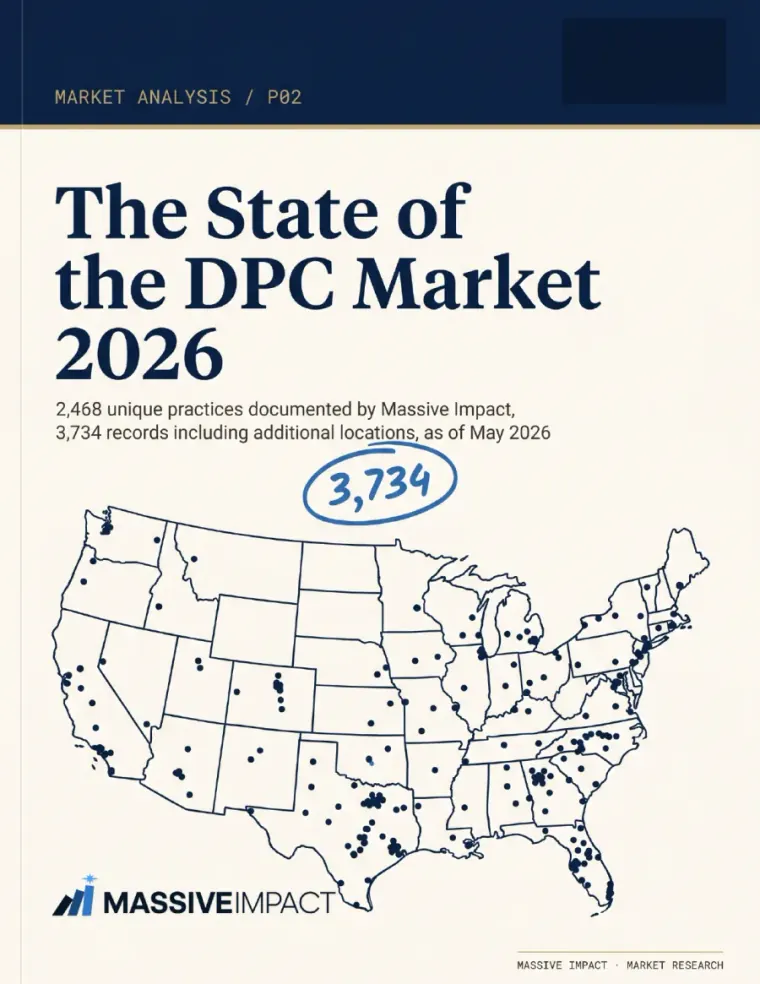
2,468 unique practices documented by Massive Impact, 3,734 records including additional locations, as of May 2026.
About this report
Massive Impact's independent research has documented 2,468 unique DPC practices, 3,734 records including additional locations, as of May 2026. We have the underlying data on every one of them. This report is what that data says about where the documented market is right now, in May 2026, six months into a year that has already changed DPC permanently. The HSA tailwind landed on January 1. Amazon One Medical launched cash-pay GLP-1 in April. Sixty percent of active DPC memberships are now employer-funded. The market is shifting under the people running the practices, and most of them are too busy seeing patients to look up. This is the look up.
Executive summary
Chapter 1: The shape of the market

How big it is
Massive Impact has documented 2,468 unique DPC practices, 3,734 records including additional locations, as of May 2026. The full dataset holds 3,734 records, with each record representing one location. The math: about a fifth of all unique practices (22.6%) run more than one location. That cohort contributes 1,823 of the 3,734 records, or 48.8% of the locations on the map.
The largest names are not solo-doc DPCs. One Medical operates 25 locations across 5 states. Marathon Health: 48 across 14. Paladina Health: 17 across 7. These are the corporate / employer-DPC chains that the open intel pass flagged as the structural fight inside the model. They sit in the dataset in reduced form after cleaning; the report names them but does not conflate them with the single-location solo-physician DPC owners who make up 1,911 of the records.
Where it is
Texas (363 locations), Florida (349), Oklahoma (174), Colorado (166), North Carolina (157). The top five states hold 32.4% of the field. Cities tell the same story sharpened: Tulsa, OK has 30 records; Houston, TX has 24; Owasso, OK has 23; Overland Park, KS has 21; New York City has 20. Oklahoma places two of the top three cities.
But raw counts mislead. California has 141 records and 39 million residents. Oklahoma has 174 records and 4.1 million. Adjusted for population:
| State | Locations / 100,000 residents |
|---|---|
| Oklahoma | 4.3 |
| Maine | 3.0 |
| Colorado | 2.8 |
| Iowa | 2.7 |
| Kansas | 2.6 |
| Nebraska | 2.6 |
| Wyoming | 2.6 |
| Montana | 2.5 |
| Wisconsin | 2.4 |
Source: Massive Impact independent research; US Census 2024 estimates. Full table on page 6.
Oklahoma is the densest DPC market in the country by a factor of 1.4x over the next state and about 12x over California. California, Hawaii, New York, and Rhode Island rank at the bottom of the country on DPC density, each with well under one location per 200,000 residents. The geographic pattern is plain to anyone reading the data: DPC concentrates where the cost-of-living-to-income ratio favors out-of-pocket primary-care spend, and where there are fewer salaried hospital-system primary-care jobs absorbing physicians who would otherwise leave.
What it is
The dataset classifies 68.7% of records as pure DPC, 10.7% as hybrid, and 20.4% as unknown. Family Medicine is the dominant specialty at 46.2% of all records (69.2% of the 2,494 records that declare a specialty). Internal Medicine sits at 6.7%. Pediatrics at 2.9%. Source: Massive Impact independent research.
The number that matters more than the type label, though, is in Chapter 5: the lines between pure DPC, hybrid DPC, longevity, and functional medicine have already blurred at the language level on the practice's own website. Type-as-declared is one number; type-as-marketed is another, and the second is what the patient actually reads.
Chapter 2: The owner behind the practice

Provider counts
51.0% of practices are solo physicians. 33.2% have 2 to 3 providers. 11.9% have 4 to 6. Only 3.9% have 7 or more. The median is 1. The mean is 2.2. The maximum disclosed is 16. n = 2,623 disclosing.
With the corporate employer-clinic chains stripped in cleaning, the field is overwhelmingly solo-and-small: 84.2% of disclosing practices run one to three providers, and only 3.9% run seven or more. That solo-and-small cohort is the real ICP for everything Massive Impact builds for.
Founding years
Of the 1,214 records that disclose a founding year (32.5% disclosure), the cohort split is:
- 30 records founded before 2000 (2.5%)
- 56 in 2000-2004 (4.6%)
- 47 in 2005-2009 (3.9%)
- 86 in 2010-2014 (7.1%)
- 477 in 2015-2019 (39.3%)
- 453 in 2020-2024 (37.3%)
- 65 in 2025+ (5.4%)
Median founding year of disclosing practices: 8 years ago. Three-quarters of the market that discloses a year was founded between 2015 and 2024, that is, inside the decade where Medicare APCM codes, HSA reform momentum, and the patient-side affordability crisis combined to make DPC commercially viable.
What the cohorts look like compared to each other
Read the cohort comparison carefully. The 2025+ cohort is small (n=68) so the directional read holds loosely, but the pattern is striking. Source: Massive Impact independent research, Phase 3 cohort analysis.
| Cohort | n | Median Individual Monthly | Cash-pay signal % | Online booking % | Patient portal % | Any social % |
|---|---|---|---|---|---|---|
| pre-2015 | 219 | $90 | 52.5% | 68.5% | 47.5% | 81.3% |
| 2015-2019 | 477 | $90 | 52.8% | 72.7% | 51.6% | 89.3% |
| 2020-2024 | 453 | $89 | 48.6% | 85.2% | 55.6% | 90.3% |
| 2025+ | 65 | $119 | 72.3% | 84.6% | 38.5% | 81.5% |
The 2025+ cohort is the loudest signal in the dataset. New practices are launching at a 32% pricing premium over the existing field ($119 vs $89-$90) and 72.3% are launching with a cash-pay specialty signal already baked into their marketing copy. The pure-membership-medicine startup is no longer the modal new entrant. The hybrid is.
Closed panels
95 practice locations (2.5%) explicitly state they are not accepting new patients. Colorado leads at 10 closed locations, then Washington (8), Florida (8), New York (7), Maine (6), Oregon (4). Compared to the 90.6% that are explicitly open and the 6.9% that don't state, the closed-panel count looks small. It is. But the Reddit discourse pass found multiple Mountain West, Salt Lake City, and college-town owners reporting full panels and waitlists, which lines up with the closed-panel state distribution. Source: Massive Impact open-pass intel, owner-conversation map.

Chapter 3: The membership economics
What practices charge
Among practices that disclose pricing, the median Individual Monthly fee is $99. The median Family Monthly is $225. The median Child Monthly is $45. The median Senior Monthly is $109. The median Enrollment Fee where present is $100. Source: Massive Impact independent research.
| Field | Records disclosing | Median | p25 | p75 |
|---|---|---|---|---|
| Individual Monthly | 2,132 (57.1%) | $99 | $79 | $120 |
| Family Monthly | 867 (23.2%) | $225 | $200 | $300 |
| Child Monthly | 1,639 (43.9%) | $45 | $29 | $59 |
| Senior Monthly | 1,048 (28.1%) | $109 | $90 | $125 |
| Enrollment Fee | 1,165 (31.2%) | $100 | $75 | $117 |
The pricing tiers concentrate at the lower end. Of the 2,132 practices that disclose Individual Monthly, 55.9% sit under $100/mo, 31.2% sit at $100-$149, 8.4% sit at $150-$199, and 4.5% sit at $200+. The bulk of the DPC market is priced at or below the HSA-reimbursable cap of $150 per month for individuals.
Family-to-individual ratios
Across the 826 practices that disclose both Individual and Family Monthly fees, at the published medians, a $225 family plan is 2.27x the $99 individual. Computed per practice, the median Family-to-Individual ratio is 2.5x (mean 2.55, p25 2.24, p75 2.92). Source: Massive Impact Phase 3 family-pricing analysis.
What this means in practice: at the median DPC, a $99/mo Individual plan pairs with a $225/mo Family plan. The family is not pricing per-member. It is pricing as a discounted bundle for a household, with the implicit assumption that the family unit averages a smaller incremental cost per dependent than a standalone adult signup would.
Enrollment-fee patterns
31.2% of practices charge an enrollment fee at a median of $100. Distribution: 60.0% of charging practices sit at $51-$100, 19.5% at $101-$200, 14.5% at $1-$50, and 6.0% above $200. The maximum disclosed is $950. Source: Phase 3 enrollment-fee analysis.

The panel math
The 600-patient solo full panel is the DPC business operator's North Star. At the dataset's median Individual Monthly of $99, a full solo panel grosses $712,800/year before family-pricing uplift and any cash-pay layer. Half-full grosses $356,400. Quarter-full grosses $178,200. These numbers explain the empty-panel anxiety the open-intel pass surfaced everywhere: an empty panel is not slow growth, it is a doctor failing to make payroll.
The 60% employer-funded reality
Hint Health's 2026 Trends Report (the closest thing the field has to an industry-level revenue source) puts the share of active DPC memberships that are now employer-funded at roughly 60%. Source: Hint Health 2026 Trends Report.
This is the single most underused piece of context in DPC marketing copy today. The owner who pictures their next 100 members as 100 individual cash-pay decisions is operating on a 5-year-old mental model. At the field level, the next 100 members are more likely to come 30 at a time, written on a brokered employer contract, with the practice's role being to deliver care and the broker / TPA's role being to deliver the lives. Chapter 6 unpacks the vendor and ecosystem map this depends on.
Chapter 4: What the practice actually sells
Service depth
3,278 of 3,734 records (87.8%) list at least one service. The top 15 services by adoption across the field:
| # | Service | Practices listing | % of listing | % of all records |
|---|---|---|---|---|
| 1 | Chronic Condition Management | 2,146 | 65.5% | 57.5% |
| 2 | Weight Management | 1,084 | 33.1% | 29.0% |
| 3 | Annual Physical Exam | 985 | 30.0% | 26.4% |
| 4 | Telehealth Services | 874 | 26.7% | 23.4% |
| 5 | Sports Physicals | 846 | 25.8% | 22.7% |
| 6 | Preventive Care | 846 | 25.8% | 22.7% |
| 7 | Acute Care Visits | 837 | 25.5% | 22.4% |
| 8 | Diabetes Management | 623 | 19.0% | 16.7% |
| 9 | Preventive Care and Wellness Visits | 616 | 18.8% | 16.5% |
| 10 | General Wellness Visits and Physicals | 601 | 18.3% | 16.1% |
| 11 | Direct Primary Care Membership | 568 | 17.3% | 15.2% |
| 12 | Women's Health (General) | 528 | 16.1% | 14.1% |
| 13 | Pediatric Care | 512 | 15.6% | 13.7% |
| 14 | Nutrition Counseling | 479 | 14.6% | 12.8% |
| 15 | Urgent Care | 473 | 14.4% | 12.7% |
Source: Massive Impact independent research.
Chronic Condition Management leads, the practical anchor of the membership relationship. Weight Management at 33.1% of listing practices is the second-most named service in the entire field. This is the GLP-1 hideout in the data; only 5.1% of practices name a GLP-1 drug directly but 42.1% mention some form of weight management. A patient who Googles "weight loss" and lands on a DPC is no longer landing on a niche selection.
Visit length
Of practices that disclose visit length, 96.1% report 30-60 minute visits, 3.4% report 60+ minute visits, 0.5% report under 30 minutes. The not-stated rate is 46.5%. Source: Phase 3 visit-length analysis.
The 30-to-60-minute visit is the structural commitment of the model. Compare this to fee-for-service primary care where 15 minutes is the modal scheduled slot. The visit length is what people leave salaried medicine to get back, and it shows up in the data with near-uniform agreement.
Operational capabilities
| Capability | Yes | % of all records |
|---|---|---|
| Telehealth | 3,077 | 82.4% |
| After-hours access | 2,928 | 78.4% |
| Same-day appointments | 2,916 | 78.1% |
| Home visits | 1,031 | 27.6% |
Source: Massive Impact independent research.
Telehealth, after-hours, and same-day are now table stakes. Home visits remain the differentiator. 27.6% offer them, meaning 72.4% don't.
Age targeting
Of the 3,223 records that disclose age range, 66.9% accept the full lifespan (0 to 65+), 22.1% accept a partial family range, 9.7% are adult-only, 1.3% are pediatric-only, and a single record positions as senior-focused. Source: Phase 3 age-targeting analysis.
The dominant DPC posture is whole-family. Pediatric-only DPC remains a thin niche by population share, but a growing one. The pediatric DPC conference sold out for the first time in 2026 (DPC Insider, Apr 20 2026).
Chapter 5: The service-mix pivot
Massive Impact ran a regex sweep of six cash-pay specialty signal categories across every services list, philosophy, mission, tagline, blog, FAQ, and specialty field on every record. The picture that came back is the most important single finding in the report. Source: Massive Impact independent research, cleaned-dataset recount, n = 3,734.
The hybrid-intensity pyramid
Of 3,734 DPC practice records:
- 1,968 (52.7%) explicitly cross-sell at least one cash-pay specialty category (weight management / GLP-1, hormone / TRT / HRT / pellet, peptide, IV therapy, longevity, or aesthetics).
- 1,027 (27.5%) straddle two or more of those categories.
- 465 (12.5%) are full hybrids carrying three or more.
- 1,766 (47.3%) are pure-primary-care DPC with no adjacent specialty mention.
The pure DPC, marketed as pure DPC, is the minority position. Read that twice.
The specialty lines, ranked by adoption
| Category | Practices | % of 3,734 records |
|---|---|---|
| Weight-loss / GLP-1 (any) | 1,573 | 42.1% |
| Hormone (any) | 968 | 25.9% |
| Aesthetic (Botox / filler) | 412 | 11.0% |
| IV therapy / hydration / NAD / Myers | 364 | 9.7% |
| Longevity | 175 | 4.7% |
| Peptide (any) | 130 | 3.5% |
Source: Massive Impact independent research, cleaned-dataset recount, n = 3,734.
The generic-vs-strict distinction
The headline "42.1% offer GLP-1 / weight-loss" understates what's hard and overstates what's loose. Strip the catch-all "weight management" wording and the picture sharpens:
- Strict GLP-1 drug mention (semaglutide, ozempic, wegovy, tirzepatide, mounjaro, zepbound): 191 practices, 5.1%.
- Generic "weight loss" or "weight management" only, no drug named: 1,382 (37.0%).
- Both strict and generic: 170.
The same pattern for peptides: 125 sites use the word, only 14 mention a specific compound. This is a language gap, not necessarily a delivery gap. Clinics may be running these programs without advertising the drug names because the regulatory state is in flux. But the public-facing positioning is still emerging, and the share of practices that visibly own the cash-pay category by name is much smaller than the share that gestures at it.
The pricing differential
The most quietly important finding in this chapter. Across practices that disclose Individual Monthly pricing:
| Group | n | Median fee | Mean | p75 |
|---|---|---|---|---|
| No pivot signal at all | 808 | $89 | $99 | $110 |
| Mentions hormone (any) | 725 | $109 | $113 | $125 |
| Mentions GLP-1 drug (strict) | 85 | $100 | $123 | $149 |
| Mentions peptide (any) | 89 | $125 | $141 | $150 |
| Mentions longevity term | 113 | $109 | $143 | $170 |
| 3+ pivot categories (stack) | 352 | $109 | $120 | $125 |
Source: open-pass intel, revenue pivot analysis [9]; recomputed on the cleaned base, n = 3,734.
Practices stacking three or more cash-pay specialty signals charge a median membership fee about 22% higher than no-pivot peers ($109 vs $89), across the 352 stacked practices that disclose pricing. The cash-pay add-ons don't just stack revenue, they anchor a higher core price. This is the buried economic logic the open intel pass surfaced and the reason the 2025+ cohort in Chapter 2 is launching at $119/mo rather than $89.
The "VitaLife stack" share
The full VitaLife pattern (weight + hormone + peptide + longevity) appears together in:
- 83 practices (2.2%) that mention weight, hormone, AND peptide.
- 148 (4.0%) that match three of the four categories.
- 30 (0.8%) that hit all four.
VitaLife sits in the top decile by service-stack breadth, not an outlier in direction, an early-mover in bundling. Source: open-pass intel, revenue pivot analysis.
Chapter 6: The vendor and ecosystem map
A modern DPC practice runs on a stack of vendor accounts. The open-intel pass catalogued 45-plus of them across compounding pharmacies, hormone networks, lab partners, supplement dispensaries, EMRs, and communication tools. Source: open-pass intel, cash-pay ecosystem catalog.
Compounding pharmacies (the bedrock)
The major compounders that supply hormones, peptides, GLP-1 formulations, and IV-therapy concentrates to DPC practices nationwide:
Empower Pharmacy (Houston, TX): the largest 503A + 503B compounder serving clinicians directly. Free provider account; wholesale per-unit pricing. After the FDA enforcement-discretion period ended for 503B and 503A semaglutide/tirzepatide replicas in May and April 2025, Empower compounds clinically-different patient-specific versions under 503A only.
Olympia Pharmaceuticals (Orlando, FL): 503B FDA-registered. Strong in IV therapy, weight management, HRT, men's sexual-health, ED, peptides.
Strive Pharmacy (Gilbert, AZ): the most provider-experience-focused. Runs Strive Sessions podcast and a Find-a-Strive-Provider directory that drives patient inquiries to certified clinics.
Hallandale Pharmacy / Pharmcore (FL), Tailor Made / Infiniwell (KY), Belmar Pharma Solutions (CO), Wells Pharmacy Network (FL): the rest of the working set. Account-opening is free everywhere; the differentiation isn't which pharmacy, it's the practice's protocols and patient experience around it.
The "white-label GLP-1 program for DPC" pitch is largely hype. A free compounding-pharmacy provider account plus the practice's own clinical protocol is the GLP-1 program. No platform required. The DTC players (Henry Meds, Mochi, Form Health, Hims, Ro) compete with the DPC, they do not enable it.
Hormone networks
Biote runs the dominant pellet-therapy network: 9,200+ certified providers, 5,300+ clinics nationwide. Training cost is not published. Comparable independent courses run around $3,500 per provider. Biote earns from training, pellets, the clinical-decision-support subscription, and a nutraceutical line.
EvexiPEL is the Biote competitor with aggressive provider economics: complete 101 paid procedures in 101 days and EvexiPEL refunds up to $3,000 of onboarding fees. The pitch is "more than a treatment, it's entry into a provider network."
SottoPelle is the older, smaller third option.
Defy Medical and Marek Health are positioned as partners in marketing language but are direct DTC competitors for the men's-health patient.
Lab partners
Rupa Health (now part of Fullscript) is the most-recommended single platform for cash and functional clinics. Free practitioner account; patients get discounted wholesale prices plus a 7% service fee.
Labcorp OnDemand and Quest Direct for patient-direct test purchase.
Getlabs for mobile phlebotomy.
Most DPCs negotiate direct cash rates with a local Quest or Labcorp sales rep, marking up modestly to the patient.
EMR / clinic software
| Vendor | Pricing |
|---|---|
| Hint Clinical (All-in-One) | $275/clinician/mo, first 3 months free for startups |
| Atlas.md | $300/registered-provider/mo, 30-day free trial, 2.1% + $0.30 card processing |
| Elation Health | $350/mo, full DPC product |
| Spruce Health (HIPAA comms) | $24/mo Basic, all-in pricing per user |
Sources: hint.com/clinical/pricing, atlas.md/pricing, elationhealth.com, sprucehealth.com/plans.
Hint is the consolidating incumbent (merged with Elation 2023, runs Hint Summit, publishes the 2026 Trends Report). Atlas.md is the DPC-loyalist alternative. Per the Reddit "best software for DPC" thread (Feb 2026), the two are the modal DPC EMR choice by a wide margin.
What the dataset actually shows about portal and booking vendor share
Of the 1,613 records that publish a patient-portal URL, the identifiable-vendor breakdown:
| Vendor | Records | % of portal-publishing |
|---|---|---|
| Elation | 353 | 21.9% |
| Hint | 207 | 12.8% |
| Atlas.md | 190 | 11.8% |
| AthenaHealth | 76 | 4.7% |
| Charm Health | 28 | 1.7% |
| Other / self-hosted | 758 | 47.0% |
Source: Phase 3 tech-stack analysis.
The "other" pile is half the field. The named DPC-specific EMRs combined (Hint + Atlas.md + Elation) cover 46.5% of identifiable portals. AthenaHealth, Charm, Kareo, Healow, MyChart, DrChrono, SimplePractice show up in the long tail.
For online booking, the field is 67.9% adoption (2,536 records publish a booking URL) with a similar long-tail distribution; Calendly, Acuity, and Square Appointments are the most common booking-tool signatures outside the integrated DPC EMRs.
The employer-contract band (PEPM)
The shift in Chapter 3 to 60%-employer-funded memberships is supported by a vendor and broker ecosystem the typical solo DPC owner has never read about. Spruce Health's DPC Employer Contract playbook (the leading peer-cited B2B education resource) names the working PEPM band as $80 to $130 per employee per month for self-funded small to mid-sized employers. Sources: blog.sprucehealth.com employer-contract series; Hint Connect; open-pass intel, owner-conversation map.
Antioch Med (Wichita, KS, founded 2016) is the publicly documented exemplar. They work with 70+ businesses, used Hint Connect to syndicate to 15 DPC practices across 18 locales to cover a 7-state employer client (343 lives, ~70% adoption, 7 weeks to implementation). Their /employers page is the build pattern that closes employer conversations between meetings. Source: hint.com/case-studies/antiochmed-cha.
Chapter 7: What owners are saying
What DPC owners are actually talking about in 2026, in the venues where they talk to each other. Source: the open-intel discourse pass, which swept r/FamilyMedicine, r/DirectPrimaryCare, DPC Insider, KevinMD DPC essays, the My DPC Story / DPC NP / DPC Pediatricians podcasts, AAFP DPC content, and the published 2026 conference programs. Source: open-pass intel, owner-conversation map.
The 2026 hot-topic ranking
Approximate distinct-conversation counts in the window from Q3 2025 to May 2026:
| Rank | Topic | Trend |
|---|---|---|
| 1 | HSA / OBBBA / IRS Notice 2026-5, DPC fees now HSA-eligible Jan 1 2026 | New in 2026, dominant |
| 2 | Employer / self-funded employer contracts | Surging; 60% of memberships now employer-paid per Hint |
| 3 | PE / corporate consolidation and the founder identity crisis | New in 2026 |
| 4 | Burnout / wanting out of corporate FFS | Evergreen but louder |
| 5 | Pediatric DPC as a distinct niche | Sold-out 2026 conference |
| 6 | Panel-size economics: 500 vs 1,000+, hybrid models | Evergreen |
| 7 | Insurance-system collapse, ACA premium hikes, Medicaid cuts | 2026-specific |
| 8 | AI scribes (Abridge, Suki, Heidi, Freed, DAX, Sully) | New volume |
| 9 | Saturation in popular metros | Newly hot |
| 10 | Specialist referral gap (UberDoc, Mending Access) | Rising |
The founder identity crisis
The single most-frequently-restated emotional thread in 2026 is the founder identity crisis: independent solo DPC physicians watching corporate and private-equity entrants reshape the model they built.
- DPC Insider, May 16 2026: "DPC Is Going Mainstream. The Doctors Who Built It Are Starting to Feel Left Out."
- DPC Insider, May 15 2026: "DPC Started as a Rebellion. Now Some of Its Founders Are Asking What It's Becoming."
- A Health Affairs study cited April 3 2026: corporate-affiliated DPC sites grew 576% from 2018 to 2023; independent ownership share dropped from 84% to 60%.
- Premise Health and Crossover Health merged in March 2026 into a $2B employer-primary-care company with 900 centers.
- Curative (an insurer) cold-called Texas DPC practices in May 2026 with network deals at 75 to 90% of Medicare that ban membership fees.
Source: DPC Insider archive, open-pass intel.
The empty-panel wound, in their own words
"Marketing and growing it has been an absolute nightmare. Far easier to grow a FFS practice." r/FamilyMedicine, "Why isn't DPC more popular?", [13 upvotes]
"I went to med school not business school. Once I start reading about collecting membership fees and marketing I immediately close my computer." r/FamilyMedicine, [8 upvotes]
"I'm just one DPC doc and there are 1,000-2,000 of us now. We really struggled with growing the DPC side at all. Do you mind me asking how you marketed/grew it?" r/FamilyMedicine, Missoula DPC hiring thread
"Where I'm located, yes very saturated with at least 5 DPCs that I know of have closed bc not enough patients bc how popular DPC has become and competition." r/FamilyMedicine, "DPC market saturation?", [9 upvotes]
The patient-acquisition pain is universal and named directly. It is also the topic the open-intel pass found is almost never discussed in the language of websites. Search of 15+ high-engagement DPC discussion threads over the past year produced essentially zero spontaneous owner questions about web design, SEO, or website agencies. Owners ask about Facebook ads, word of mouth, AAFP resources, Mastermind groups, and private DPC Docs FB groups. They do not, on average, frame the marketing-pain problem as a website problem.
What owners are buying from each other
Specifically peer-recommended vendors named multiple times across the discourse pass:
- EMR/clinic software: Elation Health (most-recommended general-purpose), Atlas.md (DPC purist), Hint Health (DPC-native, scaling fast), Charm Health, Pabau, Practice Fusion (universally panned), Scalpel, Ultralight (AI-native, $9.3M raise), DocVilla, Astrodoc/Astrid.
- Lab pricing: Quest, LabCorp at wholesale.
- Compounding pharmacies: Lavender Sky Health, Fifty410, Everwell Pharmacy, plus the major compounders catalogued in Chapter 6.
- Health-sharing ministries (paired with DPC): Planstin, Sedera, CHM, Liberty Healthshare.
- Specialist referral / direct specialty care: UberDoc (launched at Hint Summit 2026), Mending Access (launched April 2026).
- AI scribes: Abridge, Suki AI, Heidi Health, Freed, DAX Copilot, Sully.ai, Nabla, DeepScribe.
- Education and coaching: AAFP DPC resources, DPC University, the AAFP FPM March 2026 issue, My DPC Story podcast (325+ episodes, Maryal Concepcion), DPC NP podcast, DPC Pediatricians Substack.
What's conspicuously absent from peer recommendations: any specific website agency, SEO service, marketing agency, or patient-acquisition product beyond Facebook ads. The closest thing to a website recommendation in the discourse pass is St. Louis DPCs collectively running stldpc.com. Source: open-pass intel, owner-conversation map.
Chapter 8: The digital presence gap
This chapter reports direct observations of the digital presence of DPC practices in 2026. All numbers below are observed counts from scraped data. Nothing is scored against a constructed standard. Where Massive Impact's own audit (n=150) appears, the numbers are reported as direct observations from the underlying scrapes, not as graded rubric scores.
What the field has, at population level (n = 3,734)
| Channel | Practices with | % of all records |
|---|---|---|
| Website URL | 3,591 | 96.2% |
| Online booking URL | 2,536 | 67.9% |
| Patient portal URL | 1,613 | 43.2% |
| 2,791 | 74.7% | |
| 2,165 | 58.0% | |
| 1,377 | 36.9% | |
| YouTube | 855 | 22.9% |
| Twitter / X | 845 | 22.6% |
| Any social channel at all | 2,930 | 78.5% |
| No social channel of any kind | 804 | 21.5% |
| Any recent blog posts | 1,048 | 28.1% |
Source: Massive Impact independent research.
The 96.2% website-coverage and 78.5% social-presence figures put a floor under the field. Almost every DPC has some web presence. The interesting numbers are the gaps: 25.1% of records have neither online booking nor a patient-portal URL. 63.8% are missing one or the other. 71.9% have no recent blog activity. Blog activity drops by cohort age, with pre-2015 practices (40.2%) actually slightly more likely to publish blog content than 2020-2024 practices (31.6%).
What 150 DPC sites actually carried: direct observations from a stratified audit
A stratified random sample of n=150 sites (random seed 42, two-axis quota allocation on state and practice type) was scraped and parsed in May 2026. The findings below are reported as direct observations of what the scraped HTML contained or didn't contain. Source: Massive Impact n=150 audit, May 2026.
Of the 150 sites:
- 35.8% publish no pricing visible on the homepage. (At the full-dataset level, 37.4% publish no pricing at all anywhere; the two land within two points of each other.)
- 18.0% mention HSA anywhere on the site. The 2026 OBBBA / IRS Notice 2026-5 HSA change went live January 1, 2026. Five months in, the field has overwhelmingly not updated.
- 5.0% put HSA messaging on the membership page (the single highest-conversion location for this content).
- 11.3% have a dedicated employer-pitch page or section.
- 26.0% frame cash-pay services as part of the membership relationship (rather than as separate store / upsell nav).
- 4.0% carry an interactive lead-capture stack of any depth (multiple interactive tools, value-before-the-ask logic, automated follow-up).
- 8.7% carry AEO/GEO readiness signals (FAQ schema or structured data that AI search engines parse).
These are direct observations, not graded scores. The numbers are what they are.
What the audit found at the top of the field
The top 15 sites in the n=150 audit were re-read for eight DPC-specific website traits (insurance objection handled, specialist objection handled, doctor-as-peer bio, continuity-of-care signaling, cash-pay framed as relationship, HIPAA-careful patient reviews, "what's it like" visit narrative, membership-tier pricing transparency). The cleanest finding: only two of the eight traits appear in 10 or more of the top 15 sites. Continuity-of-care signaling (14 of 15 top sites do it well) and membership-tier pricing transparency (10 of 15) are the two cleanly replicated traits among the high scorers. The other six traits are sporadic. Source: Massive Impact n=150 audit.
There is no defensible "shared system" pattern across the top of the field. There are two or three operators (Tandem Health in Maryland, Seacoast DPC in New Hampshire) who carry many of these traits at once, and there is everyone else. The honest read is: the top of the DPC web field is patchy, not patterned.
Vendor share, restated
Of the 1,613 records that publish a patient-portal URL, the named DPC-specific EMRs (Elation, Hint, Atlas.md) cover 46.5%. The "other / self-hosted" bucket is 47.0%, AthenaHealth carries 4.7%, and the long tail (Charm, Kareo, Healow, MyChart, DrChrono, SimplePractice, Jane, Acuity) covers the remainder. Source: Phase 3 tech-stack analysis.
Chapter 9: The patient served
Who DPC accepts, by age
The 66.9% / 22.1% / 9.7% / 1.3% / 0.0% split from Chapter 4 reads sharply at the patient-side. The dominant DPC posture is whole-family. Adult-only is 9.7% of the field. Pediatric-only is 1.3% but growing fast (the 2026 pediatric DPC conference sold out for the first time per DPC Insider Apr 20 2026). Senior-focused as a primary positioning is essentially absent. Source: Phase 3 age-targeting analysis.
Who DPC serves, by language
Only 8.7% of practices advertise Spanish-language service (collapsing both "Spanish" and "Spanish (Español)" labels in the dataset). 10.4% advertise at least one language beyond English. Source: Phase 3 language analysis.
Top non-English languages, in % of all records:
| Language | % of all records |
|---|---|
| Spanish (any variant) | 8.7% |
| French | 0.8% |
| Portuguese | 0.4% |
| Mandarin | 0.4% |
| Hindi | 0.3% |
| Vietnamese | 0.2% |
| Arabic | 0.2% |
| American Sign Language | 0.2% |
| Urdu | 0.2% |
About 19% of US residents speak Spanish at home (US Census ACS). The DPC field's 8.7% Spanish-capable advertised rate is materially below the residential population share. This is a market gap, not a saturated one. A DPC that genuinely serves Spanish-speaking patients and advertises it has very limited competition in its language tier.
Who the cash-pay buyer actually is (KFF)
The standard mental model of the DPC patient is the affluent suburban professional with a high-deductible plan. The KFF poll data on GLP-1 use (the largest cash-pay specialty category) contradicts that picture sharply. Source: KFF GLP-1 poll, RAND August 2025.
- 1 in 8 US adults are currently taking a GLP-1 drug (KFF, 2025).
- 41% of GLP-1 users are uninsured.
- Hispanic adults: 33% prevalence. Black adults: 32%. Household income under $40k: 33%.
- Women aged 50-64 are the heaviest single user cohort: 1 in 5 women in that bracket have used GLP-1s (RAND).
The cash-pay primary-care-adjacent market is being carried by women 40-64 and by lower-income and uninsured adults paying out of pocket because their employer plan won't cover it. The patient who walks into a DPC office asking about weight management is statistically more likely to be a $40,000-a-year woman in her fifties than a $150,000 suburban professional.
Geography of the patient pool
The state-density picture from Chapter 1 (Oklahoma 4.3 / 100k, Maine 3.0, Colorado 2.8, Iowa 2.7, Kansas 2.6) is also the patient picture. Patient density follows practice density. The lowest-density DPC states (California, Hawaii, New York, and Rhode Island) are simultaneously the largest unserved patient populations and the hardest markets to enter, because patient education on the model is thinnest where the model is thinnest.
Chapter 10: The 2026 wave
Four regulatory and competitive waves landed between January and May 2026. Together they reshape DPC growth math for the next 24 months. All four are verified to primary sources. Source: open-pass intel, verification record; current-event-hooks.
Wave 1: HSA dollars now cover DPC fees, effective January 1 2026
The One Big Beautiful Bill Act (OBBBA) plus IRS Notice 2026-5 made DPC monthly fees up to $150 individual / $300 family HSA-eligible. The change went live January 1, 2026. Five months in, only 12.7% of DPC sites mention HSA anywhere (474 of 3,734 records in our research) and only 5% put it on the membership page (per the n=150 audit). The largest structural tailwind in DPC's history is sitting unused on most homepages. Source: IRS.gov; AAFP FAQ updated Oct 28 2025.
Wave 2: Amazon One Medical nationwide cash-pay GLP-1, April 21 2026
Amazon One Medical launched cash-pay GLP-1 nationwide on April 21, 2026: $149/mo oral, $299/mo injectable for cash patients; $25/mo for One Medical Insured members. This is the first time a corporate consumer brand has explicitly priced GLP-1 access at scale and explicitly tied it to a primary-care relationship. Source: hitconsultant.net, Amazon press, April 21 2026.
For DPCs offering GLP-1, the competitive bar has moved. Amazon is selling at $149. A DPC has to explain on its site why supervision, dose adjustment, in-person care, and the ongoing patient relationship are worth a premium, or it loses on price alone.
Wave 3: Hint Health 2026 Trends Report: 60% of active DPC memberships employer-funded
Hint Health's 2026 Trends Report places roughly 60% of all active DPC memberships in the United States in the employer-funded category as of early 2026. The implication for individual-patient marketing math is severe: the next 100 members for a growing DPC are statistically more likely to arrive 30 at a time through an employer contract than 1 at a time through individual cash-pay decisions. The PE-backed Premise + Crossover merger (March 2026, $2B, 900 centers) is the corporate version of this shift; Antioch Med's 343-lives employer deal is the independent-DPC version. Source: Hint Health 2026 Trends Report; DPC Insider March 23 2026 [6, 20].
Wave 4: FDA peptide reclassification, April 15-22 2026
The FDA removed 12 peptides from Category 2 (which had effectively blocked 503A compounding) between April 15 and 22, 2026. Affected peptides include BPC-157, TB-500, CJC, ipamorelin, and thymosin alpha-1. The Pharmacy Compounding Advisory Committee meets July 23-24, 2026 to decide formal Category 1 inclusion. Source: FDA.gov advisory committee calendar; agemd.com, peptidedeck.com.
The honest framing is "regulatory limbo, narrowing toward clarity." Practices that paused peptide programs during the prior crackdown can begin restarting them now. The PCAC meeting in July is the next event that moves the bar.
Chapter 11: What this means for DPC owners
Analytical, not promotional. Reading the data:
The pure-DPC marketing posture is the minority position. 52.7% of the field already cross-sells at least one cash-pay specialty service. The 2025+ cohort is launching at a 32% pricing premium with a cash-pay signal baked in from day one. A practice still marketing itself as primary-care-only in 2026 is making a deliberate niche choice that has gotten narrower, not broader, since 2023.
The cash-pay layer anchors the core price. Practices stacking three or more specialty signals charge a median membership fee about 22% higher than no-pivot peers ($109 vs $89). The math of adding hormone or GLP-1 is not just incremental revenue from add-ons. It's a higher floor on the base subscription too.
The B2B path is the dominant volume lane now. Sixty percent of active memberships are employer-funded. The patient-acquisition pain that dominates Reddit threads ("absolute nightmare", "we really struggled") is mostly the individual-cash-pay version of the problem. The employer-channel version (broker relationships, PEPM band, /employers page, syndication via Hint Connect) is wide-open and underbuilt: only 11.3% of audited sites carry a dedicated employer-pitch page.
HSA messaging is the cheapest competitive lift in the field. The legislative change went live in January. Five months later, only 12.7% of sites mention it and only 5% put it on the membership page. Updating the membership page to explain HSA eligibility is a half-day of work that vaults a practice into the top decile on a verifiable trust signal.
The geographic concentration is a competitive map. Oklahoma, Maine, Colorado, Iowa, and Kansas are the densest markets. California, Hawaii, New York, and Rhode Island are the thinnest. A new DPC choosing where to open in 2026 is choosing inside a country where the model is unevenly understood by patients. Patient-education burden inversely tracks practice density.
The corporate roll-up is real and is reshaping the term itself. Corporate-affiliated DPC sites grew 576% from 2018 to 2023; independent ownership share dropped from 84% to 60%. Premise + Crossover at $2B and 900 centers is now what the consumer-facing "DPC" can mean in a chain context. The independent solo physician working under the same word is not the same business and increasingly cannot pretend to be. Brand differentiation between independent and corporate DPC is moving from an internal community concern to a public-facing positioning question.
Visit-length consistency is the model's structural floor. 96% of disclosing practices report 30 to 60 minute visits. That commitment is the operational baseline patients leave salaried medicine to find, and it's the single most consistently delivered feature of the model at population level.
What we'd watch in the next 12 months: the PCAC July 23-24 ruling on peptides; whether Hint Clinical's land-grab moves portal share from "other / self-hosted" toward consolidated DPC EMRs; whether the 2025+ cohort's $119 median pricing holds as that cohort grows; whether ACA premium shock continues to push patient demand into DPC; and whether the founder identity discourse produces a meaningful "independent-DPC" brand split from "corporate-DPC."
Chapter 12: What this report does not cover
The data has limits. Plainly:
- Conversion data. We measure what each practice publishes about itself. We do not measure whether their website actually converts visitors into members. A separate study, per-site, would be needed.
- Clinical depth of cash-pay services. The dataset captures service names, not protocols, dosing, or quality. A practice that lists "weight management" may run a state-of-the-art compounded-semaglutide program or may run nothing of the sort. The dataset cannot tell which.
- NP-led DPC volume as a separate cut. The dataset captures provider names and credentials but does not separate NP-led from MD-led practices in a single field. NP-led DPC is growing fast (per the open-pass discourse intel) and would benefit from a dedicated analysis.
- Self-reported founding year disclosure. Year Established is disclosed by 32.5% of records. Cohort analyses are conditional on disclosure.
- Private group discourse. The Facebook groups "DPC Docs" and "DPC Mastermind," where much of the working owner conversation happens, are login-gated and not in our discourse pass. We sweep what's public.
- FAQ depth beyond present-or-absent. The dataset captures up to five FAQ pairs per practice. 88.7% of practices hit the dataset cap. We can say 11.1% of practices publish zero FAQs; we cannot tell, from the dataset, how deep the others go.
- The single most spoken-about topic in 2026 (corporate / PE consolidation of DPC) is a real story whose data infrastructure is still emerging. The Health Affairs study and DPC Insider reporting are the most current sources; a dedicated quantitative pass on independent-vs-corporate ownership at practice level would be a natural next analysis.
See the DPC Growth Site
The market is moving. Your site is either riding it or invisible to it.
This report describes the field. The DPC Growth Site is what we build inside that field. Our productized site is engineered for the modern DPC practice that's adding cash-pay services, courting employer contracts, and trying to be findable in the AI search era. Fixed price. Fixed scope. Built from one live reference practice and the same data this report draws on.
See the DPC Growth Site
`winmassiveimpact.com/dpc-growth-site
Sources and license the research
(Numbered references match the inline citations to in the chapter copy.)
- Massive Impact's independent research (n = 2,468 unique practices, 3,734 records including additional locations, as of May 2026). The underlying research is available as a licensed dataset on request.
- Phase 3 cohort comparison analysis, computed from the underlying dataset (n = 1,214 disclosing year_established). Methodology in
run_all.py(random seed = 42). - Massive Impact open-pass intel, owner-conversation map, May 2026. 22 r/FamilyMedicine threads, 27+ DPC Insider posts, podcast and conference metadata, AAFP FPM March 2026 issue. reddit.com/r ; dpcinsider.com ; aafp.org/pubs
- Phase 3 family-pricing analysis (n = 826 disclosing both). Median per-practice ratio 2.5; ratio of medians 2.27.
- Phase 3 enrollment-fee analysis (n = 1,165 disclosing > $0). Median $100.
- Hint Health 2026 Trends Report (industry-level membership-funding share). hint.com
- Phase 3 visit-length analysis (n = 1,996 disclosing).
- Phase 3 age-targeting analysis (n = 3,223 disclosing).
- Massive Impact open-pass intel, revenue pivot analysis (pricing differential math). Source URLs include Forbes (Adair Landry, Jan 31 2026), forbes.com/sites ; SigmaMD DPC pricing survey, sigmamd.com/blog ; Accresa, accresa.com/blog .
- Massive Impact open-pass intel, cash-pay ecosystem catalog. 45+ vendors verified to live websites: empowerpharmacy.com ; olympiapharmacy.com ; strivepharmacy.com ; biote.com ; evexipel.com ; rupahealth.com .
- EMR pricing references: hint.com/clinical ; atlas.md/pricing ; elationhealth.com/who-we-serve ; sprucehealth.com/plans .
- Phase 3 tech-stack vendor analysis (n = 1,613 portal-publishing; n = 2,536 booking-publishing).
- Hint Connect / Antioch Med case study. hint.com/case-studies ; antiochmed.com/employers .
- Massive Impact DPC Website Audit, May 2026 (n = 150, stratified random sample, random seed 42, Python-scored against scraped HTML). Methodology and per-site data available to licensed buyers.
- Phase 3 language analysis (n = 3,734; Spanish-capable 324 = 8.7%).
- KFF GLP-1 poll, 2025. kff.org/public-opinion ; RAND, August 2025: rand.org/news
- Massive Impact 2026 hook verification record. Primary sources: IRS.gov (OBBBA / Notice 2026-5); Amazon One Medical press; Hint Health 2026 Trends Report; FDA Advisory Committee Calendar.
- AAFP DPC FAQ (Oct 28 2025): aafp.org/pubs ; IRS guidance: irs.gov/newsroom
- Amazon One Medical GLP-1 launch: hitconsultant.net/2026
- Premise + Crossover merger: DPC Insider March 23 2026, dpcinsider.com/blog
- FDA Pharmacy Compounding Advisory Committee, July 23-24 2026 meeting: fda.gov/advisory-committees ; agemd.com longevity coverage: agemd.com/longevity
License the research
The underlying dataset and analyses are Massive Impact's independent market research. The licensed dataset is available on request: practices, researchers, vendors, and industry observers are welcome to inquire. Contact us for pricing.
`winmassiveimpact.com/request-research
Contact
Massive Impact [email protected] winmassiveimpact.com
The rest of the report is yours, free.
Enter your email to keep reading and get the PDF to keep.
No spam. One email unlocks every Massive Impact report.
