


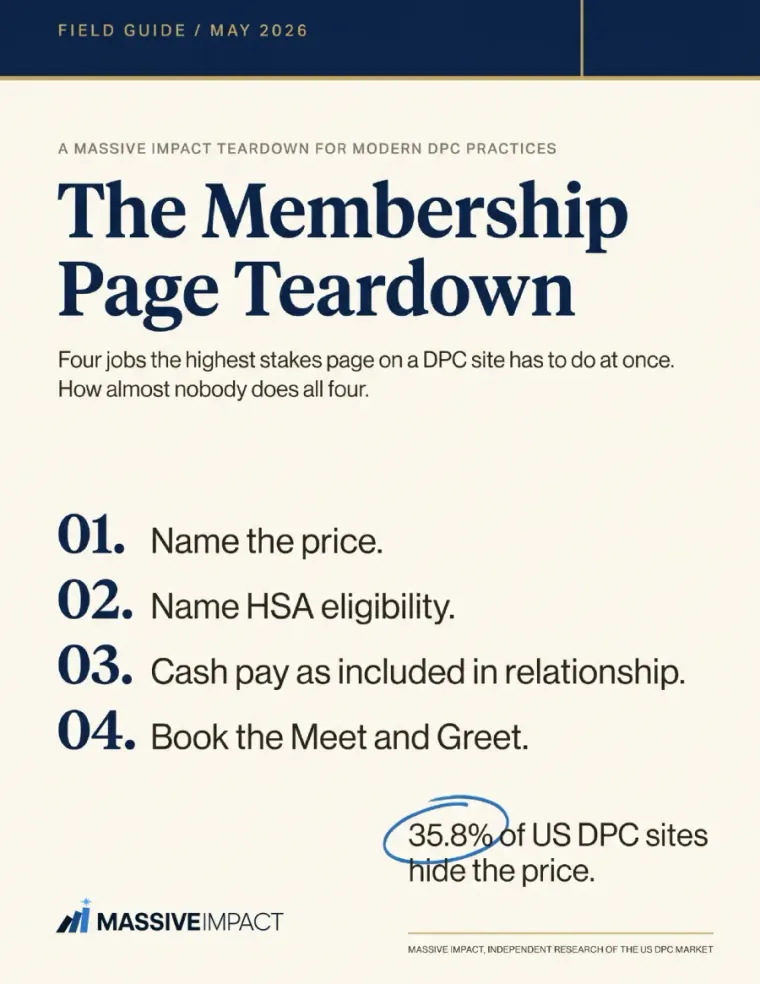
Four jobs your membership page is doing right now. It's failing at three of them.
About this report
About this teardown
This is a working document for the DPC owner who's about to redo their pricing page, or the hybrid practice that just added GLP-1 and isn't sure whether to put it on the membership page or hide it on a separate service page.
We've audited the membership page across the US DPC market, the data side and the page-by-page side, and we can tell you what the four jobs are, where most pages fail at each one, and what the version that books Meet & Greets looks like.
The numbers in this report come from two sources:
The market-wide statistics (the 37.4% who hide pricing, the median pricing data, the practice composition) come from Massive Impact's independent research of the US DPC market: n = 2,468 unique practices, 3,734 records, 108 fields, as of May 2026. The underlying research is available as a licensed dataset on request. Contact us for pricing.
The page-level observations (which sites bundle cash-pay services cleanly, which sites have a literal store in the nav, where Meet & Greet booking sits) come from a deeper audit of 27 real DPC practice websites scraped 21 to 23 May 2026 by Massive Impact's research team. Audit methodology and per-site notes are available on request.
The 5% HSA-on-membership-page rate comes from Massive Impact's n=150 site audit, May 2026. It hasn't been computed across the full 3,734-record dataset yet because the rule went live on January 1, 2026, and most sites haven't updated. Treat it as the audit figure, not a full-census number.
Two house rules for this document:
- The "before" examples in the teardown are anonymized. We don't name and shame.
- The "after" is VitaLife. It's a real, live, modern DPC build at vitalifelongevitymed.com. It's named because the people behind it agreed to be named.
The page that decides
The page that decides
Of every page on a DPC site, the membership page is the one that decides whether a visitor becomes a member.
The home page introduces. The about page reassures. The blog signals competence. The provider bios build trust. None of those pages closes the loop. The membership page is where the visitor decides whether to take action. Every other page is a step toward this one.
Which makes what we find on most DPC membership pages strange.
Your membership page is doing four jobs right now:
- Name the price. 37.4% of DPC sites don't.
- Name HSA eligibility. Around 5% do.
- Present cash-pay services as included-in-relationship. Almost no one does this cleanly. The failure mode has a name: an MLM with a stethoscope.
- Book the Meet & Greet. Most pages bury the booking on a separate contact page, or don't have one at all.
A page that does all four books Meet & Greets. A page that does two or fewer reads like a brochure for a practice the visitor will never call.
The good news: the four jobs are concrete. You can put your page against them right now.
Job 1: Name the price
Job 1. Name the price.
The number. 37.4% of US DPC sites publish no pricing at all on their website. Of 3,734 practice records in Massive Impact's market research, 1,397 hide pricing behind a phone call, a "schedule a consult," or a "request more info" button.
Source: Massive Impact's independent research of the US DPC market (n = 2,468 unique practices, 3,734 records, as of May 2026).
The defense for hiding it. Most owners who do it tell us the same thing: "we want them to call so we can sell them on the phone, the price doesn't speak for itself." Which is the exact reason they don't call.
A patient researching DPC at 9pm on a Tuesday isn't going to call. They're going to compare you to the practice down the road that printed $99/month and move on. The hidden price doesn't filter for the serious buyer. It filters out the buyer entirely.
There's also a positioning problem. DPC's central pitch is transparent pricing. A model that exists because insurance hides the price, sold on a page that hides the price, reads like a contradiction the visitor notices even if they can't articulate it.
What to print.
- The monthly membership price. Real dollars. As text, not as an image. (Images don't render in search, don't get read by screen readers, and feel like a hedge.)
- Tiered prices if you have them (adult, child, family, senior). Plain table.
- What's included at the price. A short list, framed in member language: same-day visits, direct messaging, dispensed meds at wholesale, in-office labs, the hormone or weight-loss conversation included in the relationship, whatever's true.
- What's not included. Honest. Imaging if it's billed at cost. Specialist referrals. Anything cash-priced separately.
- The enrollment fee, if you charge one. Median in the market is $100, per our data. State yours.
What never to print. "Most DPC memberships cost less than a typical monthly phone bill." That sentence is on 23 of the 27 sites we audited, and it tells the visitor nothing useful. They came for a number. Give them the number.

Job 2: Name HSA eligibility
Job 2. Name HSA eligibility.
The fact. The One Big Beautiful Bill Act and IRS Notice 2026-5 made DPC fees eligible for HSA reimbursement starting January 1, 2026. Up to $150/month for an individual or $300/month for a family of the DPC fee can be paid from an HSA, tax-free.
Source: IRS Notice 2026-5, Internal Revenue Bulletin 2026-02.
The number on the page. Around 5% of DPC sites put this rule on the membership page. Massive Impact n=150 site audit, May 2026. This is the easiest fix in DPC marketing right now. Almost nobody has done it.
The rule is five months old. Most patient research about DPC happens to a patient who already has an HSA from their job's high-deductible plan and didn't know they could use it for a DPC membership. Your membership page is the place where they find out. If it's not there, they keep looking.
The exact line for the page. Draft:
"HSA dollars cover up to $150/month for an individual or $300/month per family of your DPC membership fee, tax-free, per IRS Notice 2026-5 effective January 1, 2026."
That's the load-bearing sentence. It's also defensible. Three honest caveats sit beneath it on the page itself, not buried elsewhere on the site:
- The cap is per month, not per year. Don't let copy drift to "up to $1,800 annually." That's mathematically correct, regulatorily wrong, and a doctor's eye picks it up.
- Eligibility specifics vary by HSA administrator. Some require a coded receipt; some reimburse on attestation. Tell the patient to check with their HSA plan.
- The rule covers fees, not all DPC services. If your membership bundles in items the IRS doesn't count as primary care (specialty labs, cash-pay GLP-1, hormone pellets), those portions of what a patient pays you aren't HSA-eligible. Be careful with how the membership is structured if you want the HSA box to stay clean.
A clinic that handles all three caveats on the page reads as a clinic that knows the rule. A clinic that prints the headline and skips the caveats reads as a clinic that read a Twitter thread.
Cross-reference. A deeper operational walkthrough of how to set up the HSA receipt language, the front-desk script, and the patient FAQ is in the Massive Impact HSA Tactical Playbook (separate document). The membership page only needs the load-bearing line plus the three caveats. The mechanics live in the playbook.
Job 3: Cash-pay as included-in-relationship
Job 3. Present cash-pay services as included in the relationship.
This is the modern-DPC job. The pure DPC of 2018 had one thing to sell: the membership. The modern DPC of 2026 has GLP-1, hormone therapy, peptides, IV, longevity panels, and the membership. The question for your page is whether all of it reads as one practice, or as a primary-care doctor running five side businesses out of the same office.
The failure mode has a name. A DPC that stacks cash-pay services on the membership page without bundling them into the relationship reads, in the words of more than one Reddit DPC thread, like an MLM with a stethoscope. It's a real warning. Patients say it about practices they trusted six months ago.
Two patterns from our audit make the failure visible:
Pattern 1. The literal store. One audit practice (anonymized) puts a "Store" link in its main navigation, alongside "Aesthetics," "Medical Weight Loss," and "Wellness Services," each treated as a separate product line. Reading the page, you can't tell whether you're joining a practice or browsing an e-commerce shop. The membership becomes one tab among many.
Pattern 2. The nav full of clinics. Another audit practice lists "Hormone Replacement Clinic" and "Laser Hair Removal Service" as separate items in its top navigation, next to "Primary Care Service." The reader sees a doctor with three different shingles hanging out and no clear answer to "what is this practice." Each "clinic" gets its own page; the membership has to compete with them for the visitor's attention.
Both pages score high on shallow audit metrics (they have pages, copy, photos) and fail the only test that matters: whether the visitor reads it as one practice they trust or as a stack of upsells they're being shown.
What works instead. One audit practice, Tandem Health, lists "Management of hormone replacement therapy for appropriate patients" under What's Included in the membership block. Not as a separate clinic. Not as a store item. As part of the relationship the membership buys. The patient reads it the way it's intended: you're joining a doctor's practice, and the doctor handles the hormone conversation as one part of that. The membership doesn't compete with the hormone clinic, because there is no separate hormone clinic.
What to print.
- Cash-pay services live inside the membership page, in a section called What's Included or Services Within the Membership. Not as separate nav items.
- Each cash-pay service line names what's included with the membership (the consult, dose adjustment, supervision, ongoing follow-up) and separately lists what's billed at cost (medication, lab work, specialty supplies). The included-vs-billed split is honest and the patient gets the math.
- No "Store" in navigation. Ever.
- No "Aesthetics Clinic," "Weight Loss Clinic," "Hormone Clinic" as separate nav items. Those are services your practice provides; they aren't separate clinics.
The competitive context. Amazon One Medical launched nationwide cash-pay GLP-1 on April 21, 2026, at $149/month oral and $299/month injectable. Your page can't compete with that on price. It competes on supervision, dose adjustment, and the relationship, all of which only register on the page if the GLP-1 line is bundled inside the membership as care, not as a product. Source: Amazon press release, April 21, 2026.
Job 4: Book the Meet & Greet
Job 4. Book the Meet & Greet.
The Meet & Greet is how DPC sales close. It's the 15-minute conversation where a prospective member meets the doctor, asks the questions they didn't ask on the page, and decides whether to enroll. Almost every DPC owner who fills their panel does it through this conversation.
Which is why the booking belongs on the membership page directly. Not buried two clicks deeper on a separate contact page. Not hidden behind a "request more info" form. On the page where the buying decision happens.
Placement. Top of the membership page, near the price block. Then again at the bottom after the What's Included list. The visitor's question is "is this worth $99 a month to me," and the answer is "come spend 15 minutes with the doctor and decide." Two placements, both visible without scrolling once you're on the section.
The CTA copy. Plain. No agency-speak.
- Good: "Book a 15-minute Meet & Greet."
- Good: "Meet Dr. Lowell. 15 minutes, no pressure."
- Not good: "Schedule your discovery call." (Doctors don't have discovery calls. They have Meet & Greets. The vocabulary signals whether you wrote the page or your marketer did.)
- Not good: "Get more info." (More info is what the page already gave them. The CTA is for the next step.)
Friction killers. The booking widget loads inside the page. Not a popup. Not a redirect to a third-party scheduler the visitor has to figure out. The same 15-second flow a patient already knows from booking anything else: pick a day, pick a time, enter a name and an email, done. Calendly, Acuity, Cal.com, whatever your practice uses, embedded inline.
One name on the booking. "Meet & Greet with Dr. Lowell" is better than "Meet & Greet" alone. The visitor is buying a relationship with a specific doctor. Name them on the button.
Optional but high-value. A one-line reassurance under the button: "No medical care during the Meet & Greet. Just a conversation." This kills the silent fear that signing up commits them to anything before they've decided.
The teardown, part 1: Two pages that fail
The teardown. Two real membership pages, names withheld.
These are two anonymized examples from Massive Impact's 27-site audit. They are real, live US DPC sites that scored high on a basic audit (they look polished, they have copy, they exist) and fail the four-job test. Their names are obscured to respect the practice owners. The patterns are common enough that you'll recognize them across the market.
Example A. The store-in-the-nav site.
What you see at the top: a hero image of the doctor and the staff, the practice name, and a primary navigation that includes "Aesthetics," "Medical Weight Loss," "Immigration Exams," "Wellness Services," and "Life Store."
- Job 1 failed. No price visible on the page. Closest copy is "most DPC memberships cost less than a typical phone bill," which is everywhere and tells the visitor nothing.
- Job 2 failed. No mention of the HSA rule.
- Job 3 failed. "Life Store" appears as a top-nav item. The membership becomes one of five product lines. The MLM-with-a-stethoscope pattern is visible from the home page.
- Job 4 partial. "Contact Us" form exists, but no Meet & Greet booking widget on the membership page itself.
Four-job score: 0 of 4. The site is well-designed, polished, branded. It scored second-best in our audit on shallow metrics. It fails every one of the four jobs.
Example B. The clinic-stack site.
What you see at the top: a hero with a slogan ("Healthcare Reimagined"), the doctor's photo, and a navigation that reads "Primary Care Service," "Hormone Replacement Clinic," "Laser Hair Removal Service," "Store."
- Job 1 failed. No price visible on any landing page.
- Job 2 failed. No HSA line.
- Job 3 failed. Hormone replacement and laser hair removal are presented as separate "clinics," each with its own dedicated page. The membership has to compete with them for the visitor's attention.
- Job 4 partial. The site does call out "Every person interested in establishing care must complete an in-person Meet & Greet first." Good language. Buried two clicks deep, with no booking widget on the membership page.
Four-job score: 0.5 of 4. The "Meet & Greet first" requirement is the strongest signal on the page. It's not where the visitor will see it.
Both pages have an owner who knows their practice well. Both pages reflect a real, hard-working DPC. Both pages cost their owners Meet & Greets every week because the four jobs aren't done.

The teardown, part 2: What VitaLife does
The "after." VitaLife, vitalifelongevitymed.com.
VitaLife is a modern DPC in the truest sense. Started as primary care, grew into hormone therapy, GLP-1, peptides, and longevity panels. The exact path most modern DPC practices are on. Their membership page is the version of the four jobs working together. It's named here because the people behind VitaLife agreed to be named.
- Job 1, done. The membership price is on the page, in text, in dollars. Tiered (individual, family). What's included is itemized. What isn't included is itemized.
- Job 2, done. The HSA line is on the page. Up to $150/month individual or $300/month family, per IRS Notice 2026-5, effective January 1, 2026. The three caveats sit underneath in smaller text, on the page itself.
- Job 3, done. GLP-1, hormone therapy, peptides, and longevity panels appear under What's Included or Available Within the Membership, framed as services the relationship provides. No "store" in the navigation. No separate "clinic" pages for each service. One practice, one membership, one bundled offer.
- Job 4, done. The Meet & Greet booking widget is embedded inline at the top of the page, again at the bottom. 15 minutes. Named doctor. Inline scheduler. The reassurance line is there: no medical care during the Meet & Greet, just a conversation.
Four-job score: 4 of 4.
VitaLife is one practice. We're not claiming there are dozens of pages doing this in the market. We're claiming this is what the page looks like when the four jobs are done, and you can build the same version against your own practice.
See the live page: vitalifelongevitymed.com
The four-job checklist
The four-job checklist
Put your membership page against this. Score it honestly. If you don't hit all four, the page is leaving Meet & Greets on the table.
Job 1. Name the price.
- Monthly membership price is on the page in text, not as an image.
- Tiered prices (adult, child, family, senior) are listed where applicable.
- What's included at the price is itemized in plain language.
- What's not included is itemized honestly.
- Enrollment fee, if any, is named with the dollar amount.
Job 2. Name HSA eligibility.
- The HSA line is on the page: up to $150/month individual or $300/month family, per IRS Notice 2026-5, effective January 1, 2026.
- Caveat 1 visible: the cap is per month, not per year.
- Caveat 2 visible: eligibility specifics vary by HSA administrator.
- Caveat 3 visible: the rule covers fees, not all DPC services.
Job 3. Cash-pay as included-in-relationship.
- Cash-pay services appear under What's Included or Within the Membership, not as separate top-nav items.
- No "Store" link in main navigation.
- No "Aesthetics Clinic," "Weight Loss Clinic," or "Hormone Clinic" as separate sections.
- Each service line names what the membership covers vs. what's billed at cost.
Job 4. Book the Meet & Greet.
- Inline booking widget at the top of the membership page, near the price block.
- Same widget repeated at the bottom of the page.
- CTA copy reads "Book a 15-minute Meet & Greet" or names the doctor.
- Optional reassurance: "No medical care during the Meet & Greet. Just a conversation."
Your four-job score: ___ / 4
Three or four: the page is doing its work. One or two: the page is a brochure. Zero: the page is costing you members every week.
Next
Where this goes
If your membership page hides your price, you're in the 37.4%. The four jobs on the membership page are four items in a larger picture. The DPC Website Scorecard (a companion document in this library) covers the other twenty things a modern DPC site needs to handle. Ask us for it.
Request the DPC Website Scorecard, or walk us through your current site. winmassiveimpact.com/dpc-zoom-call
The DPC Growth Site
Massive Impact rebuilds the membership page the way VitaLife's is built, all four jobs, clean. Modern DPC, GLP-1, hormone, peptide, longevity, all bundled into the membership story the way the audit shows it should be.
The DPC Growth Site is a productized website system for modern DPC practices. from $5,900 to build, $590/month growth plan. 50% deposit on signing, 50% on launch.
The first three practices to sign are Founding DPC Partners: $600/month growth plan locked for the life of the partnership, featured as case studies, in exchange for the testimonial. The price doesn't move.
The bridge. The membership page is the most expensive page on your site to get wrong. The DPC Growth Site is built so it can't be: every page in the system handles the four jobs by default.
Two doors:
See the offer: winmassiveimpact.com/dpc-growth-site
Book a 20-minute call to walk through your current membership page: winmassiveimpact.com/dpc-zoom-call
Or email Piyush directly: [email protected]
Sources
- The 37.4% pricing-hidden rate, the pricing medians, the practice composition data. Massive Impact's independent research of the US DPC market: n = 2,468 unique practices, 3,734 records, 108 fields, as of May 2026. The underlying research is available as a licensed dataset on request. Contact us for pricing: winmassiveimpact.com/request-research
- The ~5% HSA-on-membership-page rate. Massive Impact n=150 DPC website audit, May 2026 (stratified random sample, random seed 42). Methodology and per-site data available on request.
- The four-job pattern, the included-in-relationship vs. store-in-nav examples. Massive Impact DPC Website Audit, May 2026 (n = 27). Anonymized in this document.
- The HSA regulatory facts. IRS Notice 2026-5, Internal Revenue Bulletin 2026-02. One Big Beautiful Bill Act. Effective January 1, 2026.
- The Amazon One Medical GLP-1 launch. Amazon press release, April 21, 2026.
- VitaLife as the "after" example. vitalifelongevitymed.com
License the research. Massive Impact's independent research of the US DPC market is available as a licensed dataset on request. Contact us: winmassiveimpact.com/request-research or [email protected]
Massive Impact builds productized websites for modern DPC practices, the DPC adding GLP-1, hormone therapy, peptides, IV, and longevity to the membership. One reference build live at vitalifelongevitymed.com. Independent research of the US DPC market, n = 2,468 unique practices, 3,734 records. May 2026.
The rest of the report is yours, free.
Enter your email to keep reading and get the PDF to keep.
No spam. One email unlocks every Massive Impact report.
