


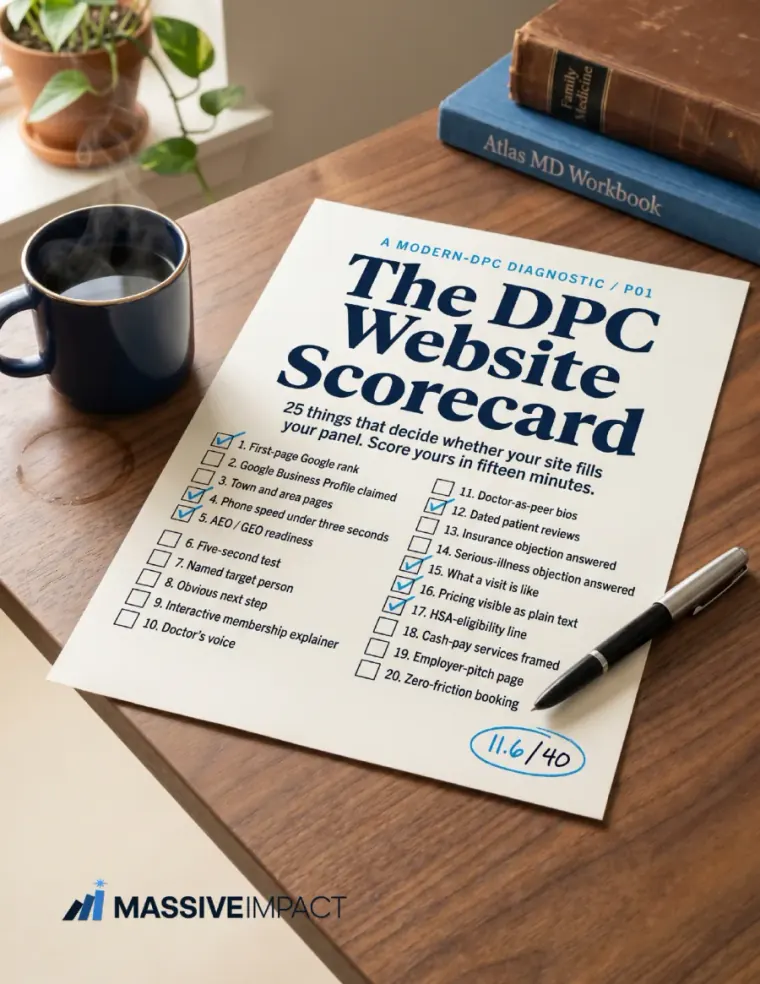
25 things that decide whether your site fills your panel
About this report
Authored by: Piyush Agarwal, Massive Impact. Massive Impact builds websites for modern DPC practices.
Data sources:
- Massive Impact's independent research of the US DPC market (n = 2,468 unique practices, 3,734 records, as of May 2026). The underlying research is available as a licensed dataset on request, contact us for pricing.
- Massive Impact DPC Website Audit, May 2026 (n = 27 randomly sampled live DPC sites, scored 21 to 22 May 2026; mean 11.6 / 40 under the v1 rubric, max 22, zero in the acquisition tier). Methodology and per-site data available to licensed buyers, contact us for pricing.
- Massive Impact Authority Audit, May 2026 (n = 15 of 27, re-read against 8 DPC-specific lenses). 15 source URLs cited; full reference list available to licensed buyers, contact us for pricing.
- Third-party: IRS.gov (HSA / DPC 2026 rule), Hint Health 2026 Trends Report, Plum Health / Dr. Paul Thomas on panel math.
Methodology: every number in this report is independently verified from a public source; every source URL appears on the final page.
As of: 23 May 2026.
Why we made this. This is the rubric we hold every DPC Growth Site to. We made it public because the audit data is independently verifiable, and the rubric works whether you hire us or build your site to it yourself.
A DPC practice lives or dies on one number, the panel. And for most practices, the site is the quietest reason that number isn't moving.
Here's the hard part. Your site looks fine to you. It has your photo, your hours, your phone number. It feels done. But "looks fine" and "fills the panel" are two different jobs, and most DPC sites only do the first. They're brochures. A brochure informs the few people who already decided to call you. It does nothing for the larger group who landed, didn't quickly see why you're worth leaving their current doctor, and closed the tab.
This scorecard measures the second job. We built it after auditing 27 live DPC sites against an earlier version of this rubric; the average came in at 11.6 out of 40 under that v1 scoring. None of the 27 scored in the top band. So the bar is low, the gap is real, and fifteen honest minutes here will tell you exactly where your panel growth is leaking.
How to score
- 25 items, 5 sections, 0 / 1 / 2 each. Max is 50.
- Score 0 if the item is missing or not true.
- Score 1 if it's partly there, or there but weak.
- Score 2 if it's solid, you'd be proud to show it on a Founders FB call.
- Be strict. Scoring your own site generously is how it stayed at this score in the first place.
- Add the section subtotals. Total at the end.
A. Can patients find you?
5 items, max 10. Findability, both classic search and AI search.
- First-page Google. You rank on the first page of Google for "[your town] direct primary care" and "[your town] DPC."
- Google Business Profile. Claimed, complete, with recent dated reviews.
- Town and area pages. A real page for each town or area you serve, not one homepage with a list of cities.
- Phone speed. Your site loads in under three seconds on a phone.
- AEO / GEO readiness. Page titles and meta descriptions are written for search AND a curious patient. FAQ schema and structured data are in place. ChatGPT, Perplexity, and Google AI Overviews can correctly answer "is there a direct primary care in [your town]" and quote your site. Most DPC sites are invisible to AI search entirely.
Section A subtotal: ___ / 10

B. Do they understand you in five seconds?
5 items, max 10. Five-second clarity, what you do, who it's for, what to do next.
- The five-second test. A first-time visitor knows what DPC is and what you offer within five seconds of landing. No scrolling, no scavenger hunt.
- Named target person. Your homepage names the specific person it's for ("families in [town] tired of 12-minute visits and surprise bills"), not "everyone."
- Obvious next step. Become a member or book a Meet and Greet, visible without scrolling. One primary action, not three.
- Interactive membership-explainer. A real mechanism on the site that helps the undecided understand the model. A comparison calculator, an "is DPC right for you?" quiz, a "savings vs your current plan" tool. Not a paragraph titled "How DPC works." A thing the visitor uses.
- Doctor's voice. The writing sounds like the doctor talking, not a hospital brochure. First person where appropriate. Specific language. Plain words.
Section B subtotal: ___ / 10
C. Do they trust you?
5 items, max 10. Trust, bios, reviews, objection-handling, the texture of the relationship.
- Doctor-as-peer bios. Every provider has a first-person bio that names why they left fee-for-service and what they believe about medicine. Not a credential list with a smiling photo. Recurrence: 4 of 15 best-audited DPC sites do this. 11 don't.
- Dated patient reviews on the page. Real reviews with names or careful initials-and-age framing, not a generic stars badge. Recurrence: 2 of 15 sites do this cleanly.
- The insurance objection, answered. With the 2026 HSA rule and the Medicare specifics. Generic "we don't bill insurance" doesn't count. Recurrence: 3 of 15 sites do this fully.
- The serious-illness and specialist objection, answered. Hospitalizations, referrals, what happens if I get sick. A doctor reading your site shouldn't have to guess. Recurrence: 1 of 15. Tandem Health in Maryland is the only audited site that does this directly.
- What a visit is like. One concrete paragraph on the texture of the relationship, same-day access, 30 to 60 minute visits, direct text to the doctor. Not a features list. Recurrence: 5 of 15 sites do this.
Section C subtotal: ___ / 10
D. Does the site fill the panel?
5 items, max 10. The modern-DPC layer, the items that separate a working brochure from a site doing its job.
- Pricing visible as plain text. Not an image. Not behind a "contact us" wall. Not on a private PDF. Image-only pricing still fails because Google can't read it and screen readers can't. Recurrence: 1 of 15 does this cleanly. 24 of 27 audited sites hide pricing entirely.
- HSA-eligibility line on the membership page. HSA dollars now reimburse DPC membership fees up to $150 a month for individuals and $300 a month for families, effective 1 January 2026 under the One Big Beautiful Bill Act and IRS Notice 2026-5. Most DPC sites still read like it's 2025.
- Cash-pay services framed inside the membership. GLP-1, hormones, peptides, IV, longevity panels presented with named pricing inside the relationship, not as a separate "Store" or "Shop" in the navigation. Patients are pricing GLP-1 against Amazon One Medical at $149 a month; if your site reads like a supplement store, you lose the relationship test before the visitor reads a word.
- An employer-pitch page. A dedicated page that pitches to local employers, not a buried contact form. Per Hint Health's 2026 Trends Report, employer contracts now fund roughly 60% of active DPC memberships in the US.
- Zero-friction booking. The path from "I want to talk to this doctor" to a booked slot is one online step. Not phone tag. Not a contact form that gets a manual reply tomorrow. Not "we'll call you back."
Section D subtotal: ___ / 10
E. Does the site capture and qualify the not-yet-ready?
5 items, max 10. Lead Acquisition, the layer almost no DPC site has at all.
- Multiple interactive lead tools, not one form. A calculator, a quiz, a screener, a savings comparison. Not just one newsletter signup. A modern DPC Growth Site delivers a system for the not-yet-ready, not a single capture form.
- The tools deliver real value before the ask. The visitor gets a useful output, a number, a result, a personalized read, BEFORE being asked for an email. Value first, capture second.
- A real reason to give the email. The lead magnet names a specific outcome ("see how DPC compares to your current plan, line by line"), not "subscribe to our newsletter."
- Automated two-to-five-week follow-up. A real sequence runs after capture. Five to eight emails, written, scheduled, working without you. Not a manual reply when you remember. Recurrence (items 21 through 24 combined): 0 of 27 audited sites do this. The market gap is the entire market.
- The tool ties to a membership conversion path. Each lead magnet has a specific next step into the relationship, a Meet and Greet offer, a member-only resource, a calendar link. Not a dead-end download.
Section E subtotal: ___ / 10

Your total: ___ / 50
What your score means
0 to 12, Broken. The site is not doing the job a DPC site has to do in 2026. A patient who lands here undecided leaves with no understanding of what they're being offered, no price, no trust signal, and no way for you to reach them again.
13 to 25, Brochure. Where most DPC sites land. It informs the few people who were already going to call. It doesn't convert the undecided, it doesn't capture the not-yet-ready, and it doesn't ride the 2026 tailwinds. You're getting some of your panel from the site and losing most of the opportunity.
26 to 38, Working. The site clears the basics, names the model, holds the price, and starts to handle objections. The gap is in the panel-fill layer (Section D) and the lead-capture layer (Section E). A few sharpened items move you into the top band.
39 to 50, Acquisition tier. The site finds people, makes them understand the model fast, earns trust with real bios and real reviews, and gives both the ready and the not-ready a way in. Zero of the 27 sites in the original audit (against a 40-point rubric) reached the equivalent top band. If you did, your site is working for you, and we want to talk to you for a different reason.
The panel math behind why this matters
Dr. Paul Thomas at Plum Health has shared the working number, about 20 site visitors per 1 new enrollment. That's the rough conversion of a working DPC site. If your site is in the brochure band, you can multiply your traffic and still not move the panel, because the leak isn't visitors, it's what the site does with them.
What to do next
If you scored 0 to 25, your site is a brochure. Pages and a nicer photo won't fix it, because what this scorecard measures is structural. That's the whole reason the DPC Growth Site exists. It's a productized DPC site, built in-house at Massive Impact, scored against this rubric by default. Every item you just read is a standard part of the build, not an upgrade.
If you scored 26 to 50, you're ahead of the field, which means the conversation we should have is different. The $590 a month growth plan is built for sites already at this level, to keep moving them.
Fastest path either way, walk your score with us on a 20-minute call. We'll go item by item against your real site and show you exactly where the panel growth is leaking.
→ Book a 20-minute call: winmassiveimpact.com/dpc-zoom-call
This rubric is what the DPC Growth Site is built against. We didn't reverse-engineer a checklist from a site we already sold; we built the system that scores 45 or higher on every item.

Sources
- Massive Impact DPC Website Audit, May 2026 (n = 27). Scored 21 to 22 May 2026. Methodology and per-site data available to licensed buyers, contact us for pricing.
- Massive Impact Authority Audit, May 2026 (n = 15 of 27). Re-read 23 May 2026 against 8 DPC-specific lenses (insurance objection, specialist objection, doctor-as-peer bio, continuity signaling, cash-pay-as-relationship, HIPAA-careful reviews, "what's it like" narrative, pricing transparency). 15 source URLs cited; full reference list available to licensed buyers, contact us for pricing.
- Massive Impact's independent research of the US DPC market. n = 2,468 unique practices, 3,734 records, 108 fields, as of May 2026. The underlying research is available as a licensed dataset on request, contact us for pricing.
- IRS Notice 2026-5, One Big Beautiful Bill Act, HSA / DPC provision. Effective 1 January 2026; HSA dollars reimburse DPC membership fees up to $150 / month individual, $300 / month family. irs.gov
- Amazon One Medical cash-pay GLP-1, launched 21 April 2026. $149 / month oral, $299 / month injectable; $25 / month for One Medical Insured members. Amazon press release, 21 April 2026.
- Hint Health, 2026 Trends Report. Employers now fund roughly 60% of active DPC memberships in the US. hint.com
- Panel math, Dr. Paul Thomas, Plum Health DPC. Working ratio, about 20 site visitors per 1 new enrollment. plumhealthdpc.com
- Tandem Health DPC (MD), audited reference. The single audited site that scored YES on 5+ of the 8 authority lenses. tandemhealthmd.com
- Seacoast DPC (NH), audited reference. Dated, named patient-review embed, doctor-as-peer bios. seacoastdirectprimarycare.com
License the research
Massive Impact's DPC market research and the audit per-site scores are available as a licensed dataset. The dataset, the methodology, and the per-site authority scores are paid IP, not a free download. Contact us for pricing.
→ winmassiveimpact.com/request-research
The DPC Website Scorecard, by Massive Impact. winmassiveimpact.com
The rest of the report is yours, free.
Enter your email to keep reading and get the PDF to keep.
No spam. One email unlocks every Massive Impact report.
