


About this report
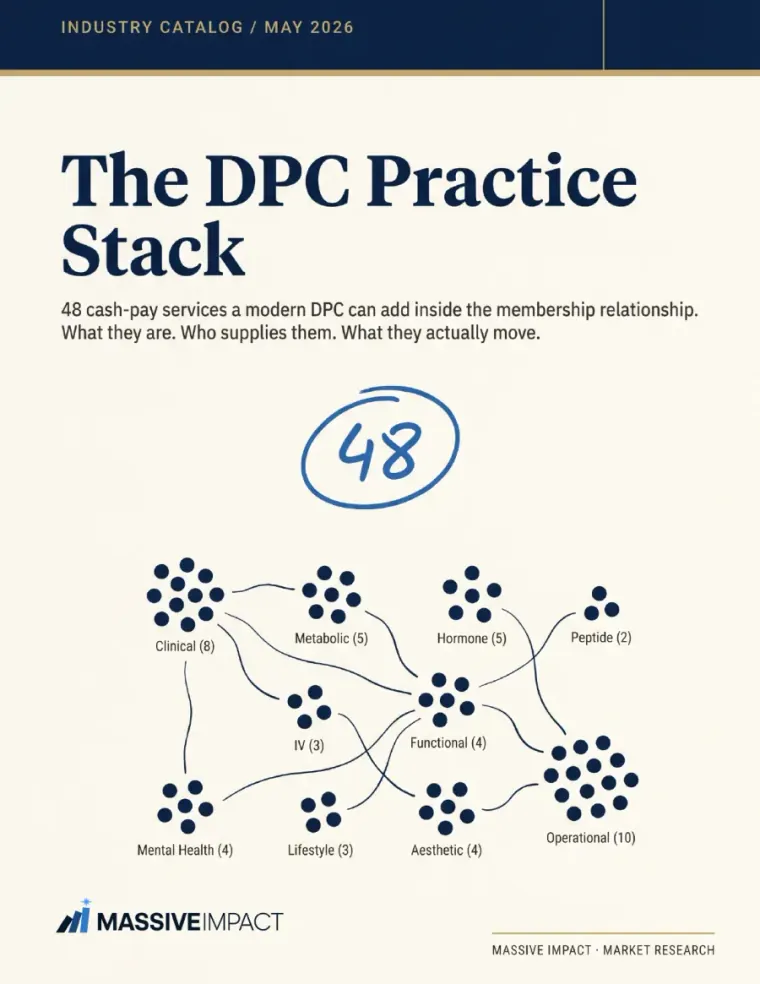
48 cash-pay services a modern DPC can add inside the membership relationship. What they are. Who supplies them. What they move.
The membership relationship is the spine. Every entry in this catalog is a service a modern DPC includes inside that relationship, not on top of it. The catalog is a map of what fits, what doesn't, and where the line bends.
Executive summary
A modern DPC has 48 cash-pay and operational services it can offer, all of them inside the membership relationship. The catalog ranks them, names the real vendors, and prints the honest verdict on each.
The headline finding
The framing is what protects the brand. The math is what makes the panel work.
Three rising entries that move the panel hardest in 2026
- #1. GLP-1 Weight-Loss Program (Compounded 503A). Amazon One Medical set the cash-pay price floor at $149 per month for oral, $299 for injectable, in April. A DPC can't win on price against that. It wins on supervision, dose adjustment, continuity, and the membership relationship the telehealth platforms cannot replicate.
- #7. BHRT for Women. 18.0% of the documented dataset offers women's hormone replacement. The highest-adoption hormone line in the data, and still growing.
- #35. Employer Direct Contracts. Sixty percent of active DPC memberships are now employer-funded per Hint Health's 2026 Trends Report. 8.8% of practices mention employer contracts on their public site. The gap between adoption and delivery is the cleanest growth lever in the catalog.
How the catalog is organized
Ten categories. 48 entries. The categories are not equally sized. The smallest, peptide therapy, has 2 entries because we kept the discipline tight on regulatory limbo. The largest, operational add-ons, has 10 entries because the modern DPC's biggest 2026 levers are operational, not clinical (HSA documentation, employer contracts, supplement dispensary discipline, in-house dispensing, premium tiers).
Tag distribution
3 entries are table stakes (50%+ adoption). 21 are rising (10 to 30%). 19 are differentiators (under 10% but real revenue). 5 are emerging (under 5%, regulatory or market shift).
Two recommendations the catalog earns the right to make
One yellow flag: #32 Botox. Available for established members only, never marketed on the home page. One skip: #44 Morpheus8 / SkinPen. Most modern DPCs should not add this. The catalog says so because the data and the brand math support it.
What we deliberately excluded
The categories that don't appear in this catalog were not missed. They were excluded on purpose because they drift a DPC toward medspa or wellness-boutique territory and away from the relationship-based membership model that defines the modern DPC.
The discipline is editorial. This catalog covers what fits inside the modern DPC. What's excluded is named so the reader sees the choice was deliberate, not an oversight.
Metabolic and weight
1. GLP-1 Weight-Loss Program (Compounded 503A)
Tag: Rising
How to frame it. Lead the metabolic category. State the Amazon $149 number plainly, then state what supervision adds. Don't oversell margins; the lane is real but the price floor is set by a giant.
What to avoid. Pitching GLP-1 as a separate Shop product creates the 'MLM with a stethoscope' read. The frame is 'as a member, you have access to a supervised weight-management program', not 'add GLP-1 to your cart.' The Reddit r/Charlotte DPC story shows what happens when patients feel upsold inside a relationship they paid for.
What it is. A supervised weight-loss program using a compounded GLP-1 (semaglutide or tirzepatide, typically as a clinically-different 503A formulation, e.g., semaglutide + B12 or + glycine). The practice writes the protocol, the compounding pharmacy ships, the DPC manages dose titration and side effects.
Adoption. 5.1%. 191 of 3,734 practices (5.1%) name a GLP-1 drug directly on their public site (semaglutide, tirzepatide, ozempic, wegovy, mounjaro, zepbound). Compounded-GLP-1-specific language is even narrower at 0.2% (8 practices). The Open Pass 01 figure of 5.2% from the strict GLP-1 sweep matches within rounding. Generic 'weight management' (medical weight loss / weight loss program) sits at 41.6% of practices, so the delivery rate is far higher than the public-facing drug language.
Vendor and setup. Free wholesale provider account at a 503A compounding pharmacy. Empower (Houston), Olympia (Orlando), Strive (Gilbert AZ), Hallandale (FL), Belmar (CO), Wells (FL) all offer this. No inventory required. Patient-specific scripts shipped to home or office. Setup lift: Low. Free account, intake template, dosing protocol, monthly check-in cadence. Days, not weeks, once a DEA-licensed clinician is on file.
Revenue. Example: 40 patients × $300/mo cash bundle = $12,000/mo revenue. Wholesale compounded semaglutide runs roughly $80-150/dose at clinic price. Gross margin per patient $150-200/mo after the drug. At 40 patients that is $6,000-8,000/mo gross to the practice. Patient pricing: $250-500/mo cash-pay, bundled monthly. Telehealth competitors set the floor: Henry Meds $179/mo entry; Hims & Hers compounded $200-300/mo; Amazon One Medical $149/mo oral, $299/mo injectable (cash-pay). DPC programs typically run higher and bundle the supervision.
Who it's for. Any modern DPC whose patients are already asking about GLP-1. Demand is mainstream: RAND August 2025 puts 11.8% of US adults having used a GLP-1; KFF says 1 in 8 currently on one. Not a niche bet.
Regulatory (2026). The FDA ended its enforcement-discretion period for compounded GLP-1 in May 2025 (503B) and April 2025 (503A). Mass-produced essentially-copies are gone. Clinically-different patient-specific 503A formulations (semaglutide + B12, + glycine, or other dose customizations) remain legal. Empower, Strive, Olympia have all kept these in their catalogs through 2026. The lane is narrower than 2023-24 but real.
Competitive pressure. Amazon One Medical, launched April 21, 2026 at $149/$299 cash-pay nationwide, is now the price floor. Hims & Hers spent $221M on marketing in 2024 (46% of revenue) to acquire these same patients. A DPC cannot win on price; it wins on supervision, dose adjustment, continuity, and the membership relationship the telehealth platforms cannot replicate.
2. Medical Weight-Loss Program (non-GLP-1, behavioral + Rx)
Tag: Rising
How to frame it. Pair this with the GLP-1 entry as 'the full metabolic ladder', DPCs that own both Rx tiers serve the panel that drops off GLP-1 due to side effects, cost, or supply.
What to avoid. Calling it 'medical weight loss' on the site and then quietly delivering only GLP-1 in practice, patients feel bait-and-switched. Be explicit on the membership page about what's bundled and what's a la carte.
What it is. A structured weight-loss program separate from GLP-1, phentermine, naltrexone-bupropion, or topiramate combinations, plus behavioral coaching, lab monitoring, and (usually) a meal-plan framework. For patients GLP-1 isn't right for, or patients post-GLP-1 maintenance.
Adoption. 41.6%. 1,552 practices (41.6%) describe a 'medical weight loss' or 'weight loss program' or 'weight management' explicitly. In the cleaned dataset this is the broadest cash-pay category by adoption signal, the layer the GLP-1 prescribers hide behind.
Vendor and setup. No external vendor required. Generic Rx through any pharmacy. Compounding pharmacy optional for lipotropic injection bundles (B12, MIC, lipo-C). Setup lift: Low. The Rx is on the DPC formulary already. The work is the protocol and the coaching cadence.
Revenue. Example: 30 patients × $200/mo = $6,000/mo. Margin is the visit time after generic Rx cost. The bigger revenue lever is patient retention: patients in a medical weight-loss program stay members longer. Patient pricing: $150-350/mo bundled. Often includes monthly visit, lab work, and Rx. Lower-priced than the GLP-1 lane and a sensible second tier.
Who it's for. Patients who can't tolerate or can't afford GLP-1, patients with contraindications, and patients post-GLP-1 in maintenance phase. Roughly 30-50% of the weight-loss inquiry pool ends up here, not on a GLP-1.
Regulatory (2026). Standard generic Rx, no regulatory window. Phentermine remains DEA Schedule IV; the rest are off-schedule.
Competitive pressure. Plenfity, Calibrate, Found, Sequence, and other behavioral-coaching weight-loss apps compete in this lane at $99-149/mo. The DPC advantage is the same as everywhere else: real clinician relationship and labs done at cost.
3. Continuous Glucose Monitoring (CGM) Cash-Pay Program
Tag: Emerging
How to frame it. List it inside the metabolic ladder, not as a category. The interesting fact is the regulatory shift to OTC, which signals patient demand is now mainstream enough that a DPC can offer it without insurance friction.
What to avoid. Becoming 'the CGM clinic' is a brand mistake. CGM is a diagnostic add-on inside a weight or metabolic program, not a service line.
What it is. A wearable glucose monitor (Dexcom, Abbott Freestyle Libre, Levels, Stelo) prescribed for metabolic insight in non-diabetic patients. Cash-pay, often a 2-4 week trial during a weight or longevity workup.
Adoption. 23.2%. 867 practices (23.2%) mention metabolic panels, CGM, insulin resistance, or HbA1c monitoring in their content. CGM-specific language is much smaller, the regex bundle picks up clinical care alongside the wearable program. Treat the 23.2% as an upper bound for 'practices doing any metabolic workup' and assume CGM-as-cash-pay-product is a small fraction inside that.
Vendor and setup. Direct purchase from Dexcom or Abbott (consumer or pharmacy). Some clinics use Levels Health or Nutrisense as the patient-app layer. Setup lift: Low. No special account required. Patient buys the sensor or it's billed through the clinic.
Revenue. Example: 20 patients × $250 (sensor + interpretation visit) = $5,000 one-off, recurring as patients cycle. Not a big revenue line on its own; a credibility add-on to the metabolic workup. Patient pricing: $150-400 per 2-4 week sensor cycle. Abbott Stelo retails $89 for 2 sensors (28 days) direct-to-consumer; clinic-supervised programs add the visit and the interpretation.
Who it's for. Patients in the weight-management funnel, longevity-curious patients, prediabetic patients, athletes optimizing. The Levels Health customer base is a fair proxy: tech-forward, willing to pay, 35-55 years old.
Regulatory (2026). Stelo (the OTC CGM) got FDA clearance in March 2024 for non-diabetic use. Prescription CGMs remain available off-label for non-diabetic monitoring; insurance won't cover non-diabetic use, which is exactly why it's cash-pay.
Competitive pressure. Levels Health ($199/mo), Nutrisense, Veri, January AI all compete here. DPC differentiation is the licensed clinician interpretation, not the wearable.
4. Lipotropic / B12 Injection Series
Tag: Differentiator
How to frame it. List as an ancillary inside the medical weight-loss bundle, not a standalone. Honest verdict: small margin, easy to add, watch the framing.
What to avoid. The vitamin-shot category is where the 'MLM with a stethoscope' read bites hardest. If a DPC's site lists vitamin shots as their own service-page category, the framing has slipped from membership medicine into wellness retail. Bundle inside the metabolic program or omit.
What it is. Weekly or biweekly intramuscular injections of B12 (methylcobalamin) and lipotropic compounds (methionine, inositol, choline, MIC; sometimes with L-carnitine or B6). Marketed for energy and metabolic support, often paired with a weight program.
Adoption. 7.8%. 291 practices (7.8%) explicitly mention B12 injections, lipotropic injections, MIC, or lipo-C. Adoption is higher than the public language suggests, clinics often deliver these as a quiet add-on without writing about them.
Vendor and setup. Compounding pharmacy supplies the lipotropic compounds. Empower, Olympia, Wells all carry MIC formulations. B12 is generic and stocked through any wholesale pharmacy. Setup lift: Low. Wholesale account already exists for the weight program. Add the SKU.
Revenue. Example: 25 patients × $200 per 6-pack quarterly = $5,000/quarter, $20K/yr. Wholesale cost per shot is low ($5-10). Margin is strong; volume is the constraint. Patient pricing: $25-50 per shot, often sold as a 6- or 12-pack ($150-500). Some clinics include in the weight-program bundle at no extra charge.
Who it's for. Existing weight-loss program patients, energy-complaint patients, longevity-curious patients. Treat as a small add-on, not a standalone service line.
Regulatory (2026). B12 and the lipotropic compounds are unrestricted. Standard 503A compounding rules apply.
Competitive pressure. Every medspa offers these for $20-40 a shot. DPC competition is on convenience inside the membership relationship, not on price.
5. Bariatric Behavioral Coaching / Registered Dietitian
Tag: Rising
How to frame it. List as the human-relationship layer that makes the GLP-1 program survive past month 6. The data on GLP-1 discontinuation rates (40-60% within a year per multiple studies) is why coaching matters.
What to avoid. Hiring a dietitian as a profit center fails, the math doesn't pencil at DPC visit volumes. Hire as a retention lever or contract part-time.
What it is. A dietitian or behavioral coach inside the practice (or contracted) delivering a structured nutrition/behavior change program, usually paired with the medical weight-loss or GLP-1 ladder.
Adoption. 16.7%. 624 practices (16.7%) mention nutrition counseling, a registered dietitian, or a weight/behavioral coach. The layer is real and growing.
Vendor and setup. Contracted RD or behavioral coach, in-person or telehealth. Some DPCs hire a 1-day-a-week dietitian; others use Fay (telehealth dietitian network) or NutriAdmin for the back office. Setup lift: Medium. Contracting and credentialing a dietitian is real work. The administrative side (notes, scheduling, billing if any) is the harder piece.
Revenue. Example: 1-day-a-week dietitian at $400/day cost, sees 8 patients/day at $75 = $600 revenue, $200 margin per day. Real but small as a profit center; bigger as a retention lever inside the weight program. Patient pricing: Often bundled into the weight-loss program ($50-100/mo add-on inside a $250-400 bundle). Standalone visits $75-150 each.
Who it's for. Mid- to high-engagement weight-loss patients. Doesn't add much for patients who only want the Rx.
Regulatory (2026). RDs require state licensure in most states; behavioral coaches do not. Insurance billing is separate and out of scope for a cash-pay DPC.
Competitive pressure. Noom, WeightWatchers, MyFitnessPal, all priced at $20-50/mo. DPC differentiation is the medical integration and the actual human attention.

Hormone optimization
6. Testosterone Replacement Therapy (TRT), Men
Tag: Rising
How to frame it. Print the price comparison plainly: a DPC bundled at $200/mo against a $400 Defy program. Don't pretend to win on price against Hone. Win on the bundle.
What to avoid. Becoming 'the TRT clinic' is a brand risk for a DPC, the men's-health-clinic aesthetic and the primary-care aesthetic clash. Keep TRT inside the membership relationship, not on its own website-within-the-website.
What it is. Cash-pay testosterone replacement for men with documented low T. Cypionate or enanthate injections (most common), gel, or pellet. Bundled with monitoring labs (testosterone total + free, estradiol, hematocrit, PSA) every 3-6 months.
Adoption. 10.6%. 396 practices (10.6%) name TRT or testosterone therapy explicitly. Open Pass 01 strict hormone language is 20.2% (includes BHRT and pellets); this entry is the narrower TRT-specifically-for-men slice.
Vendor and setup. Generic testosterone cypionate is on most DPC formularies already. Compounded testosterone (cream, troche, alternate strengths) goes through Empower, Olympia, Belmar, Wells. Pellet implantation needs the Biote/EvexiPEL/SottoPelle training pathway OR independent training (Dr. Mark Richards $3,500, Elite Nurse Practitioner $7 CE hours). Setup lift: Low if injection-only (clinic already prescribes). Medium if adding pellets (training cost + procedure room + scheduling).
Revenue. Example: 40 men × $200/mo cash bundle = $8,000/mo. Wholesale cypionate is roughly $20-40/month of supply at clinic prices. Labs at wholesale are $30-50/quarter. Net margin per patient is $100-150/mo. Patient pricing: $100-300/mo cash-pay bundle (Rx + labs + visits). Injectable cypionate is the cheap end; pellets the higher end. Telehealth comps: Hone Health $40-100/mo; Marek Health $130-200/mo; Defy Medical $200-400/mo.
Who it's for. Men 35-65 with fatigue, low libido, weight gain, the buyer pool the men's-health telehealth players (Hone, Marek, Defy) have proven exists at scale. DPC differentiation is the in-person clinical exam, the integrated labs, and the relationship.
Regulatory (2026). Testosterone is DEA Schedule III. Requires DEA registration for the prescribing clinician. State-level licensure rules apply for NP/PA prescribers.
Competitive pressure. Hone Health, Marek Health, Defy Medical own significant share at lower prices. DPC wins on the bundled labs, the same-doctor continuity, and the absence of telehealth handoffs.
7. Bioidentical Hormone Replacement Therapy (BHRT), Women
Tag: Rising
How to frame it. This is the highest-adoption hormone line in the dataset and a real demand category. Two paths: independent BHRT (cheaper, fully owned) or the Biote/EvexiPEL pathway (more expensive, comes with a referral pipeline). Name both honestly.
What to avoid. The Biote/EvexiPEL training pathways are training-and-supply networks that double as patient-referral funnels. A clinic that joins Biote becomes searchable on biote.com/find-a-provider. That's a real lead source, and it's also where the framing slip happens: clinics that lean into 'Biote provider' as their brand drift away from DPC into pellet-medspa territory. Hold the membership relationship as the spine.
What it is. Estradiol, progesterone, and (sometimes) testosterone for perimenopausal and postmenopausal women. Compounded creams, troches, vaginal estrogen, or oral progesterone. Increasingly pellet-delivered.
Adoption. 19.8%. 739 practices (19.8%) mention HRT, hormone replacement, menopause, or related terms. The women's-hormone layer is wider than the men's TRT layer and growing.
Vendor and setup. Compounding pharmacies are central: Empower, Olympia, Belmar, Wells. Pellet networks (Biote, EvexiPEL, SottoPelle) supply the trained-provider pathway plus the pellet supply. Independent training is the cheaper alternative. Setup lift: Low for cream/troche/oral protocols. Medium-high for pellets (training cost $3,500-$5,000, procedure room).
Revenue. Example: 50 women × $150/mo bundle = $7,500/mo. With pellets at $500/insertion × 4 per year × 50 women = $100K/yr supplemental, minus pellet wholesale ($24-32 per pellet × 6-10 pellets per insertion). Patient pricing: $100-300/mo for a bundled BHRT program (Rx + labs + visits). Pellet insertions $300-800 every 3-4 months (women).
Who it's for. Women 40-65 with menopause symptoms, the patient pool the Midi, Alloy, Evernow telehealth players have demonstrated. The DPC differentiation is the full intake, the labs at cost, and the longitudinal relationship.
Regulatory (2026). Compounded BHRT remains legal under 503A. The FDA has periodically pressured compounders on 'essentially copies' of branded products; bioidentical (E2, P4, T) formulations don't have branded comparators.
Competitive pressure. Midi, Alloy, Evernow, all telehealth, mostly $99-200/mo. Biote network at 5,300+ clinics nationwide. The DPC differentiation is integrated primary care alongside the hormone work.
8. Thyroid Optimization (T3/T4, NDT, Hashimoto's)
Tag: Rising
How to frame it. The honest-good-medicine entry. This is the category where the DPC model outperforms insurance primary care, and that story belongs on the membership page directly.
What to avoid. Marketing 'thyroid optimization' as a cash-pay add-on when it's clinical primary care creates the wellness-clinic framing slip. Keep thyroid inside the membership as 'what we do better than rushed insurance care.'
What it is. A non-insurance, full thyroid workup and management protocol, full panel (TSH, free T3, free T4, reverse T3, TPO, TgAb), plus prescribing options conventional primary care often won't touch (compounded T3, natural desiccated thyroid, slow-release T3).
Adoption. 27.2%. 1,017 practices (27.2%) mention thyroid management or related terms. One of the most-deployed cash-pay clinical add-ons in the dataset.
Vendor and setup. Generic levothyroxine on every formulary. NDT (Armour, Nature-Throid) through standard pharmacies. Compounded T3 or sustained-release T3 via Empower, Belmar, Olympia, Wells. Setup lift: Low. Pure clinical work, no special vendor account beyond the compounding-pharmacy account already needed for other lines.
Revenue. Mostly a retention play, not a margin play. Patients who get their thyroid optimized are some of the most loyal members in the panel. Worth quantifying as retention months, not as direct revenue. Patient pricing: Usually inside the membership ($75-150/mo). Compounded T3 or NDT scripts at wholesale cost ($20-50/mo to the patient). Annual full thyroid panel at wholesale $50-100.
Who it's for. Women 30-65 with fatigue, weight gain, hair loss, low mood, a huge underserved patient pool that conventional PCPs dismiss when TSH is in range.
Regulatory (2026). Standard Rx. No regulatory hooks.
Competitive pressure. Paloma Health is the dominant telehealth thyroid-specific player ($79-99/mo). Midi includes thyroid in their menopause panels. DPC wins on the full workup and the integrated care.
9. Men's Health / ED Treatment Program
Tag: Rising
How to frame it. Bundle inside the men's-health line. Don't list as a standalone service tile. The product entry calls out that the dataset already shows 14.6% adoption, so this is mainstream.
What to avoid. Standalone ED programs detached from the primary-care relationship are the wellness-clinic drift. Keep this inside the TRT or men's-health bundle.
What it is. Erectile dysfunction Rx (sildenafil, tadalafil generics, trimix injection for non-responders), often bundled with TRT. May include shockwave therapy (Gainswave-style) in higher-margin practices.
Adoption. 31.1%. 1,163 practices (31.1%) mention men's health, ED treatment, or erectile dysfunction. One of the deepest cash-pay layers in the cleaned dataset.
Vendor and setup. Generic sildenafil/tadalafil any pharmacy. Trimix (alprostadil + papaverine + phentolamine) via Empower or Olympia compounding. Shockwave devices are capex ($30K-80K) and outside the DPC scope. Setup lift: Low for the Rx program. Avoid the shockwave path unless there's strong existing demand and a real procedure room.
Revenue. Generic Rx adds $20-50/patient/mo gross. At 50 patients that's $1-2.5K/mo. Not a profit center; an inclusion that completes the men's-health offering. Patient pricing: $30-100/mo for generic sildenafil/tadalafil cash-pay. Trimix programs $150-300/mo. Shockwave packages $1,500-3,000.
Who it's for. Men 40-70, overlaps almost entirely with the TRT panel. Bundle the ED Rx into the TRT visit.
Regulatory (2026). Generic sildenafil and tadalafil have been off-patent since 2017 and 2018 respectively. Trimix is compounded; falls under 503A patient-specific.
Competitive pressure. Hims, Roman/Ro, and every men's-health telehealth offers sildenafil at $1-3/dose. DPC competition is not on price; it's on the bundle.
10. Hormone Pellet Therapy (Biote / EvexiPEL / Independent)
Tag: Rising
How to frame it. Cover both paths honestly (network vs. independent). Print the EvexiPEL $3,000 refund detail, it's the kind of specific vendor economics a DPC owner needs to know.
What to avoid. This is the category where the MLM-with-stethoscope warning bites hardest. Biote certified providers can drift into 'pellet practitioner' branding that overshadows the primary-care identity. The best clinics keep their identity as the DPC; pellets are one of the services in the membership relationship, not the brand.
What it is. Subcutaneous insertion of compounded testosterone or estradiol pellets, lasting 3-6 months per insertion. Procedure done in-office with local anesthesia. The dominant US delivery system for BHRT outside topical/injectable.
Adoption. 9.0%. 337 practices (9.0%) mention BHRT, pellets, Biote, EvexiPEL, or SottoPelle. Biote alone claims 9,200+ certified providers and 5,300+ clinics nationwide; not all of these are in our research, suggesting pellet provision is broader than the regex captures.
Vendor and setup. Three vendor paths. (1) Biote, largest network, training $3,500+, in-person or virtual, plus 'Biote Method Clinical DS' decision support, plus a provider-directory referral pipeline. (2) EvexiPEL, direct Biote competitor, more aggressive provider economics ($3,000 refund for 101 procedures in 101 days). (3) Independent training, Dr. Mark Richards $3,500, Elite Nurse Practitioner 7 CE hours online, AAOPM in-person, no network, no referrals, no ongoing markup. Pellets supplied through compounding pharmacies regardless of training path. Setup lift: Medium-high. Training, certification, procedure room with sterile setup, scheduling cadence, after-care protocol.
Revenue. Example: 30 women × 3 insertions/yr × $500 each = $45K/yr. 20 men × 2 insertions/yr × $800 each = $32K/yr. Wholesale per pellet is $24-32; per insertion uses 6-10 pellets; gross margin per insertion is $300-600. Patient pricing: $300-800 per insertion for women (every 3-4 months); $500-1,200 for men (every 5-6 months). Some practices bill a procedure fee of $75 first-time plus $24-32 per pellet (visible in published clinic fee schedules).
Who it's for. Practices that want a real hormone book and are willing to do the procedure work. The buyer of the pellet program is committed: monthly creams require monthly compliance, pellets are a one-and-done quarterly visit, which is why patients prefer them.
Regulatory (2026). Compounded pellets under 503A patient-specific. Standard DEA requirements for testosterone (Schedule III).
Competitive pressure. Biote is the dominant network, its provider directory is real lead flow. EvexiPEL is competing for trained providers with the $3,000 refund. The competitive question for a DPC is whether to join the network (lead flow + training markup) or stay independent (cheaper, no leads).
Peptide therapy
11. Peptide Therapy, Growth-Hormone Family (Sermorelin, Ipamorelin, CJC)
Tag: Emerging
How to frame it. Lead with the regulatory honesty. The lane is opening but not open.
What to avoid. Overclaiming the regulatory state ('approved,' 'FDA-cleared,' 'now legal') is the fastest way to lose physician credibility and invite FDA attention. The Forbes Nov 2025 piece on celebrity GLP-1/peptide marketing already names this risk. Print the limbo framing plainly.
What it is. Subcutaneous peptide injections that stimulate endogenous growth-hormone release, sermorelin, ipamorelin, CJC-1295 (with or without DAC). Marketed for sleep, body composition, recovery, and longevity.
Adoption. 0.2%. 9 practices (0.2%) mention sermorelin, ipamorelin, or CJC by name. The generic 'peptide' search returns 125 practices (3.3%). The gap (named vs. generic) tells you most practices doing peptides aren't publishing about them, a regulatory caution carryover from the 2023 FDA Category 2 action.
Vendor and setup. Tailor Made Compounding / Infiniwell (historically the peptide-focused house), Empower, Strive, Belmar, Hallandale, Olympia, Wells all carry peptide formulations in 2026. Setup lift: Low if the wholesale account exists. The work is the clinical protocol, the labs (IGF-1, fasting glucose), and the documentation.
Revenue. Example: 20 patients × $400/mo bundle = $8K/mo. Margin is solid because the compounded peptides are not expensive at wholesale. Patient pricing: $200-600/mo cash bundle (Rx + monitoring). Telehealth peptide companies like ShineRx list recurring subscription pricing at $249-699/mo with 50-75% margins.
Who it's for. Longevity-curious patients, sleep-complaint patients, athletes. Overlaps with the TRT/BHRT panel; the same buyer often wants both.
Regulatory (2026). Important and changing. CJC-1295 and ipamorelin were already removed from FDA Category 2 in September 2024 (before the 2026 RFK wave). On April 15, 2026, the FDA removed 12 more peptides from Category 2 (including BPC-157, TB-500, KPV, MOTS-c, DSIP, Semax, Epitalon). The Pharmacy Compounding Advisory Committee meets July 23-24, 2026. Honest framing: these substances are in regulatory limbo, not affirmatively approved. Clinics offering peptide therapy still face material compliance risk. Do not use 'FDA-approved' or 'now legal.'
Competitive pressure. ShineRx and similar telehealth peptide platforms compete directly with DPC peptide programs. Telehealth has scale; DPC has the in-person visit, the labs, and the documented protocol that withstands regulatory scrutiny.
12. Peptide Therapy, Healing & Recovery (BPC-157, TB-500)
Tag: Emerging
How to frame it. The most-watched peptide line in 2026. Frame the regulatory state precisely (checked against FDA primary sources). The July 23-24 PCAC meeting is the next inflection point.
What to avoid. Two specific risks. (1) Sourcing from anywhere other than a 503A pharmacy, gray-market peptides are common and dangerous. (2) Overclaiming therapeutic effect, BPC-157 has limited published human data; framing it as proven medicine invites both regulatory and clinical liability.
What it is. BPC-157 and TB-500 (Thymosin Beta-4 fragment), peptides marketed for tissue repair, gut healing, and injury recovery. The two peptides at the center of the April 2026 FDA action.
Adoption. 0.2%. 5 practices (0.1%) name BPC-157 explicitly. 1 practice mentions TB-500. The under-the-radar adoption pattern dominates this category.
Vendor and setup. Tailor Made Compounding / Infiniwell was historically the peptide-focused house. Empower, Belmar, and other major compounders carry post-April-2026 formulations. The peptideassociation.org directory acts as a referral channel for patients searching 'BPC-157 near me', listed providers must name their 503A/503B sourcing pharmacy. Setup lift: Low once a peptide protocol exists.
Revenue. Smaller revenue line than GH-family peptides. Episodic, patient courses rather than ongoing subscriptions. $5-10K/yr practice-wide for most adopters. Patient pricing: $150-400/mo per peptide. Often sold as injury-recovery course (4-8 weeks) rather than ongoing subscription.
Who it's for. Athletes, injury recovery patients, GI symptom patients. The smallest patient pool in the cash-pay stack.
Regulatory (2026). BPC-157 and TB-500 were both on the FDA's Category 2 'do-not-compound' list until April 15-22, 2026. They were removed from Category 2, NOT added to Category 1 (approved). The Pharmacy Compounding Advisory Committee meets July 23-24, 2026 to consider formal 503A Bulks List inclusion. Until that vote and the subsequent rulemaking, these substances are in legal limbo. The FDA may or may not extend enforcement discretion. The peptide-association directory exists for clinics that want to be listed publicly; most clinics are still cautious about advertising.
Competitive pressure. Gray-market 'research chemical' suppliers undercut clinic pricing wildly. The clinic value is supervision, sterile sourcing, and the legitimate 503A pharmacy chain of custody.
IV therapy
13. IV Therapy, Myers Cocktail / Hydration / Vitamin
Tag: Rising
How to frame it. Honest verdict: easy to add, hard to differentiate. Worth running as a small-margin add-on if the room and the staff exist. Not worth building a brand around.
What to avoid. IV therapy is the single most commoditized cash-pay category. The VitaLife pivot away from IV-only is itself the signal that IV-alone is not a moat. List it as a service inside the membership, never lead a brand on it.
What it is. In-office IV infusion of vitamins, electrolytes, and (sometimes) glutathione. The Myers cocktail (B-vitamins + Mg + Ca + vitamin C) is the legacy formula; modern variants add NAD+, glutathione, or higher-dose vitamin C.
Adoption. 11.2%. 420 practices (11.2%) mention IV therapy, IV hydration, Myers cocktail, or vitamin IV. Open Pass 01 IV category sat at 12.6% on the prior dataset, consistent with this scan.
Vendor and setup. Empower (IV therapy line), Olympia, VLS Pharmacy supply compounded IV concentrates. Pipeline Medical, Medical Spa Supply, Farris Labs, SurgiMac, Mountainside Medical for consumables (IV bags, tubing, infusion sets). Training: IIVNTP (Institute of IV Nutritional Therapy), IV Therapy Academy, Empire Medical Training. Setup lift: Medium. Procedure space with comfortable chairs, sterile prep, RN or trained MA to start IVs, training certification, supplies inventory.
Revenue. Example: 30 IVs/week × $175 average = $5,250/wk = $21K/mo. Supplies cost $20-50/IV; staff time is the real cost. Gross margin 50-65%. Patient pricing: $125-300/session. Often sold as a 6- or 10-pack at a small discount. Membership add-ons sometimes price at $99-149/mo for one IV/month.
Who it's for. Wellness-curious patients, hangover/recovery use, athletes, peri-event use (pre-wedding, pre-marathon). Easy to add but commoditized, every medspa offers this.
Regulatory (2026). Standard practitioner-administered drugs. State scope-of-practice rules apply for RNs starting IVs. No specific 2026 regulatory shifts.
Competitive pressure. Restore Hyper Wellness, Drip Hydration, Reviv, IV bars, all medspa or franchise. Liquivida Lounge runs as a franchise ($75K franchise fee, $645K-929K buildout). The category is saturated and price-compressed.
14. IV Therapy, NAD+ Infusion
Tag: Differentiator
How to frame it. List inside the IV menu, flag as a longevity-pivot lever, note the cost ceiling. Honest verdict: a real demand category, but the margin pressure is real.
What to avoid. NAD+ at clinic scale is expensive on the wholesale side; pricing aggressive to compete with medspas erodes margin fast. Don't price-compete on this.
What it is. Higher-dose IV nicotinamide adenine dinucleotide (NAD+) infusions, marketed for cellular energy, cognitive support, and longevity. Sessions typically 1-4 hours.
Adoption. 1.0%. 36 practices (1.0%) explicitly mention NAD+ infusions. Real adoption is higher, NAD+ is often listed as a sub-bullet under IV therapy without distinct keyword mention.
Vendor and setup. Empower and Olympia compound NAD+ for clinical use. Pipeline Medical for consumables. Setup lift: Low if IV therapy already exists. Same room, longer chair time per patient.
Revenue. Higher per-session margin than Myers cocktail; lower volume. 8-15 NAD+ infusions per month is typical at a single clinic = $4-10K/mo. Patient pricing: $300-800/session. Often a 4-6 session protocol at a small package discount.
Who it's for. Longevity-curious patients, addiction-recovery patients (an off-label NAD+ use), high-end wellness buyers. Overlaps with the longevity-panel patient.
Regulatory (2026). NAD+ is on the FDA's interim 503A Bulks List with conditions. Compounding remains legal. Some practices use IM-NAD+ instead of IV due to cost and time.
Competitive pressure. Next Health, Restore Hyper Wellness, every longevity clinic, saturated. DPC differentiation is the clinical wrapper around it.
15. IV Therapy, Mobile / Concierge
Tag: Differentiator
How to frame it. List as an optional concierge layer, not a profit center. Most DPCs should skip this.
What to avoid. Operating mobile IV at a loss to feel premium. Run the math on RN time + travel + supplies before launching.
What it is. IV infusions delivered to the patient's home or office, by a clinic-employed or contracted RN.
Adoption. 0.2%. 9 practices (0.2%) mention mobile or in-home IV. A small but real niche.
Vendor and setup. Same supply chain as in-office IV. The differentiator is the operational model. Setup lift: High. Requires a trained RN willing to travel, sterile transport, scheduling system, mileage tracking.
Revenue. Lower volume, higher per-session price. Hard to scale beyond one RN. Patient pricing: $200-400/session typical, with a $50-100 travel fee. Membership tiers sometimes bundle 1 in-home IV/month.
Who it's for. High-income concierge patients, post-procedure recovery, event-related (weddings, business travel). Niche by design.
Regulatory (2026). State scope-of-practice rules vary widely on RN scope outside a facility. Check state law before launching.
Competitive pressure. Drip Hydration, Mobile IV Medics, dozens of local players. Pure mobile-IV companies dominate. DPC mobile is rare.
Clinical add-ons
16. In-House Lab Draw + Point-of-Care Testing
Tag: Table stakes
How to frame it. Table-stakes infrastructure, not a competitive moat. The catalog entry exists because the membership page has to communicate that labs are included or cheap, which is one of the most-resonant messages a modern DPC site can carry.
What to avoid. Marking up labs aggressively to make labs a profit center damages trust. Wholesale-plus-small-markup or wholesale-passthrough is the pattern that holds up.
What it is. On-site phlebotomy, point-of-care strep, flu, COVID, urinalysis, pregnancy, glucose, EKG, spirometry. The infrastructure that makes a DPC visit feel different from a 7-minute insurance visit.
Adoption. 43.5%. 1,623 practices (43.5%) mention point-of-care testing, in-office lab work, rapid tests, or EKG/spirometry. Plus 'EKG/spirometry' at 33.6% (1,255 practices), these are widely-deployed clinical-care basics.
Vendor and setup. Quest Diagnostics and Labcorp direct-pay accounts via local reps. Rupa Health (free practitioner account) for specialty panels, acquired by Fullscript and now consolidating. Getlabs for mobile phlebotomy that drops at Quest/Labcorp. Setup lift: Low for direct-pay lab accounts. Medium for full in-house phlebotomy and POC testing (CLIA-waived setup, equipment).
Revenue. Mostly a cost item, not a revenue item. The math is retention: members who see results turned around in 24-48 hours stay members. Some clinics charge a small lab markup ($5-15/test). Patient pricing: Bundled into the membership at most DPCs. Send-out labs (CBC, CMP, lipids, etc.) at wholesale + small markup. Specialty/functional labs separately.
Who it's for. Every DPC member. This is foundational.
Regulatory (2026). CLIA waiver for POC testing. State scope rules for clinic-based phlebotomy.
Competitive pressure. Insurance primary care has labs at insurance rates (higher patient cost, longer turnaround). DPC wholesale wins on price and turnaround.
17. Vaccinations (Adult + Pediatric + Travel)
Tag: Rising
How to frame it. List as clinical infrastructure. Travel medicine as a specialty subline is the only revenue-relevant variant.
What to avoid. Stocking expensive low-volume vaccines (yellow fever, typhoid) without a real travel-medicine practice loses money on expirations.
What it is. On-site administration of common adult and pediatric vaccines, plus travel medicine (yellow fever, typhoid, hepatitis A/B, etc.). Cash-pay or wholesale-cost-plus model.
Adoption. 25.4%. 949 practices (25.4%) mention vaccinations or immunizations. Top100_services ranks 'Vaccinations (General)' at #41 (6.3%) and 'Immunization Administration & Counseling' at #42 (6.2%).
Vendor and setup. GSK, Sanofi, Merck, Pfizer direct accounts. Vaccines For Children (VFC) program for pediatric DPCs that participate. Setup lift: Medium. Cold storage requirements, expiration management, state immunization registry reporting.
Revenue. Modest margin on adult vaccines ($10-30 each above wholesale). Travel medicine consultations can be a real revenue line ($150-300 per consult plus vaccines). Patient pricing: Wholesale-plus pricing. Routine vaccines $20-100 each at wholesale; travel vaccines (yellow fever, etc.) $150-300. Pediatric vaccines are an operational decision (some DPCs send out to public health for the VFC program).
Who it's for. Every DPC member, plus the travel-medicine niche for clinics near international airports or in international-tourism areas.
Regulatory (2026). State immunization registry reporting required. VFC program rules for pediatric vaccines if participating.
Competitive pressure. Costco, CVS, Walgreens, all offer cash-pay vaccines at competitive prices. DPC advantage is integrated record-keeping and counseling time.
18. Minor In-Office Procedures (Joint Injections, Skin Biopsies, Lacerations, I&D)
Tag: Table stakes
How to frame it. Foundational clinical scope. The membership page should name this concretely (joint injections, skin biopsies) rather than abstractly (minor procedures).
What to avoid. Listing procedures without doing them at scale wastes the marketing. List only what the clinic delivers in volume.
What it is. Skin tag removal, mole biopsies, joint injections (knee, shoulder, trigger point), laceration repair, incision and drainage of abscesses, toenail procedures, cryotherapy for warts.
Adoption. 39.7%. 1,482 practices (39.7%) list one or more in-office procedures. The most-deployed clinical infrastructure line in the dataset.
Vendor and setup. Standard medical supply chain. Cryosurgery devices, suture kits, biopsy punches via Henry Schein, McKesson, Cardinal Health. Setup lift: Low-medium. Procedure room, sterile setup, biopsy disposal pathway (pathology lab account).
Revenue. Procedures generate $5K-20K/mo in a clinic with even modest procedure volume. The retention math is bigger: members who can get a small procedure done in-office instead of being sent to dermatology or urgent care stay members. Patient pricing: $50-300 per procedure, often included in the membership at a discount or at cost. Mole biopsy with path $100-200; joint injection $50-150; laceration repair $100-300.
Who it's for. Every DPC. This is core clinical scope, not specialty.
Regulatory (2026). State scope-of-practice. Some procedures (e.g., complex skin biopsies) require physician scope; nurse practitioner state laws vary.
Competitive pressure. Hospital outpatient clinics and dermatology offices charge dramatically more for the same procedures. DPC wholesale-plus pricing is genuinely competitive.
19. In-House Imaging (X-Ray, Ultrasound) or Cash-Pay Partnerships
Tag: Rising
How to frame it. Lead with the partnership path; flag POCUS for niche clinics. The DPC Alliance has documented the negotiation playbook.
What to avoid. Buying expensive in-house imaging that's underutilized. The cap-ex math rarely works at solo-DPC volumes.
What it is. Either in-clinic point-of-care ultrasound and small-X-ray setups, or negotiated cash-pay rates with a local imaging center (SimonMed, RAYUS Radiology, independent chains).
Adoption. 21.0%. 783 practices (21.0%) mention in-house imaging, point-of-care ultrasound, wholesale imaging, or cash-pay imaging. The Quill Health DPC reference record lists 'Wholesale Imaging' as a service line, a typical DPC framing.
Vendor and setup. POCUS devices (Butterfly iQ, Clarius, sub-$5K consumer-grade ultrasounds; Sonosite at $20K+) for in-clinic. SimonMed and RAYUS chains publish cash rates publicly; local independent centers usually beat them with a negotiated DPC rate. Setup lift: High for in-house X-ray (cap-ex, licensure, lead-lined room). Low for the cash-pay-partnership path, just negotiate with the local imaging center.
Revenue. Cash-pay imaging partnerships are usually pass-through (clinic gets a referral relationship, not a margin). In-house POCUS pays back through faster clinical decisions, not direct revenue. Patient pricing: X-ray cash rate $35-100; ultrasound $100-300; MRI $300-800 (vs. $2,000-5,000 insurance). The savings are the story.
Who it's for. Every DPC should have at least the partnership path. POCUS for clinics with sports-medicine or pain-management lean.
Regulatory (2026). X-ray licensure varies by state. POCUS requires CME training for documented competence.
Competitive pressure. Hospital and insurance-coded imaging is the comparison. DPC cash-pay rates are the win.
20. Allergy Testing + Immunotherapy (Sublingual SLIT)
Tag: Differentiator
How to frame it. Real differentiator for the right geography. List as a true cash-pay specialty line that fits the DPC model.
What to avoid. Marketing SLIT as a panacea (it works for inhalant allergies, less for food). Stay clinical.
What it is. In-clinic allergy testing (skin prick or blood IgE) followed by a custom sublingual immunotherapy program, daily drops self-administered at home, formulated to the patient's specific allergens.
Adoption. 5.0%. 188 practices (5.0%) mention allergy testing, allergy shots, or immunotherapy. SLIT is the modern DPC variant (no weekly office shots required).
Vendor and setup. AllergyEasy, La Crosse Method (United Allergy Services), Allergy Choices, turnkey clinic-based SLIT programs. Suppliers provide the antigens, the testing kits, and the protocol. Setup lift: Medium. Training, testing equipment, partner-vendor account, patient education materials.
Revenue. Example: 30 patients × $75/mo SLIT = $2,250/mo recurring; plus $300/test × 50 patients/yr in testing = $15K/yr. Real margin on the SLIT supply; testing is more pass-through. Patient pricing: $200-500 for initial testing. $50-100/mo for the SLIT supply, typically a 3-5 year course.
Who it's for. Clinics in high-allergen geographies (Texas, Southeast, Midwest spring). Members with chronic allergy or eczema complaints.
Regulatory (2026). SLIT is off-label use of allergen extracts that are individually FDA-licensed. Subcutaneous immunotherapy (shots) is FDA-approved. Both are legitimate clinical practice; SLIT has a wider evidence base in Europe than in the US.
Competitive pressure. Allergists charge dramatically more for the same testing and a more complex shot regimen. DPC SLIT is a real outperform vs. specialty.
43. In-House Medication Dispensing (Wholesale Generics)
Tag: Differentiator
How to frame it. List with the state-licensure caveat. Real operational lever for the right state, real differentiator on the membership page.
What to avoid. Stocking inventory that ties up cash and expires. Stick to a tight formulary of common generics.
What it is. The DPC dispenses common generic medications directly from in-office stock, at wholesale-plus pricing, atorvastatin, metformin, lisinopril, sertraline, levothyroxine, etc.
Adoption. 1.2%. 43 practices (1.2%) explicitly mention in-house dispensing or in-office pharmacy. The Atlas.md / AAFP DPC literature suggests delivery is higher than public-language reporting, this is a quiet operational add-on at many DPCs.
Vendor and setup. GoodRx and Cost Plus Drugs (Mark Cuban) have raised public awareness of generic-medication cost transparency. AndaMeds, Henry Schein, McKesson for wholesale supply. State-level pharmacy law varies, some states allow physicians to dispense without a separate pharmacy license; others require a dispensing-physician registration. Setup lift: Medium. State-level licensing question is the gating issue. Inventory management.
Revenue. Small line, but a clear membership-value signal. $5-20/mo gross margin per medication × 30 patients on the formulary = $150-600/mo. Patient pricing: Wholesale + small markup. Most common generics dispensed at $1-10/month supply vs. $4-30 at retail.
Who it's for. DPCs in states with permissive dispensing laws.
Regulatory (2026). State pharmacy law. The Federal Trade Commission and state attorneys-general have been more active on PBM-related pricing transparency, generally tailwinds for the in-house dispensing model.
Competitive pressure. Cost Plus Drugs (Mark Cuban) and GoodRx push generic prices down at retail. DPC in-house dispensing competes on convenience, not just price.
46. Travel Medicine Consultation
Tag: Differentiator
How to frame it. Niche-but-real revenue line for the right geography.
What to avoid. Listing travel medicine without yellow fever certification or current ISTM expertise. Stay current or skip.
What it is. Pre-travel consultation for international travelers, risk assessment, prescriptions (malaria prophylaxis, antibiotics, altitude meds), and travel vaccines (yellow fever, typhoid, hepatitis A/B, rabies).
Adoption. 3.7%. Top100_services ranks 'Travel Medicine Consultation' at #75 (3.7%).
Vendor and setup. Yellow fever vaccine through registered providers (state health departments). Other travel vaccines through standard vaccine vendors. Setup lift: Medium. Yellow fever certification (state-by-state), CDC travel-medicine knowledge maintenance, current ISTM / ASTMH guidelines.
Revenue. Niche revenue line. 5-10 travel consults/mo × $200 = $1-2K/mo plus vaccine margin. Patient pricing: $150-300/consultation + vaccines at wholesale + small markup. Yellow fever vaccine has limited supply nationally; clinics with yellow-fever-certified status are a referral magnet.
Who it's for. DPCs in international-traveler corridors (near airports, in business-travel hubs, with international expat communities).
Regulatory (2026). Yellow fever vaccine state registration. CDC Yellow Book guidance updated annually.
Competitive pressure. Passport Health (national travel-medicine chain), local independent travel clinics.
48. Smoking Cessation / Tobacco-Use Disorder Program
Tag: Differentiator
How to frame it. List as clinical scope and as a membership-page promise. The 5.8% adoption rate proves real DPCs already name it deliberately, and the underclaim rate is high, most family-medicine DPCs do this work without writing about it. Naming it is the membership-communication win.
What to avoid. Listing 'smoking cessation' on the website without an actual structured offering, patients call expecting a program and find a general primary-care conversation. Either build the protocol (5A's + Rx + cadence) or omit. The wellness-clinic drift risk is zero here; this is honest primary care.
What it is. A structured tobacco-cessation program inside primary care, combined behavioral counseling (the 5A's framework or motivational interviewing), pharmacotherapy (varenicline / Chantix, bupropion, or NRT, patch, gum, lozenge), follow-up cadence, and integration with the rest of the member's chronic-disease management. Not a separate service line; a deliberately-named clinical scope.
Adoption. 5.8%. 218 practices (5.8%) list smoking cessation, tobacco cessation, quit smoking, or nicotine cessation explicitly in their service lists. The search captures clinics that name smoking cessation as a deliberate service rather than burying it inside 'chronic disease management.' Sample matches include Mperial Health (smoking cessation alongside healthy-living coaching), Anchor DPC, Balanced Physician Care, Portland DPC, My3Wellness ('quit smoking/smoking cessation'), Birmingham DPC ('tobacco cessation counseling'). Verified 2026-05-23 in missing-additions-verification.json.
Vendor and setup. No external vendor required. Generic Rx through any pharmacy or the in-house dispensary. CDC Quitline (1-800-QUIT-NOW) and state-level tobacco-cessation programs as free patient adjuncts. Behavioral framework: 5A's (Ask, Advise, Assess, Assist, Arrange) from the US Preventive Services Task Force. Setup lift: Low. Clinical scope, not procedure or capex.
Revenue. Not a revenue line. Pure clinical-scope inclusion. The math is retention and outcomes: a member who quits smoking inside a DPC membership stays longer and uses less acute care. The point of listing this entry is the membership-page communication, not a profit center. Patient pricing: Bundled inside the membership. Pharmacotherapy at wholesale through the DPC dispensary or a partner pharmacy: varenicline ~$60-90/mo wholesale, bupropion generic ~$5-15/mo, NRT patches ~$30-60/mo. The behavioral counseling visits are included in the standard membership cadence.
Who it's for. Every modern DPC. Tobacco use prevalence among US adults remains around 11-12% per CDC 2024 data; in primary-care-dominated panels, 10-15% of members will have a tobacco-use disorder at any time.
Regulatory (2026). Standard Rx. Varenicline (Chantix) returned to market after the 2021-2023 nitrosamine recall, generic available 2024. No 2026 regulatory shifts.
Competitive pressure. Quit.com (Lyft Health), Truth Initiative free programs, employer-sponsored cessation benefits, telehealth platforms. The DPC differentiation is the integrated primary-care relationship and the ability to write the Rx and follow up in the same visit.

Functional and integrative
21. Functional Medicine Workup (Full Labs + Protocol)
Tag: Rising
How to frame it. Print the Open Pass 04 finding: functional medicine is one of the legitimate cash-pay adjacencies, but the framing must stay DPC-first. Hold the brand.
What to avoid. Drifting from a DPC identity into a functional-medicine identity, the Option C lock prohibits this. Stay a modern DPC that includes functional workups, don't become a functional-medicine clinic with a membership tier.
What it is. An extended initial visit (1-2 hours) with full functional labs (gut, hormone, thyroid, micronutrient, inflammation) and a personalized protocol, supplements, dietary changes, lifestyle, sometimes pharmacological.
Adoption. 8.6%. 322 practices (8.6%) explicitly call themselves functional-medicine practices or use 'root-cause' language. Top100_services ranks 'Functional Approach to Health' at #37 (6.7%). Open Pass 04 functional-medicine bucket sat at 22.0% of DPC411 on the prior dataset; the lower 8.6% here reflects the narrower 'explicit functional-medicine identity' framing.
Vendor and setup. Rupa Health (now Fullscript), 30+ specialty labs in one practitioner dashboard, free practitioner account. Genova Diagnostics, DUTCH, GI-MAP, Vibrant America are the most-used lab vendors inside Rupa. Setup lift: Low operationally (just the Rupa account). High clinically, functional-medicine clinical training is a real investment (IFM certification, A4M, Kresser Institute, etc.).
Revenue. Example: 8 functional workups/month × $500 = $4K/mo, plus ongoing follow-up visits and supplement margin. The math works mainly through patient retention, functional patients have higher lifetime value. Patient pricing: $300-800 initial functional workup (visit + interpretation). Labs ordered through Rupa Health at patient-direct wholesale + 7% service fee.
Who it's for. Chronic-fatigue, autoimmune, GI, hormone-imbalance patients. The patient segment that conventional primary care leaves frustrated. Open Pass 04 data shows this is increasingly the DPC adjacency.
Regulatory (2026). No specific regulatory action. Functional-medicine practice operates within state medical scope.
Competitive pressure. Parsley Health ($499/mo subscription, telehealth), Forum Health (multi-state functional clinic chain), individual MD/NP functional clinics. The DPC differentiation is the bundled primary care.
22. Gut Health / Microbiome Testing (GI-MAP, GI Effects)
Tag: Differentiator
How to frame it. List as a functional-medicine workup component, not a service line on its own.
What to avoid. Treating every dysbiosis pattern as pathological. The clinical interpretation discipline matters, these tests show patterns, not diseases.
What it is. Full stool testing, pathogens, parasites, dysbiosis markers, inflammation, digestive function. GI-MAP (Diagnostic Solutions) and GI Effects (Genova) are the two market leaders.
Adoption. 4.2%. 158 practices (4.2%) mention gut health testing, microbiome testing, GI-MAP, or related. Real adoption is higher in functional-leaning DPCs that don't keyword-optimize their service pages.
Vendor and setup. Diagnostic Solutions (GI-MAP) or Genova (GI Effects), both through Rupa Health. Setup lift: Low.
Revenue. Small as a direct revenue line. Bigger as the diagnostic gateway into a longer functional-medicine protocol with multiple follow-ups. Patient pricing: $300-500 per panel. Follow-up protocol pricing $200-500 for elemental diets, antimicrobials, probiotic protocols.
Who it's for. Patients with IBS, IBD-like symptoms, chronic bloating, food reactions, recent antibiotic exposure.
Regulatory (2026). These tests are sold as clinical tools (CLIA-certified labs); interpretation is by the clinician.
Competitive pressure. DTC platforms (Viome, Thryve) compete on convenience but lack clinical interpretation.
23. Full Hormone Panel (DUTCH Test, Saliva Hormone)
Tag: Differentiator
How to frame it. List inside the hormone-optimization workflow, not as a standalone line.
What to avoid. Selling DUTCH as a standalone product disconnected from hormone-management protocols. Bundle it.
What it is. DUTCH test (Dried Urine Test for Comprehensive Hormones), measures sex hormones, cortisol patterns, melatonin, and metabolites. Provides a more complete picture than serum testing.
Adoption. 1.4%. 53 practices (1.4%) mention DUTCH, saliva hormones, or full hormone panels.
Vendor and setup. Precision Analytical (DUTCH) is the dominant vendor. Through Rupa Health. Setup lift: Low.
Revenue. Small standalone. Adds clinical sophistication to the hormone-optimization offerings. Patient pricing: $300-450 per panel, plus interpretation visit. Often bundled inside a BHRT/TRT initial workup.
Who it's for. Patients in the BHRT/TRT initial workup, women with menopause complications, men with TRT side effects (high E2, low SHBG).
Regulatory (2026). Clinical lab test; standard 503A pathways don't apply (this is a diagnostic, not a therapy).
Competitive pressure. DUTCH is monopoly-positioned. Compete on interpretation.
24. Longevity Panel (NMR Lipid, ApoB, Lp(a), CAC Score, Advanced Inflammation)
Tag: Differentiator
How to frame it. List as the annual upgrade that completes the modern-DPC clinical picture for the longevity-curious member. Note the Function Health competitive context.
What to avoid. Marketing 'longevity panel' without the clinical follow-through. The labs only matter if the practice acts on them.
What it is. A bundled deeper-than-standard lab panel, NMR LipoProfile (lipid particles, not just totals), ApoB, lipoprotein(a), hsCRP, homocysteine, insulin, fasting glucose, HbA1c. Plus, for some clinics, a Coronary Artery Calcium (CAC) score referral.
Adoption. 1.6%. 60 practices (1.6%) explicitly mention advanced lipid panels, NMR lipid, ApoB, Lp(a), or CAC scoring. Real adoption is higher inside the longevity-leaning subset.
Vendor and setup. Quest, Labcorp, or Boston Heart Diagnostics for the NMR LipoProfile. Through Rupa or direct-account. Setup lift: Low.
Revenue. Annual recurring bundled into the membership or a longevity-tier upcharge. $200-500 annually × 50-100 members = $10K-50K/yr. Patient pricing: $200-500 bundled (annual). CAC score is referral-out ($75-200 at local imaging center).
Who it's for. Patients 40+ taking healthspan seriously. The longevity-curious segment.
Regulatory (2026). Standard clinical labs.
Competitive pressure. Function Health ($499/yr direct-to-consumer, 100+ biomarkers) is the largest commodity-priced competitor. DPC differentiation is the clinical interpretation.
Mental health
25. Psychiatry / Mental Health Integration
Tag: Rising
How to frame it. List as clinical scope, not as a specialty product. The 20-25% deduped adoption tells you it's already what a modern DPC does inside the membership.
What to avoid. Becoming the area's de facto Adderall prescriber. The patient pool that wants stimulants without the underlying clinical work is real and will deplete clinical capacity.
What it is. Psychiatric prescribing inside the DPC, SSRIs, anxiolytics, mood stabilizers, ADHD medications. May involve a psychiatric NP contracted in or a primary-care prescriber operating within scope.
Adoption. 21.6%, the deduped Top100-based figure for distinct mental-health service offerings: 'Mental Health Management' at #26 (8.9%), 'Depression & Anxiety Management/Treatment' at #39 (6.5%), 'Anxiety & Depression Management' at #46 (5.9%). When the duplicate-category overlap is subtracted, aggregate mental-health-related services account for roughly 20-25% of practice mentions. A broader regex on mental health|depression|anxiety|psychiatr|behavioral health returns 35.5% (1,325 practices), but primary care lists anxiety and depression as treated conditions, not as a separate service line, so the 35.5% overstates a distinct service offering when most hits are primary-care language. The 21.6% headline is the honest figure.
Vendor and setup. In-house prescriber (PCP within scope) or contracted psychiatric NP. Headway, Alma offer credentialing-and-billing platforms for the insurance-billing side; for DPCs the cash-pay model bypasses these. Setup lift: Low for primary-care-scope prescribing. Medium for contracting in a psychiatric NP.
Revenue. Mostly a clinical-scope inclusion, not a profit center. Real value is patient retention and avoiding referrals to scarce specialty psychiatry. Patient pricing: Bundled into the membership. Specialty psychiatric NP visits (when contracted in) $150-300/visit cash.
Who it's for. Every DPC patient panel, common comorbidity with chronic conditions, hormone work, weight management.
Regulatory (2026). Controlled-substance prescribing (Schedule II stimulants for ADHD; benzodiazepines) requires DEA-Schedule-II registration and state PDMP integration.
Competitive pressure. Cerebral, BetterHelp, Talkspace, Hims Mental Health, telehealth-only competitors at $100-300/mo. DPC differentiation is the integrated primary-care relationship.
26. Ketamine for Treatment-Resistant Depression / Anxiety
Tag: Emerging
How to frame it. List with the regulatory and clinical caveats. Not a fit for most DPCs. The few clinics that have it built are doing it right; new entrants should be cautious.
What to avoid. Adding ketamine without the clinical infrastructure (monitoring, therapy support, careful patient selection) creates real liability. This is not a 'just add it to the menu' service.
What it is. Off-label ketamine for treatment-resistant depression, typically IV infusion (the classic Yale protocol) or intramuscular. Sometimes ketamine-assisted psychotherapy (KAP) with a contracted therapist.
Adoption. 0.8%. 31 practices (0.8%) mention ketamine therapy. A genuinely small niche today.
Vendor and setup. Generic IV ketamine. Spravato (esketamine nasal spray) is FDA-approved and Schedule III, requiring REMS certification and a different (insurance) pricing model. Setup lift: High. DEA Schedule III ketamine, monitored-anesthesia setup, vital-signs monitoring, dissociative-state aftercare, often a therapist for KAP.
Revenue. Example: 10 patients × 6 infusions × $500 = $30K induction revenue + ongoing maintenance. Real margin per infusion if room and time exist. Patient pricing: $400-800 per infusion, typical 6-infusion induction series ($2,500-5,000), plus maintenance.
Who it's for. Patients with treatment-resistant depression, severe anxiety, PTSD. A clinically narrow but high-engagement patient pool.
Regulatory (2026). Ketamine is DEA Schedule III. The Drug Enforcement Administration has signaled increased scrutiny of off-label ketamine prescribing through 2025-2026, especially via telehealth (Field Trip, Mindbloom, others have faced regulatory pressure).
Competitive pressure. Ketamine clinics, Mindbloom, Field Trip, Better U. Telehealth ketamine ('at-home lozenges') is regulatorily exposed.
27. ADHD Evaluation and Management (Adult)
Tag: Rising
How to frame it. Time-bound opportunity. The regulatory tightening on telehealth stimulants is genuinely steering patients toward DPC-style in-person prescribers. List with both the demand framing and the clinical discipline caveat.
What to avoid. Becoming the regional ADHD-Rx clinic without the thorough diagnostic workup. The clinical (and legal) discipline is the diagnosis, not the Rx.
What it is. Adult ADHD diagnostic assessment and ongoing stimulant management. Has become a high-demand service post-pandemic as telehealth-stimulant access tightened.
Adoption. 6.1%. 226 practices (6.1%) mention ADHD evaluation or management. Top100_services ranks 'ADHD Evaluation and Management' at #74 (3.8%).
Vendor and setup. Standard Rx. Schedule II stimulants, methylphenidate, amphetamine salts, DEA-controlled. Setup lift: Low clinically. Medium for the DEA Schedule II prescribing infrastructure (PDMP, controlled-substance dispensing rules, the new in-person-visit requirement post-COVID).
Revenue. Modest as a direct line. Significant as a patient-acquisition channel, the adult ADHD inquiry pipeline post-Cerebral collapse is huge. Patient pricing: Bundled in the membership. Initial evaluation may be a separate fee ($150-300) for non-members or for the thorough workup.
Who it's for. Adults 25-50 who've struggled with attention/executive function. Patients displaced by Cerebral / Done shutdowns of telehealth stimulant prescribing.
Regulatory (2026). DEA Schedule II prescribing requires in-person evaluation (final DEA rule from 2024 ended pandemic-era telehealth flexibility for controlled substances). PDMP check mandatory in most states. State-level rules tighten through 2025-2026.
Competitive pressure. Done Health, Cerebral both faced DEA scrutiny and pulled back. The market has shifted toward in-person prescribers, which is the DPC.
28. Sleep Health Management (Insomnia, Apnea, At-Home Sleep Studies)
Tag: Differentiator
How to frame it. List as a clinical scope, not a profit center.
What to avoid. Marketing sleep medicine as a service line when the DPC has no specific protocol or training. Bundle inside the medical workup, don't list as a specialty.
What it is. Insomnia evaluation and CBT-I referral; sleep-apnea screening and home sleep study ordering; sleep-medication management for chronic insomnia.
Adoption. 5.2%. 194 practices (5.2%) mention sleep health, sleep medicine, insomnia treatment, or sleep apnea. Sleep services appear outside the top 100 in the cleaned dataset.
Vendor and setup. Lofta (direct-to-patient sleep apnea platform with clinician integration), WatchPAT testing through several mail-order vendors. CPAP fulfillment usually via patient's preferred DME company. Setup lift: Low.
Revenue. Small direct revenue line. Bigger as a clinical-trust signal that the DPC handles modern primary-care problems insurance doesn't engage with. Patient pricing: Bundled in membership. At-home sleep study (WatchPAT, Lofta) $150-400 to the patient at wholesale cost.
Who it's for. Members 40+ with snoring complaints, daytime fatigue, weight-management patients with sleep apnea risk.
Regulatory (2026). Sleep studies need CMS-recognized AASM scoring; home sleep tests are well-established. No specific 2026 shifts.
Competitive pressure. Lofta, Vivos, telehealth sleep clinics. DPC integration is the differentiator.
Lifestyle and wellness
29. Nutrition Counseling (Registered Dietitian or In-Practice Coach)
Tag: Rising
How to frame it. Bundle inside the metabolic program. Listing as standalone risks the wellness-clinic drift.
What to avoid. Hiring full-time RD without the patient volume to support the salary.
What it is. Structured nutrition guidance, either an RD on staff or contracted, or a behavioral nutrition coach. Often paired with weight, metabolic, or functional-medicine work.
Adoption. 15.3%. 570 practices (15.3%) mention nutrition counseling, registered dietitian, or nutrition coaching. Top100_services ranks 'Nutrition Counseling' at #14 (12.8%).
Vendor and setup. Contracted RD (in-person or telehealth via Fay, Berry Street, similar dietitian platforms). Behavioral coach contracted hourly. Setup lift: Medium. Contracting, scheduling, credentialing if billing insurance (not applicable for cash-pay DPC).
Revenue. Modest. RD-as-profit-center math is tight; RD-as-retention-lever is the better frame. Patient pricing: Standalone $75-150/visit cash. Bundled into a weight-loss or metabolic program at no extra charge for 1-2 visits.
Who it's for. Weight, metabolic, GI, autoimmune patients. Already counted in the weight-management entry; listed standalone for completeness.
Regulatory (2026). State RD licensure rules. No specific 2026 shifts.
Competitive pressure. Telehealth dietitian platforms (Fay, Berry Street), insurance-covered RD visits.
30. Health / Wellness Coaching
Tag: Differentiator
How to frame it. List as a quiet retention tool inside the membership, not as a service tier.
What to avoid. Marketing 'coaching' as a service line without a real coach in the practice. The wellness-clinic-aesthetic risk again.
What it is. Non-clinical behavior-change coaching, habits, lifestyle, stress, accountability. May be an in-practice coach, a contracted health coach, or a digital platform integration.
Adoption. 7.0%. Top100_services ranks 'Lifestyle & Wellness Coaching' at #23 (9.9%) and 'Health and Wellness Coaching' at #47 (5.9%) and 'Stress Management & Mental Well-Being' at #69 (4.1%). My narrower regex (health/wellness coach explicit) found only 29 practices (0.8%); the broader top100 figure is more accurate, call it ~6-10%.
Vendor and setup. Contracted health coach, often part-time. Some clinics use Noom or similar app integrations for the digital touchpoint. Setup lift: Low. Hiring decisions, not vendor account decisions.
Revenue. Coaching as retention. Not a profit center; a retention amplifier. Patient pricing: Bundled in higher membership tiers, or $50-100/session a la carte.
Who it's for. Chronic-condition members, weight-loss members, members in mid-life lifestyle transitions.
Regulatory (2026). Health coaches don't require state licensure. NBHWC certification is the recognized voluntary credential.
Competitive pressure. Noom, Hims Lifestyle, dozens of apps. The DPC value is the human-in-the-loop relationship.
31. Stress Management / Mindfulness Programs
Tag: Differentiator
How to frame it. List as a quiet membership benefit, not a service line.
What to avoid. Slapping 'mindfulness' on the service menu without anyone in the practice owning the program. Don't list what isn't delivered.
What it is. Structured mindfulness or stress-management curriculum, often using a digital platform (Calm, Headspace partnership) or an in-practice group program.
Adoption. 5.8%. 215 practices (5.8%) mention stress management, mindfulness, or meditation. Top100_services ranks 'Stress Management & Mental Well-Being' at #69 (4.1%).
Vendor and setup. Calm B2B, Headspace B2B, or in-practice physician-led group programs. Setup lift: Low.
Revenue. Negligible direct revenue. A retention and patient-experience layer. Patient pricing: Usually bundled in membership at no extra cost. Some clinics resell Calm or Headspace subscriptions at a small discount.
Who it's for. Chronic-disease members, high-anxiety patients, lifestyle-medicine-oriented practices.
Regulatory (2026). No regulatory considerations.
Competitive pressure. Apps are free or cheap. The DPC value is the framing.
Aesthetic and regenerative
32. Botox / Neurotoxin Aesthetic Injections
Tag: Rising
Recommendation: Available for established members only
How to frame it. Yellow-flag service, not green-light recommendation. Available for established members only, never marketed on the home page. Honest verdict, one line, doctor-to-doctor: keep it if you already do it well and your members ask for it; don't add it because the margin looks good, the margin is real and the brand cost is bigger. Most modern DPCs should skip this. The few who keep it bundle it inside member access, never feature it.
What to avoid. This is THE category where the MLM-with-stethoscope warning bites hardest. A DPC that promotes Botox is one step from looking like a medspa. The framing that survives: 'available for established members,' not 'now offering Botox.' If the home page features Botox, the brand has already drifted. The rule here: revenue math on this page only with the brand-drift warning on the same page.
What it is. Cosmetic botulinum toxin injections (Botox, Dysport, Xeomin, Jeuveau) for facial wrinkles and migraines.
Adoption. 7.3%. 272 practices (7.3%) mention Botox, Dysport, Xeomin, Jeuveau, or neurotoxins. Open Pass 01 broader aesthetic category was 16.9% on the prior dataset, this entry is the narrower neurotoxin-specific subset.
Vendor and setup. Allergan Aesthetics (AbbVie) is the dominant supplier via AllerganDirect. The catch for DPCs: an RN/NP cannot open a Botox account alone, needs a Medical Director NPI plus state injection authority for the prescriber. Wholesale alternatives via Medical Spa Rx, Pipeline Medical. Setup lift: Medium. Training required (Allergan Medical Institute, Empire Medical Training, or in-person preceptorship). Procedure room. Vials are expensive on the wholesale side.
Revenue. Example: 30 sessions/mo × $400 average = $12K/mo. Wholesale cost roughly $4-6 per unit; 30 units per session is typical = $120-180 wholesale per session. Gross margin 50-70%. Patient pricing: $10-18 per unit ($300-600 typical session). Membership tiers sometimes include 1-2 free sessions.
Who it's for. DPCs with an MD/DO on the license, a real procedure room, and a real existing patient demand. Not a starter add-on.
Regulatory (2026). State scope-of-practice rules for injectors. Medical director requirements vary. The August 2024 FDA letter on counterfeit Botox highlighted supply-chain risks, only buy from authorized distributors.
Competitive pressure. Every medspa offers Botox. Price is a race to the bottom in saturated metros. The DPC's edge is the integrated primary-care relationship, if patients are doing both, they consolidate visits.
33. PRP / PRF (Microneedling, Joint Injection, Hair Restoration)
Tag: Rising
How to frame it. List joint-injection PRP separately from aesthetic PRP. The clinical use is defensible; the aesthetic use is the brand-drift watch.
What to avoid. PRP is the wedge category where aesthetic and clinical-use cases blur. A joint-injection PRP program is defensible inside a DPC. An aesthetic-PRP-microneedling program drifts the brand.
What it is. Platelet-rich plasma (or platelet-rich fibrin) drawn from the patient and reinjected, for facial microneedling, joint pain (knee, shoulder), hair restoration, or wound healing.
Adoption. 10.7%. 401 practices (10.7%) mention PRP, platelet-rich plasma, microneedling, SkinPen, or Morpheus. Note: this regex bundles aesthetic microneedling with PRP joint injections. The aesthetic share is the larger half.
Vendor and setup. Integrity PRP, Eclipse PRP, Magellan PRP for the centrifuge/kit setup. SkinPen (Crown Aesthetics) is the leading branded microneedling device. Capex is real ($3K-15K for the centrifuge, $5K-15K for SkinPen). Setup lift: Medium. Training, equipment, sterile procedure flow.
Revenue. Example: 15 PRP procedures/mo × $700 average = $10.5K/mo. Per-session consumable cost $50-100. Strong gross margin. Patient pricing: PRP microneedling $600-1,200/session. PRP joint injection $400-800. PRP hair restoration program $1,500-3,000 (3-4 session course).
Who it's for. Practices with a real procedure room and a clinically-oriented PRP use case (joint injection in a sports-medicine-leaning practice; aesthetic only if the brand can carry it).
Regulatory (2026). PRP is autologous (patient's own blood), no FDA approval needed for procedure. The kits themselves are FDA-cleared devices.
Competitive pressure. Medspas dominate aesthetic PRP. Orthopedic clinics dominate joint-injection PRP.
34. Dermal Fillers (Hyaluronic Acid, Sculptra)
Tag: Differentiator
How to frame it. Listed for completeness. Recommendation for most modern DPCs: skip.
What to avoid. Same as Botox, more so. The complications (vascular occlusion, nodule, infection) are real and the brand risk is real.
What it is. Hyaluronic acid fillers (Juvederm, Restylane) and biostimulators (Sculptra, Radiesse) for facial volume restoration.
Adoption. 2.2%. 83 practices (2.2%) mention dermal fillers, Juvederm, Restylane, or Sculptra.
Vendor and setup. Allergan (Juvederm, Voluma) via AllerganDirect; Galderma (Restylane, Sculptra). Same accreditation requirements as Botox. Setup lift: High. Training is more extensive than for Botox (anatomical complications are real). Insurance not applicable; cash-pay only.
Revenue. Stronger per-procedure margin than Botox. Lower volume. Patient pricing: $600-1,200/syringe. Sculptra programs $2,000-5,000.
Who it's for. Practices that have already established aesthetic credibility. Not a first aesthetic add.
Regulatory (2026). Counterfeit-filler warnings from FDA in 2024-2025 emphasize legitimate supply chain. State scope rules apply.
Competitive pressure. Medspa-saturated. The DPC niche is small.
44. Aesthetic Microneedling (SkinPen, Morpheus8)
Tag: Differentiator
Recommendation: Skip. Most DPCs should not add this.
How to frame it. Recommendation for most DPCs: SKIP. The clearest brand-drift category in this catalog. Listed for completeness; the verdict is unambiguous. A DPC offering Morpheus8 starts looking like a medspa with a primary-care side hustle, not a modern DPC. The few practices for whom this fits already know who they are and don't need the catalog's permission.
What to avoid. The clearest brand-drift category in this catalog. A DPC offering Morpheus8 starts looking like a medspa with a primary-care side hustle, not a modern DPC.
What it is. Mechanical microneedling for skin rejuvenation, sometimes paired with PRP (the vampire facial), or via RF-microneedling devices like Morpheus8.
Adoption. 2.5%. Captured inside the PRP/microneedling regex (401 practices, 10.7%); standalone microneedling without PRP is roughly 2-3%. Most DPCs that have this do it as part of an aesthetic line.
Vendor and setup. Crown Aesthetics (SkinPen) is the FDA-cleared market leader. Morpheus8 by InMode is the higher-end RF option. Both require capex ($5K-15K SkinPen, $80K-150K Morpheus8). Setup lift: Medium. Training, capex, procedure room.
Revenue. Example: 10 sessions/mo × $450 = $4.5K/mo. Strong margin per session. Patient pricing: $300-600/session (basic SkinPen). $800-1,500/session (Morpheus8 RF-microneedling).
Who it's for. Aesthetic-leaning DPC hybrid practices. Not a fit for most DPCs. The brand drift is real.
Regulatory (2026). FDA-cleared devices for cosmetic use.
Competitive pressure. Medspa-saturated.

Operational add-ons
35. Employer Direct Contracts (Direct-to-Employer DPC)
Tag: Rising
How to frame it. List as the most-underused-lever category. Cite the Hint Health 60% figure and the Antioch/Simplified case studies. The Open Pass 07 file has the case-study depth.
What to avoid. Treating an employer contract as a one-off sales win instead of as a long-term renewal relationship. Without ongoing reporting and outcomes communication, contracts churn at renewal.
What it is. The DPC contracts directly with a local employer to provide primary care to that employer's employees at a per-employee-per-month (PEPM) rate. Funds 60% of active DPC memberships per Hint Health's 2026 Trends Report.
Adoption. 8.8%. 327 practices (8.8%) mention employer contracts, small business plans, HR, workplace, or PEPM pricing. The Hint Health 2026 figure (60% of active DPC memberships are employer-funded) suggests delivery far exceeds the public-language adoption rate.
Vendor and setup. Hint Connect, Hint Health's syndication marketplace where DPC clinics aggregate to serve multi-state employer contracts. Antioch Med used 15 practices through Hint Connect to cover a 7-state employer. Setup lift: Medium. The website work matters (a real /employers page, the broker-facing pitch). The relationship work, meeting brokers, sitting with HR, matters more.
Revenue. Example: 1 employer with 30 employees × $100 PEPM = $3K/mo recurring. Antioch's largest disclosed deal: 343 lives × undisclosed PEPM but plausibly $75-100 = $25K-35K/mo. Simplified Health: 34+ employer lives. Mid Cities: 115+ employer lives = ~25-30% of a typical panel. Patient pricing: $55-160 PEPM (per-employee-per-month) at the employer level. Defensible band from DPC411 employer-pricing scrapes: $55 (Riverfront Medicine), $85 (About You Family Medicine), $100 typical (Antioch Med, Mid Cities), $160 (My3Wellness for groups of 5+).
Who it's for. Every DPC after 12-18 months of operation. The most underused growth lever in the stack.
Regulatory (2026). Self-funded employer plans, reference-based pricing models. State insurance law boundaries vary. Most DPC-employer arrangements are not insurance, they're contracted primary-care services.
Competitive pressure. ProactiveMD, Eden Health, Crossover Health, Iora, corporate near-site/onsite-clinic players. They serve large enterprise; DPCs serve small-to-medium employers.
36. Telehealth Scope Expansion (Multi-State Cash-Pay)
Tag: Table stakes
How to frame it. Table-stakes infrastructure. The catalog entry exists because the cross-state telehealth tier is a real revenue lever for low-density-market DPCs.
What to avoid. Listing telehealth as a service line as if it's a differentiator. It isn't anymore.
What it is. Video visits, secure messaging, asynchronous communication, extended to include cross-state cash-pay telehealth for select services (often as a $30-100/mo telehealth-only membership for out-of-state patients).
Adoption. 45.4%. 1,696 practices (45.4%) mention telehealth or telemedicine. Top100_services ranks 'Telehealth Services' at #4 (23.4%) and 'Telehealth Video Consultations' at #16 (11.9%). Post-pandemic, this is now table stakes.
Vendor and setup. Spruce Health ($24+/mo per user, HIPAA-compliant phone, fax, SMS, secure messaging, video visits). Doxy.me free or paid. Hint Health, Atlas.md, Elation Health all bundle telehealth. Setup lift: Low.
Revenue. Telehealth-only tier as a growth lever for solo DPCs in low-density geographies. 20 telehealth-only members × $59/mo = $1,180/mo recurring. Patient pricing: Telehealth visits bundled inside the membership. Some clinics run a telehealth-only tier at $30-75/mo for cross-state patients (Simplified Health DPC runs a $59/mo telehealth tier for CA, WA, UT, AR patients).
Who it's for. Every DPC. The cross-state question is the strategic decision (licensure in each state, scope rules).
Regulatory (2026). Cross-state licensure: most states require state-specific licensure for the prescribing clinician. The Interstate Medical Licensure Compact (IMLC) covers 39 states. Controlled-substance prescribing has the post-DEA in-person-visit rule.
Competitive pressure. Every primary-care alternative has telehealth. DPC differentiation is the same-clinician continuity, not the telehealth itself.
37. Supplement Dispensary (Fullscript, Designs for Health, Pure Encapsulations)
Tag: Differentiator
How to frame it. Lead with the discipline, not the dollar. Fullscript's Patient Direct mode exists so a DPC can prescribe protocols without taking a clip, that's how a self-respecting modern DPC runs supplements. The 15% margin path is available; the recommendation is to refuse it. Reddit r/Charlotte and r/FunctionalMedicine threads name the 'kickback' perception explicitly, and the DPC owners who survived their first wave of skepticism survived it partly by not monetizing supplements. If a practice chooses the markup model, the math is in the entry below, but the catalog recommendation is Patient Direct.
What to avoid. The second-highest MLM-with-stethoscope risk in the catalog after Botox. The 15% margin × 50 patients × $200/mo math is technically defensible and operationally exactly what gets read by patients (and other DPC owners) as 'MLM with a stethoscope.' The Reddit r/Charlotte DPC story and the r/FunctionalMedicine 'kickbacks' thread document the perception. Fix is editorial: run Patient Direct (no margin) or cap margin at 5-10% and call it 'convenience pricing' on the membership page. Don't optimize it.
What it is. A practitioner-channel supplement dispensary, Fullscript is the dominant platform (355+ brands in one practitioner dashboard). The clinic recommends, the patient orders direct from Fullscript, supplements ship to home, the clinic earns the margin set on the account (or runs no-margin via Patient Direct).
Adoption. 0.2%. 8 practices (0.2%) mention Fullscript or practitioner-grade supplement dispensaries by name. Actual delivery rate is much higher (functional-medicine-leaning DPCs almost universally use Fullscript), most clinics don't write about their supplement protocol on the public site.
Vendor and setup. Fullscript (free practitioner account; acquired Rupa Health in 2025). Designs for Health (free practitioner account, drop-ship). Pure Encapsulations / Atrium (free virtual dispensary, 400+ products). Standard Process, Thorne, Metagenics, all available inside Fullscript. Setup lift: Low.
Revenue. If a practice chooses the markup model (NOT the catalog's recommendation): $200/mo average supplement order × 50 active patients × 15% margin = $1,500/mo recurring. The math creates the perception this entry warns against. The discipline is choosing not to optimize it. Patient pricing: Supplements priced at the brand's retail. Clinic margin (if set) is 5-25% typical. Patient Direct mode = no margin, patient gets a discount.
Who it's for. Functional-medicine-leaning DPCs, BHRT/TRT/peptide patients (who often need adjunct supplements), nutrition-coaching patients.
Regulatory (2026). Supplements are FDA-regulated as food, not drugs. Practitioner-channel brands are sold only to credentialed providers.
Competitive pressure. Amazon, iHerb, big-box vitamin retailers undercut on price. The practitioner-channel value is the brand integrity (Fullscript's brands are usually higher quality than Amazon equivalents) and the clinical curation.
38. Direct-Pay Lab Network (Rupa Health, Labcorp OnDemand, Quest Direct)
Tag: Rising
How to frame it. Foundational infrastructure. The Rupa Health + Fullscript consolidation is a meaningful market shift to call out.
What to avoid. Marking up labs aggressively to make labs a profit center damages the trust the DPC model relies on. Wholesale-plus-small-markup is the discipline.
What it is. Direct-pay specialty and functional labs accessible through a single practitioner dashboard. The infrastructure that makes a $79/mo membership viable economically, labs at wholesale, marked up modestly or passed through.
Adoption. 15.0%. 559 practices (15.0%) mention wholesale labs, direct-pay labs, cash-pay labs, or discounted labs. Plus 234 practices (6.3%) mention Rupa, Labcorp OnDemand, Quest Direct, or Getlabs by name.
Vendor and setup. Rupa Health (now Fullscript), 30+ specialty labs, free practitioner account, free for patients pay direct, EHR integration. Labcorp OnDemand and Quest Direct, patient-direct test ordering, countersigned by Labcorp/Quest clinician. Getlabs for mobile phlebotomy. DPC Alliance documents the local-rep direct-pay agreement playbook. Setup lift: Low.
Revenue. Mostly pass-through. The math is on the membership-affordability side, not the lab-margin side. Patient pricing: Member-direct: wholesale + small markup (e.g., CMP $8 wholesale → $12 to patient). Specialty/functional labs at wholesale + 7% Rupa fee.
Who it's for. Every DPC.
Regulatory (2026). Direct-pay labs are well-established. No 2026 shifts.
Competitive pressure. Insurance-billed labs (higher patient cost, often). DPC wholesale is genuinely cheaper.
39. Occupational Health Services (DOT Physicals, Drug Screens, Workers' Comp)
Tag: Rising
How to frame it. Real, defensible side revenue. The B2B-employer angle pairs with the direct-contract entry, DOT/physicals are often the door into a broader employer relationship.
What to avoid. Becoming the local occ-health clinic and losing the DPC identity. Manage scope.
What it is. DOT physicals for CDL drivers, pre-employment physicals, drug screens, return-to-work evaluations, workers' compensation injury treatment.
Adoption. 9.8%. 365 practices (9.8%) mention occupational health, workers' comp, DOT physicals, pre-employment, or drug screens. Top100_services ranks 'DOT Physicals' at #30 (8.3%) and 'Occupational Health Services' at #70 (4.0%).
Vendor and setup. Standard clinical infrastructure plus FMCSA Medical Examiner certification for DOT physicals (online course + exam, ~$300). Setup lift: Low. Provider certification is a one-time investment.
Revenue. Example: 20 DOT physicals/mo × $125 = $2.5K/mo. 30 pre-employment screens/mo × $75 = $2.25K/mo. $50K-60K/yr possible at modest volume. Patient pricing: DOT physical $100-150 cash. Pre-employment exam $50-150. Drug screen $40-75. Workers' comp on a contract or per-incident basis with the employer's WC carrier.
Who it's for. DPCs in or near trucking corridors, warehouses, manufacturing. A real B2B referral pipeline.
Regulatory (2026). FMCSA Medical Examiner certification required for DOT physicals.
Competitive pressure. Concentra, US HealthWorks (Optum), local occupational-health clinics. DPCs win on convenience and the relationship.
40. House Calls / Home Visits
Tag: Differentiator
How to frame it. List as a premium-tier differentiator, not a default membership feature.
What to avoid. Promising unlimited house calls and burning the clinician out. Cap at 2-4 per member per year, or price as a la carte.
What it is. In-home physician visits, for high-engagement membership tiers, concierge-style positioning, or specific patient situations (post-surgical, frail elderly, palliative).
Adoption. 4.9%. 183 practices (4.9%) list 'House Calls' in services_offered (Top100 rank #59) and 173 (4.6%) list 'Home Visits' (rank #63). Combined, 415 practices (11.1%) mention either house calls or home visits in their public services language.
Vendor and setup. No vendor required. Clinic-operational decision. Setup lift: Low operationally, high on time. Each house call burns 60-90 minutes of clinician time.
Revenue. Mostly a premium-tier differentiator, not a profit center. Premium tier at $300/mo with 2 house calls/yr is competitive against concierge at $3,000/yr. Patient pricing: Included in some premium membership tiers; $200-500 per visit as an a la carte add-on for non-premium members.
Who it's for. Premium membership tiers, elderly panels, post-acute care patients.
Regulatory (2026). Standard scope of practice.
Competitive pressure. Concierge primary care (MD², SignatureMD, MDVIP) all include house calls in higher tiers.
41. Concierge / Executive Membership Tier
Tag: Rising
How to frame it. A real revenue lever for clinics with the right patient base, but the brand-drift question and the HSA cap make this a 2026-different decision than it was in 2024. Use 4.6% as the honest adoption number, not the regex floor.
What to avoid. Two failure modes. (1) Scope creep, the clinician burns out delivering 24/7 access to 100 members. Cap the premium-tier panel. (2) Brand drift, adding a concierge tier is the fastest way to move a DPC into a different category. The HSA cap arithmetic ($150/$300 from Jan 2026) makes premium pricing harder than it was in 2024; tiers above the cap disqualify the patient from HSA reimbursement for the DPC fee.
What it is. A higher-priced membership tier ($300-800/mo) with extra access (24/7 cell phone, house calls, annual executive physical, expedited specialty referrals). Distinct from concierge medicine, but inside the modern DPC.
Adoption. 4.0%, the cleaner Top100_services figure for 'Concierge Primary Care' (rank #72). This is the real adoption rate for an actual concierge tier. A broader regex on concierge|vip membership|executive (physical|membership)|premium membership returns 21.1% (789 practices), but that regex catches DPC sites that use 'concierge' as a contrast term to describe themselves as DPC, not concierge (sentences like 'we are not a concierge medicine practice' show up in many modern-DPC differentiation pages), so the 21.1% overstates a service line many DPC owners explicitly distance themselves from. The Top100 4.0% is the headline.
Vendor and setup. No vendor. Pricing and scope decision. Setup lift: Low. The risk is operational, not financial.
Revenue. Example: 20 premium members × $400/mo = $8K/mo on top of the base panel. Patient pricing: $200-800/mo premium tier, vs. $79-150/mo standard tier.
Who it's for. Practices in higher-income metros with patients willing to pay for elevated access.
Regulatory (2026). HSA-eligibility cap (Jan 1, 2026, OBBBA / IRS Notice 2026-5): $150/mo single, $300/mo family. A premium tier above these caps disqualifies the patient from using HSA for the DPC fee. Real consideration for premium-tier pricing.
Competitive pressure. MDVIP, SignatureMD, the established concierge networks. DPC premium-tier is a hybrid play.
42. Cash-Pay Imaging Partnership (SimonMed, RAYUS, Local Independents)
Tag: Differentiator
How to frame it. Foundational infrastructure for the cost-savings story the membership page tells.
What to avoid. Promising imaging discounts the practice can't deliver. Verify the cash rates and the patient experience before adding to the membership page.
What it is. Negotiated cash rates with local imaging centers, MRI $300-800 (vs. $2-5K insurance), CT $300-600, ultrasound $100-300. The DPC orders, the center performs and bills the patient at the negotiated rate.
Adoption. 1.9%. 72 practices (1.9%) explicitly mention imaging partnerships or wholesale imaging. Most DPCs have this relationship informally without naming it on the site.
Vendor and setup. SimonMed and RAYUS publish cash rates online; local independents often beat them with a personal-relationship negotiation. The DPC Alliance has documented the pattern. Setup lift: Low.
Revenue. Zero direct revenue. Significant patient-trust value. Patient pricing: Pass-through to the imaging center. DPC gets no margin; gets the relationship signal.
Who it's for. Every DPC, especially in markets with independent imaging centers willing to negotiate.
Regulatory (2026). No regulatory considerations.
Competitive pressure. Insurance-billed imaging at the hospital is the comparison.
45. Pediatric DPC Membership
Tag: Differentiator
How to frame it. Genuinely rare as a dedicated category (0.4%), and a real revenue lever for the few family-medicine DPCs in suburban geographies with kids in the patient base. Don't conflate 'family-medicine DPC that treats kids' with 'Pediatric DPC tier', they are different products.
What to avoid. Adding a pediatric line without a real pediatric clinical anchor. Family medicine training varies in pediatric depth; not every FM-DPC should pitch a pediatric-specific tier.
What it is. A pediatric-specific DPC offering, well-child visits, vaccines, sick visits, ADHD assessment, mental health, sports physicals, at a $25-65/mo per-child membership.
Adoption. 0.3%, 11 practices specifically position themselves as Pediatric DPC. A broader pediatric-care regex returns 14.3%, but that captures general pediatric service mentions in a primary-care-dominated dataset (most family-medicine DPCs see kids), not dedicated Pediatric DPC tier positioning. Top100_services ranks 'Pediatric Care' at #13 (13.7%) and 'Pediatric Well Child Care' at #32 (7.9%): pediatric services are common, but a Pediatric DPC as a membership category is rare. The 0.3% is the dedicated tier; the 13.7% is the broader pediatric-care scope.
Vendor and setup. Standard clinical infrastructure. VFC program participation for vaccines (federal program; clinic-side admin) or cash-pay vaccines. Setup lift: Low if pediatric clinical scope already exists; high if hiring a pediatrician.
Revenue. Real revenue lever for family-medicine DPCs with significant pediatric inquiries. 50 kids × $40/mo = $2K/mo. Patient pricing: $25-65/mo per child, often with sibling discounts. Family caps common ($150-250/mo for the whole family).
Who it's for. Family-medicine DPCs in suburban geographies with kids in the patient base.
Regulatory (2026). VFC program rules for pediatric vaccine participation. Standard pediatric scope of practice.
Competitive pressure. Insurance pediatricians cover well-child visits. DPC pediatric value is the access, the time, and the unlimited visits.
47. HSA-Eligibility Compliance & Workplace Coordination
Tag: Emerging
How to frame it. This is the most-overlooked operational layer in the modern DPC stack and the most-important 2026 hook. Lead the operational-add-ons section with this. The membership page implications are real.
What to avoid. Bundling cash-pay specialty services INTO the DPC fee in a way that disqualifies the HSA-eligibility. The IRS-aligned guidance is explicit: ONLY primary care, fixed periodic fee, not exceeding the cap. Specialty services (GLP-1, BHRT, peptides) must be priced and billed separately to preserve the arrangement.
What it is. Not a clinical service. A modern DPC's operational layer that handles HSA-eligibility documentation (post-OBBBA / IRS Notice 2026-5, effective Jan 1, 2026), employer-coordination paperwork, and patient receipts formatted for HSA reimbursement.
Adoption. 12.7%. 12.7% of DPC sites mention HSA anywhere on the site (474 of 3,734 records, recounted on the cleaned dataset). Only a fraction surface that mention on the membership page specifically, where it matters most. Even the broader site-wide rate is one of the most-overlooked 2026 modern-DPC infrastructure items. (The earlier <5% figure from the Open Pass intel was an under-count from a narrower scan of membership pages only.)
Vendor and setup. No vendor. EMR/billing template update plus a membership page line plus a receipt format plus the rule the practice teaches its members about. Setup lift: Low.
Revenue. Indirect. HSA eligibility is the single biggest 2026 enrollment hook, it turns a $1,800/yr DPC fee from after-tax to pre-tax for ~30 million HSA-account holders. Patient pricing: Free to the member, it's documentation, not a service. Critical for the $150/$300 cap members who want HSA reimbursement.
Who it's for. Every DPC priced at or under $150/$300 a month.
Regulatory (2026). OBBBA + IRS Notice 2026-5 made HSA eligibility for DPC fees permanent and structured: not exceeding $150/mo individual or $300/mo family (indexed for inflation). The DPC arrangement must provide ONLY primary-care services, fees that bundle in specialty care, labs, or pharmacy could disqualify the arrangement under IRS interpretation. This is the single most-important regulatory item for the 2026 modern DPC's membership page.
Competitive pressure. No vendor competition.
Methodology and honest gaps
Adoption percentages were computed from a documented dataset of 3,734 records covering 2,468 unique practices. The regex patterns and per-entry counts live in the dataset documentation.
Three tightened adoption figures
- #41 Concierge / Executive Membership Tier. Headline 4.0% (Top100 rank #72, "Concierge Primary Care"). The broader regex floor of 21.1% catches sites that use "concierge" as a contrast term to describe themselves as DPC, not concierge, so it overstates the real tier.
- #25 Psychiatry / Mental Health Integration. Headline 21.6% (deduped Top100 across "Mental Health Management," "Depression & Anxiety Management/Treatment," and "Anxiety & Depression Management"). The broader regex on mental-health terms returns 35.5%, but primary care lists anxiety and depression as treated conditions, not as a separate service line, so the 35.5% overstates a distinct service.
- #45 Pediatric DPC Membership. Headline 0.3% (11 practices that specifically position themselves as Pediatric DPC). Pediatric care more broadly sits at 13.7% (Top100 #13, "Pediatric Care"). The 0.3% is the dedicated tier; the 13.7% is the scope. These are different products.
What the catalog does not cover
Clinical depth of any one service (the entry tells you the service shape, not whether your protocol is good). State-by-state regulatory nuance (named where load-bearing, not exhausted). Quality differences between named vendors (named, not ranked). Insurance-billed equivalents of any service (this is a cash-pay catalog).
How adoption is computed
Each entry's adoption percentage is the share of the 3,734-record dataset (2,468 unique practices) whose public text mentions the service by a defined regex or top100 service category. The dataset under-counts services not named on the public site, so each percentage is a floor, not a ceiling.
The DPC Growth Site
A catalog of 48 services is real revenue only if your site presents them inside the membership the way patients buy.
Massive Impact builds the website that markets every service in this catalog the way it should be marketed, inside the membership, not as a separate store. Fixed scope. Fixed price. Built from one live reference practice and the same data this catalog draws on.
Two to three founding DPC partners. Locked $600 per month growth plan plus featured case-study rights. The story flexes. The price never drops.
Sources
Every source URL cited inside the 48 entries, mapped to the entries that cite it. Verified as of May 2026.
- Cited in #1. empowerpharmacy.com/glp1-agonists
- Cited in #1. empowerpharmacy.com/503b-semaglutide
- Cited in #1. hitconsultant.net/2026
- Cited in #1. aboutamazon.com/news
- Cited in #1. henrymeds.com/treatments
- Cited in #1. rand.org/news
- Cited in #1. kff.org/public-opinion
- Cited in #2, #5, #21. patientoptions.org/how-dpc-practices-make-more-money
- Cited in #2. alinehealthdpc.com/medical-weight-loss-shreveport-la
- Cited in #3. dexcom.com/en-us
- Cited in #3. levelshealth.com
- Cited in #4, #13, #14. empowerpharmacy.com/compound-medication
- Cited in #6, #9. empowerpharmacy.com/compound-medication
- Cited in #6. honehealth.com/edge
- Cited in #6. marekhealth.com
- Cited in #6. new.defymedical.com/home
- Cited in #7, #10. biote.com/clinician-training-certification
- Cited in #7, #10. evexipel.com/become-a-certified-bhrt-pellet-provider
- Cited in #7. belmarpharmasolutions.com/clinicians
- Cited in #7, #8. empowerpharmacy.com/compound-medication
- Cited in #7. tryamie.com/editorial
- Cited in #8. palomahealth.com
- Cited in #10. biote.com/provider-onboarding
- Cited in #10. floridaveincare.com/biote-pricing
- Cited in #10. courses.elitenp.com/p
- Cited in #10. myhormonetherapy.com/physicians
- Cited in #11, #12. fda.gov/advisory-committees
- Cited in #11, #12. frierlevitt.com/articles
- Cited in #11. orrick.com/en
- Cited in #11. tailormadecompounding.com
- Cited in #11. shinerx.com/profit-models-pricing-strategies
- Cited in #12. peptideassociation.org/find-bpc-157-peptide-therapy-near-me
- Cited in #12. peptidedeck.com/blog
- Cited in #13. ivnutritionaltherapy.com
- Cited in #13. ivtherapyacademy.com/iv-course-information
- Cited in #13. liquivida.com/franchise-business-opportunity
- Cited in #16, #21, #22, #23, #24, #38. rupahealth.com
- Cited in #16. labcorp.com/patients
- Cited in #16, #38. getlabs.com
- Cited in #16, #19, #38, #42. dpcalliance.org/patient-communications
- Cited in #17, #45. cdc.gov/vaccines
- Cited in #19. butterflynetwork.com
- Cited in #20. allergyeasy.com
- Cited in #20. allergychoices.com
- Cited in #21. parsleyhealth.com
- Cited in #22. diagnosticsolutionslab.com
- Cited in #23. dutchtest.com
- Cited in #24. functionhealth.com
- Cited in #26. dea.gov/press-releases
- Cited in #26. spravato.com
- Cited in #27. dea.gov/sites
- Cited in #28. lofta.com
- Cited in #29. faynutrition.com
- Cited in #29. berrystreet.co
- Cited in #30. nbhwc.org
- Cited in #31. calm.com/b2b
- Cited in #32, #34. nextgen.allerganaesthetics.com/getting-started
- Cited in #32. medicaldirectorco.com/can-a-nurse-order-botox-fillers
- Cited in #32. medicalsparx.com
- Cited in #33. integrityprp.com
- Cited in #33, #44. crownaesthetics.com/products
- Cited in #34. galderma.com/professional
- Cited in #35. hint.com/case-studies
- Cited in #35. hint.com/case-studies
- Cited in #35. blog.hint.com/bridging-the-dpc-employer-gap-with-hint-connect
- Cited in #35. healthcompiler.com/why-2025-is-the-tipping-point-for-employer-sponsored-direct-primary-care
- Cited in #36. sprucehealth.com/plans
- Cited in #36. imlcc.org
- Cited in #37. fullscript.com
- Cited in #37. pureencapsulationspro.com/practitioner-account
- Cited in #37. designsforhealth.com
- Cited in #37. reddit.com/r
- Cited in #38. ondemand.labcorp.com
- Cited in #39. nationalregistry.fmcsa.dot.gov
- Cited in #41, #47. irs.gov/pub
- Cited in #41, #47. rsmus.com/insights
- Cited in #42. simonmed.com
- Cited in #42. rayusradiology.com
- Cited in #43. atlas.md/features
- Cited in #43. costplusdrugs.com
- Cited in #44. inmodemd.com
- Cited in #46. wwwnc.cdc.gov/travel
- Cited in #47. irs.gov/irb
- Cited in #47. accresa.com/blog
- Cited in #48. uspreventiveservicestaskforce.org/uspstf
- Cited in #48. cdc.gov/tobacco
- Cited in #48. truthinitiative.org
License the research
The underlying dataset and the analyses in this catalog are Massive Impact's independent market research. The licensed dataset is available on request: practices, researchers, vendors, and industry observers are welcome to inquire. Contact us for pricing.
Contact
Massive Impact
[email protected]
winmassiveimpact.com
The rest of the report is yours, free.
Enter your email to keep reading and get the PDF to keep.
No spam. One email unlocks every Massive Impact report.
