


The six positioning instruments behind a modern DPC lead engine
About this report
Authored by: Piyush Agarwal, Massive Impact. Massive Impact builds websites for modern DPC practices.
Data sources:
- Massive Impact DPC Website Audit (n = 27 randomly sampled live DPC sites). Methodology and per-site data available to licensed buyers, contact us for pricing.
- Massive Impact's independent research of the US DPC market (n = 2,468 unique practices, 3,734 records). The underlying research is available as a licensed dataset on request, contact us for pricing.
- A live Massive Impact reference build, currently in production. Screenshots throughout this report are captured from that build.
Methodology: every number in this report is independently verified from a public source or a Massive Impact-conducted audit; every source URL appears on the final page.
Why we made this. The cleanest, sharpest gap in 27 audited DPC sites is the lead-capture layer. The instruments below close it. They aren't a recommendation, they're what ships in the DPC Growth Site already.
The gap
Of the 27 DPC sites we audited, the number that capture a not-yet-ready visitor's email and follow up with anything: 0. Not one quiz, not one calculator, not one "is DPC right for me" tool. Item 19 (email capture) scored an average of 0.07 out of 2.0 across the sample. Item 20 (auto follow-up) scored 0.00. Zero.
Three reasons it stays that way:
- Doctors don't think of their site as a lead engine. It's built to inform the people who already decided to call. That's the brochure default every web vendor ships.
- The tools that exist aren't built for DPC. Generic lead-capture widgets ask for an email in exchange for nothing real. A doctor sees that as marketing fluff and won't put it on the site.
- "Email marketing" sounds gross to a mission-driven physician. Most of it is. The reframe is below, but the objection has to be named first.
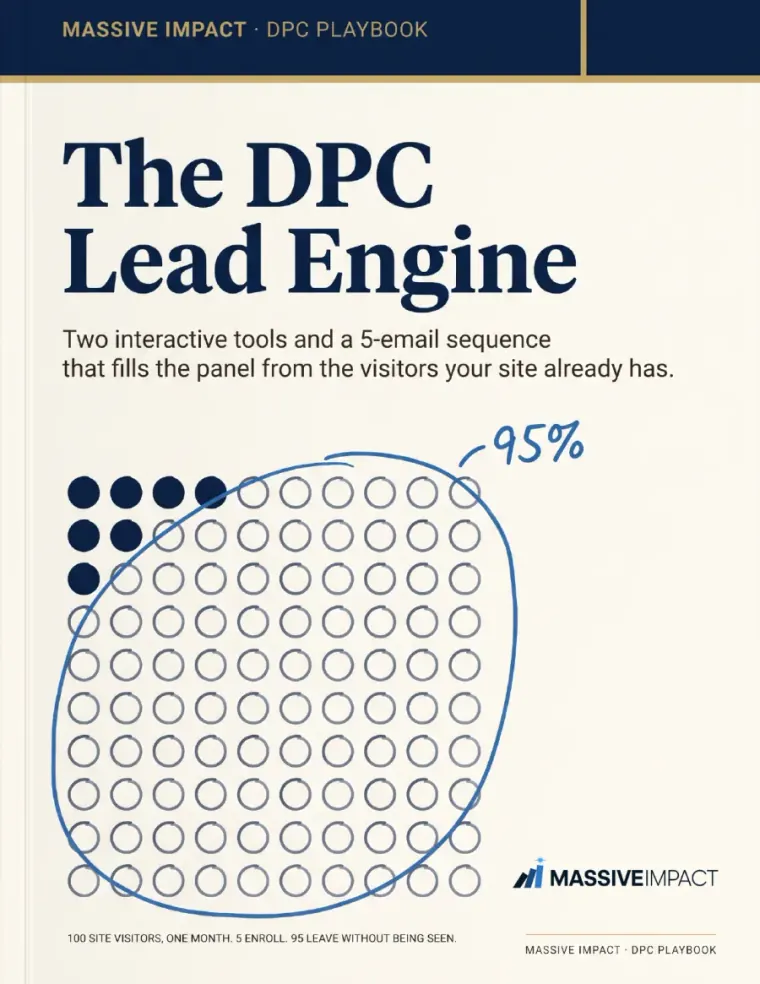
So 95% of the people who land on a DPC site, curious but not ready, leave forever. On a normal month of 600 visitors and a 5% first-visit conversion, that's 570 lost, never followed up with, never spoken to again. The lead engine is the layer that makes the second number untrue.
But a lead engine isn't a quiz. It's an arsenal of positioning instruments, each one winning a specific argument with the visitor. Six of them, named below.
The six positioning instruments
A DPC practice doesn't deploy all six. It picks the two or three that match how it differentiates. What the six are, what each one does, and when to pick each:
1. Anti-insurance positioning
The moment a curious patient asks "but what about my insurance?" is the most common door the curious walk back out of. They came because they're frustrated with the system. They leave because they're scared of leaving it. Nobody ever drew that fear a map.
The instrument that does is a long-form report that performs one piece of arithmetic out loud: the lifetime cost of staying with insurance. Premiums plus deductibles plus copays plus the visits that don't solve anything plus the time on hold. Conservatively run. The number is the argument.
Why it works: the report doesn't attack insurance. It adds up what insurance does to a normal person over thirty years and shows them the receipt. The reader closes the tab convinced of nothing, and opens it back up two days later. The next email finds them ready.
Pick this instrument when: your buyer is HSA-eligible, employer-sponsored, or in a market where premiums have spiked. The arithmetic lands hardest where the bleed is biggest.
2. Cost reframe
A patient looking at a DPC membership fee assumes they're being asked to ADD a new monthly cost on top of insurance they already pay for. That framing kills the sale before it starts.
The cost-reframe instrument dissolves the framing instead of arguing with it. The visitor answers a few questions about what they currently spend: copays, urgent-care visits, the prescription that wasn't covered, the lab that came back as a bill. The instrument adds it up. The total is bigger than the membership.
Why it works: the visitor isn't being asked to trust a vendor's math. They're doing their own math, with their own numbers. The output isn't "DPC is cheaper" said by a marketer; it's "you're already spending more than this" said by the visitor's own answers.
Pick this instrument when: your buyer has a high deductible, multiple medications, or a lot of incidental healthcare contact (urgent care, walk-in clinics, telehealth platforms). The math gets sharper the more fragmented their current care is.
3. Depth-of-care proof
The most common reason a curious patient leaves DPC unsigned is that they think their current doctor is "good enough." Annual physical, labs came back "normal," why pay extra for what they're already getting.
The depth-of-care instrument shows them they're not. The visitor answers ten symptom and history questions; the output is a named list of lab markers a standard annual panel doesn't typically include, mapped to their specific symptoms. The gap is visible on the page, by name.
Why it works: "your doctor is fine" is a feeling. "Your panel didn't run CRP, ferritin, and DHEA-S given the symptoms you described" is a fact with names. You don't argue with the feeling; you replace it with the fact.
Pick this instrument when: your buyer is symptomatic-but-undiagnosed (chronic fatigue, weight resistance, brain fog) or arrives via a longevity / functional-medicine angle. The instrument is wasted on the well-managed-on-insurance patient; it lands hardest on the person who already suspects the standard panel missed something.
4. Symptom validation
A lot of patients who land on a DPC site are there because they feel something is wrong and their doctor said they were fine. They've Googled. They've been told it's stress, weight, age. They're tired of being told to wait.
The symptom-validation instrument names what's likely happening to them and shows them when it likely started. Age, sex, a few symptoms in; a plausible hormonal or physiological story out, with a rough timeline. It doesn't diagnose. It validates. The reader sees their experience written down by someone who took it seriously.
Why it works: validation is the deepest positioning move in healthcare marketing. The DPC site becomes the first place that didn't dismiss them. Trust precedes any sales argument.
Pick this instrument when: your buyer is perimenopausal or menopausal women, men 40+, post-pregnancy patients, or anyone whose symptoms have been minimized in conventional care. The strongest instrument for a hormone-, longevity-, or women's-health-leaning practice.
5. Decision architecture
A DPC pricing page with three tiers asks the visitor to do an analytical job before they've decided emotionally. "Basic vs. Premium vs. Family, which is right for me?" is a friction-creating question. Most visitors stall on it and leave without picking any.
The decision-architecture instrument removes the comparison work. The visitor takes a short quiz about their goals and life situation; the output recommends ONE tier, theirs. By the time the price appears, the visitor isn't comparing options; they're seeing the price of their plan.
Why it works: the visitor goes from analytical (which is the best deal?) to identified (this is my plan). Emotional commitment precedes financial commitment.
Pick this instrument when: your buyer is mid-funnel and stalled. They've heard of DPC, they're considering it, and "which tier is right for me?" is the question that's freezing them. Practices with two or more tiers benefit most. Single-tier practices skip it.
6. Before/after hook
Most lead-engine asks are commitments. Book a call. Schedule a Meet and Greet. Fill out the intake form. A lot of visitors aren't ready for a commitment yet; they want to look around.
The before/after instrument gives them a low-commitment way to engage that builds a future reason to return. They take a short wellness assessment; the output is a numeric score against meaningful health categories. The score is theirs. It's also a baseline.
Why it works: the score creates a "before" snapshot that begs an "after." Ninety days from now, the visitor wants to know if their number went up. To know, they have to come back. The clinic is the only place that holds that baseline.
Pick this instrument when: your buyer is health-optimization minded but not in acute pain: executive health, longevity, performance. Buyers with urgent issues skip this; they need help, not a 90-day check-in.

The follow-up layer
The instruments capture an email and a specific story about the visitor. The 5-email sequence behind them does the next job: answering the four real questions a DPC-curious patient has, and inviting the Meet and Greet.
- The welcome and the DPC explainer in plain English. What DPC is, in a doctor's voice, in two minutes of reading.
- The insurance objection answered. What you keep, what changes, and how the 2026 HSA rule applies.
- The specialist and serious-illness objection answered. What happens for hospitalizations, referrals, emergencies. The mechanics, not "trust us."
- What it's like. A narrative of the first appointment. Texture of the relationship, not features of the membership.
- The Meet and Greet invitation. Fifteen minutes, no obligation. One link, real calendar.
The sequence is conditional: enrollment stops it, unsubscribe stops it, non-engagement skips to the close. No drift into permanent campaign land.
The math, on the other side
Layer the lead engine on the same 600 visitors. The two instruments together capture, conservatively, 10% of the people who didn't enroll on the first visit (60 emails). The follow-up sequence converts roughly 10% of those to a booked Meet and Greet (6 conversations). The clinic enrolls, say, two-thirds (4 new members).
Where those 4 come from: they aren't word-of-mouth referrals, the practice already gets those. They aren't first-visit immediate-decision visitors, the site already enrolled those. These 4 are the not-yet-ready visitors the site used to lose. For a typical practice where the site itself accounts for ~4 monthly enrollments from immediate visitors, the lead engine doubles what the site produces.
At $100 a month, 4 new members brings $4,800 a year in recurring panel revenue from one month of traffic. Run the same engine for twelve months at the same conversion: ~$57,000 a year in recurring panel revenue, from visitor traffic that was already coming to your site, already curious, already on the page.
That is the size of what's sitting in the gap right now.
The full audit it came from
The 0 of 27 finding is one of five failure patterns in The State of DPC Websites 2026, our independent audit of the modern DPC web. The audit, the per-site scores, and the underlying research are available as a licensed dataset.
→ License the research: winmassiveimpact.com/request-research
What to do next
The DPC Growth Site ships with two instruments by default, picked to match how your practice differentiates. Not "two interactive tools" generically; the two that fit you specifically. The 5-email follow-up is included. The lead engine is part of the engine, not an upgrade.
We didn't write a guide to lead capture. We built the lead engine. When you buy the DPC Growth Site, you buy the engine and the instruments matched to your positioning, not a recommendation that you go build one.
See the DPC Growth Site, the offer, and the founding-partner terms:
→ winmassiveimpact.com/dpc-growth-site
Or walk it with us on a 20-minute call. We'll look at your site analytics together, name which two instruments fit your practice, and tell you honestly what the gap is worth.
→ winmassiveimpact.com/dpc-zoom-call

Sources
- Massive Impact DPC Website Audit (n = 27). Item 19 (email capture for not-yet-ready visitors) scored 0.07 / 2.0 across the sample (25/27 zeros). Item 20 (auto follow-up sequence) scored 0.00 / 2.0 (27/27 zeros). Methodology and per-site data available to licensed buyers, contact us for pricing.
- Massive Impact's independent research of the US DPC market. n = 2,468 unique practices, 3,734 records, 108 fields. The underlying research is available as a licensed dataset on request, contact us for pricing.
- Panel math reference, Dr. Paul Thomas, Plum Health DPC. Working DPC site conversion ratio. plumhealthdpc.com
- IRS Notice 2026-5, One Big Beautiful Bill Act, HSA / DPC provision. Effective 1 January 2026; HSA dollars reimburse DPC membership fees up to $150 a month individual, $300 a month family. Referenced in the follow-up layer email 2. irs.gov
License the research
Massive Impact's DPC market research and the DPC Website Audit per-site scores are available as a licensed dataset. The dataset, methodology, and per-site scores are paid IP, not a free download. Contact us for pricing.
→ winmassiveimpact.com/request-research → [email protected]
The DPC Lead Engine, by Massive Impact. winmassiveimpact.com
The rest of the report is yours, free.
Enter your email to keep reading and get the PDF to keep.
No spam. One email unlocks every Massive Impact report.
